
A project manager should consider the impact of project..............manager following
A project manager should consider the impact of project decisions on supporting and maintaining the product along with project results Which process is the project manager following?
Project Cost Management
Project Integration Management
Project Resources Management
Project Scope Management
According to the PMBOK® Guide, specifically the overview of Project Cost Management, the scope of this knowledge area extends beyond the immediate costs of project activities to include the long-term cost of ownership.
Life-Cycle Costing (Choice A): Project Cost Management should consider the effect of project decisions on the subsequent cost of using, maintaining, and supporting the product, service, or result of the project. For example, limiting the number of design reviews may reduce the project ' s cost but could increase the resulting product ' s operating costs later. This perspective is known as Life-Cycle Costing.
Project Integration Management (Choice B): While Integration Management involves making choices about resource allocation and balancing competing objectives, the specific focus on the financial impact of supporting and maintaining the product is a core tenet of Cost Management.
Project Resource Management (Choice C): This focuses on the human and physical resources needed to complete the project, rather than the long-term maintenance costs of the project ' s output.
Project Scope Management (Choice D): This ensures the project includes all the work required, and only the work required, to complete the project successfully. It defines the boundaries but does not traditionally analyze the downstream maintenance costs.
By following the principles of Project Cost Management, the project manager ensures that the project remains valuable to the organization over its entire life cycle, not just during the project ' s duration.
What are the objectives of Initiation processes?
Initiation processes are performed in order to develop the project charier and Identify stakeholders.
Initiation processes are performed in order to obtain budget approval for a project or phase and approve scope with customers.
Initiation processes are performed to identify business objectives for a project or phase and identify stakeholders ' goals.
Initiation processes are performed to map initial requirements for a project or phase and prioritize them with stakeholders.
According to the PMBOK® Guide, the Initiating Process Group consists of those processes performed to define a new project or a new phase of an existing project by obtaining authorization to start the project or phase.
The primary objectives of this group are encapsulated in its two core processes:
Develop Project Charter: The purpose is to create a document that formally authorizes the existence of a project and provides the project manager with the authority to apply organizational resources to project activities.
Identify Stakeholders: The purpose is to identify the people, groups, or organizations that could impact or be impacted by the project, and to document relevant information regarding their interests, involvement, interdependencies, influence, and potential impact on project success.
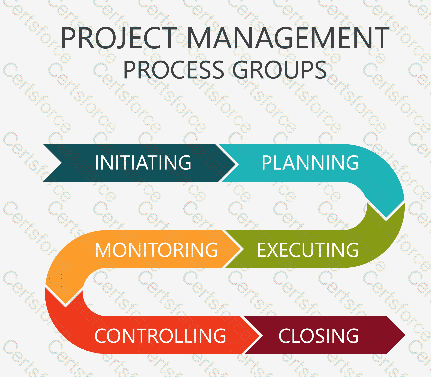
Why Option A is correct: Option A directly aligns with the formal names and outputs of the processes within the Initiating Process Group. By developing the charter and identifying stakeholders, the project manager sets the initial boundary for the project, ensures high-level alignment with organizational strategy, and identifies the human landscape of the project.
Analysis of Distractors:
B (Budget and Scope Approval): Detailed budget approval and formal scope approval (the Scope Baseline) are primary outputs of the Planning Process Group. Initiation only involves " pre-approved financial resources " and high-level scope.
C (Business Objectives and Stakeholder Goals): Identifying business objectives is typically part of the Business Case or Needs Assessment conducted before initiation. While stakeholders ' goals are explored, the formal objective of the process group is the identification of the stakeholders themselves and the formal authorization of the project.
D (Map and Prioritize Requirements): Collecting, mapping, and prioritizing requirements are activities that take place during the Collect Requirements process, which is part of the Planning Process Group.
A project manager is in the process of onboarding resources to start work on a project. Which of the following components of a project management plan will the project manager update after completing this activity?
Resource management plan and lessons learned register
Resource management plan and cost baseline
Resource management plan and procurement management plan
Resource management plan and preassignment
According to the PMBOK® Guide, specifically the Acquire Resources process, onboarding specific team members is a critical transition from planning to execution that impacts several management artifacts.
Resource Management Plan: While the plan initially outlines how resources will be acquired, it must be updated to reflect the actual resources assigned to the project. This includes their specific roles, responsibilities, and the timing of their involvement. Onboarding also triggers updates to the Project Team Assignments and Resource Calendars, which are sub-components or closely related to the Resource Management Plan.
Cost Baseline: In many organizations, resources are planned using " average " or " standard " rates. Once the project manager completes the actual onboarding, the specific costs (actual salaries, contractor rates, or specialized equipment costs) become known. If there is a significant difference between the estimated costs and the actual costs of the onboarded resources, the Cost Baseline must be updated to reflect the true financial commitment of the project.
The Transition: Onboarding is the point where " Generic Resource A " becomes " John Doe at $\$150$/hour. " This precision is what necessitates the baseline update.
Analysis of other options:
Option A: The Lessons Learned Register is typically updated after a process is completed to capture what went well or poorly. While you might update it eventually, it is a project document, not a component of the Project Management Plan.
Option C: The Procurement Management Plan governs the process of how you buy goods or services. Once resources are onboarded, you are executing that plan, not necessarily updating it (unless the procurement strategy itself changed).
Option D: Preassignment is a tool and technique (or an input) of the Acquire Resources process, not a component of the Project Management Plan that is updated after the activity. You cannot " update " a preassignment once the person is already onboarded.
Per PMI standards, when moving from resource planning to actual acquisition and onboarding, the project manager must ensure that the Resource Management Plan reflects the current team structure and the Cost Baseline remains accurate based on actual resource expenditures.
Plan Schedule Management is a process in which Knowledge Area?
Project Scope Management
Project Human Resource Management
Project Integration Management
Project Time Management
According to the PMBOK® Guide and the Standard for Project Management, the process Plan Schedule Management belongs to the Project Time Management (often referred to in newer editions as Project Schedule Management) Knowledge Area.
This process is the first step in managing a project ' s timeline and occurs within the Planning Process Group. Its primary purpose is to establish the policies, procedures, and documentation for planning, developing, managing, executing, and controlling the project schedule.
Key outputs of this process, as defined by PMI standards, include the Schedule Management Plan, which identifies:
Project schedule model development: The methodology and scheduling tool to be used.
Level of accuracy: The acceptable range used in determining realistic activity duration estimates.
Units of measure: Defined for each of the resources (such as staff hours, staff days, or weeks).
Organizational procedure links: The Work Breakdown Structure (WBS) provides the framework for the schedule management plan.
Control thresholds: Variance thresholds for monitoring schedule performance.
The other options are incorrect based on the following Knowledge Area mappings:
Project Scope Management: This area includes processes like Plan Scope Management, Collect Requirements, Define Scope, and Create WBS.
Project Human Resource Management: (Now referred to as Project Resource Management) This area includes processes like Plan Resource Management and Estimate Activity Resources.
Project Integration Management: This area includes high-level processes that coordinate all other knowledge areas, such as Develop Project Charter and Develop Project Management Plan.
As per the PMI Process Group and Knowledge Area Mapping, Plan Schedule Management provides the necessary guidance and direction on how the project schedule will be managed throughout the project.
Those who enter into a contractual agreement to provide services necessary for a project are:
buyers
sellers
business partners
product users
According to the PMBOK® Guide (Project Management Body of Knowledge), specifically within the Project Procurement Management knowledge area, the relationship between parties in a contract is defined by their role in the transaction:
Sellers (Option B): These are the individuals, departments, or organizations that enter into a contractual agreement to provide services, products, or results necessary for a project. Depending on the industry and the specific application area, a seller may also be referred to as a contractor, subcontractor, vendor, or supplier. In the procurement process, the seller is the provider of the work.
Buyers (Option A): The buyer is the party that is purchasing the services or products. This is typically the performing organization or the project team itself. The buyer is the recipient of the work and the one who pays for the services rendered.
Business Partners (Option C): While sellers are technically partners in the project ' s success, " Business Partners " refers to external organizations that have a special relationship with the enterprise, such as providing specific expertise or filling a specified role like installation or training. They may not always be under a formal procurement contract for specific project deliverables.
Product Users (Option D): These are the individuals or groups who will use the project ' s product, service, or result once it is completed. They are key stakeholders, but they are not the ones providing the services under a contractual procurement agreement.
In the PMI framework, understanding the Buyer-Seller relationship is critical for the Conduct Procurements and Control Procurements processes. The Project Manager must ensure that the seller ' s performance meets the contractual requirements and that the legal obligations of both parties are fulfilled to minimize project risk.
Which of the following is a tool or technique used in the Determine Budget process?
Variance analysis
Three-point estimating
Bottom-up estimating
Historical relationships
According to the PMBOK® Guide, the Determine Budget process is the process of aggregating the estimated costs of individual activities or work packages to establish an authorized cost baseline.
Historical Relationships: This is a specific tool and technique used in this process. It involves using project characteristics (parameters) to develop mathematical models to predict total costs. These models can be simple (e.g., residential home construction costing a certain amount per square foot) or complex (e.g., software development costs based on points of complexity).
Reliability: To be effective, these relationships must be based on accurate historical data and be scalable (the parameters used in the model must be quantifiable).
Other Tools and Techniques for Determine Budget:
Cost Aggregation: Summing lower-level cost estimates up to higher WBS levels.
Funding Limit Reconciliation: Adjusting the project schedule to stay within budget constraints imposed by the organization or customer.
Expert Judgment: Leveraging experience from similar past projects.
Reserve Analysis: Establishing management reserves and contingency reserves.
Analysis of Other Options:
A. Variance analysis: This is a tool and technique used in the Control Costs process to compare actual performance against the baseline. It is a " monitoring and controlling " tool, not a " planning " tool.
B. Three-point estimating: This is a tool and technique primarily used in the Estimate Costs or Estimate Activity Durations processes. While it helps create the estimates that go into the budget, the PMBOK® Guide specifically categorizes it under the " Estimate " processes.
C. Bottom-up estimating: Similar to three-point estimating, this is a method used to create cost estimates during the Estimate Costs process. Once those estimates are created, the Determine Budget process uses Cost Aggregation to roll them up.
In the Define Activities process, the schedule management plan is used to:
Capture the lessons learned from other projects for comparison.
Contain the standard activity list.
Document and support the project change requests.
Prescribe the level of detail needed to manage the work.
According to the PMBOK® Guide (Project Management Body of Knowledge), specifically within the Project Schedule Management knowledge area and the Define Activities process:
Prescribe Level of Detail (Option D): The Schedule Management Plan is a primary input to the Define Activities process. Its role is to provide the " how-to " for the scheduling processes. Specifically, it prescribes the level of detail necessary to manage the work, including the methodology and the scheduling tool to be used. It sets the criteria for how activities are identified and the degree of decomposition required for the project ' s unique complexity.
Lessons Learned (Option A): While lessons learned are valuable inputs (as part of Organizational Process Assets), they are used to inform the process based on past experiences, but they are not the primary function of the Schedule Management Plan itself.
Standard Activity List (Option B): Standard activity lists are typically part of Organizational Process Assets (OPAs) or templates provided by the performing organization. The Schedule Management Plan guides how these lists are utilized or created but does not " contain " the actual project-specific list.
Change Requests (Option C): Documenting and supporting change requests is the primary function of the Change Management Plan and the Perform Integrated Change Control process. While the schedule management plan may define how schedule changes are managed, it is not the primary document for documenting specific requests.
In the PMI framework, the Schedule Management Plan ensures consistency throughout the project. By prescribing the level of detail during the Define Activities process, the Project Manager ensures that the resulting Activity List is granular enough for accurate estimation and tracking without becoming over-encumbered by unnecessary administrative detail.
What is a tailoring consideration in Project Integration Management?
Validation and control
Benefits
Technology support
Physical location
According to the PMBOK® Guide, tailoring is necessary because every project is unique; not every process, tool, or technique is required on every project. For Project Integration Management, the project manager must consider specific factors to determine how to integrate the various project components effectively.
One of the primary tailoring considerations for Integration Management identified by PMI is Benefits:
Benefits: The project manager must consider how and when benefits will be reported. This includes determining whether they will be reported during the project, at the end of the project, or at the end of the phase. Since integration is about the " big picture, " ensuring that the project ' s outputs align with the intended business benefits is a critical integration activity.
Other Tailoring Considerations in Integration Management include:
Project Life Cycle: What is an appropriate project life cycle? What phases should comprise the life cycle?
Development Life Cycle: What development life cycle and approach are appropriate for the product, service, or result? (Predictive, adaptive, or hybrid?)
Management Approaches: What management processes are most effective based on the organizational culture and the complexity of the project?
Change: How will change be managed in the project?
Governance: What control boards, committees, and other stakeholders are part of the project?
Lessons Learned: What information should be collected throughout and at the end of the project?
Analysis of other options:
A. Validation and control: These are general management functions (found in the Monitoring and Controlling process group) rather than specific tailoring considerations for the Integration knowledge area.
C and D. Technology support and Physical location: While these are factors that can influence how a project is managed (often categorized under Enterprise Environmental Factors), they are more commonly cited as tailoring considerations for Communication Management or Resource Management rather than the core Integration Management strategy.
In summary, because Integration Management is the " glue " that holds the project together, the project manager must tailor the integration approach to ensure that the realized Benefits remain the focus of all coordinated activities.
A project manager has just completed several brainstorming sessions and has gathered the data to show commonality and differences in one single place. What technique was followed?
Collective decision making
Multicriteria decision analysis
Mind mapping
Affinity diagram
According to the PMBOK® Guide, the Affinity Diagram is a key data representation technique used in the Collect Requirements and Manage Quality processes. It is specifically designed to organize a large number of ideas or data points generated during brainstorming into logical groups for review and analysis.
Organizing Brainstorming Data: After a brainstorming session, teams are often left with a massive, disorganized list of ideas. The affinity diagram allows the project manager to map these ideas based on their " affinities " or relationships.
Finding Commonality and Differences: By grouping related ideas together, the project manager can see which themes are most common (large groups) and which are unique or outliers (differences). This " single place " view makes complex data sets much easier to digest and prioritize.
Process Application: It is highly effective when the team needs to move from a divergent thinking phase (generating many ideas) to a convergent thinking phase (organizing and selecting ideas).
Analysis of other options:
A. Collective decision making: This refers to the process of reaching a conclusion or agreement (such as unanimity, majority, or plurality) rather than a visual technique used to organize and show relationships between data points.
B. Multicriteria decision analysis: This technique uses a decision matrix to provide a systematic analytical approach for establishing criteria (such as risk levels, uncertainty, and valuation) to evaluate and rank many ideas. It is about scoring ideas, not just showing their commonalities.
C. Mind mapping: While mind mapping also organizes data visually, it typically radiates from a single central concept. An affinity diagram is better suited for taking a large, existing set of disparate ideas from a brainstorming session and sorting them into categories from the bottom up.
Per PMI standards, the Affinity Diagram is the preferred tool for sorting large amounts of data into categories to reveal patterns and structure.
The creation of an internet site to engage stakeholders on a project is an example of which type of communication?
Push
Pull
Interactive
Iterative
According to the PMBOK® Guide, specifically within the Plan Communications Management and Manage Communications processes, there are three primary methods used to share information among stakeholders. These are classified based on how the information is sent and received:
Pull Communication: This method is used for very large volumes of information or for very large audiences. It requires the recipients to access the communication content at their own discretion.
Examples: Intranet sites, e-learning, knowledge repositories, and internet sites or project websites.
Mechanism: The information is " posted " to a central location, and the stakeholder must " pull " the information by navigating to the site to read or download it.
Push Communication: This is sent to specific recipients who need to receive the information. This ensures that the information is distributed but does not certify that it actually reached or was understood by the intended audience.
Examples: Letters, memos, reports, emails, faxes, and press releases.
Interactive Communication: This occurs between two or more parties performing a multi-directional exchange of information. It is the most efficient way to ensure a common understanding among all participants on specific topics.
Examples: Meetings, phone calls, instant messaging, and video conferencing.
Comparison with other options:
A. Push: An internet site is not " pushed " to a user; the user must proactively visit the URL to engage with the content. If the project manager sent an email with the site ' s updates, that specific email would be Push, but the site itself is a Pull source.
C. Interactive: While a website can have interactive elements (like a comment section), the fundamental classification for a broadcasted repository of information like an internet site is " Pull. " Interactive communication requires real-time or near real-time back-and-forth exchange.
D. Iterative: This is not a communication method defined in the PMBOK® Guide. Iterative refers to a project life cycle or a process of repeated cycles (as seen in Agile or progressive elaboration), but it does not describe how information is transmitted between stakeholders.
An adaptive project team is meeting for the first time and deciding on the project management approach. After defining the project artifacts, one team member argues that the events are missing. The scrum master coaches the team to complete the planning.
Which two of the following elements should be included? (Choose two)
Daily scrum
Increments
Sprint retrospective
Sprint backlog
Product backlog
According to the Agile Practice Guide and the Scrum Guide, Scrum is defined by three specific categories: Roles, Artifacts, and Events (also called Ceremonies).
Defining " Events " : The team member correctly pointed out that the " events " are missing. In Scrum, there are five formal events for inspection and adaptation: The Sprint, Sprint Planning, Daily Scrum, Sprint Review, and Sprint Retrospective.
Daily Scrum (Option A): A 15-minute event for the Developers to synchronize activities and create a plan for the next 24 hours.
Sprint Retrospective (Option C): An event held at the end of the sprint to plan ways to increase quality and effectiveness by inspecting how the last Sprint went with regards to people, relationships, processes, and tools.
Coaching the Team: The Scrum Master’s role is to ensure the team understands the framework. By identifying these missing events, the team completes the " heartbeat " of the Scrum process, allowing for the empirical process control of transparency, inspection, and adaptation.
Analysis of other options:
Option B (Increments): This is an Artifact, not an event. The Increment is a concrete stepping stone toward the Product Goal.
Option D (Sprint backlog): This is an Artifact, not an event. It is the set of Product Backlog items selected for the Sprint, plus a plan for delivering them.
Option E (Product backlog): This is an Artifact, not an event. It is an emergent, ordered list of what is needed to improve the product.
Per PMI standards, when a team is organizing their approach and identifies that events are missing, they must select from the timeboxed activities defined in the framework, such as the Daily Scrum and the Sprint Retrospective.
Which is one of the determining factors used to calculate CPI?
EV
SPI
PV
ETC
According to the PMBOK® Guide, specifically within the Control Costs process, the Cost Performance Index (CPI) is a measure of the cost efficiency of budgeted resources. It is one of the most critical metrics in Earned Value Management (EVM).
The Formula: The CPI is calculated by dividing the Earned Value ($EV$) by the Actual Cost ($AC$).
$$CPI = \frac{EV}{AC}$$
Determining Factors: To calculate CPI, you must have:
Earned Value (EV): The measure of work performed expressed in terms of the budget authorized for that work.
Actual Cost (AC): The realized cost incurred for the work performed on an activity during a specific time period.
Significance: The CPI allows the project manager to determine if the project is over budget ($CPI < 1.0$) or under budget ($CPI > 1.0$) at a specific point in time.
Analysis of Other Options:
B. SPI (Schedule Performance Index): This is another performance metric ($EV / PV$). While it is part of the overall EVM suite, it is not used to calculate the CPI; rather, both are calculated using $EV$.
C. PV (Planned Value): PV is used to calculate the Schedule Variance (SV) and Schedule Performance Index (SPI). It represents the authorized budget assigned to scheduled work but does not factor into the cost efficiency (CPI) calculation.
D. ETC (Estimate to Complete): This is a forecasting metric that predicts the expected cost to finish all the remaining project work. While CPI is often used as a factor to calculate the Estimate at Completion (EAC), the ETC itself is not a factor used to determine the current CPI.
What is project management?
A logical grouping of project management inputs, outputs, tools, and techniques
Applying knowledge, skills, tools, and techniques to project activities to meet the project requirements
Launching a process that can result in the authorization of a new project
A formal, approved document that defines how the project is executed, monitored, and controlled
According to the PMBOK® Guide, Project Management is defined as the application of knowledge, skills, tools, and techniques to project activities to meet the project requirements.
Core Purpose: Project management is accomplished through the appropriate application and integration of the project management processes identified for the project. It allows organizations to execute projects effectively and efficiently.
Effective Project Management: Managing a project typically includes, but is not limited to:
Identifying requirements.
Addressing the various needs, concerns, and expectations of the stakeholders in planning and executing the project.
Setting up, maintaining, and carrying out communications among stakeholders that are active, effective, and collaborative in nature.
Managing stakeholders towards meeting project requirements and creating project deliverables.
Balancing the competing project constraints, which include, but are not limited to: Scope, Quality, Schedule, Budget, Resources, and Risk.
Analysis of Other Options:
A. A logical grouping of project management inputs...: This describes a Project Management Process. Processes are the " building blocks " that make up the practice of project management, but a single grouping does not define the entire discipline.
C. Launching a process that can result in the authorization...: This describes the Initiating Process Group or specifically the Develop Project Charter process. While a critical part of project management, it is only the starting phase.
D. A formal, approved document...: This is the definition of the Project Management Plan. This document is a primary output of the planning process and a tool for management, but it is not the definition of the practice itself.
During a retrospective, the team finds that all of the user stories are not complete. What should be done with the incomplete user stories?
Move these user stories back to the product backlog for reprioritization.
Remove these user stories as they are not important.
Advance these user stories to the top of the next sprint backlog.
Complete these user stories in the current sprint and extend the sprint length.
In Agile and Scrum frameworks, specifically during the Sprint Review and Sprint Retrospective, any work that does not meet the " Definition of Done " (DoD) cannot be considered complete or demonstrated to the customer.
Why Choice A is correct:
Maintaining the Backlog: According to the Scrum Guide, incomplete user stories are returned to the Product Backlog. They do not " automatically " move to the next sprint.
Reprioritization: The Product Owner must re-evaluate these stories. Business priorities may have shifted, or new information discovered during the sprint might make an incomplete story less valuable than other items currently sitting in the backlog.
Transparency: Moving them back ensures that the team’s velocity is calculated accurately (only counting completed points) and that the Product Owner maintains control over the project ' s direction.
Analysis of other options:
B (Remove these user stories): Just because a story wasn ' t finished in one sprint doesn ' t mean it lacks value. Removing them without a business justification violates the goal of delivering maximum value to the customer.
C (Advance to the top of the next sprint): This is a common mistake in practice, but it is technically incorrect according to Agile principles. The Product Owner, not a default rule, decides the priority of the next sprint. Forcing them to the top bypasses the Sprint Planning process.
D (Extend the sprint length): One of the core tenets of Scrum is the Timebox. Sprints have a fixed duration to create a predictable rhythm (cadence). Extending a sprint to finish work breaks this cadence and hides the team ' s true capacity/velocity issues.
Key Concept: The Project Management Institute (PMI) and the Agile Practice Guide emphasize that Incomplete Work (Choice A) should always be re-estimated and re-prioritized. This prevents " technical debt " from being hidden and ensures that the team is always working on the highest-priority items as defined by the most current business needs.
In addition to the project charter, what other artifact is produced as a result of the Develop Project Charter process ' ?
Assumption log
Milestone list
Business case
Risk register
According to the PMBOK® Guide (specifically the 6th and 7th Editions), the Develop Project Charter process is the very first step in the project life cycle. While the primary output is the Project Charter itself, there is a second, critical output that is often overlooked in study.
The Assumption Log: This is the secondary output of the Develop Project Charter process. Strategic and high-level business assumptions and constraints are typically identified in the business case before the project is initiated and will flow into the project charter. Throughout the process of creating the charter, the project manager uses the Assumption Log to document all high-level technical and operational assumptions and constraints that will affect the project.
Purpose: It serves as a repository for any factor that is considered to be true, real, or certain without proof or demonstration. Because these assumptions are not yet proven, they represent potential risks that must be validated during the planning phase.
Why other options are incorrect:
Option B: Milestone list: While a high-level summary of milestones is contained within the Project Charter, the formal " Milestone List " is an output of the Define Activities process in the Planning process group.
Option C: Business case: The Business Case is an input to the Develop Project Charter process, not an output. It is a business document created by the sponsor or organization to justify the investment before the project manager even starts the charter.
Option D: Risk register: The Risk Register is an output of the Identify Risks process. While the Project Charter contains " high-level overall project risks, " the detailed register is not created until the planning phase.
A project manager has a project schedule baseline. How can the critical path be determined from the finalized schedule?
Identify the crashed project schedule to find the shortest duration to complete the project.
Identify the longest activity path in the schedule with the shortest possible duration.
Identify the tasks with float duration, which do not impact the duration of the project.
Identify the path through the schedule with leveled resources and the shortest duration.
According to the PMBOK® Guide, specifically the Develop Schedule process, the Critical Path Method (CPM) is a fundamental technique used to estimate the minimum project duration and determine the amount of scheduling flexibility on the logical network paths within the schedule model.
The Definition of Critical Path: The critical path is defined as the sequence of activities that represents the longest path through a project, which determines the shortest possible duration to complete the project.
Total Float (Slack): Activities on the critical path typically have zero float. This means any delay to an activity on this path will directly delay the project completion date.
Logical Network Analysis: To determine the critical path, the project manager performs a " Forward Pass " to calculate the earliest start and finish dates, and a " Backward Pass " to calculate the latest start and finish dates. The path where these dates are the same (Zero Float) is the critical path.
Dynamic Nature: A project can have multiple critical paths, and the critical path can change throughout the project as activities are completed earlier or later than planned.
Analysis of other options:
Option A: Crashing is a schedule compression technique used to shorten the duration for the least incremental cost. While it involves the critical path, the definition of the critical path itself is not " the crashed schedule. "
Option C: Tasks with float (or slack) are specifically not on the critical path. Identifying them helps you understand where you have flexibility, but it does not define the critical path itself.
Option D: Resource Leveling is a technique used to adjust the schedule based on resource constraints. While leveling can change the critical path (often resulting in a " Critical Chain " ), the standard definition of a critical path is based on the sequence of activities, not the leveled resource state.
Per PMI standards, the critical path is the sequence of dependent tasks that forms the longest duration path, thereby establishing the earliest possible date the project can be finished.
Which input to the Manage Stakeholder Engagement process provides guidance on how stakeholders can best be involved in a project?
Feedback analysis
Stakeholder analysis
Communication management plan
Stakeholder management plan
According to the PMBOK® Guide and the Standard for Project Management, the Stakeholder Management Plan (referred to in the most recent editions as the Stakeholder Engagement Plan) is the primary input to the Manage Stakeholder Engagement process that provides the strategy for involving stakeholders.
As per PMI standards, the Stakeholder Management Plan is a formal document that identifies the management strategies required to effectively engage stakeholders. It provides specific guidance on:
Desired and current engagement levels: Identifying where stakeholders are (e.g., Unaware, Resistant, Neutral, Supportive, or Leading) and where the project needs them to be.
Scope and impact of stakeholder change: How the project affects stakeholders and vice versa.
Engagement strategies: Specific activities and approaches for involving stakeholders based on their power, interest, and influence.
The other options are incorrect based on their specific roles within the PMI framework:
Feedback analysis: This is a Tool and Technique (Data Analysis) used in the Monitor Stakeholder Engagement process to evaluate information received from stakeholders, rather than an input providing guidance for engagement.
Stakeholder analysis: This is a Tool and Technique used during the Identify Stakeholders and Plan Stakeholder Engagement processes to create the plan; it is not the plan itself.
Communication management plan: While this plan describes how information will be distributed (the " what, when, and how " ), the Stakeholder Management Plan focuses on the why and the behavioral strategies to ensure stakeholders are appropriately involved and supportive.
As per the PMI Lexicon of Project Management Terms, the Stakeholder Management Plan ensures that stakeholders are involved at the right time and in the right way to foster support and minimize resistance.
Which quality tool may prove useful in understanding and estimating the cost of quality in a process?
Checksheets
Histograms
Flowcharts
Control charts
According to the PMBOK® Guide (Project Management Body of Knowledge), specifically within the Project Quality Management knowledge area, various tools and techniques are used to plan, manage, and control quality.
Flowcharts (Option C): These are also referred to as process maps because they display the sequence of steps and the branching possibilities that exist for a process that transforms one or more inputs into one or more outputs. Flowcharts are specifically noted in the PMI standards for their utility in understanding and estimating the cost of quality in a process. This is because they show where potential failures can occur or where quality checks are needed, allowing the team to visualize the relationship between process steps and identify where rework or inspection costs (Internal/External Failure costs) might accumulate.
Checksheets (Option A): Also known as tally sheets, these are used to organize data during the collection process. While they help identify defects, they do not provide the process-wide visualization needed to estimate the total cost of quality.
Histograms (Option B): These are bar charts that show the graphical representation of numerical data, often used to show the frequency of defects or the central tendency of a data set. They describe the state of the data but not the flow of the process.
Control Charts (Option D): These are used to determine whether or not a process is stable or has predictable performance. They monitor process variance over time but are not primarily used for initial cost estimation of the quality process itself.
In the PMI framework, the Cost of Quality (COQ) includes all costs incurred over the life of the product by investment in preventing nonconformance to requirements. Flowcharts help identify these investment points (Prevention and Appraisal) versus the potential failure points.
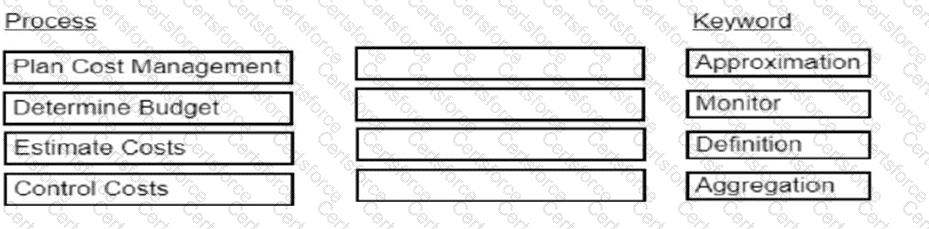
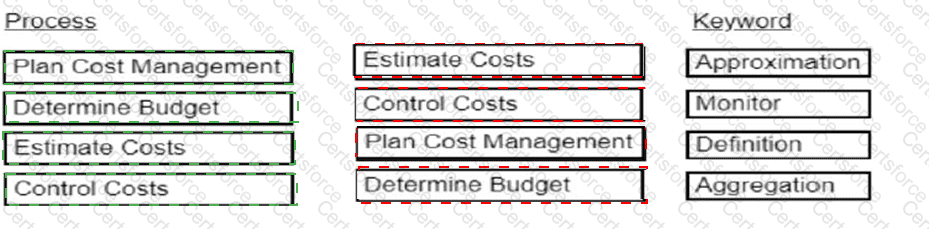
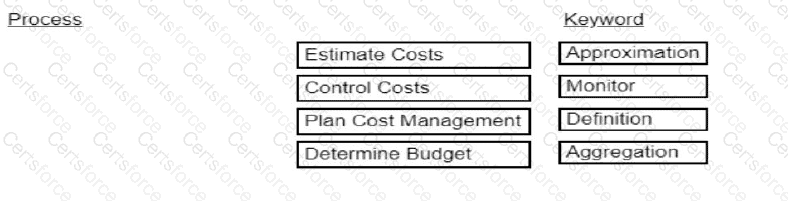
Match each Project Cost Management process with its appropriate keyword
 A few black text boxes Description automatically generated with medium confidence
According to PMI standards, Cost Management is a sequential flow that moves from high-level strategy to detailed execution and monitoring.
Plan Cost Management (Keyword: Policies): This is the first step where you decide how you will manage the budget. It results in the Cost Management Plan, which dictates the level of precision (e.g., rounding to $10 or $100), units of measure, and organizational procedure links.
Estimate Costs (Keyword: Approximation): In this process, the project manager looks at individual work packages or activities to predict how much they will cost. Because it happens during planning, it is an " approximation " based on known information at that point in time (using tools like Analogous or Parametric estimating).
Determine Budget (Keyword: Baseline): This process involves summing the costs of individual activities or work packages. Crucially, this includes adding Contingency Reserves to create the Cost Baseline. Once approved, this is the version of the budget against which performance is measured.
Control Costs (Keyword: Variance): This is a Monitoring and Controlling process. The PM looks for the " Variance " (the difference between what was planned and what was actually spent). Tools like Earned Value Management (EVM) are used here to see if the project is over or under budget.
A common point of confusion is the difference between Estimate Costs and Determine Budget. Remember: you estimate individual pieces, but you determine the budget for the whole project by adding those pieces together along with reserves.
Correlated and contextualized information on how closely the scope is being maintained relative to the scope baseline is contained within:
project documents updates.
project management plan updates.
change requests.
work performance information.
According to the PMBOK® Guide, specifically within the Control Scope process, the conversion of raw data into meaningful metrics is a critical function of project monitoring.
Work Performance Information (WPI): This is the specific output where Work Performance Data (raw observations like " this feature is 50% done " ) is gathered from controlling processes, analyzed in context, and integrated based on relationships across areas.
Correlation and Context: In the context of scope, WPI includes correlated and contextualized information on how the project scope is performing compared to the Scope Baseline. It identifies causes of scope variances, the impact of those variances on schedule or cost, and a forecast of future scope performance.
The Data-Information-Report Cycle:
Work Performance Data: Raw status (Input).
Work Performance Information: Analyzed data showing status relative to the baseline (Output of Control processes).
Work Performance Reports: The physical or electronic representation of WPI used for decision-making (Output of Monitor and Control Project Work).
Comparison with other options:
A and B. Project documents/management plan updates: These are results of the process (often triggered by change requests) to reflect new realities, but they do not contain the analyzed performance metrics themselves.
C. Change requests: These are formal proposals to modify documents, deliverables, or baselines based on the variances identified in the Work Performance Information, but they are not the medium for the performance analysis itself.
Which tool or technique is used in validating the scope of a project?
Facilitated workshops
Interviews
Inspection
Meetings
In accordance with the PMBOK® Guide (Project Scope Management), the Validate Scope process is the process of formalizing acceptance of the completed project deliverables. The primary tool and technique used in this process is Inspection.
Definition of Inspection: Inspection includes activities such as measuring, examining, and validating to determine whether work and deliverables meet requirements and product acceptance criteria.
Alternative Names: Depending on the industry and application area, inspections are also called reviews, product reviews, audits, or walkthroughs.
Relationship to Control Quality: While Control Quality is generally performed before Validate Scope (to ensure the deliverable is correct and meets technical quality standards), Validate Scope is the process where the Customer or Sponsor inspects the deliverables to ensure they are satisfied with the result and to formally sign off.
Output: The primary result of successful inspection in this process is Accepted Deliverables.
Analysis of Distractors:
A. Facilitated workshops: This is a tool and technique used in the Collect Requirements process to bring stakeholders together to define product requirements.
B. Interviews: This is also a tool used in Collect Requirements to elicit information from stakeholders by talking to them directly.
D. Meetings: While meetings may occur during Validate Scope to discuss the results of an inspection, Inspection is the specific, technical tool defined by PMI for the physical or functional examination of the deliverables themselves to ensure they match the scope.
Which of the following are components of the technical project management skill?
Ability to explain business aspects of the project, business strategy, goals and objectives, and business value.
Ability to deal with people, to be collaborative, and to apply persuasion and negotiation.
Ability to focus on relationships with people, inspire trust, and implement decisions and actions that support the business strategy.
Ability to plan and prioritize, gather the right artifacts available for each project, and focus on critical success factors.
According to the PMBOK® Guide (6th Edition) and the PMI Talent Triangle®, Technical Project Management refers to the skills to effectively apply project management knowledge to deliver the desired outcomes for programs or projects. It is the " domain-specific " leg of the triangle that focuses on the mechanics of the role.
Key components of the Technical Project Management skill set include:
Focus on Critical Success Factors: Identifying the specific elements that must go right for the project to succeed.
Artifact Management: Knowing which documents (charter, WBS, logs) are necessary for the specific project and tailoring them accordingly.
Planning and Prioritization: The ability to organize work, manage schedules, and ensure that the team is working on the most valuable tasks at the right time.
Technical Tools: Mastery of specific techniques like Earned Value Management (EVM), critical path, and decomposition.
Analysis of Distractors:
A (Business Strategy/Value): This describes the Strategic and Business Management skill set. It involves understanding the organizational overview and how the project aligns with high-level goals.
B (Persuasion and Negotiation): This describes the Leadership skill set. These are interpersonal or " soft skills " used to guide and motivate a team.
C (Inspiring Trust/Relationships): This is another core component of Leadership. While technical skills get the work organized, leadership skills get the people moving toward the goal.
Key Document Reference: Section 3.4 of the PMBOK® Guide details that while all three legs of the Talent Triangle are necessary, the Technical Project Management leg is what allows a project manager to " plan and prioritize " the actual project work effectively.
An input to the Manage Project Team process is:
Work performance reports.
Change requests.
Activity resource requirements.
Enterprise environmental factors.
According to the PMBOK® Guide, the Manage Project Team process is the process of tracking team member performance, providing feedback, resolving issues, and managing team changes to optimize project performance. This process is part of the Executing Process Group.
Work Performance Reports: These are a formal input to this process. Work performance reports are the physical or electronic representation of work performance information intended to generate decisions, actions, or awareness. In the context of managing a team, these reports provide documentation about the project ' s status compared to the project forecast. They help the project manager determine reward and recognition needs, identify resource gaps, and assess how the team is performing against the schedule and budget baselines.
Use in Management: By reviewing these reports, a project manager can identify if a specific team member or sub-group is struggling or excelling, allowing for targeted coaching or adjustments to the Resource Management Plan.
Why the other options are incorrect:
B. Change requests: These are an output of the Manage Project Team process. When the project manager identifies that team changes are necessary (e.g., replacing a team member or adjusting roles), a formal change request is generated to update the Project Management Plan.
C. Activity resource requirements: This is an input to the Acquire Resources (formerly Acquire Project Team) process. It identifies the types and quantities of resources required for each activity in a work package. By the time you are managing the team, these requirements should have already been met.
D. Enterprise environmental factors: While EEFs are inputs to the Planning and Acquisition of resources, the standard ITTO (Input, Tool, Technique, Output) mapping for Manage Project Team specifically focuses on Project Staff Assignments, Team Performance Assessments, and Issue Logs as the primary human-related inputs. Note: In some versions of the guide, EEFs are listed as general influences, but Work Performance Reports is the most specific, high-value document used to drive the " management " of the team.
What organizational asset can influence the Plan Risk Management process?
Corporate policies and procedures for social media, ethics, and security
Organizational risk policy
Stakeholder register templates and instructions
Organizational communication requirements
According to the PMBOK® Guide, the Plan Risk Management process involves defining how to conduct risk management activities for a project. To ensure alignment with the broader organization, the project manager must utilize Organizational Process Assets (OPAs).
Organizational Risk Policy: This is a primary OPA that influences this process. It provides the predefined thresholds, tolerances, and mandates for how risks should be handled within the company. For example, a company policy might dictate specific levels of risk that require immediate escalation to senior management.
Other Influencing OPAs: These include risk categories (often organized into a Risk Breakdown Structure), standard definitions of risk terms, and templates for the risk management plan.
Purpose: By using the organizational risk policy, the project manager ensures that the project ' s risk management approach is consistent with the organization’s overall risk appetite and strategic objectives.
Analysis of other options:
A. Corporate policies for social media, ethics, and security: While these are OPAs, they generally influence processes related to communication, human resources, or security protocols rather than the specific methodology for risk management planning.
C. Stakeholder register templates: These are OPAs used during the Identify Stakeholders process. While stakeholders influence risk, the templates for the register itself are not the driving asset for the risk management plan.
D. Organizational communication requirements: These are OPAs that primarily influence the Plan Communications Management process, detailing how information should be distributed and stored.
Per PMI standards, the Organizational risk policy is the specific asset that provides the " guardrails " for the project manager when deciding the scale and rigor of risk management activities.
Which of the seven basic quality tools is especially useful for gathering attributes data while performing inspections to identify defects?
Histograms
Scatter diagrams
Flowcharts
Checksheets
According to the PMBOK® Guide, specifically within the Control Quality process, Checksheets (also known as tally sheets) are one of the seven basic quality tools used to organize data in a format that yields effective information about a specific quality problem.
Definition and Purpose: A checksheet is a structured, prepared form for collecting and analyzing data. It is especially useful for gathering attributes data while performing inspections to identify defects.
Attributes Data: This refers to qualitative data that can be categorized (e.g., " Pass/Fail, " " Yes/No, " or " Type of Error " ). When a project team inspects a deliverable, they use the checksheet to mark the frequency or location of specific defects they find.
Application:
Data Collection: It provides a consistent way for different inspectors to record data.
Trend Identification: Once the data is gathered on a checksheet, it is often used as an input for other tools, such as creating a Pareto diagram to determine which defects are occurring most frequently.
Example: In a software project, a checksheet might list common bug types (e.g., " UI Glitch, " " Logic Error, " " Security Vulnerability " ). As testers find bugs, they place a tally mark next to the corresponding attribute.
Comparison with other options:
A. Histograms: These are bar charts used to show the graphical representation of numerical data distribution. They show the central tendency and dispersion of a data set, but they are a method for displaying data rather than the primary tool for gathering attribute data during an inspection.
B. Scatter diagrams: These are used to plot data points on a horizontal and vertical axis to show how much one variable is affected by another (correlation). They do not collect raw attribute data during inspections.
C. Flowcharts: Also known as process maps, these display the sequence of steps and the branching possibilities that exist for a process. They help in understanding how a process works and where quality issues might occur, but they are not data collection forms for defects.
The initial development of a Project Scope Management plan uses which technique?
Alternatives identification
Scope decomposition
Expert judgment
Product analysis
According to the PMBOK® Guide, the Plan Scope Management process is the process of creating a scope management plan that documents how the project scope will be defined, validated, and controlled.
Expert Judgment: This is a primary tool and technique used in the initial development of the Project Scope Management plan. Expert judgment is defined as judgment provided based upon expertise in an application area, Knowledge Area, discipline, industry, etc., as appropriate for the activity being performed.
Application in Scope Planning: For this specific process, expertise should be sought from individuals or groups with specialized knowledge or training in:
Previous similar projects.
Information in the industry, discipline, and application area.
Developing scope management plans and requirements management plans.
Other Tools in Plan Scope Management: In addition to expert judgment, Data Analysis (specifically alternatives analysis) is used to evaluate different ways of creating the scope management plan and managing the scope.
Analysis of Other Options:
A. Alternatives identification: This is a technique used during the Define Scope process to generate different approaches to execute and perform the work of the project.
B. Scope decomposition: This is the primary technique for the Create WBS process, where the project scope and project work are subdivided into smaller, more manageable components.
D. Product analysis: This is a technique used in the Define Scope process for projects that have a product as a deliverable (as opposed to a service or result). It involves asking questions about a product and forming answers to describe the use, characteristics, and other relevant aspects of the product.
The staffing management plan is part of the:
organizational process assets.
resource calendar.
human resource plan.
Develop Project Team process.
According to the PMBOK® Guide (specifically within the Plan Human Resource Management process), the Staffing Management Plan is a formal component of the Human Resource Plan (and by extension, the overall Project Management Plan).
The Relationship: The Human Resource Plan provides guidance on how project human resources should be defined, staffed, managed, and eventually released. The Staffing Management Plan is the specific section within it that handles the " timetable " and " mechanics " of the staff.
Contents of the Staffing Management Plan:
Staff acquisition: Where the people come from (internal vs. external).
Resource histograms: A tool for showing the number of hours a person or department will be needed over time.
Staff release plan: How and when team members will leave the project.
Training needs: Any skills the team lacks that must be acquired.
Recognition and rewards: How the team will be motivated.
Compliance and Safety: Regulations the project must follow.
Modern Note: In the current PMBOK® Guide (6th and 7th editions), this is now integrated into the Resource Management Plan, which covers both human and physical resources. However, in the context of this question set, it remains a subsidiary of the Human Resource Plan.
Analysis of Other Options:
A. organizational process assets: OPAs are external to the project plan; they are the templates, historical files, and procedures already existing in the company. While you use a template from the OPAs to write your plan, the plan itself is a project document, not an OPA.
B. resource calendar: This is actually the other way around. The Staffing Management Plan includes or informs the resource calendars by defining when resources are needed. The plan is the high-level management document; the calendar is the specific data of availability.
D. Develop Project Team process: This is a process (an action), not a document. The Staffing Management Plan is an input to this process, but it is not " part of " the process itself. Processes are verbs; plans are nouns.
Projects are undertaken by an organization to support the:
Product performance.
Budget process.
Collective capabilities.
Organizational strategy.
According to the PMBOK® Guide and The Standard for Portfolio Management, projects are not isolated activities; they are the primary means by which organizations implement their strategic plans.
Strategic Alignment: Organizations use projects to bridge the gap between their high-level organizational strategy and the actual delivery of business value. Every project should be linked to the organization ' s goals to ensure that resources are being used effectively.
Business Value Creation: Projects are initiated as a result of one or more of the following strategic considerations:
Market demand (e.g., building a new fuel-efficient car).
Strategic opportunity/Business need (e.g., a training company authorizing a project to create a new course to increase its revenue).
Social need (e.g., a non-governmental organization authorizing a project to provide potable water to a community).
Environmental considerations (e.g., a project to reduce a company ' s carbon footprint).
Portfolio Management Link: Projects and programs are often grouped into portfolios specifically to ensure they align with and support the overall organizational strategy and objectives. If a project no longer aligns with the strategy, it is often terminated to redirect resources to more relevant initiatives.
Comparison with other options:
A. Product performance: While a project might improve a product ' s performance, this is a technical objective or a result of a project, rather than the high-level organizational reason why the project was undertaken in the first place.
B. Budget process: The budget process is a functional activity that supports the project by providing funds. Projects are not undertaken to support the budget; rather, the budget exists to support the projects that drive the strategy.
C. Collective capabilities: While projects can enhance the " collective capabilities " of a team or organization (through learning and development), the fundamental driver for initiating a project is to meet a strategic business goal.
A project manager is preparing a monthly status report for the project, which includes project performance compared to the baseline schedule. How can the project manager calculate the schedule variance (SV) for tasks on the critical path?
Earned Schedule + Actual Time
Actual Time - Earned Schedule
Planned Value - Earned Value
Earned Value - Planned Value
According to the PMBOK® Guide, specifically the Monitor and Control Project Work process and Earned Value Management (EVM), the Schedule Variance (SV) is a quantitative measure used to determine if a project is ahead of, behind, or on its baseline schedule.
The Formula: The standard formula for calculating Schedule Variance is:
$$SV = EV - PV$$
(Where $EV$ is Earned Value and $PV$ is Planned Value).
The Components:
Earned Value ($EV$): The measure of work actually performed expressed in terms of the budget authorized for that work.
Planned Value ($PV$): The authorized budget assigned to scheduled work.
Interpreting the Result:
Positive SV ($ > 0$): The project is ahead of schedule because the value of the work performed is greater than the value of the work planned.
Negative SV ($ < 0$): The project is behind schedule because the value of work performed is less than what was planned.
Zero SV ($= 0$): The project is exactly on schedule.
Critical Path Context: While $SV$ can be calculated for any task, applying it to tasks on the critical path is vital because any negative variance there directly impacts the project ' s overall completion date.
Analysis of other options:
Option A and B: These involve Earned Schedule (ES) and Actual Time (AT). While Earned Schedule is a valid theory for measuring time-based variance, the standard formula for $SV$ in the PMBOK® Guide is based on $EV$ and $PV$. Furthermore, the formula for time-based variance is $ES - AT$, not the variations shown in A or B.
Option C: This is the inverse of the correct formula ($PV - EV$). Using this would result in a positive number when the project is behind schedule, which contradicts standard Earned Value logic where positive always equals " good. "
Per PMI standards, the most common and accepted way to communicate project performance relative to the schedule baseline is by calculating Earned Value minus Planned Value.
How can a project manager maintain the engagement of stakeholders in a project with a high degree of change?
Monitor project stakeholder relationships using engaging strategies and plans
Send all project documents to stakeholders each time they are modified
Schedule monthly meetings with the stakeholders, including team members
Engage only with the project sponsors
According to the PMBOK® Guide, specifically within the Monitor Stakeholder Engagement process, projects characterized by a high degree of change (such as those using agile or adaptive methodologies) require continuous and proactive management of stakeholder relationships.
Dynamic Engagement: In high-change environments, stakeholder needs, influence, and interest levels can shift rapidly. The project manager must use the Stakeholder Engagement Plan as a living document, constantly monitoring the effectiveness of engagement strategies and adjusting them as the project evolves.
Continuous Feedback Loops: Rather than relying on static communication, the project manager monitors relationships to ensure that stakeholders remain aligned with project goals. This involves using data analysis (such as stakeholder engagement assessment matrices) to identify gaps between desired and actual engagement levels.
Adaptive Strategies: The " Monitor " process ensures that if an engagement strategy is no longer working due to a change in project direction or stakeholder turnover, the project manager can implement a corrective action to bring stakeholders back into the fold.
Analysis of Other Options:
B. Send all project documents to stakeholders each time they are modified: This is an example of information overload. Sending every technical or minor update to all stakeholders can lead to " noise, " causing them to ignore critical communications and decreasing their overall engagement.
C. Schedule monthly meetings with the stakeholders, including team members: In a project with a high degree of change, monthly meetings are likely too infrequent. High-change projects typically require more frequent interaction (such as bi-weekly reviews or daily stand-ups in agile) to ensure stakeholders stay informed.
D. Engage only with the project sponsors: While sponsors are critical, the definition of a stakeholder includes anyone who can affect or be affected by the project. Ignoring other stakeholders (users, customers, functional managers) leads to missed requirements and potential resistance later in the project.
Calculate the Schedule Performance Index (SPI) based on the following information: earned value (EV) is 30 and planned value (PV) is 15.
2.0
45
0.5
15
According to the PMBOK® Guide, specifically within the Monitor and Control Project Work process, the Schedule Performance Index (SPI) is a measure of schedule efficiency expressed as the ratio of earned value to planned value.
The Formula: The SPI is calculated using the following equation:
$$SPI = \frac{EV}{PV}$$
The Calculation:
Given Earned Value ($EV$) = $30$
Given Planned Value ($PV$) = $15$
$SPI = \frac{30}{15} = 2.0$
Interpreting the Result:
SPI > 1.0: Indicates that more work was completed than was originally planned. The project is ahead of schedule.
SPI < 1.0: Indicates that less work was completed than was planned. The project is behind schedule.
SPI = 1.0: Indicates that the project is exactly on schedule.
Context: An SPI of $2.0$ means the project team is performing at $200\%$ efficiency relative to the schedule. For every hour of work planned, two hours ' worth of work (in terms of value) has been accomplished.
Analysis of other options:
Option B (45): This is the result of adding $EV$ and $PV$ ($30 + 15$), which has no standard meaning in Earned Value Management.
Option C (0.5): This is the result of dividing $PV$ by $EV$ ($15 / 30$). This is the inverse of the SPI formula and is incorrect.
Option D (15): This is the result of $EV - PV$ ($30 - 15$), which is the formula for Schedule Variance (SV), not the index.
Per PMI standards, the Schedule Performance Index (SPI) is a critical metric for determining the efficiency of the project team ' s use of time, and in this specific case, the value of 2.0 indicates exceptionally high schedule performance.
A project manager is assigned to a project, and the sponsor signals to perform first actions. However, the project manager is unsure how to apply organizational resources into project activities before a formal authorization. Which document should be used in this case?
Project plan
Business case
Budget requirement
Project charter
According to the PMBOK® Guide, specifically the Develop Project Charter process, the Project Charter is the foundational document that bridges the gap between organizational strategy and project execution.
Formal Authorization: The Project Charter is the document that formally authorizes the existence of a project. Without a signed charter, a project does not officially exist in the eyes of the organization, and the project manager lacks the legal or administrative standing to proceed.
Empowerment of the PM: The most critical function of the charter in this specific scenario is that it provides the project manager with the authority to apply organizational resources to project activities. Until the charter is approved by the sponsor or the initiating entity, the project manager cannot officially assign staff, spend budget, or utilize company equipment.
High-Level Scope: It establishes the high-level objectives and boundaries of the project. This ensures that when the PM does start applying resources, they are doing so in alignment with the goals the sponsor has officially sanctioned.
Analysis of other options:
Option A: The Project Management Plan is a detailed document created after the charter has been signed. You cannot effectively build a project plan without the authority and high-level direction provided by the charter.
Option B: The Business Case provides the economic justification for the project. While it explains why the project should happen, it does not grant the project manager the authority to manage resources.
Option C: Budget requirements are specific financial needs identified during the planning phase. Like the project plan, a budget cannot be officially executed or managed until the PM is authorized via the charter.
Per PMI standards, the Project Charter is the only document that solves the project manager ' s dilemma by providing the formal authorization necessary to move from a conceptual idea to an active project with assigned organizational resources.
A full-time project manager with low to moderate authority and part-time administrative staff is working in an organizational structure with which type of matrix?
Strong
Weak
Managed
Balanced
According to the PMBOK® Guide (Project Management Body of Knowledge), specifically within the section on Organizational Systems and Organizational Structures, the authority and resource availability of a Project Manager vary significantly across different matrix environments:
Balanced Matrix (Option D): In this structure, the Project Manager is typically assigned full-time, but their authority is considered low to moderate. They share authority with the functional manager. A defining characteristic of the Balanced Matrix is that the project manager usually has part-time administrative staff to assist with project coordination.
Weak Matrix (Option B): In a weak matrix, the project manager’s role is more of a coordinator or " expediter. " They have low authority, and the role is often part-time. The functional manager maintains most of the power and control over resources.
Strong Matrix (Option A): In a strong matrix, the Project Manager has moderate to high authority. They are assigned full-time, and they typically have full-time administrative staff. This structure most closely resembles a Project-Oriented organization.
Managed Matrix (Option C): This is not a standard term used in the PMI framework or the PMBOK® Guide to describe organizational structures.
In the PMI framework, understanding the Organizational Structure is vital because it dictates the Project Manager ' s level of influence, the availability of resources, and who controls the project budget. In a Balanced Matrix, the Project Manager must rely heavily on interpersonal and negotiation skills, as they do not have full command over the team members who still report to their respective functional managers.
The table represents the possible durations of a specific project task.
Using the three-point estimating technique what is the expected number of days it should take to complete the task?
2
3
4
6
In Project Management, when we are given a range of possible durations, we use the Three-Point Estimating formula to determine the expected duration ($t_E$).
While there are two formulas, the standard calculation for this problem (Triangular Distribution) is:
$$t_E = \frac{O + M + P}{3}$$
Where:
$O$ (Optimistic): 2 days
$M$ (Most Likely): 3 days
$P$ (Pessimistic): 7 days
Calculation:
$$t_E = \frac{2 + 3 + 7}{3}$$
$$t_E = \frac{12}{3}$$
$$t_E = 4$$
Why this matters:
Reduces Bias: Relying on a single " Most Likely " estimate can be risky. Three-point estimating forces the team to consider risks (Pessimistic) and opportunities (Optimistic).
Accuracy: It provides a more mathematically sound average than a simple guess, helping the Project Manager create a more realistic Schedule Baseline.
Note on PERT (Beta Distribution):
If the question specifically asked for PERT or a Weighted Average, the formula would be $t_E = \frac{O + 4M + P}{6}$. Using PERT for these numbers would result in $3.5$ days. Since $4$ is the available choice that aligns with the simple triangular average, Option C is the correct answer.
Per PMI standards, this technique is used within the Estimate Activity Durations process to improve the accuracy of time estimates when there is uncertainty associated with the activity.
The project manager and project team are developing approximations of the cost of resources needed to complete the project work. On which process are they working?
Plan Cost Management
Estimate Activity Resources
Estimate Costs
Determine Budget
According to the PMBOK® Guide, the process described is Estimate Costs. This is the process of developing an approximation of the monetary resources needed to complete project work.
Purpose: The key benefit of this process is that it determines the monetary resources required for the project. These estimates are expressed in units of currency (e.g., dollars, euros, etc.) to facilitate comparison between activities and projects.
Accuracy over Time: Cost estimates are refined throughout the project. For example, a project in the initiation phase may have a Rough Order of Magnitude (ROM) estimate in the range of −25% to +75%. Later in the project, as more information is known, estimates could narrow to a Definitive Estimate range of −5% to +10%.
Inputs and Tools: This process uses inputs such as the project management plan, project documents (like the lessons learned register and project schedule), and enterprise environmental factors. Common tools include Analogous, Parametric, Bottom-up, and Three-point estimating.
Why other options are incorrect:
Option A: Plan Cost Management: This is the process that establishes the policies, procedures, and documentation for planning, managing, expending, and controlling project costs. It defines how costs will be estimated, not the actual estimates themselves.
Option B: Estimate Activity Resources: This process (part of Project Resource Management) is about identifying the types and quantities of material, human resources, equipment, or supplies required. While it is a precursor to estimating costs, it focuses on the physical/human requirements rather than the monetary approximation.
Option D: Determine Budget: This is the process of aggregating the estimated costs of individual activities or work packages to establish an authorized cost baseline. Estimating the individual resource costs (Option C) must happen before they can be aggregated into a budget.
A project manager read the initial contract when a project was started. The contract states a house has to be built in one year, and the foundation has to be completed in 30 days. What should the project manager do?
Add the milestones to the risk register, as time is short.
Add the two milestones to the project plan, as they are mandatory.
Calculate the duration of the two milestones stated in the contract.
Start the project as soon as possible, as time is short.
According to the PMBOK® Guide, specifically within the Develop Project Management Plan and Define Activities processes, requirements stipulated in a contract are considered Project Constraints.
Contractual Obligations: A contract is a legally binding document. If the contract specifies a final completion date (one year) and a specific interim deadline (foundation in 30 days), these are classified as Milestones.
Milestones vs. Activities: A milestone is a significant point or event in a project. Unlike activities, milestones have zero duration. Because these specific dates are " Hard " constraints dictated by the contract, they must be incorporated into the Milestone List and the Project Management Plan.
Mandatory Nature: The project manager does not have the discretion to ignore these dates. They form the basis of the Schedule Baseline. Once these milestones are added to the plan, the project manager will then sequence the necessary activities to ensure these deadlines are met.
Analysis of other options:
Option A: While the tight timeline represents a risk, milestones are primarily schedule components. You would record the risk of missing the deadline in the register, but you must first put the actual dates into the project plan to manage them.
Option C: This is a technical distractor. Milestones, by definition, have zero duration. They represent a point in time (the completion of the foundation), so there is no duration to calculate for the milestone itself—only for the activities leading up to it.
Option D: " Starting as soon as possible " is a proactive sentiment, but it is not a formal project management procedure. Proper planning (adding the constraints to the plan) must occur to ensure the " fast start " is actually directed toward the correct goals.
Per PMI standards, any date or requirement explicitly mentioned in a legal contract is a Constraint that must be documented in the Project Management Plan and tracked as a milestone to ensure compliance.
The project manager has following information about duration for an activity:
* Most likely [tM] - 15 days
* Pessimistic [tP] - 20 days
* Optimistic [tO] - 10 days
What is the estimated duration of this activity, according to the triangular distribution technique?
10 days
15 days
12.5 days
5 days
According to the PMBOK® Guide, specifically within the Estimate Activity Durations process, project managers use Three-Point Estimating to improve the accuracy of activity duration estimates. This technique considers uncertainty and risk by using three estimates:
Optimistic ($t_O$): The best-case scenario (10 days).
Most Likely ($t_M$): The most realistic scenario (15 days).
Pessimistic ($t_P$): The worst-case scenario (20 days).
There are two common formulas used for three-point estimating. The question specifically asks for the Triangular Distribution:
The Formula:
$$E = \frac{t_O + t_M + t_P}{3}$$
The Calculation:
$$E = \frac{10 + 15 + 20}{3}$$
$$E = \frac{45}{3}$$
$$E = 15 \text{ days}$$
Why other options are incorrect:
Option A (10 days): This is simply the Optimistic estimate ($t_O$), which ignores the most likely and pessimistic scenarios.
Option C (12.5 days): This value does not correspond to any standard PMBOK duration estimation formula based on the numbers provided.
Option D (5 days): This is significantly lower than even the optimistic estimate and has no mathematical basis in this context.
Note on Beta Distribution (PERT):
It is important to distinguish this from the Beta Distribution (often used in PERT), which gives more weight to the " Most Likely " estimate. If the question had asked for the Beta distribution, the calculation would be:
$$E = \frac{t_O + 4t_M + t_P}{6} = \frac{10 + (4 \times 15) + 20}{6} = \frac{90}{6} = 15 \text{ days}$$
One of the tools and techniques of the Manage Project Team process is:
organization charts.
ground rules.
organizational theory,
conflict management.
According to the PMBOK® Guide, Conflict Management is a primary tool and technique used in the Manage Project Team process. This process involves tracking team member performance, providing feedback, resolving issues, and managing team changes to optimize project performance.
Role of the Project Manager: In a project environment, conflict is inevitable. Sources of conflict include scarce resources, scheduling priorities, and personal work styles. The project manager must use conflict management to minimize negative impacts and turn differences into positive outcomes.
Conflict Resolution Techniques: The PMBOK® identifies five general techniques for resolving conflict:
Withdraw/Avoid: Retreating from a potential conflict situation.
Smooth/Accommodate: Emphasizing areas of agreement rather than areas of difference.
Compromise/Reconcile: Searching for solutions that bring some degree of satisfaction to all parties.
Force/Direct: Pushing one ' s viewpoint at the expense of others (win-lose).
Collaborate/Problem Solve: Incorporating multiple viewpoints and insights from different perspectives to reach a consensus.
Comparison with Other Options:
Organization charts (A): These are a tool and technique for Plan Human Resource Management (now Plan Resource Management) used to document roles and reporting relationships.
Ground rules (B): These are established in the Develop Project Team process to set expectations regarding acceptable behavior by project team members.
Organizational theory (C): This is a tool and technique used in Plan Human Resource Management to provide information regarding the way in which people, teams, and organizational units behave.
An input of the Control Schedule process is the:
resource calendar.
activity list.
risk management plan.
organizational process assets.
According to the PMBOK® Guide, the Control Schedule process is the process of monitoring the status of the project to update the project schedule and manage changes to the schedule baseline. To perform this effectively, the project manager must utilize existing organizational frameworks.
Organizational Process Assets (OPAs): These are internal to the performing organization and serve as a formal input to the Control Schedule process. They provide the necessary context and tools for monitoring time-related performance.
Specific Examples: OPAs include existing formal and informal schedule control-related policies, procedures, and guidelines; schedule control tools used by the organization; and monitoring and reporting methods to be used (such as specific software or reporting templates).
Other Key Inputs:
Project Management Plan: Contains the schedule management plan and the schedule baseline (the version against which actual progress is compared).
Project Documents: Including the project schedule, resource calendars, and schedule data.
Work Performance Data: Raw observations and measurements identified during activities being performed to carry out the project work (e.g., actual start and finish dates).
Comparison with other options:
A. resource calendar: While the resource calendar is a project document that can be an input to Control Schedule, the question asks for a specific category or standard input. In the formal input list for Control Schedule, Organizational Process Assets is a mandatory and broader category defined in the PMBOK® framework for this process.
B. activity list: This is an output of the Define Activities process and is primarily used as an input for estimating and sequencing. While it exists during the control phase, it is not listed as a primary direct input for the specific mechanics of controlling the schedule.
C. risk management plan: This plan describes how risk management activities will be structured. While risks affect the schedule, the Risk Register (which contains specific threats to the timeline) is a more direct document used in monitoring, whereas the plan itself is not a primary input for the Control Schedule process.
When the business objectives of an organization change, project goals need to be:
realigned.
performed.
improved.
controlled.
According to the PMBOK® Guide and The Standard for Portfolio Management, projects exist to deliver value and achieve the strategic goals of an organization.
Strategic Alignment: A fundamental principle of project management is that projects are the primary vehicle for executing an organization ' s strategy. When the executive leadership shifts the business objectives (due to market changes, financial shifts, or new regulations), the ongoing and planned projects must be evaluated.
The Realignment Process: This involves reviewing the Project Charter and the Business Case to ensure they still support the updated organizational strategy. If a project no longer contributes to the new objectives, it may be changed, rescoped, or even terminated.
Portfolio Management Role: High-level alignment is typically managed at the portfolio level, where the " mix " of projects is adjusted to ensure the highest return on investment relative to the current strategic direction.
Comparison with other options:
B. Performed: Simply continuing to " perform " or execute a project that is no longer aligned with business goals is a waste of organizational resources (sunk cost fallacy).
C. Improved: While quality improvement is always a goal, " improving " a project ' s performance does not solve the fundamental issue of the project no longer serving the organization ' s revised strategic purpose.
D. Controlled: " Controlled " refers to the Monitoring and Controlling Process Group, which ensures the project stays on its current baseline. However, if the business objectives change, the baseline itself must be questioned and realigned before it can be controlled.
What is the best tool to calculate the critical path on a project?
Critical chain method
Graphical evaluation and review technique (GERT) diagram
Gantt chart
Project network diagram
According to the PMBOK® Guide, the Project Network Diagram is the primary tool used to perform Critical Path Method (CPM) analysis. To calculate the critical path, the project manager must be able to visualize the logical relationships (dependencies) between activities, which is exactly what a network diagram provides.
The calculation involves:
Forward Pass: To determine the early start (ES) and early finish (EF) dates.
Backward Pass: To determine the late start (LS) and late finish (LF) dates.
Float Calculation: Identifying paths with " Zero Float. " The longest path through the network diagram with zero total float is the Critical Path.
Why the Project Network Diagram is the best tool: While software can automate this, the underlying tool remains the network diagram (often using the Precedence Diagramming Method - PDM). It shows the sequence of activities and how a delay in one activity impacts the entire chain, allowing for the mathematical determination of the shortest possible project duration.
Analysis of Distractors:
A (Critical chain method): This is a schedule network analysis technique that modifies the project schedule to account for limited resources and adds " buffers " to manage uncertainty. It is an alternative or an advanced evolution of the critical path method, but the baseline tool for identifying the longest path remains the network diagram.
B (Graphical evaluation and review technique - GERT): GERT is a sophisticated network analysis technique that allows for conditional branching and loops (probabilistic treatment). It is rarely used in standard project management and is not the standard tool for a traditional critical path calculation.
C (Gantt chart): While a Gantt chart (bar chart) is excellent for displaying the schedule and progress over time, it is often difficult to see complex dependencies on a Gantt chart alone. In professional project management, the network diagram calculates the path, and the Gantt chart displays the result.
Conflict should be best addressed in which manner?
Early, in private, using a direct, collaborative approach
Early, in public, using an indirect, collaborative approach
Early, in private, using an indirect, cooperative approach
As late as possible, in public, using a direct, confrontational approach
According to the PMBOK® Guide, specifically within the Manage Project Team process, conflict management is a key tool and technique. Conflict is inevitable in a project environment, but how it is handled determines whether it becomes a functional or dysfunctional force.
Timing (Early): Conflicts should be addressed early. Proactive management prevents minor disagreements from escalating into major issues that could impact team morale, productivity, and the project schedule.
Setting (In Private): As a general rule, conflict should be addressed in private. Handling disagreements away from the larger group or stakeholders protects the professional reputation of the individuals involved and fosters a safer environment for honest communication.
Approach (Direct/Collaborative): The most effective method for long-term resolution is a direct, collaborative approach (also known as the Problem Solving or Confronting technique). This involves treating the conflict as a problem to be solved, examining alternatives, and requiring a " give-and-take " attitude from all parties to reach a consensus.
Analysis of other choices:
Choice B (Early, in public, using an indirect, collaborative approach): While " early " and " collaborative " are positive, " in public " is generally discouraged as it can lead to defensiveness, embarrassment, and a breakdown in team trust.
Choice C (Early, in private, using an indirect, cooperative approach): " Indirect " or " cooperative " (often associated with Smoothing or Accommodating) may provide temporary relief but often fails to address the root cause of the conflict, leading to the issue resurfacing later.
Choice D (As late as possible, in public, using a direct, confrontational approach): This is the least desirable method. Waiting " as late as possible " allows the conflict to fester, while " public " and " confrontational " (associated with Forcing) usually results in a win-lose situation that damages long-term team dynamics.
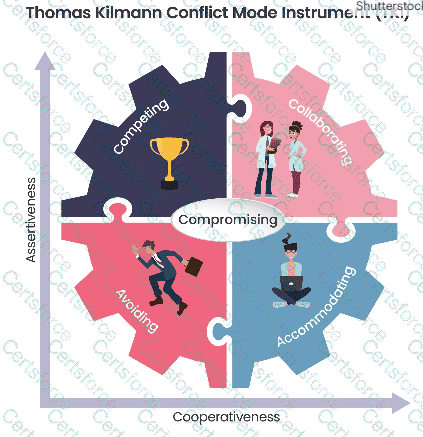
Assigned risk ratings are based upon:
Root cause analysis.
Risk probability and impact assessment.
Expert judgment.
Revised stakeholders ' tolerances.
According to the PMBOK® Guide and the Standard for Risk Management in Portfolios, Programs, and Projects, risk ratings are the primary output of the Perform Qualitative Risk Analysis process.
The assignment of these ratings is fundamentally based on the following two dimensions:
Risk Probability Assessment: Investigates the likelihood that a specific risk will occur.
Risk Impact Assessment: Investigates the potential effect on a project objective (such as schedule, cost, quality, or performance) if the risk occurs.
By combining these two variables, typically through a Probability and Impact Matrix, the project team can calculate a Risk Score (Probability $\times$ Impact). This score determines the risk ' s priority level (e.g., Low, Medium, High), which is the " assigned risk rating. "
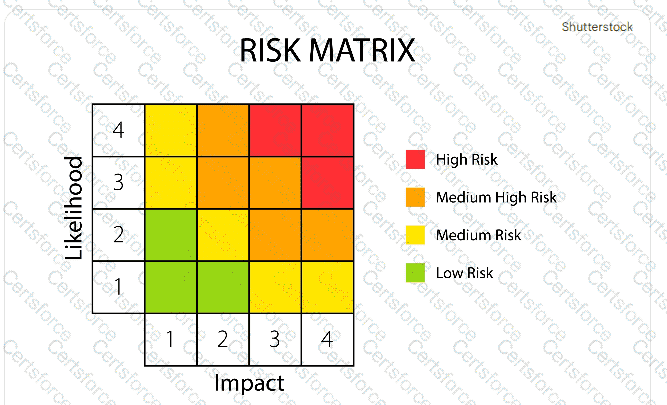
Choice A (Root cause analysis) is a tool used in Identify Risks to understand why a risk might happen, but it does not provide the numerical or qualitative rating itself.
Choice C (Expert judgment) is a tool/technique used to help determine the values, but the ratings themselves are formally based on the assessment of probability and impact.
Choice D (Revised stakeholders ' tolerances) influences the thresholds (what is considered " High " or " Low " ), but the individual risk rating remains a product of its specific probability and impact.
Project deliverables that have been completed and checked for correctness through the Control Quality process are known as:
Verified deliverables.
Validated deliverables.
Acceptance criteria.
Activity resource requirements.
According to the PMBOK® Guide (Project Management Body of Knowledge), specifically within the Quality Management and Integration Management knowledge areas, the flow of deliverables follows a very specific sequence of states:
Verified Deliverables (Option A): These are the completed project deliverables that have been checked for correctness through the Control Quality process. The primary goal of Control Quality is to ensure that the technical requirements and quality standards defined in the project management plan have been met. Once they pass this internal check, they are " Verified. "
Validated Deliverables (Option B): These are deliverables that have been signed off by the customer or sponsor during the Validate Scope process. Verification (Internal/Quality) must happen before Validation (External/Customer Acceptance).
Acceptance Criteria (Option C): These are the standards, rules, or requirements that a deliverable must meet to be accepted by the customer. They are the inputs or benchmarks used during the testing, not the deliverables themselves.
Activity Resource Requirements (Option D): This is a document from the Project Schedule Management area that identifies the types and quantities of resources required for each activity; it is unrelated to the status of completed deliverables.
In the standard PMI process flow, the Control Quality process produces Verified Deliverables as an output, which then becomes an input to the Validate Scope process to eventually become Accepted Deliverables.
Which of the following is the primary output of the Identify Risks process?
Risk management plan
Risk register
Change requests
Risk response plan
According to the PMBOK® Guide, specifically within the Identify Risks process, the primary output is the Risk Register. This document serves as the central repository for recording all individual project risks identified during the project lifecycle.
The Identify Risks process is the act of determining which risks may affect the project and documenting their characteristics.
Initial Documentation: The process initiates the transformation of uncertainty into documented data. The Risk Register starts as a simple list of identified risks and potential responses during this process.
Evolution of the Document: While created in this process, the Risk Register is a living document. It is subsequently updated in the Perform Qualitative Risk Analysis, Perform Quantitative Risk Analysis, and Plan Risk Responses processes as more information is gathered.
Key Content at this Stage: At the conclusion of the Identify Risks process, the register typically contains:
List of identified risks: A description of the event, the cause, and the effect.
List of potential risk owners: Stakeholders who might be best suited to manage specific risks.
List of potential risk responses: Initial ideas on how to handle the risk if it occurs.
A. Risk management plan: This is an input to Identify Risks. It is the output of the Plan Risk Management process and defines how risk activities will be structured and performed, but it does not contain the actual risks themselves.
C. Change requests: Identifying a risk might eventually lead to a change request if a preventive action is needed, but they are not a primary output of the initial identification process.
D. Risk response plan: Specific strategies (Avoid, Transfer, Mitigate, Accept, etc.) are formalized during the Plan Risk Responses process, which happens after risks have been identified and analyzed.
In more recent editions of the PMBOK® Guide, the Identify Risks process also produces a Risk Report. While the Risk Register focuses on individual risks, the Risk Report provides information on sources of overall project risk and summary information on the identified individual project risks.
An output of the Develop Project Team process is:
change requests
team performance assessments
project staff assignments
project documents updates
According to the PMBOK® Guide, specifically the Develop Team process (formerly Develop Project Team), this process focuses on improving competencies, team member interaction, and the overall team environment to enhance project performance.
Team Performance Assessments: This is a primary output of the process. As the project manager implements various development strategies (such as training, team-building activities, and ground rules), they must evaluate the effectiveness of these efforts.
Evaluation Criteria: The success of the team development is measured against formal or informal assessments of the team’s effectiveness. Criteria include:
Improvements in individual skills (technical or soft skills).
Improvements in team competencies (working better as a collective).
Reduced staff turnover rate.
Increased team cohesiveness and improved communication.
Impact on the Project: By assessing performance, the project manager can identify the specific training or coaching required to close gaps and ensure the project objectives are met.
Comparison with other options:
A. Change requests: While change requests can occur in many processes, they are typically a " by-product " rather than the defining primary output of the Develop Team process.
C. Project staff assignments: This is an output of the Acquire Resources (Acquire Project Team) process. It identifies who is on the team before the development process begins.
D. Project documents updates: While project documents (like the resource calendar) may be updated, Team Performance Assessments is the unique, core functional output specifically associated with the " Develop " phase of human resource management.
Analyzing activity sequences, durations, resource requirements, and schedule constraints for project execution and monitoring and controlling relates to which process?
Develop Schedule
Control Schedule
Estimate Activity Durations
Define Activities
According to the PMBOK® Guide, the process of Develop Schedule is the iterative task of analyzing activity sequences, durations, resource requirements, and schedule constraints to create the project schedule model for project execution and monitoring and controlling.
Purpose: This process integrates all previous time-management data—such as the activity list (Define Activities), the network diagram (Sequence Activities), and resource needs (Estimate Activity Resources) — to generate a schedule model with planned dates for completing project activities.
Key Tools: This process often utilizes techniques like Critical Path Method (CPM), Resource Leveling, and Schedule Compression (Crashing or Fast Tracking) to ensure the schedule is realistic and aligns with project constraints.
Output: The primary output is the Schedule Baseline and the Project Schedule.
Analysis of other options:
B. Control Schedule: This is the process of monitoring the status of the project to update the project schedule and manage changes to the schedule baseline. It happens during execution, not when initially analyzing sequences and durations to build the model.
C. Estimate Activity Durations: This is a prerequisite process where you estimate the number of work periods needed to complete individual activities. It provides data to the Develop Schedule process but does not perform the final integration of constraints and sequences.
D. Define Activities: This is the very first step where you identify and document the specific actions to be performed to produce project deliverables. It does not involve analyzing sequences or constraints.
Per PMI standards, Develop Schedule is the " culmination " of the planning activities for the Schedule Management knowledge area, as it pulls all variables together into a finalized timeline.
What is main purpose of Project Quantity Management?
To meet customer requirements by overworking the team
To fulfill project schedule objectives by rushing planned inspections
To fulfill project requirements of both quality and grade
To exceed customer expectations
According to the PMBOK® Guide (Project Quality Management knowledge area), the primary goal is to ensure that the project meets the requirements for which it was undertaken.
Quality vs. Grade: It is critical to distinguish between these two concepts. Quality is the degree to which a set of inherent characteristics fulfills requirements, while Grade is a category assigned to deliverables having the same functional use but different technical characteristics. The project management team must ensure that the project delivers the required level of both quality (e.g., no defects) and grade (e.g., the specific features requested).
Fulfillment of Requirements: Project Quality Management focuses on the management of the project and the quality of its deliverables. It applies to all projects, regardless of the nature of their deliverables. Quality measures and techniques are used to ensure that the project ' s " specs " are met.
Why other options are incorrect:
Option A: Overworking the team is a practice that often leads to decreased quality, increased attrition, and errors. Modern quality management (such as Total Quality Management or Lean) explicitly discourages this.
Option B: Rushing inspections to meet a schedule usually results in undetected defects and " hidden " rework costs, which is the opposite of effective quality management.
Option D: While exceeding expectations sounds positive, in professional project management, this is often considered " Gold Plating. " Gold plating (adding extra features not in the requirements) can lead to scope creep, increased risks, and wasted resources. The goal is to meet the agreed-upon requirements.
After defining activities in project schedule management, which processes should a project manager follow?
Sequence Activities and Estimate Activity Durations
Estimate Activity Durations and Control Schedule
Develop Schedule and Control schedule
Review Activities and Develop Schedule
According to the PMBOK® Guide, Project Schedule Management consists of a specific logical sequence of processes within the Planning Process Group. Once the Define Activities process is complete (resulting in the Activity List, Activity Attributes, and Milestone List), the project manager must determine how those activities relate to one another and how long they will take.
Sequence Activities: This is the process of identifying and documenting relationships among the project activities. It involves using the Precedence Diagramming Method (PDM) to define logical dependencies (Finish-to-Start, Start-to-Start, etc.) so that a project schedule network diagram can be created.
Estimate Activity Durations: This is the process of estimating the number of work periods needed to complete individual activities with estimated resources. This must happen before the final schedule can be developed, as the total duration is a result of the individual activity estimates and their logical sequence.
The standard flow of Schedule Planning is:
Plan Schedule Management
Define Activities
Sequence Activities 4. Estimate Activity Durations 5. Develop Schedule
Why other options are incorrect:
Option B: Control Schedule is a Monitoring and Controlling process. It cannot be performed immediately after Defining Activities because the baseline schedule has not yet been created.
Option C: While Develop Schedule is a subsequent process, you cannot accurately develop a schedule until the activities have been sequenced and their durations have been estimated. Control Schedule is also misplaced in the planning sequence.
Option D: " Review Activities " is not a formal PMI process. Furthermore, you cannot jump directly to Develop Schedule without first establishing the logical relationships (Sequence) and the time required (Estimate) for each activity.
In one of the project meetings during project execution, a new stakeholder attends and highlights a new risk. What should the project manager do next?
Ignore the risk from this stakeholder as this stakeholder never showed up at the start of the project.
Make sure proper testing gets completed to minimize the risk highlighted.
Add this risk to the lessons learned register on project completion.
Add the stakeholder to the stakeholder register and add the risk to the risk register.
According to the PMBOK® Guide, specifically within the Identify Stakeholders and Identify Risks processes, project management is an iterative effort. New information must be integrated into the project ' s formal records as soon as it is discovered.
Identifying the Stakeholder: Stakeholders can be identified at any point during the project life cycle. When a " new " stakeholder appears in a meeting and begins to influence or provide input on the project, the project manager must first document their presence in the Stakeholder Register. This document captures their interests, involvement, interdependencies, and potential impact on project success.
Identifying the Risk: One of the primary responsibilities of any stakeholder is to assist in identifying risks. According to the Identify Risks process, the project manager should never ignore a potential threat or opportunity. The first step after a risk is identified is to record it in the Risk Register. This ensures the risk is tracked and can subsequently undergo Qualitative and Quantitative Risk Analysis to determine the appropriate response.
The " Identify First, Act Later " Rule: In PMI methodology, you must always document and analyze a situation before taking corrective action (like testing or mitigation). By updating both registers, the project manager ensures that the project ' s scope of influence and its risk profile are accurate and up-to-date.
Analysis of other options:
Option A: Ignoring a stakeholder is a violation of project management principles. Any person who can affect or be affected by the project must be managed, regardless of when they join.
Option B: Performing testing is a Risk Response (Mitigation). You cannot implement a response until the risk has been formally identified, recorded in the register, and analyzed for its probability and impact.
Option C: The Lessons Learned Register is for documenting knowledge gained during the project to improve future performance. While this situation might eventually be a lesson learned, the immediate next step is to manage the active risk and stakeholder during the current execution phase.
Per PMI standards, the project manager must maintain transparency and control by ensuring all Project Documents reflect the current reality of the project environment. Documenting the new stakeholder and the new risk is the essential first step in the Monitor and Control cycle.
