
A business analyst is working on a project that follows an adaptive life cycle. Due to budgetary constraints, the sponsor asks the team to focus on critical requirements. What should the business analyst do?
Prioritize requirements.
Document requirements.
Trace requirements.
Validate requirements.
According to the PMI Guide to Business Analysis and the Agile Practice Guide, when a project is operating under constraints—whether they be time, budget, or resources—the most critical activity is to ensure the team is working on the most valuable items first.
Focus on Value: In an adaptive (Agile) life cycle, requirements are maintained in a Product Backlog. When the sponsor introduces budgetary constraints, the Business Analyst (BA) must work with the Product Owner and stakeholders to Prioritize these requirements. This ensures that the " critical " items (the ones with the highest business value or risk reduction) are at the top of the list.
MoSCoW and Other Techniques: The BA might use techniques such as MoSCoW (Must have, Should have, Could have, Won ' t have), Kano Analysis, or Relative Prioritization to distinguish between " critical " and " nice-to-have " features. This allows the team to deliver a Minimum Viable Product (MVP) within the remaining budget.
Maximizing ROI: Prioritization is the mechanical way to fulfill the sponsor ' s request. It ensures that if the budget runs out, the organization has already received the highest possible return on investment (ROI) because the most important work was completed first.
Analysis of other options:
Option B: Documenting requirements is a baseline activity, but simply writing them down does not help the team focus on " critical " items in the face of a budget cut.
Option C: Tracing requirements (using a Requirements Traceability Matrix) ensures that each requirement links back to a business objective. While useful for scope management, it is not the primary tool for responding to a mandate to focus only on critical items.
Option D: Validating requirements ensures that the requirements meet the needs of the stakeholders and are " fit for purpose. " This happens after requirements are defined but before (or during) delivery; it doesn ' t solve the problem of which requirements to work on first.
Per PMI standards, in an adaptive environment facing constraints, the Business Analyst must lead the effort to Prioritize requirements to ensure the project delivers the maximum possible value with the available funding.
Due to new market conditions a five-year project......need to be updated
Due to new market conditions a five-year project requires a full revision of project objectives. Which components to the stakeholder engagement plan need to be updated?
Scope and impact of change to stakeholders
Project scope and stakeholders goals
Engagement level of key stakeholders
Stakeholders expectations for the project
According to the PMBOK® Guide, specifically within the Plan Stakeholder Engagement and Monitor Stakeholder Engagement processes, the Stakeholder Engagement Plan is a formal document that identifies the strategies and actions required to promote productive involvement of stakeholders in decision-making and execution.
Why Choice A is correct: When project objectives undergo a " full revision " due to market conditions, the most critical elements to update in the Stakeholder Engagement Plan are the scope and impact of the change on various stakeholder groups. Changes in objectives usually shift who is impacted and how significantly they are affected. Identifying these new impacts is a prerequisite to determining if engagement strategies need to be modified.
Engagement level of key stakeholders (Choice C): While the desired engagement level might eventually change, the " engagement level " itself is usually a measurement (e.g., Unaware, Resistant, Neutral, Supportive, Leading) found in the Stakeholder Engagement Assessment Matrix. The plan ' s primary role during a major shift is to document the new scope and the resultant impact to justify further strategy changes.
Stakeholders expectations (Choice D): Expectations are generally captured and managed through the Stakeholder Register and communication activities. While expectations will shift, the " impact of change " (Choice A) is the broader planning component that dictates how the engagement plan itself must be restructured.
Project scope and goals (Choice B): These are components of the Project Management Plan (Scope Baseline) and the Project Charter, rather than the Stakeholder Engagement Plan itself.
When external factors like market conditions force a shift in core objectives, the project manager must reassess the Stakeholder Cube or Salience Model to understand how the power, urgency, and legitimacy of stakeholders have changed in relation to the new project scope.
In order to detect quality Issues earlier in the project life cycle, the project manager is using an agile/adaptive environment. What is the main difference between waterfall and agile/adaptive development approaches tor Project Quality Management?
The frequency of the quality and review steps
The number of deliverables
The duration of each of the quality and review steps
The tools used in the quality and review steps
According to the PMBOK® Guide and the Agile Practice Guide, the core philosophy of Quality Management in agile/adaptive environments shifts from a " big-batch " inspection model to a continuous feedback loop.
Waterfall Approach: In predictive (waterfall) cycles, quality reviews often occur at the end of a phase or after a major deliverable is completed. This can lead to the " discovery " of quality issues late in the project life cycle, making them expensive or difficult to fix.
Agile/Adaptive Approach: Agile environments utilize frequent quality and review steps throughout the entire life cycle. By conducting reviews at the end of every iteration (Sprints) and integrating continuous testing (such as Test-Driven Development or Pair Programming), the team can detect and remediate quality issues almost immediately.
The Goal of Frequency: Increasing the frequency of these steps reduces the " cost of quality " and minimizes waste by ensuring that the product is built correctly incrementally, rather than checking it all at the end.
Analysis of Other Options:
B. The number of deliverables: While agile might deliver smaller increments more often, the total number of deliverables is defined by the product scope, not the specific approach to quality management.
C. The duration of each of the quality and review steps: Agile review steps (like Sprint Reviews or Daily Stand-ups) are typically shorter (time-boxed), but the duration is a byproduct of the frequency. The " main difference " cited in PMI documentation regarding quality detection is how often these checks occur.
D. The tools used in the quality and review steps: While specific tools (like automated testing suites) are common in agile, many quality tools (Checksheets, Fishbone diagrams, etc.) are used across both methodologies. The fundamental shift is in the timing and recurrence of the review process.
A risk response strategy in which the project team shifts the impact of a threat, together with ownership of the response, to a third party is called:
mitigate
accept
transfer
avoid
According to the PMBOK® Guide and the Standard for Project Management, the strategy described is Transfer. This is a specific response strategy for Threats (negative risks) where the project team shifts the impact of the threat to a third party, along with the responsibility for responding to it.
As per PMI standards, transferring a threat does not eliminate it; it simply passes the management of the financial or operational impact to another entity. This is most effective for low-probability, high-impact risks and typically involves the payment of a risk premium to the party taking on the risk. Common examples of the Transfer strategy include:
Insurance: Purchasing a policy to cover potential losses.
Performance bonds: A guarantee by a third party to pay if the project fails to meet specific obligations.
Warranties and Guarantees: Shifting the risk of product failure back to the manufacturer or vendor.
Contracts: Using Fixed-Price contracts to transfer the risk of cost overruns to the seller.
The other options are incorrect based on the following PMI definitions for threat responses:
Mitigate: This involves taking action to reduce the probability of occurrence or the impact of a threat. The project team retains ownership of the risk.
Accept: This strategy is used when it is not possible or cost-effective to address a risk. It involves acknowledging the risk and taking no action unless the risk occurs (passive) or establishing a contingency reserve (active).
Avoid: This involves changing the project management plan to eliminate the threat entirely, such as changing the project scope or schedule to bypass a specific hazard.
As per the PMI Lexicon of Project Management Terms, the Transfer strategy is a critical tool for managing uncertainty, particularly when the organization does not have the expertise or financial capacity to handle the potential impact internally.
After an internal deliverable review session with the team, the project manager indicates some issues that need to be fixed before submitting the deliverable for formal approval. The project manager will need to manage the additional costs and the required network. How would the project manager define extra costs?
Appraisal costs
Management reserves
Cost of nonconformance
Cost of conformance
According to the PMBOK® Guide, specifically within the Cost of Quality (COQ) framework, the costs associated with fixing issues discovered before a deliverable is sent to the customer are classified as Internal Failure Costs, which fall under the broader category of the Cost of Nonconformance.
Cost of Nonconformance: These are the costs incurred because of failures. Because the project manager identified " issues that need to be fixed " during an internal review, the work must be redone. This is commonly referred to as rework.
Internal Failure Costs: Since the issues were found internally (before the deliverable reached the customer), the extra costs for fixing them and the " additional network " (resource coordination) required represent money spent due to the deliverable not meeting the quality standards the first time.
Impact on Project: These costs are considered a waste of resources and are typically not planned for in the primary work packages, though they may be covered by contingency reserves.
Why other options are incorrect:
Option A: Appraisal costs: These are costs associated with measuring, evaluating, or auditing products to ensure they conform to quality standards (e.g., the " review session " itself). The act of checking is an appraisal cost, but the act of fixing the found errors is a nonconformance cost.
Option B: Management reserves: These are funds set aside for " unknown-unknowns " (unforeseen changes in scope or risks). Internal rework is a quality failure issue, not a reserve category used to define the nature of the cost itself.
Option D: Cost of conformance: This is money spent during the project to avoid failures. It includes Prevention costs (training, equipment) and Appraisal costs (inspections). Since the failure has already occurred and requires fixing, it is no longer a cost of conformance.
An output of the Validate Scope process is:
A requirements traceability matrix.
The scope management plan.
Work performance reports.
Change requests.
According to the PMBOK® Guide and the Standard for Project Management, the Validate Scope process is the process of formalizing acceptance of the completed project deliverables. It belongs to the Monitoring and Controlling Process Group.
While the primary goal of this process is to obtain Accepted Deliverables, it frequently results in Change Requests. According to PMI standards, if deliverables are inspected and do not meet the acceptance criteria established in the scope documentation, change requests are created for defect repair or enhancement. These requests are then processed through the Perform Integrated Change Control process.
The outputs of Validate Scope include:
Accepted Deliverables: Deliverables that meet acceptance criteria and are formally signed off by the customer or sponsor.
Change Requests: Requests for modifications or repairs to deliverables that were not accepted.
Work Performance Information: Includes data on which deliverables have been started, their progress, or which have been finished and accepted.
Project Documents Updates: Updates to documents such as the Requirements Traceability Matrix or Lessons Learned Register.
The other options are incorrect based on their classification in the PMI framework:
A requirements traceability matrix: This is an input to the Validate Scope process, used to compare requirements against the actual results. It is an output of the Collect Requirements process.
The scope management plan: This is an input to Validate Scope, as it contains the procedures for formalizing acceptance. It is an output of the Plan Scope Management process.
Work performance reports: These are outputs of the Monitor and Control Project Work process and serve as inputs to several other processes; they are not generated by Validate Scope.
As per the PMI Lexicon of Project Management Terms, the Validate Scope process is primarily concerned with the acceptance of the deliverables, whereas Quality Control is concerned with the correctness of the deliverables.
Howls program success measured?
By delivering the benefit of managing the program ' s projects in a coordinated manner
By the quality, timeliness, cost-etfectiveness. and customer saDstaction of the product or service
By completing the right projects to achieve objectives rather than completing projects the right way
By aggregating the successes of the individual projects in the program
According to the PMBOK® Guide and the Standard for Program Management, there is a distinct difference between how project success and program success are measured. While projects are focused on outputs (deliverables), programs are focused on outcomes and benefits.
Realization of Benefits: The primary measure of program success is the degree to which it satisfies the needs and benefits for which it was initiated. These benefits are the result of managing related projects together. For example, if three separate software projects are managed as a program, the success isn ' t just that three apps were built, but that their integration created a seamless user experience that increased company revenue (the benefit).
Coordinated Management: Program success also hinges on the effectiveness of the coordination. This includes managing shared resources, resolving conflicts between projects, and aligning the program ' s components with the organization’s strategic goals.
Synergy: A program is successful when the collective value of the group of projects is greater than the sum of the individual parts if they were managed independently.
Analysis of Other Options:
B. By the quality, timeliness, cost-effectiveness, and customer satisfaction of the product or service: These are the classic " Triple Constraint " and customer metrics typically used to measure project success. While important at the project level, they do not encompass the high-level benefit-realization focus of a program.
C. By completing the right projects to achieve objectives rather than completing projects the right way: This is the definition of Portfolio success. Portfolios are about " doing the right work " (strategic alignment and ROI), whereas programs and projects are about " doing the work right " to achieve specific benefits or deliverables.
D. By aggregating the successes of the individual projects in the program: This is a common misconception. Even if every individual project finishes on time and on budget, the program could still be a failure if those projects fail to integrate properly or fail to deliver the intended strategic benefit.
A team was hired to develop a next generation drone. The team created a prototype and sent it to the customer for testing. The feedback collected was used to refine the requirements. What technique is the team using?
Early requirements gathering
Feedback analysis
Progressive elaboration
Requirements documentation
According to the PMBOK® Guide (6th and 7th Editions), the scenario described is a classic application of Progressive Elaboration. This is the iterative process of increasing the level of detail in a project management plan as greater amounts of information and more accurate estimates become available.
In this specific case, the team uses a prototype—a tangible model of the final product—to allow the customer to interact with the drone and provide feedback. This feedback reveals nuances and specific needs that were not apparent during initial discussions, allowing the team to " elaborate " or refine the requirements for the next iteration.
Why Progressive Elaboration is the correct technique:
Iterative Nature: It recognizes that at the start of a project (especially for " next generation " technology), requirements are often broad or unclear.
Refinement: It allows the project team to manage at a higher level early on and then develop the details as the project evolves.
Connection to Prototyping: Prototyping is one of the primary tools used to facilitate progressive elaboration, as it provides the necessary data to move from a high-level concept to a detailed technical requirement.
Analysis of Distractors:
A (Early requirements gathering): While gathering requirements early is a best practice, it is a general activity rather than a specific technique for refinement. Furthermore, the prompt describes an ongoing, iterative process, not just an " early " one.
B (Feedback analysis): While the team is analyzing feedback, " Feedback Analysis " is not a formal PMI technique for the refinement of requirements. The overarching methodology of refining details over time is Progressive Elaboration.
D (Requirements documentation): This is an output of the Collect Requirements process. It refers to the actual recording of the requirements (like a Business Requirements Document), but it does not describe the process of refining those requirements through testing and prototypes.
A logical relationship in which a successor activity cannot start until a predecessor activity has finished is known as:
Start-to-start (SS).
Start-to-finish (SF).
Finish-to-start (FS).
Finish-to-finish (FF).
In accordance with the PMBOK® Guide (Project Schedule Management), specifically regarding the Precedence Diagramming Method (PDM), there are four types of logical relationships or dependencies used to sequence activities.
The Finish-to-start (FS) relationship is defined as:
Definition: A logical relationship in which a successor activity cannot start until a predecessor activity has finished.
Usage: This is the most commonly used logical relationship in project scheduling.
Example: In a construction project, the activity " Level Concrete " (Successor) cannot start until the activity " Pour Concrete " (Predecessor) has finished.
Analysis of Distractors:
A. Start-to-start (SS): A logical relationship in which a successor activity cannot start until a predecessor activity has started. (e.g., Leveling concrete cannot start until pouring concrete has started).
B. Start-to-finish (SF): A logical relationship in which a successor activity cannot finish until a predecessor activity has started. This is the rarest type of relationship used in project management.
D. Finish-to-finish (FF): A logical relationship in which a successor activity cannot finish until a predecessor activity has finished. (e.g., Writing a document must be finished before the editing of that document can be finished).
A Project manager is using agile in a project. As development life cycle is adaptive, how does the project manager handle key stakeholder involvement?
Key stakeholders are regularly involved
Key stakeholders are continuously involved
Key stakeholders are involved at specific milestones
Key stakeholders are always involved
According to the PMBOK® Guide and the Agile Practice Guide, the nature of stakeholder engagement changes significantly when moving from a predictive (waterfall) to an adaptive (agile) lifecycle.
Continuous Involvement: In agile projects, key stakeholders (including customers and product owners) are continuously involved. They do not just provide requirements at the beginning and check the results at the end; they provide ongoing feedback, clarify requirements, and participate in iterative reviews.
Frequency of Interaction: High-frequency interaction reduces the risk of building the wrong product. By being continuously involved, stakeholders can see the product as it grows, allowing them to request changes or pivot the project ' s direction based on real-time learning.
Collaborative Environment: Adaptive environments emphasize " Customer Collaboration over Contract Negotiation. " This requires a partnership where stakeholders are integrated into the rhythm of the project, often participating in Daily Stand-ups, Sprint Reviews, and Backlog Refinement.
Why other options are incorrect:
Option A: Key stakeholders are regularly involved: While " regularly " implies a pattern, it doesn ' t quite capture the " always-on " nature of agile. In agile, the involvement is tighter than just " regular " intervals—it is a continuous loop.
Option C: Key stakeholders are involved at specific milestones: This is a characteristic of Predictive (Waterfall) lifecycles. In those projects, stakeholders are often only engaged during major phase gates or milestone approvals, which can lead to significant gaps between expectations and reality.
Option D: Key stakeholders are always involved: While it sounds similar to continuous, " always " can be misleading in a professional context. Stakeholders are not literally present 24/7 (as " always " might imply), but their feedback and presence are continuous throughout the iterative process. " Continuously " is the formal term used by PMI to describe the active, ongoing engagement model.
What prototyping technique shows a sequence or navigations through a series of images or illustrations?
Storyboarding
Wireframes
Data simulation
Report prototyping
In the PMBOK® Guide and the PMI Guide to Business Analysis, prototyping is a method of obtaining early feedback on requirements by providing a working model of the expected product before actually building it.
Why Choice A is correct:
Visual Sequence: Storyboarding is a prototyping technique that uses a sequence of images or illustrations to show how a user would navigate through a system or how a business process flows.
UX and Flow: It is particularly effective for explaining the " user journey. " Instead of showing a single static screen, it shows the progression (Step 1 - > Step 2 - > Step 3), making it easier for stakeholders to visualize the logic and transitions of the solution.
Low Fidelity: It is often a low-fidelity technique (hand-drawn or simple digital sketches), which allows for quick changes and iterative feedback without a heavy investment in coding.
Analysis of other options:
B (Wireframes): While wireframes are a type of prototype, they usually represent a single static page or screen layout. They show the structural elements (buttons, text boxes, headers) but do not inherently show a " sequence or navigation " unless they are linked together in a more advanced interactive prototype.
C (Data simulation): This is a technical technique used to test how a system handles specific data inputs or volumes. It does not use images or illustrations to show a user interface or navigation flow.
D (Report prototyping): This focuses specifically on the layout, data fields, and formatting of an output document (like a PDF or Dashboard report). It does not show a navigational sequence through a software application.
Key Concept: The Project Management Institute (PMI) emphasizes that Storyboarding (Choice A) is a powerful communication tool. By showing the navigation through a series of images, the project team can identify gaps in logic or " dead ends " in the user experience early in the requirements phase, preventing costly rework during the development phase.
Which of the in an adaptive project environment, which action helps the project manager?
Project charter and project management plan
Communications management plan and scope management plan
Quality management plan and risk management plan
Project scope statement and communications management plan
According to the PMBOK® Guide and the Agile Practice Guide, even in an Adaptive (Agile) environment, the fundamental governance and direction of a project must be established. While the level of detail in these documents evolves, their presence is essential to help the project manager align the team and stakeholders.
Project Charter and Project Management Plan (Choice A): * Project Charter: This is the document that formally authorizes the existence of a project and provides the project manager with the authority to apply organizational resources to project activities. In adaptive environments, the charter provides the high-level vision and " north star " that keeps the team focused as specific requirements change.
Project Management Plan: While agile teams don ' t create a massive, 200-page static plan, they do have a project management plan that describes how the project will be executed, monitored, and controlled. In an adaptive context, this plan outlines the cadence (sprints/iterations), the definition of done, and the governance framework the team will use to manage changes.
Scope and Communications Management Plans (Choice B): While important, these are subsidiary components of the Project Management Plan. The question asks what " helps the project manager " in a broad sense; the overarching plan and charter provide the foundational authority and strategy required to implement these subsidiary plans.
Quality and Risk Management Plans (Choice C): Like Choice B, these are specific focus areas. In agile, quality is often handled through " Definition of Done " and risks through " Risk-Adjusted Backlogs, " but these are managed under the umbrella of the Project Management Plan.
Project Scope Statement and Communications Plan (Choice D): In an adaptive environment, a detailed Project Scope Statement is often avoided early on because the scope is expected to be refined iteratively. Instead, a Product Vision or Backlog is used.
By having a Project Charter, the project manager ensures there is an agreement on the project’s value proposition. By utilizing a Project Management Plan, the PM establishes the rules of engagement (such as how often the team meets and how they measure progress), which is vital for the self-organizing nature of adaptive teams.
How many Project Management Process Groups are there?
3
4
5
6
According to the PMBOK® Guide (Project Management Body of Knowledge), project management is performed through the integration of processes. These processes are logically grouped into five categories known as the Project Management Process Groups.
These groups are independent of process phases and are applied to every project or project phase to manage the flow of work:
Initiating Process Group: Those processes performed to define a new project or a new phase of an existing project by obtaining authorization to start.
Planning Process Group: Those processes required to establish the scope of the effort, refine the objectives, and define the course of action required to attain the objectives.
Executing Process Group: Those processes performed to complete the work defined in the project management plan to satisfy the project requirements.
Monitoring and Controlling Process Group: Those processes required to track, review, and regulate the progress and performance of the project; identify any areas in which changes to the plan are required; and initiate the corresponding changes.
Closing Process Group: Those processes performed to formally complete or close the project, phase, or contract.
Process Groups vs. Knowledge Areas: While there are 5 Process Groups, there are 10 Knowledge Areas (such as Scope, Schedule, Cost, etc.).
Process Groups vs. Project Life Cycle: Process Groups are not the same as project phases. Most process groups will typically be repeated within each phase of a project ' s life cycle.
Continuous Nature: The Monitoring and Controlling process group occurs concurrently with all other process groups (except Initiating in some frameworks) to ensure the project stays on track.
Perform Quantitative Analysis focuses on:
compiling a lsit of known risks and preparing responses to them
assessing the probability of occurrence and impact for every risk in the risk register
evaluating the contingency and management reserves required for the project
analyzing numerically the impact of individual risks on the overall project ' s time and cost objectives
According to the PMBOK® Guide, the Perform Quantitative Risk Analysis process is the process of numerically analyzing the combined effect of identified individual project risks and other sources of uncertainty on overall project objectives.
Numerical Analysis: Unlike Qualitative analysis, which uses subjective scales (like High/Medium/Low), Quantitative analysis uses mathematical modeling and data to provide a statistical approach to uncertainty.
Impact on Objectives: It specifically quantifies the potential project outcomes and their probabilities. It is used to estimate the likelihood of achieving specific project targets, such as finishing on a certain date or within a certain budget.
Tools and Techniques: Common techniques used in this process include Monte Carlo simulations, Decision Tree analysis, and Sensitivity Analysis.
Why other options are incorrect:
Option A: Compiling a list of known risks is the output of the Identify Risks process. Preparing responses is part of the Plan Risk Responses process.
Option B: Assessing probability and impact for every risk in the register is a characteristic of Perform Qualitative Risk Analysis. Quantitative analysis is often only performed on high-priority risks that have already been vetted qualitatively.
Option C: While Quantitative analysis provides the data needed to justify Contingency Reserves, the actual evaluation and allocation of reserves is an output of the Determine Budget and Develop Schedule processes. Quantitative analysis is the input that informs those calculations.
Which Project Management Process Group includes Collect Requirements, Define Activities, Sequence Activities, Perform Qualitative Risk Analysis, and Perform Quantitative Risk Analysis?
Initiating
Monitoring and Controlling
Planning
Closing
According to the PMBOK® Guide, the Planning Process Group consists of those processes performed to establish the total scope of the effort, define and refine the objectives, and develop the course of action required to attain those objectives.
Iterative Nature: Planning is the most process-intensive group in the PMI framework. It is highly iterative; as more project information or characteristics are gathered, additional planning is likely required. This is often referred to as Progressive Elaboration.
The Processes Mentioned:
Collect Requirements: Defining and documenting stakeholder needs to meet project objectives.
Define Activities: Identifying the specific actions to be performed to produce deliverables.
Sequence Activities: Identifying and documenting relationships among the project activities.
Perform Qualitative Risk Analysis: Prioritizing risks by assessing their probability and impact.
Perform Quantitative Risk Analysis: Numerically analyzing the effect of identified risks on overall project objectives.
Developing the Baseline: The ultimate goal of the Planning Process Group is to create the Project Management Plan and the performance measurement baselines (Scope, Schedule, and Cost) that will be used to track progress during execution.
Comparison with other options:
A. Initiating: This group only includes two processes: Develop Project Charter and Identify Stakeholders. It occurs before the detailed planning of activities or risks begins.
B. Monitoring and Controlling: This group focuses on tracking, reviewing, and regulating the progress and performance of the project. It includes processes like Control Schedule and Monitor Risks, but not the initial definition or analysis of them.
D. Closing: This group includes the processes performed to formally complete or close the project, phase, or contract. It does not involve defining requirements or analyzing risks for future work.
Which technique is used in Perform Quantitative Risk Analysis?
Sensitivity analysis
Probability and impact matrix
Risk data quality assessment
Risk categorization
According to the PMBOK® Guide, specifically within the Perform Quantitative Risk Analysis process, numerical analysis is performed on the combined effect of identified individual project risks and other sources of uncertainty on overall project objectives.
Sensitivity Analysis: This is a quantitative technique used to determine which individual project risks or other sources of uncertainty have the most potential impact on project outcomes. It helps to correlate the variations in project outcomes with variations in elements of the quantitative risk model.
Tornado Diagram: A common display for sensitivity analysis is the Tornado Diagram, which graphs the calculated correlation coefficient for each element of the quantitative risk model that can influence the project outcome.
Other Quantitative Techniques: Perform Quantitative Risk Analysis also utilizes:
Representations of Uncertainty (e.g., probability distributions like beta, triangular, or lognormal).
Decision Tree Analysis (to evaluate the Expected Monetary Value - EMV).
Influence Diagrams.
Simulations (typically using Monte Carlo analysis to provide a distribution of possible project durations or costs).
Comparison with other options:
B. Probability and impact matrix: This is a tool used in Perform Qualitative Risk Analysis. It is a descriptive (non-numerical) method used to prioritize risks by mapping their probability and impact into categories like " High, " " Medium, " or " Low. "
C. Risk data quality assessment: This is a technique used in Perform Qualitative Risk Analysis to evaluate the degree to which the data about individual project risks is accurate and reliable.
D. Risk categorization: This is a technique used in Perform Qualitative Risk Analysis to group risks by sources (using a Risk Breakdown Structure), by area of the project affected, or other useful categories to identify the areas of the project most exposed to the effects of uncertainty.
During the requirements verification process, stakeholders are finding many errors in the requirements definition. What could the business analyst have done to avoid these errors?
Asked the stakeholders to write the requirements themselves
Included the project manager in the elicitation sessions
Confirmed the elicitation results after sessions
Updated the requirements traceability matrix
According to the PMI Guide to Business Analysis and the PMBOK® Guide, elicitation is an iterative process. Errors in the requirements definition often stem from " noise " or misunderstandings that occur during the initial gathering of information.
Why Choice C is correct:
The Verification Loop: Elicitation and Confirmation are two distinct but inseparable steps. After a session (like an interview or workshop), the Business Analyst (BA) should summarize the findings and review them with the stakeholders to ensure what was heard is what was actually meant.
Error Prevention: By confirming results immediately, the BA catches ambiguities, contradictions, and missing details early—before they are formalized into the requirements definition.
Stakeholder Buy-in: This step ensures that stakeholders agree with the BA’s interpretation, which dramatically reduces the number of errors discovered during the formal " Verification " or " Validation " phases later in the project.
Analysis of other options:
A (Stakeholders write requirements): Stakeholders are subject matter experts in their business domain, but they are rarely trained in technical requirement writing. This often leads to vague, non-testable, or incomplete requirements, which would likely increase the error rate rather than decrease it.
B (Include the project manager): While the Project Manager (PM) provides oversight and ensures the sessions stay within scope, the PM is not responsible for the technical accuracy of the requirements themselves. Their presence does not solve the root cause of communication gaps between the BA and the stakeholders.
D (Update the RTM): The Requirements Traceability Matrix (RTM) tracks requirements throughout the project lifecycle. However, if the requirements themselves are fundamentally incorrect or contain errors, the RTM will simply be tracking " incorrect " information. It is a tracking tool, not a verification tool for accuracy.
Key Concept: The Project Management Institute (PMI) emphasizes that the Confirmation of Elicitation Results (Choice C) is a proactive quality control measure. It closes the feedback loop between the sender (Stakeholder) and the receiver (Business Analyst), ensuring that the foundation of the project scope is accurate and agreed upon before further resources are spent on development.
Which organizational process assets update is performed during the Close Procurements process?
Procurement audit
Lessons learned
Performance reporting
Payment requests
According to the PMBOK® Guide, the Close Procurements process (often integrated into Control Procurements in the most recent editions) is the process of finishing each project procurement. A critical component of closing out any contract is the capture of knowledge for future use.
Organizational Process Assets (OPA) Updates: During the formal closure of a contract, the project manager and the procurement team update the organization ' s knowledge base. Lessons learned documentation is a primary OPA update. This includes documenting what went well during the procurement, what challenges were faced, and how the seller performed.
Purpose of Lessons Learned: Capturing this information helps the organization improve its future procurement processes, refine its " Preferred Seller " lists, and avoid repeating the same mistakes in subsequent projects.
Other OPA Updates: These may include the Procurement File, which is a complete set of indexed contract documentation (including the closed contract), and Final Acceptance notices.
Comparison with other options:
A. Procurement audit: This is a Tool and Technique used to identify successes and failures that warrant recognition in the preparation or administration of other procurement contracts. It is the action taken to generate the lessons learned, not the update itself.
C. Performance reporting: This is a tool and technique (or part of the Monitor and Control Project Work process) used during the execution and monitoring phases of the project to communicate progress, not a final OPA update during procurement closure.
D. Payment requests: These are typical activities or Inputs within the Control Procurements process throughout the project life cycle as work is completed. By the time you reach " Close Procurements, " final payments are typically being processed or confirmed rather than " requested. "
A few project team members are having issues understanding the requirements as described. Which action should be taken to resolve this issue?
Review the requirements traceability matrix and set up a meeting with the business analyst and key stakeholders.
Review the requirements traceability matrix, the business analysis communications management plan, and set up a meeting with the business analyst and key stakeholders.
Review the business analysis communications management plan and set up a meeting with the business analyst and key stakeholders.
Review the project management plan and set up a meeting with the project manager and key stakeholders.
According to the PMBOK® Guide and the PMI Guide to Business Analysis, resolving misunderstandings regarding requirements requires a combination of reviewing formal documentation and facilitating targeted communication.
Requirements Traceability Matrix (RTM): This document links requirements to their origins (business needs, stakeholder requests) and follows them through the project lifecycle. Reviewing the RTM helps the team understand the context and the source of the requirements, which often clarifies " why " a requirement exists and " what " it is intended to achieve.
Business Analysis Communications Management Plan: While the general Project Communications Management Plan handles high-level project info, the business analysis version specifically outlines how requirements-related information is shared, which stakeholders are responsible for clarifying them, and the established protocols for communication between the Business Analyst (BA) and the team.
Stakeholder and BA Collaboration: The Business Analyst is the specialist responsible for requirements elicitation and analysis. Setting up a meeting with the BA and the Key Stakeholders (who originally provided the requirements) ensures that any ambiguities are resolved directly by the people who understand the business need best. This aligns with the " Conflict Management " and " Facilitation " power skills a project manager must employ.
Analysis of other options:
Option A: This is a strong choice, but it omits the Communications Management Plan. Without looking at the plan, the project manager might not be following the agreed-upon protocol for how requirements issues should be escalated or discussed.
Option C: This focuses only on communication protocols but ignores the RTM, which contains the actual technical data and " traceability " needed to understand the requirement ' s logic.
Option D: The Project Management Plan is too broad. While it contains the scope and communication plans, a specific issue with requirement understanding needs the granular detail found in business analysis artifacts. Additionally, the PM is already involved; the " missing link " for the team is usually the BA and the stakeholders.
Per PMI standards, when team members struggle with requirement clarity, the project manager must facilitate a deep dive into the Requirements Management artifacts and bring the right subject matter experts together to ensure a shared understanding.
A project manager who communicates to the project team though email is using which type of communication?
Formal
Informal
Horizontal
Unofficial
According to the PMBOK® Guide, communication within a project is categorized by its level of formality and the direction of the information flow.
Informal Communication: This includes emails, memos, ad hoc conversations, and social media. While email is a written record, it is technically classified as informal written communication in the context of standard project management terminology. It is used for day-to-day coordination and information exchange that does not require the level of legal or contractual weight found in formal documents.
Formal Communication: This is reserved for official project documents such as the Project Charter, Project Management Plan, status reports to stakeholders, and legal contracts.
Choice of Medium: The project manager selects the communication method based on the Communications Management Plan, which identifies the requirements of the team and stakeholders. Email is the most common form of informal written communication used to manage project work efficiently.
Comparison with other options:
A. Formal: Formal communication typically refers to official reports, briefings, or legal documents. While some high-level emails might be considered " formal, " the standard PMI classification for general email use is informal.
C. Horizontal: This describes the direction of communication (between peers at the same level of the organization) rather than the type or formality of the communication itself.
D. Unofficial: While similar to informal, " unofficial " is not a standard term used in the PMBOK® Guide to classify communication types; the guide strictly uses the Formal/Informal and Written/Verbal axes.
A project team is working on relocating offices to another building and providing new furniture. The new furniture was purchased from an international vendor. The price was negotiated in a foreign currency, and due to changes in the exchange rate, the cost has increased by 10%. There is no contingency in the project budget. What should the project manager do?
Escalate this issue to the project management office (PMO).
Escalate this issue to the chief financial officer (CFO).
Escalate this issue to the procurement team.
Escalate this issue to the project sponsor.
According to the PMBOK® Guide, specifically regarding the Monitor and Control Project Work and Determine Budget processes, a project manager ' s authority is limited by the approved cost baseline and management reserves.
Exceeding the Budget: When a project experiences a cost increase (such as a 10% currency exchange fluctuation) and there is no contingency reserve left to cover it, the project manager has exceeded their spending authority.
Role of the Project Sponsor: The sponsor is the individual or group that provides the financial resources for the project. They are ultimately responsible for the project ' s business case and success. Because this issue impacts the project ' s financial viability and requires additional funding beyond the baseline, the project manager must escalate the situation to the Project Sponsor.
Risk vs. Issue: While exchange rate fluctuation is a known risk in international procurement, once it has occurred and there is no budget to address it, it becomes an Issue. The sponsor must decide whether to provide additional funds (from management reserves), reduce the project scope, or accept a lower quality of furniture to stay within the original budget.
Management Reserves: These are amounts of the project budget withheld for management control purposes (the " unknown-unknowns " ). Accessing these funds typically requires formal approval from the sponsor or a steering committee.
Analysis of other options:
Option A: The PMO provides support, governance, and templates. While they may offer advice on how to handle the documentation, they generally do not provide the additional funding needed to solve a project ' s budget deficit.
Option B: Escalating directly to the CFO skips the project ' s established governance structure. The project manager should follow the chain of command, which starts with the project sponsor.
Option C: The procurement team handles the contract and vendor relationship. While they can confirm the price increase and the exchange rate logic, they do not have the authority to grant additional budget to the project.
Per PMI standards, any significant variance that threatens the project ' s baseline and cannot be resolved using the project manager ' s allotted contingency must be escalated to the Project Sponsor for a strategic decision on how to proceed.
Identifying major deliverables, deciding if adequate cost estimates can be developed, and identifying tangible components of each deliverable are all part of which of the following?
Work breakdown structure
Organizational breakdown structure
Resource breakdown structure
Bill of materials
According to the PMBOK® Guide, specifically the Create WBS process, the Work Breakdown Structure (WBS) is a hierarchical decomposition of the total scope of work to be carried out by the project team. The activities described in the question are the core components of the Decomposition technique.
Identifying Major Deliverables: The first step in creating a WBS is identifying the high-level deliverables or phases of the project. This ensures that the entire scope is captured before moving into details.
Deciding if Adequate Cost Estimates Can Be Developed: This refers to the concept of the Work Package. A work package is the lowest level of the WBS. It is defined as the point at which cost and duration can be reliably estimated and managed. If a component is still too vague to estimate, it must be decomposed further.
Identifying Tangible Components: The WBS is " deliverable-oriented. " By breaking the project down into tangible components, the project manager can assign responsibility, track progress, and ensure that no " gold plating " (work outside the scope) occurs.
The 100% Rule: A key principle of the WBS is that it includes 100% of the work defined by the project scope and captures all deliverables—internal, external, and interim.
Comparison with other options:
B. Organizational breakdown structure (OBS): While similar in hierarchy, the OBS is used to show which organizational units or departments are responsible for specific work packages. It focuses on people/departments, not the deliverables themselves.
C. Resource breakdown structure (RBS): The RBS is a hierarchical representation of resources by category and type (e.g., labor, material, equipment). It is used for resource management, not for defining the scope or deliverables of the project.
D. Bill of materials (BOM): A BOM is a table or list of the raw materials, sub-assemblies, and components needed to manufacture a product. While it identifies components, it is a manufacturing/technical document rather than a project management tool used for cost estimation and scope control across the whole project lifecycle.
The project manager is creating the communications management plan Which group of inputs Is required to begin?
Work performance reports, change requests, and risk register
Work performance data, project documents, and stakeholder engagement plan
Project charter, project management plan, and project documents
Work performance data, stakeholder register, and team management plan
According to the PMBOK® Guide, the Plan Communications Management process is the process of developing an appropriate approach and plan for project communication activities based on the information needs of each stakeholder or group. To initiate this process, the project manager requires high-level direction, existing management frameworks, and specific stakeholder data.
The primary groups of inputs include:
Project Charter: Provides the high-level project description, objectives, and the list of key stakeholders which helps determine initial communication requirements.
Project Management Plan: Specifically the Resource Management Plan (to understand team roles) and the Stakeholder Engagement Plan (to understand the engagement strategies that require communication support).
Project Documents: Key documents used as inputs include the Stakeholder Register (which identifies who needs information) and the Requirement Documentation (which may include communication requirements).
Enterprise Environmental Factors (EEFs) and Organizational Process Assets (OPAs): These provide the organizational culture, established communication channels, and historical templates.
Analysis of Other Options:
A. Work performance reports and change requests: These are primary inputs to the Manage Communications process (Executing), where you are actually distributing information, rather than the planning stage.
B. Work performance data: This is raw data from project execution. It is an input to Control Communications (Monitoring and Controlling) to see if communication is effective, but it is not used to create the initial plan.
D. Team management plan: While resource information is needed, " Team management plan " is a sub-component of the Resource Management Plan. More importantly, Work performance data is again incorrectly placed in the planning phase.
Which tool should a project manager use to calculate cost variance for a project?
Contingency analysis
Review lessons learned from similar projects
Expert judgment
Actual cost
According to the PMBOK® Guide, specifically the Control Costs process, Earned Value Analysis (EVA) is the standard method used to assess project performance and progress.
Why Choice D is correct: To calculate Cost Variance (CV), you must have the Actual Cost (AC).
The Formula: Cost Variance is calculated using the formula:
$$CV = EV - AC$$
Components:
EV (Earned Value): The value of the work actually performed expressed in terms of the approved budget.
AC (Actual Cost): The total cost actually incurred and recorded in accomplishing work performed for an activity or WBS component.
Significance: You cannot determine if you are over or under budget without knowing exactly how much money has been spent (Actual Cost). A positive CV indicates the project is under budget, while a negative CV indicates it is over budget.
Analysis of other options:
A (Contingency analysis): This is used to determine the amount of management or contingency reserves needed for a project based on risk. It is a planning and risk management tool, not a performance measurement tool for calculating current variance.
B (Review lessons learned): Historical data from similar projects is used during the Estimate Costs phase (Analogous Estimating). While it helps in setting the baseline, it cannot be used to calculate the real-time variance of the current project ' s spending.
C (Expert judgment): While expert judgment is a tool and technique for almost every process, it is used to interpret data or make estimates. Calculating variance is a mathematical exercise requiring specific data points (EV and AC) rather than an opinion-based assessment.
Key Concept:
The Project Management Institute (PMI) emphasizes that Actual Cost (AC) (Choice D) is one of the three fundamental data points (along with Planned Value and Earned Value) required for Earned Value Management. Without capturing the actual spend, a project manager lacks the " reality " component needed to measure financial performance against the Cost Baseline.
Which of the following is a goal of the project charter?
Detail requirements for the project tasks.
Empower the project manager to manage the project.
List all tasks the team should perform in the project.
Develop a business case to support the project.
According to the PMBOK® Guide, specifically the Develop Project Charter process, the primary function of the project charter is to formally authorize the project and provide the project manager with the authority to act.
Formal Authority: The charter is signed by the project initiator or sponsor. By signing it, the organization officially recognizes the project ' s existence and, most importantly, empowers the project manager to use organizational resources (such as people, equipment, and budget) to achieve the project objectives.
Establishing a Partnership: It creates a formal link between the performing organization and the requesting organization. Before the charter is signed, a project manager may be " assigned, " but they do not have the formal power to make financial commitments or direct staff until the charter is approved.
High-Level Alignment: The charter provides the " why " of the project. It outlines the high-level objectives, success criteria, and constraints, ensuring that the project manager and the stakeholders are aligned before detailed planning begins.
Analysis of other options:
Option A: Detailing requirements for project tasks occurs much later in the planning phase during the Collect Requirements and Define Scope processes. The charter only contains high-level requirements.
Option C: Listing all tasks is the purpose of the Work Breakdown Structure (WBS) and the Activity List, which are created during the planning phase. The charter is too high-level to include individual tasks.
Option D: The Business Case is actually an input to the project charter. It is usually developed by a business analyst or sponsor before the project starts to justify the investment. The charter uses the business case as a foundation but does not " develop " it.
Per PMI standards, the most critical goal of the Project Charter is the formalization of the project and the empowerment of the project manager, granting them the legal and organizational standing to lead the project team toward its goals.
Which tools or techniques are used during the Close Project or Phase process?
Reserve analysis and expert judgment
Facilitation techniques and meetings
Expert judgment and analytical techniques
Performance reviews and meetings
According to the PMBOK® Guide (Project Management Body of Knowledge), specifically within the Project Integration Management knowledge area, the Close Project or Phase process is the process of finalizing all activities for the project, phase, or contract. The standard tools and techniques for this process are:
Expert Judgment (Option C): This is required to ensure the closure meets organizational and legal standards. Experts provide insight on administrative closure, final lessons learned, and the transfer of the product to operations.
Analytical Techniques (Option C): In the context of closure, analytical techniques are used to perform regression analysis, trend analysis, and variance analysis to verify that the project met its objectives and to document the final project performance.
Meetings (Option B and D): While meetings are used in nearly every process (including closure for lessons learned or wrap-up sessions), they are often paired with other specific tools.
Reserve Analysis (Option A): This is a tool used in Cost Management and Risk Management to determine if the remaining contingency and management reserves are sufficient. It is not a primary tool for the formal administrative closure of a project.
Performance Reviews (Option D): These are typically part of Control Schedule, Control Costs, or Manage Team to compare actual performance against the baseline. While relevant to the final report, the PMBOK® specifically highlights " Analytical Techniques " as the broader category for closure.
In the PMI framework, the combination of Expert Judgment, Analytical Techniques, and Meetings represents the standard toolkit for ensuring a project is legally, financially, and administratively finalized.
The project sponsor wants to know when an in-flight adaptive project will be done. Which of the following metrics will help the team to predict how much longer the project will take?
Risk burnup and control chart
Customer satisfaction index and workload
Average burndown and velocity
Average velocity and cycle time
In an adaptive (Agile) project, predicting completion dates is based on empirical data derived from the team ' s actual performance in previous iterations. According to the Agile Practice Guide and the PMBOK® Guide, forecasting tools rely on the speed of delivery and the stability of the workflow.
Why Choice D is correct:
Average Velocity: This is the average amount of work (usually in story points) that a team completes during a sprint. By dividing the remaining work in the Product Backlog by the Average Velocity, a project manager can estimate the number of iterations remaining.
Cycle Time: This is the amount of time it takes for a single unit of work to travel through the team ' s workflow (from " In Progress " to " Done " ). In a Kanban or continuous flow environment, cycle time is the primary metric used to predict how long it will take to finish individual items or the remaining backlog.
Together, these provide a " trend-based " forecast rather than a static deadline.
Analysis of other options:
A (Risk burnup and control chart): A risk burnup tracks the effectiveness of risk mitigation, and a control chart measures process stability/variance. While helpful for quality control, they don ' t directly forecast a completion date for the entire project scope.
B (Customer satisfaction index and workload): These are " lagging " indicators or resource management metrics. They do not provide the mathematical basis required to calculate a projected end date.
C (Average burndown and velocity): While " Velocity " is correct, an " Average burndown " is less of a metric and more of a visualization. Cycle Time (in Choice D) is a more precise metric for forecasting in adaptive environments because it accounts for the actual lead time of work items.
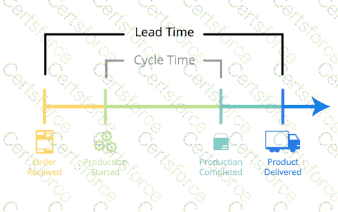
Manufacturing cycle time to see lead time and cycle time since order received until order delivered
By analyzing Average Velocity and Cycle Time, the project manager can provide the sponsor with a data-driven range for the completion date, which is more accurate than a single fixed date in an environment with evolving requirements.
Which of the following change requests can bring expected future performance of the project work in line with the project management plan?
Corrective action
Defect repair
Preventative action
Probable action
According to the PMBOK® Guide, change requests are an output of various monitoring and controlling processes. They are formal proposals to modify any document, deliverable, or baseline.
Preventative Action: This is an intentional activity that ensures the expected future performance of the project work is aligned with the project management plan. While corrective action deals with existing deviations, preventative action is proactive. It is based on trend analysis and risk assessment to stop a potential problem before it occurs.
Examples:
Cross-training a team member because a key subject matter expert might be leaving soon.
Ordering equipment early to avoid a forecasted supply chain delay.
Adding extra testing cycles to a high-risk software module to prevent bugs in the final build.
Key Distinction: The focus is on the future. If the project manager notices that the project is currently on track but could slip due to an emerging risk, they initiate a preventative action.
Analysis of Other Options:
A. Corrective action: This is an intentional activity that realigns the performance of the project work with the project management plan. The key difference is that corrective action addresses past or current deviations (the problem has already happened).
B. Defect repair: This is an intentional activity to modify a nonconforming product or product component. It specifically targets the quality of a deliverable that has already been produced and found to be faulty.
D. Probable action: This is not a formal term recognized in the PMBOK® Guide or PMI standards.
A project manager is experiencing a project with a high degree of change. Which type of stakeholder engagement does this project require?
Discussing with management
Escalating to the sponsors
Engaging regularly with stakeholders
Engaging only with decision makers
According to the PMBOK® Guide and the Agile Practice Guide, projects characterized by a high degree of change (such as those using adaptive, iterative, or agile life cycles) necessitate a different approach to stakeholder management than predictive projects.
Frequent and Regular Engagement: When requirements are volatile or the environment is rapidly changing, the project manager must engage stakeholders regularly and frequently. This ensures that the team and the stakeholders remain in constant alignment regarding the project ' s direction and priorities.
Feedback Loops: Regular engagement creates shorter feedback loops. This allows the project manager to identify changes in stakeholder expectations or business needs early, reducing the risk of rework and ensuring that the final product delivers the intended value.
Proactive Management: Instead of waiting for formal reviews, the project manager uses continuous engagement (such as sprint reviews, demonstrations, or collaborative backlog refinement) to manage the " high degree of change " effectively.
Analysis of other options:
A. Discussing with management: While management is a stakeholder group, focusing only on them ignores the end-users, customers, and technical experts who are often the primary drivers of change in a project.
B. Escalating to the sponsors: Escalation is a conflict resolution or risk management path, not a proactive engagement strategy for handling high-change environments. Over-escalation can lead to a breakdown in the project manager ' s authority.
D. Engaging only with decision makers: In a high-change project, valuable information often comes from " influencers " or " users " who may not be final decision-makers. Ignoring these groups leads to missing critical requirements or identifying changes too late.
Per PMI standards, regular engagement with a broad range of stakeholders is the most effective way to navigate uncertainty and maintain agility throughout the project life cycle.
An input to the Control Quality process is:
Activity attributes
Quality control measurements
Enterprise environmental factors
Deliverables
According to the PMBOK® Guide (Project Management Body of Knowledge), specifically within the Project Quality Management knowledge area, the Control Quality process is the process of monitoring and recording results of executing the quality management activities to assess performance and ensure the project outputs are complete, correct, and meet customer expectations.
Deliverables (Option D): This is a critical input to the Control Quality process. Deliverables are the unique and verifiable products, results, or capabilities that are produced to complete a process, phase, or project. In this process, these " raw " deliverables (from the Direct and Manage Project Work process) are inspected and measured against the quality standards defined in the Quality Management Plan. If they pass, they become Verified Deliverables, which then serve as an input to the Validate Scope process for formal customer acceptance.
Quality Control Measurements (Option B): These are an output of the Control Quality process, not an input. They represent the documented results of the control quality activities in the format specified during quality planning.
Activity Attributes (Option A): These are typically an input to schedule-related processes (like Estimate Activity Durations or Develop Schedule) as they provide additional information about each individual activity.
Enterprise Environmental Factors (Option C): While EEFs influence many processes, the PMBOK® Guide specifically identifies Organizational Process Assets (OPAs) and the Project Management Plan as the primary environmental/organizational inputs for Control Quality, rather than EEFs.
In the PMI framework, the Control Quality process ensures that the project team is " doing things right " by verifying that the Deliverables meet the technical requirements and quality standards before they are presented to the customer.
When an activity cannot be estimated with a reasonable degree of confidence, the work within the activity is decomposed into more detail using which type of estimating?
Bottom-up
Parametric
Analogous
Three-point
According to the PMBOK® Guide, specifically within the Estimate Activity Durations and Estimate Costs processes, Bottom-up Estimating is a method of estimating project duration or cost by aggregating the estimates of the lower-level components of the Work Breakdown Structure (WBS).
When to Use: This technique is utilized when an activity cannot be estimated with a reasonable degree of confidence. In such cases, the work within the activity is decomposed into even more detail.
The Process:
The activity is broken down into smaller, more granular pieces of work.
Detailed estimates are created for each of these lower-level components.
These individual estimates are then " rolled up " or aggregated into a total quantity for each of the activity ' s resources or costs.
Accuracy and Cost: Bottom-up estimating is typically the most accurate estimation technique because it looks at the work at a very granular level. However, it is also the most time-consuming and costly method to perform. The accuracy is often driven by the size and complexity of the activity; smaller pieces of work generally lead to higher confidence in the estimate.
Comparison with other options:
B. Parametric: This uses a statistical relationship between historical data and other variables (e.g., square footage in construction) to calculate an estimate. It is based on unit rates rather than decomposition of work.
C. Analogous: This is a " top-down " approach that uses the values of a previous, similar project as the basis for estimating. it is used when there is limited information, making it the opposite of the detailed decomposition required for bottom-up.
D. Three-point: This technique uses three estimates (Most Likely, Optimistic, and Pessimistic) to account for uncertainty and risk. While it addresses a lack of confidence, it does not involve the decomposition of work into more detail to arrive at the figure.
Which type of analysis is used as a general management technique within the Plan Procurements process?
Risk assessment analysis
Make or buy analysis
Contract value analysis
Cost impact analysis
In accordance with the PMBOK® Guide, specifically within the Plan Procurement Management process, Make-or-buy analysis is the primary general management technique used to determine whether particular work can best be accomplished by the project team or should be purchased from outside sources.
Core Objective: This analysis is used to reach a decision on whether the organization should produce the product or service itself (Make) or purchase it from an external vendor (Buy).
Factors Considered:
Cost: Comparing the direct and indirect costs of internal production versus the purchase price and ongoing support costs of a vendor.
Capacity and Capability: Evaluating if the internal team has the skills, tools, and time available to perform the work.
Strategic Alignment: Determining if the work is a core competency that should remain in-house or if it is a commodity better handled by specialists.
Risk: Assessing the risks associated with internal execution versus the risks of relying on a third-party provider.
The Output: The primary result of this analysis is the Make-or-Buy Decisions, which are documented and used to move forward with the procurement process if a " buy " decision is reached.
Comparison with Other Options:
Risk assessment analysis (A): While risk is a factor in procurement, " Risk Assessment " is a broader set of processes (Identify Risks, etc.) and not the specific management technique defined for making the initial procurement choice.
Contract value analysis (C): This is a distractor term. While the value is analyzed, it falls under cost analysis or price evaluation during the " Conduct Procurements " phase.
Cost impact analysis (D): This is a general term often used in change management to see how a change affects the budget, but it is not the specific technique used in the Plan Procurements process to decide between internal and external work.
In a project using agile methodology, who may perform the quality control activities?
A group of quality experts at specific times during the project
The project manager only
All team members throughout the project life cycle
Selected stakeholders at specific times during the project
In an agile or adaptive environment, as outlined in the Agile Practice Guide and the PMBOK® Guide, quality is not a phase or a separate department ' s responsibility; it is " built-in " to the process.
Collective Responsibility: Unlike traditional (predictive) projects where a separate Quality Assurance (QA) team might perform inspections at the end of a phase, Agile teams follow the principle of collective ownership. Every team member—developers, testers, and even the Product Owner—is responsible for the quality of the increments being produced.
Continuous Quality: Quality control activities occur " throughout the project life cycle " rather than at specific intervals. This is achieved through practices such as:
Pair Programming: Real-time code review and quality checking.
Test-Driven Development (TDD): Writing tests before the code itself to ensure requirements are met.
Continuous Integration (CI): Frequently integrating work to catch defects early.
Definition of Done (DoD): A shared checklist that every work item must meet to ensure consistent quality before it is considered complete.
The Role of the Team: Agile teams are cross-functional. This means the people doing the work are also the ones verifying it, leading to faster feedback loops and a significant reduction in rework.
Analysis of Other Options:
A. A group of quality experts at specific times during the project: This describes a traditional " Silo " or Waterfall approach where quality is a hand-off. In Agile, waiting for " specific times " or external experts creates bottlenecks.
B. The project manager only: In Agile, the Project Manager (or Scrum Master) acts as a servant-leader who facilitates the process. They do not have the technical oversight to perform all quality control activities personally.
D. Selected stakeholders at specific times during the project: While stakeholders participate in the Sprint Review to validate that the product meets their needs, the actual quality control (ensuring the product is built correctly and is free of defects) is the responsibility of the delivery team during the iteration.
A project manager providing information to the right audience, in the right format, at the right time is an example of which type of communication?
Efficient
Effective
Push
Pull
According to the PMBOK® Guide, specifically within the Project Communications Management knowledge area, PMI distinguishes between two fundamental dimensions of successful communication: Effectiveness and Efficiency.
Effective Communication: This is defined as providing the information in the right format, at the right time, to the right audience, and with the right impact. The focus is on the quality and relevance of the communication to ensure the message is understood and achieves its intended purpose.
Efficient Communication: This refers to providing only the information that is needed. The focus here is on minimizing the waste of resources (such as time or budget) by avoiding " information overload " or sending unnecessary data.
Why the other options are incorrect:
A. Efficient: While a project manager should strive to be efficient, efficiency is about the quantity and resource usage (providing " only " what is needed). The specific criteria mentioned in the question (right audience, format, and time) are the literal definition of " Effective " communication in PMI standards.
C. Push: This is a Communication Method where information is sent to specific recipients who need to receive the information (e.g., emails, memos, reports). It does not guarantee that the information reached the right audience at the right time in the right format.
D. Pull: This is a Communication Method used for very large volumes of information or very large audiences. It requires the recipients to access the communication content at their own discretion (e.g., intranet sites, e-learning, lessons learned databases). Like push communication, it is a method, not a qualitative description like " effective. "
Which of the following factors is lowest at the start of the project?
Cost of changes
Stakeholder influences
Risk
Uncertainty
According to the PMBOK® Guide and the general principles of the Project Life Cycle, various project characteristics change as the project progresses from initiation to closure.
Cost of Changes: At the start of a project, the cost of making changes is at its lowest. This is because very little work has been completed, few resources have been committed, and no physical deliverables have been built yet. As the project moves toward completion, the cost of changes increases significantly because rework may involve scrapping completed components or re-ordering materials.
Stakeholder Influences: These are typically at their highest at the start of the project. Stakeholders have the greatest opportunity to influence the final characteristics of the project ' s product and the project ' s scope without significantly impacting cost.
Risk and Uncertainty: Both risk and uncertainty are at their highest at the start of the project. As the project progresses, team members gain more information, and many risks are either resolved or mitigated, causing these factors to decrease over time.
Comparison Summary:
Start of Project: High Risk, High Uncertainty, High Stakeholder Influence, Low Cost of Changes.
End of Project: Low Risk, Low Uncertainty, Low Stakeholder Influence, High Cost of Changes.
What are the Project Procurement Management processes?
Conduct Procurements, Control Procurements, Integrate Procurements, and Close Procurements
Estimate Procurements, Integrate Procurements, Control Procurements, and Validate Procurements
Plan Procurement Management, Conduct Procurements, Control Procurements, and Close Procurements
Plan Procurement Management, Perform Procurements, Control Procurements, and Validate Procurements
According to the PMBOK® Guide, specifically within the Project Procurement Management knowledge area, the processes are designed to acquire goods and services from outside the project team. While modern versions (PMBOK® 6th Edition) officially integrated " Close Procurements " into " Control Procurements, " the standard certification framework typically recognizes these four distinct functional stages:
Plan Procurement Management: The process of documenting project procurement decisions, specifying the approach, and identifying potential sellers. Key outputs include the Procurement Management Plan, Procurement Strategy, and Source Selection Criteria.
Conduct Procurements: The process of obtaining seller responses, selecting a seller, and awarding a contract. This involves tools like Bidder Conferences and Proposal Evaluation.
Control Procurements: The process of managing procurement relationships, monitoring contract performance, making changes and corrections as appropriate, and closing out contracts.
Close Procurements: The formal process of completing each procurement. In many exam contexts, this remains the definitive term for the administrative closure of a contract, ensuring all deliverables are accepted and final payments are made.
Analysis of Distractors:
A, B, and D: These options include non-existent PMI terms such as Integrate Procurements, Estimate Procurements, or Perform Procurements.
While Validate Procurements sounds plausible, it is not a standard process; " Validate Scope " exists in Scope Management, but not in Procurement.
Control Procurements is the correct monitoring process, not " Validate Procurements. "
Given the following information.
Activity A takes one week.
Activity B takes three weeks.
Activity C takes two weeks.
Activity D takes five weeks.
Activity A starts at the same time as Activity B.
Activity C follows Activity B and Activity A.
Activity D follows Activity C.
How long will it take to complete the project?
Eleven weeks
Nine weeks
Eight weeks
Ten weeks
To determine the total duration of the project, we use the Precedence Diagramming Method (PDM) to calculate the Critical Path. The Critical Path is the longest sequence of activities that dictates the minimum time required to complete the project.
Step 1: Map the Dependencies
Activity A and B start simultaneously ($T=0$).
Activity C is a " sink " for A and B. It cannot start until both are finished.
Activity D starts after C is completed.
Step 2: Calculate the Paths
We have two possible paths from the start of the project to the end:
Path 1: A $\rightarrow$ C $\rightarrow$ D
Duration: $1 \text{ (A)} + 2 \text{ (C)} + 5 \text{ (D)} = 8 \text{ weeks}$.
Path 2: B $\rightarrow$ C $\rightarrow$ D
Duration: $3 \text{ (B)} + 2 \text{ (C)} + 5 \text{ (D)} = 10 \text{ weeks}$.
Step 3: Identify the Project Duration
Because Activity C requires both A and B to be finished, it must wait for the longer of the two.
Activity A finishes at end of Week 1.
Activity B finishes at end of Week 3.
Therefore, Activity C starts at the beginning of Week 4.
Calculation:
End of B = Week 3
End of C = $3 \text{ (Start)} + 2 \text{ (Duration)} = \text{Week 5}$
End of D = $5 \text{ (Start)} + 5 \text{ (Duration)} = \text{Week 10}$
The project will take 10 weeks to complete. Path 2 (B-C-D) is the Critical Path.
Analysis of Other Options:
A. Eleven weeks: This would be the result if A and B were sequential rather than parallel ($1+3+2+5=11$).
B. Nine weeks: This does not align with any logical combination of the given activity durations.
C. Eight weeks: This is the duration of the shorter path (A-C-D). However, the project cannot finish until the longest path is completed.
Which format can a network diagram take?
Flow chart
Control chart
Affinity diagram
Cause-and-effect diagram
According to the PMBOK® Guide, a project schedule network diagram is a graphical representation of the logical relationships (dependencies) among the project schedule activities.
Logical Flow: The network diagram is essentially a specialized flow chart that moves from left to right, showing the sequence of work. It uses nodes (representing activities) and arrows (representing logical dependencies) to illustrate how the project " flows " from initiation to completion.
Precedence Diagramming Method (PDM): This is the most common flow chart format used in network diagrams today. It depicts four types of dependencies: Finish-to-Start (FS), Finish-to-Finish (FF), Start-to-Start (SS), and Start-to-Finish (SF).
Purpose: Unlike a standard business flow chart that might show decision loops, a project network flow chart is typically " acyclic " (no loops), focusing on the path required to reach the project finish.
Analysis of Other Options:
B. Control chart: This is a Quality Management tool used to determine whether a process is stable or has predictable performance. It tracks data over time against mean and control limits; it does not show activity sequences or dependencies.
C. Affinity diagram: This is a Data Representation technique used to organize large numbers of ideas into groups for review and analysis (often used after a brainstorming session). It is not used for scheduling or sequencing.
D. Cause-and-effect diagram: Also known as a Fishbone or Ishikawa diagram, this is a root-cause analysis tool used in Quality Management to identify the potential causes of a specific problem. It does not map the chronological flow of project work.
Which of the following is an input to the Direct and Manage Project Execution process?
Approved change requests
Approved contract documentation
Work performance information
Rejected change requests
According to the PMBOK® Guide, the Direct and Manage Project Work process (historically referred to as Direct and Manage Project Execution) is the process of leading and performing the work defined in the project management plan and implementing approved changes to achieve the project ' s objectives.
Role of Approved Change Requests: These are a critical input to this process. Once a change request is processed and approved through the Perform Integrated Change Control process, it is sent back to the project team to be implemented.
Implementation: This implementation may include a corrective action, a preventive action, or a defect repair. Without the " Approved " status, the project team should not be executing the requested change.
Process Flow:
Direct and Manage Project Work (Execution) identifies a need for change.
Perform Integrated Change Control (Monitoring and Controlling) reviews and approves the change.
Approved Change Requests flow back into Direct and Manage Project Work for actual implementation.
Comparison with Other Options:
Approved contract documentation (B): While contracts exist, they are generally part of the project management plan or procurement documentation, not a specific primary input named for the daily direction of work in the same way change requests are.
Work performance information (C): This is typically an Output of the monitoring and controlling processes (like Control Scope or Control Schedule), which is derived from Work Performance Data (an output of Execution).
Rejected change requests (D): These are recorded in the change log but are not acted upon or " executed " by the project team.
The business needs, assumptions, and constraints and the understanding of the customers needs and high-level requirements are documented in the:
Project management plan.
Project charter.
Work breakdown structure.
Stakeholder register.
In accordance with the PMBOK® Guide (Project Integration Management), the Develop Project Charter process is the process of developing a document that formally authorizes the existence of a project and provides the project manager with the authority to apply organizational resources to project activities.
The Project Charter is the specific document where the following elements are first formally recorded:
Business Needs: The high-level business case or the reason why the project is being undertaken (e.g., market demand, legal requirement).
High-Level Requirements: The preliminary requirements that satisfy stakeholder needs and expectations.
Assumptions and Constraints: Factors that are believed to be true without proof (assumptions) and limiting factors that affect the execution of the project (constraints).
Customer Needs: A high-level understanding of what the customer expects the project to deliver.
Analysis of Distractors:
A. Project management plan: While the project management plan eventually contains much more detailed versions of the requirements, assumptions, and constraints, it is a downstream document created during the Planning Process Group, whereas the Charter is the originating document in the Initiating Process Group.
C. Work breakdown structure (WBS): The WBS is a tool used to decompose the project scope into smaller work packages. It does not document business needs or high-level requirements in a narrative format; it is a hierarchical decomposition of deliverables.
D. Stakeholder register: This document is used to identify and categorize project stakeholders. While it may link stakeholders to their requirements, it does not serve as the primary repository for the project ' s business needs or high-level constraints.
Processes in the Planning Process Group are typically carried out during which part of the project life cycle?
Only once, at the beginning
At the beginning and the end
Once during each phase
Repeatedly
According to the PMBOK® Guide, the Planning Process Group consists of those processes performed to establish the total scope of the effort, define and refine the objectives, and develop the course of action required to attain those objectives.
A fundamental principle of project management is Progressive Elaboration, which means that as more information or even more accurate estimates become available, the project management plan is updated. Because projects are dynamic, the planning processes are carried out repeatedly throughout the project life cycle.
Rolling Wave Planning: This is a specific form of progressive elaboration where work to be accomplished in the near term is planned in detail, while future work is planned at a higher level.
Feedback Loops: As the project progresses through the Executing and Monitoring and Controlling process groups, changes often require the team to return to the planning processes to update the schedule, budget, or scope (the " Plan-Do-Check-Act " cycle).
Analysis of Distractors:
A. Only once, at the beginning: This describes a " static " plan. In reality, a plan that is never updated is rarely successful, as it does not account for changes or new information.
B. At the beginning and the end: Planning is continuous. While the Closing Process Group occurs at the end, planning is not restricted to these two bookends.
C. Once during each phase: While planning does happen within each phase, it is not restricted to a single event per phase. Within a single phase, planning processes may be revisited many times as the team refines their approach.
Which are the main objectives of Project Risk Management?
Increase the probability of positive risks and decrease the probability of negative risks
Avoid all kind of risks
Increase the probability of positive risks and eliminate all negative risks
Identify positive and negative risks
According to the PMBOK® Guide, the primary objective of Project Risk Management is to optimize the project ' s chances of success by proactively addressing uncertainty. Risk is defined as an uncertain event or condition that, if it occurs, has a positive or negative effect on one or more project objectives.
Positive Risks (Opportunities): The goal is to increase the probability and/or impact of these events. If an opportunity is realized, it can lead to benefits such as reduced cost, accelerated schedule, or enhanced quality.
Negative Risks (Threats): The goal is to decrease the probability and/or impact of these events. This involves planning responses to mitigate, transfer, or avoid threats that could jeopardize the project ' s constraints.
Overall Project Risk: Beyond individual risks, the process also aims to manage the overall project risk exposure to keep it within an acceptable range for the stakeholders.
Analysis of Other Options:
B. Avoid all kind of risks: This is impossible and undesirable. Every project involves some level of risk to achieve a reward. Furthermore, " Avoid " is only one specific strategy for negative risks; you cannot avoid " positive " risks if you want to benefit from them.
C. Increase the probability of positive risks and eliminate all negative risks: While increasing positive risks is correct, it is a common misconception that all negative risks can be eliminated. Many risks are inherent to the work and can only be mitigated or accepted. Elimination (Avoidance) is not always possible or cost-effective.
D. Identify positive and negative risks: Identification is merely the first step (the Identify Risks process). The " main objective " of the entire knowledge area is the active management and optimization of those risks, not just the act of listing them.
When a dynamic systems development method (DSDM) practitioner receives a new high-priority feature request, what should the practitioner do first?
Develop the feature as a parallel work package.
Shorten the current work period and begin the new work.
Ask a dedicated team member to complete it immediately.
Prioritize it in the requirements list for the next work period.
Dynamic Systems Development Method (DSDM) is an Agile framework that operates on the principle that " nothing is built perfectly the first time " and focuses on frequent delivery of business value. In DSDM, time and cost are fixed, while the scope is variable.
Why Choice D is correct: In DSDM, work is organized into Timeboxes (similar to Sprints in Scrum). One of the core principles of DSDM is " Never Compromise Quality. " When a new high-priority feature arrives, the practitioner follows the formal change process within the Agile framework:
MoSCoW Prioritization: New requirements are added to the prioritized requirements list (Backlog) and categorized using MoSCoW (Must have, Should have, Could have, Won ' t have this time).
Timeboxing: DSDM does not allow for " mid-timebox " disruptions that compromise the current commitments. Instead, the new feature is evaluated and prioritized for the next work period (Timebox). This maintains the team ' s focus and ensures that the current timebox ' s " Must Haves " are delivered as promised.
Analysis of other options:
A (Parallel work package): This creates multitasking and resource contention, which DSDM aims to avoid. It compromises the focus of the current timebox.
B (Shorten the current period): Timeboxes in DSDM are fixed. Shortening them disrupts the cadence and usually results in incomplete or low-quality deliverables for the current cycle.
C (Complete it immediately): This is " reactive " management. It bypasses the prioritization process and ignores the impact on existing work. In DSDM, the Business Visionary or Business Ambassador must first agree on the priority relative to other items.
Key Concept: DSDM relies on Empowered Teams and Iterative Development. By placing the request in the requirements list for the next period (Choice D), the practitioner respects the DSDM philosophy of " fixing " the time and quality while allowing the scope to be re-prioritized based on evolving business needs.
The procurement process that documents agreements and related documentation for future reference is known as:
Plan Procurements.
Control Procurements.
Close Procurements.
Conduct Procurements.
According to the PMBOK® Guide, the Control Procurements process is the process of managing procurement relationships, monitoring contract performance, making changes and corrections as appropriate, and closing out contracts.
Documentation and Future Reference: While " Closing " sounds like the final resting place for documents, the Control Procurements process is functionally responsible for the administrative activities associated with documenting agreements and performance. This includes maintaining a record of the contract, all supporting schedules, requested and approved change requests, and any related documentation for future reference.
Key Activities:
Reviewing and documenting how a seller is performing.
Ensuring that both the buyer and seller meet procurement requirements according to the terms of the legal agreement.
Managing contract-related records, which are often indexed and filed in the Records Management System.
Transition in PMBOK® 6th/7th Ed: In earlier versions of the PMBOK® Guide, there was a separate process called " Close Procurements. " However, in more recent standards, the administrative closure of a procurement is consolidated into Control Procurements. This process ensures that all deliverables have been provided, accepted, and that the final procurement file is archived for historical use.
Comparison with other options:
A. Plan Procurement Management: This is the initial process of documenting project procurement decisions, specifying the approach, and identifying potential sellers. It creates the " plan " but does not document the final agreements for future reference.
C. Close Procurements: As noted above, in current PMI standards, the functions of closing a procurement (including the archiving of documents) are handled within the Control Procurements process. If this were a question based on older standards (PMBOK® 5th Ed or earlier), " Close Procurements " might have been the distinct answer, but modern standards integrate it into Control.
D. Conduct Procurements: This is the process of obtaining seller responses, selecting a seller, and awarding a contract. It is the " action " phase where agreements are signed, but it is not the ongoing process of managing and archiving those documents for the long term.
Which tools and techniques will a project manager use to develop a project charter?
Project manager experience, expert judgment, scope statement, and meetings
Lessons learned database. Interpersonal and team skills, cost baseline, and meetings
Expert judgment, data gathering. scope statement, schedule baseline, and meetings
Expert judgment, data gathering. interpersonal and team skills, and meetings
According to the PMBOK® Guide, the Develop Project Charter process is the process of developing a document that formally authorizes the existence of a project and provides the project manager with the authority to apply organizational resources to project activities.
Because this process occurs at the very beginning of the project (Initiation), the tools and techniques focus on high-level analysis and consensus-building rather than detailed project management baselines.
Expert Judgment: Defined as judgment provided based upon expertise in an application area, knowledge area, or industry. It is used to process the information from the business case and agreements.
Data Gathering: Includes techniques such as:
Brainstorming: To identify risks, participants, and success criteria.
Focus Groups: To bring together stakeholders and subject matter experts to learn about the project expectations.
Interviews: To obtain information from high-level stakeholders.
Interpersonal and Team Skills: Specifically Conflict Management (to align stakeholders on objectives), Facilitation (to lead the group toward a decision), and Meeting Management.
Meetings: Used to discuss project objectives, success criteria, key deliverables, and high-level milestones with key stakeholders.
Analysis of Other Options:
A and C. Scope statement / Schedule baseline: These are incorrect because the Scope Statement and Baselines are outputs of the Planning process group. They do not exist yet when the Project Charter is being developed; in fact, the Charter is what provides the authority to create these documents later.
B. Cost baseline: Similar to the above, the cost baseline is a result of the Determine Budget process in Planning. Furthermore, while the Lessons Learned database is an input (part of OPA), it is not a tool or technique.
Which of the following documents allows the project manager to assess risks that may require near term action?
Probability and impact matrix
Contingency analysis report
Risk urgency assessment
Rolling wave plan
In accordance with the PMBOK® Guide, specifically within the Perform Qualitative Risk Analysis process, Risk Urgency Assessment is the tool used to identify risks that require near-term action.
Definition: Risk urgency assessment reviews and determines the timing of actions that may need to occur sooner than other risk responses. It considers the time available to react to a risk, the time to implement a risk response, and the project ' s tolerance for delay.
Purpose: While the Probability and Impact Matrix helps prioritize risks based on their severity, it does not necessarily account for when those risks might occur. A high-impact risk that is scheduled to happen in two days is more " urgent " than a high-impact risk scheduled for next year.
Categorization: Risks that may occur soon or require a long lead time to implement a response are moved to the top of the priority list for immediate attention. Indicators of urgency can include " Time to Effect " or " Time to Respond. "
Output: The results of this assessment are typically documented in the Risk Register to help the project manager focus on the most pressing threats or opportunities.
Comparison with Other Options:
Probability and impact matrix (A): This identifies the importance of a risk but not necessarily the timing or urgency of the required response.
Contingency analysis report (B): This usually refers to the amount of funds or time set aside (reserves) to handle identified risks; it is a result of planning, not a tool for assessing near-term timing.
Rolling wave plan (D): This is a form of progressive elaboration used in Schedule Management where work to be accomplished in the near term is planned in detail, while future work is planned at a higher level. While it deals with " near term, " it is a scheduling technique, not a risk assessment document.
Which degree of authority does a project manager have on a project in a strong matrix organizational structure?
Limited
Low to moderate
Moderate to high
High to almost total
According to the PMBOK® Guide, specifically the section on Organizational Structures, a Strong Matrix organization maintains many of the characteristics of the projectized organization and can have full-time project managers with considerable authority.
Project Manager Authority: In a strong matrix, the balance of power shifts toward the project manager. While they still operate within a functional framework, their authority is characterized as moderate to high.
Resource Availability: The project manager has a moderate to high level of control over resource availability. They negotiate with functional managers but generally have the " upper hand " or a formal mandate to utilize staff for project objectives.
Budget Control: Unlike functional or weak matrix structures, in a strong matrix, the Project Manager typically manages or has significant control over the project budget.
Project Management Administrative Staff: In this structure, the project manager and the project management administrative staff are usually assigned full-time.
Comparison with Other Options:
Limited (A): This degree of authority is found in a Weak Matrix organization, where the project manager acts more as a coordinator or expeditor.
Low to moderate (B): This characterizes a Balanced Matrix organization, where the power is shared relatively equally between the functional manager and the project manager.
Moderate to high (C): This is the definitive classification for a Strong Matrix.
High to almost total (D): This degree of authority is reserved for Project-Oriented (Projectized) organizations, where the entire company is organized around projects and functional departments may not exist or only provide support.
A projects purpose or justification, measurable project objectives and related success criteria, a summary milestone schedule, and a summary budget are all components of which document?
Work breakdown structure
Requirements document
Project charter
Project management plan
According to the PMBOK® Guide (Project Management Body of Knowledge), specifically within the Project Integration Management knowledge area and the Develop Project Charter process:
Project Charter (Option C): This is the document issued by the project initiator or sponsor that formally authorizes the existence of a project and provides the project manager with the authority to apply organizational resources to project activities. Per PMI standards, a standard Project Charter includes high-level information such as the project purpose or justification, measurable project objectives, success criteria, a summary milestone schedule, and a summary budget. It also identifies the high-level risks and the assigned project manager.
Work Breakdown Structure (WBS) (Option A): This is a hierarchical decomposition of the total scope of work. It focuses on deliverables and work packages, not on project justification, budgets, or milestone schedules.
Requirements Document (Option B): This document describes how individual requirements meet the business need for the project. While it includes measurable criteria for the product, it does not contain the project ' s financial authorization or the milestone schedule.
Project Management Plan (Option D): This is a comprehensive document that describes how the project will be executed, monitored, and controlled. While it incorporates high-level information from the charter, the charter is the specific, formal starting document where these summary-level components are first established and authorized.
In the PMI framework, the Project Charter serves as a bridge between the organization ' s strategic objectives and the project ' s tactical execution. By documenting the summary budget and milestone schedule at this early stage, the sponsor set the boundaries within which the Project Manager must plan the detailed project activities.
Which input to the Plan Risk Management process provides information on high-level risks?
Project charter
Enterprise environmental factors
Stakeholder register
Organizational process assets
According to the PMBOK® Guide and the Standard for Project Management, the Project Charter is a primary input to the Plan Risk Management process because it establishes the high-level boundaries and context for the project.
Specifically, the Project Charter contains high-level project requirements, a high-level project description, and high-level risks. These initial risks are identified during the initiation phase and serve as the starting point for the more detailed risk management planning that occurs during the planning phase.
The other options are incorrect based on their specific roles as defined by PMI:
Enterprise Environmental Factors (EEF): These are external or internal factors that surround or influence the project ' s success, such as risk attitudes, thresholds, and tolerances of the organization or stakeholders. While they influence risk management, they do not provide a list of project-specific high-level risks.
Stakeholder Register: This document is an input that provides a list of project stakeholders and details regarding their interests and involvement. It helps identify who may be affected by risks or who may have a high risk tolerance, but it is not the source of high-level project risks.
Organizational Process Assets (OPA): These include the organization ' s plans, processes, policies, procedures, and knowledge bases. They provide templates and historical information from previous projects (lessons learned) rather than current project-specific risks.
As per the PMI Standard for Project Risk Management, the Project Charter provides the necessary high-level information that allows the project team to define how risk management activities will be structured and performed.
A key stakeholder has left the project management team. The team now has a new key stakeholder who is requesting project reports from team members out of sequence.
What should the project manager do first?
Extend an iteration review invite to the new stakeholder.
Perform qualitative risk analysis.
Engage with the new stakeholder.
Allow team members to share project status reports.
According to the PMBOK® Guide, specifically the Stakeholder Engagement and Communications Management knowledge areas, the arrival of a new key stakeholder is a significant change that requires immediate management action.
Why Choice C is correct:
Assess and Align: The project manager must first engage with the new stakeholder to understand their specific information needs, expectations, and influence on the project. This is a prerequisite to any other action.
Clarify Procedures: By engaging directly, the PM can explain the existing Communications Management Plan and the established reporting cadence. This prevents team disruption (team members being distracted by ad-hoc requests) while ensuring the stakeholder feels supported.
Relationship Building: Building rapport with a " key " stakeholder early is essential for long-term project success and conflict prevention.
Analysis of other options:
A (Extend an iteration review invite): While this is a good secondary step for transparency (especially in Agile), it doesn ' t address the immediate issue of the stakeholder ' s " out of sequence " report requests. The PM first needs to understand why they need those reports before just inviting them to a meeting.
B (Perform qualitative risk analysis): While the change in stakeholders is a risk, the PMBOK® Guide emphasizes that personal engagement and communication management are the primary tools for stakeholder issues. Risk analysis is a backend process; engagement is the active resolution.
D (Allow team members to share reports): This is incorrect. Allowing " out of sequence " reporting bypasses the Communications Management Plan and the Change Control processes. It leads to " noise, " potential misinformation, and wastes the team ' s productive time. The PM should act as a buffer.
Key Concept: When a new stakeholder enters the project, the Project Manager must perform the Identify Stakeholders and Plan Stakeholder Engagement processes. Choice C is the " first " logical step in these processes—initiating a dialogue to align the stakeholder ' s needs with the project ' s governance framework.
