In an adaptive (Agile) project, predicting completion dates is based on empirical data derived from the team ' s actual performance in previous iterations. According to the Agile Practice Guide and the PMBOK® Guide, forecasting tools rely on the speed of delivery and the stability of the workflow.
Why Choice D is correct:
Average Velocity: This is the average amount of work (usually in story points) that a team completes during a sprint. By dividing the remaining work in the Product Backlog by the Average Velocity, a project manager can estimate the number of iterations remaining.
Cycle Time: This is the amount of time it takes for a single unit of work to travel through the team ' s workflow (from " In Progress " to " Done " ). In a Kanban or continuous flow environment, cycle time is the primary metric used to predict how long it will take to finish individual items or the remaining backlog.
Together, these provide a " trend-based " forecast rather than a static deadline.
Analysis of other options:
A (Risk burnup and control chart): A risk burnup tracks the effectiveness of risk mitigation, and a control chart measures process stability/variance. While helpful for quality control, they don ' t directly forecast a completion date for the entire project scope.
B (Customer satisfaction index and workload): These are " lagging " indicators or resource management metrics. They do not provide the mathematical basis required to calculate a projected end date.
C (Average burndown and velocity): While " Velocity " is correct, an " Average burndown " is less of a metric and more of a visualization. Cycle Time (in Choice D) is a more precise metric for forecasting in adaptive environments because it accounts for the actual lead time of work items.
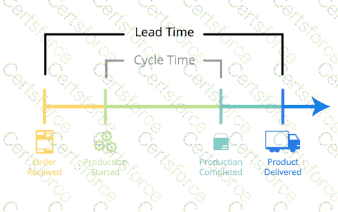
Manufacturing cycle time to see lead time and cycle time since order received until order delivered
By analyzing Average Velocity and Cycle Time, the project manager can provide the sponsor with a data-driven range for the completion date, which is more accurate than a single fixed date in an environment with evolving requirements.


Submit