
A construction project is underway with three months left to complete the building. A public authority responsible for approving the final stage is stalling the project. What should the project manager do?
Discuss this with the department head and arrive at an acceptable solution to expedite the approval process.
Report the issue to major stakeholders and explore possible corrective actions along with legal assistance.
Mitigate the risk by requesting an alternative public authority to participate in the approval process.
Visit the public authority headquarters and formally petition them, demanding an explanation about the delay.
According to the PMBOK® Guide, specifically within the Monitor Risks and Manage Stakeholder Engagement processes, external dependencies—such as government or public authority approvals—represent a significant risk to project completion.
Issue Escalation: Since the project is in its final stages (three months left) and the authority is " stalling, " this is no longer just a risk; it is an issue. When a project manager encounters a roadblock that is outside their direct sphere of influence (external bureaucratic stalling), they must inform the major stakeholders and the project sponsor.
Corrective Actions and Legal Support: Construction projects are governed by contracts and local laws. Stalling by a public authority can have massive financial implications. Exploring corrective actions may include re-sequencing work to accommodate the delay, while legal assistance is often required to navigate regulatory hurdles, ensure compliance, or invoke specific clauses that protect the organization ' s interests against arbitrary delays.
Stakeholder Management: Reporting the issue ensures that those with the most influence (executives or sponsors) can use their political or professional capital to assist the project manager in resolving the bottleneck.
Analysis of other options:
Option A: While talking to a department head might seem proactive, a project manager often lacks the organizational standing to " demand " solutions from a public authority head. This approach ignores the formal governance and legal frameworks usually required in construction.
Option B: This is the most professional and standard-aligned response. It recognizes the limits of the PM ' s authority and utilizes the organization ' s broader power (stakeholders and legal) to address a critical external threat.
Option C: In most jurisdictions, public authority jurisdictions are non-negotiable. You cannot simply " request an alternative authority " to provide a legal approval if they do not have the legal mandate to do so.
Option D: Demanding an explanation in person is aggressive and often counterproductive. In project management, " demanding " is rarely an effective strategy for managing external stakeholders who hold the power of approval.
Per PMI standards, when an external dependency threatens the project ' s critical path and is outside the PM ' s control, the PM must report the issue to stakeholders and seek corrective and legal pathways to resolve the impasse.
A project manager is managing a small project that has a time constraint. What should the project manager do to ensure the delivery is on time?
Expand the scope of the project.
Schedule the tasks in sequence.
Increase quality review cycles.
Schedule the tasks in parallel.
According to the PMBOK® Guide, specifically the Develop Schedule process, when a project is facing a time constraint (a fixed deadline), the project manager must employ Schedule Compression techniques to shorten the project duration without reducing the project scope.
Why Choice D is correct: Scheduling tasks in parallel is a technique known as Fast Tracking.
Fast Tracking: This involves performing activities that would normally be done in sequence (one after the other) in parallel for at least a portion of their duration. For example, starting to write the user manual while the software is still being coded.
Impact on Time: This directly reduces the total elapsed time of the project ' s critical path, helping to meet tight deadlines.
Risk Trade-off: While Fast Tracking saves time, it often increases risk and may lead to rework because tasks are being performed before the preceding task is 100% complete.
Analysis of other options:
A (Expand the scope): Expanding scope (Scope Creep) is the opposite of what should be done under a time constraint. More work typically requires more time, which would further jeopardize the deadline.
B (Schedule the tasks in sequence): Sequential scheduling is the " natural " flow of project work, but it is the least efficient way to save time. If a project is already under a time constraint, relying on a linear sequence is what leads to delays.
C (Increase quality review cycles): While quality is important, adding more review cycles consumes more time. Under a strict time constraint, the project manager might actually need to streamline processes rather than add extra steps, provided the Definition of Done is still met.
Key Concept: The Project Management Institute (PMI) emphasizes that a project manager must balance the " Triple Constraint " (Scope, Time, and Cost). When Time is fixed, Choice D (Fast Tracking) is the primary strategy used to compress the schedule by overlapping phases or activities, ensuring that the project reaches completion as quickly as possible without necessarily increasing the project ' s budget.
What earned value (EV) measure indicates the cost efficiency of the work completed?
Cost variance (CV)
Cost performance index (CPI)
To-complete performance index (TCPI)
Variance at completion (VAC)
According to the PMBOK® Guide, specifically in the Control Costs process within the Project Cost Management knowledge area, the Cost Performance Index (CPI) is the specific metric used to measure the cost efficiency of a project.
Definition of CPI: CPI is a measure of the cost efficiency of budgeted resources, expressed as the ratio of earned value ($EV$) to actual cost ($AC$). The formula is:
$$CPI = \frac{EV}{AC}$$
Efficiency Indicator: Because it is an index (a ratio), it tells you how much value you are getting for every dollar spent.
A CPI of 1.0 indicates the project is exactly on budget (spending $1 to get $1 of work).
A CPI greater than 1.0 indicates that the work is being performed with better efficiency than planned (under budget).
A CPI less than 1.0 indicates that the work is being performed inefficiently (over budget).
Importance: CPI is considered the most critical EVM metric as it influences the calculation of the Estimate at Completion (EAC). It provides a clear snapshot of how efficiently the project team is using the financial resources allocated to the project.
Why other options are incorrect:
Option A: Cost variance (CV): While CV also relates to cost performance, it is expressed as a currency value ($CV = EV - AC$) rather than a ratio. It shows the magnitude of the deviation from the budget, but not the " efficiency rate " or " percentage " of efficiency.
Option C: To-complete performance index (TCPI): TCPI is a measure of the cost performance that must be achieved with the remaining resources to meet a specific goal (like the original BAC or a new EAC). It describes the efficiency required for the future, not the efficiency of the work already completed.
Option D: Variance at completion (VAC): VAC is a projection of the final budget deficit or surplus ($VAC = BAC - EAC$). It is a forecasting metric used to see where the project will end up, not a measure of current work efficiency.
What should a project manager use to determine how much money is needed to complete a project?
Earned value management (EVM)
Estimate at completion (EAC)
Earned value analysis (EVA)
Budget at completion (BAG)
According to the PMBOK® Guide (6th Edition), the Estimate at Completion (EAC) is the specific forecasting metric used to determine the total expected cost of finishing all the project work. It is a vital component of Earned Value Management (EVM) that projects the final cost based on current performance and the work remaining.
The EAC is typically determined by adding the actual costs incurred to date (AC) to the Estimate to Complete (ETC), which represents the expected cost to finish the remaining work.
Why EAC is the correct tool for this determination:
Forecasting: Unlike the original budget, the EAC is dynamic. It accounts for variances that have occurred during execution, providing a realistic view of how much money will ultimately be needed.
Accuracy: It allows the project manager to communicate to stakeholders whether the project will require more or less funding than originally authorized.
Analysis of Distractors:
A (Earned value management - EVM): This is the overarching methodology that combines scope, schedule, and resource measurements. While EAC is a part of EVM, " EVM " itself is the system, not the specific value that tells you the total money needed.
C (Earned value analysis - EVA): This is the activity of comparing the planned amount of work with what has actually been completed. It is the process of calculating variances, but the " answer " to how much money is needed is the EAC.
D (Budget at completion - BAC): This is the original total budget established during the planning phase. While it was the initial estimate of how much money was needed, it does not reflect the current reality of the project if there have been any performance deviations or changes.
Which two processes should be used to influence costs in the early stages of a project?
Estimate Costs and Determine Budget
Plan Cost Management and Estimate Activity Durations
Control Quality and Control Costs
Plan Stakeholder Engagement and Plan Communications Management
According to the PMBOK® Guide, the ability to influence costs is highest during the early stages of a project, specifically during the Planning Process Group. As the project progresses, the cost of changes increases, making early intervention critical.
Estimate Costs: This process involves developing an approximation of the monetary resources needed to complete project work. By accurately estimating costs early, the project manager can identify potential overruns or savings before significant resources are committed.
Determine Budget: This process aggregates the estimated costs of individual activities or work packages to establish an authorized Cost Baseline. Setting this baseline early allows for effective management and influence over the project ' s financial trajectory.
Analysis of other options:
B: While " Plan Cost Management " is an early process, " Estimate Activity Durations " is primarily a Schedule Management process. While duration impacts cost, it is not one of the two primary cost-influencing processes compared to direct estimation and budgeting.
C: Control Quality and Control Costs occur during the Monitoring and Controlling phase. By the time you are " controlling, " the project is already in execution, and the window for maximum influence at a low cost has largely closed.
D: These are Stakeholder and Communications processes. While they support project success, they do not directly manage or influence the financial cost structure of the project deliverables.
Per PMI standards, the most direct impact on the project ' s financial outcome is established when the team defines what things will cost (Estimate Costs) and secures the funding and baseline for them (Determine Budget).
Match the process with its corresponding Process Group:
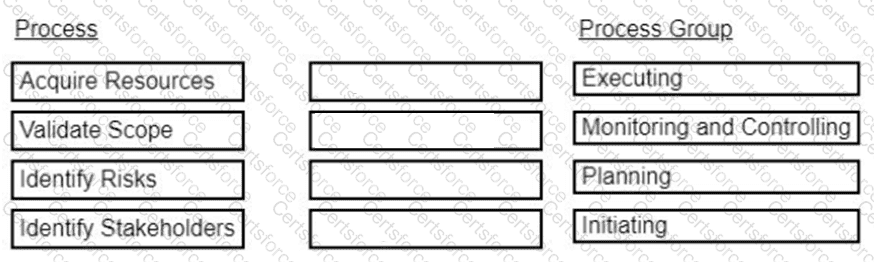
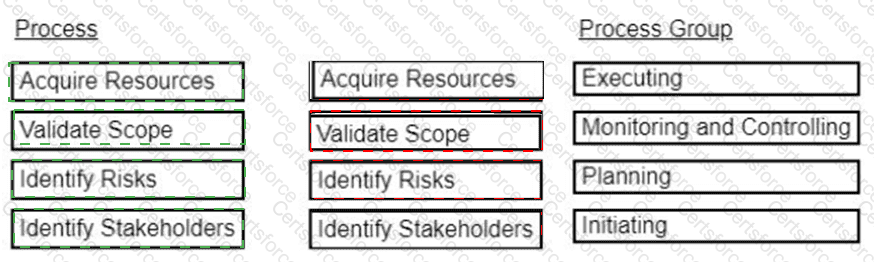
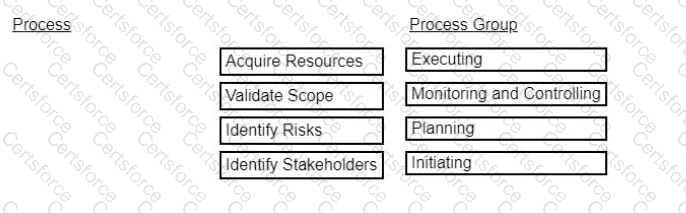
According to the PMI standard, processes are categorized into five distinct Process Groups. These groups are independent of project phases and represent the logical grouping of project management inputs, tools and techniques, and outputs.
Initiating (Process: Develop Project Charter): This group consists of those processes performed to define a new project or a new phase of an existing project by obtaining authorization to start. The Project Charter is the foundational document here.
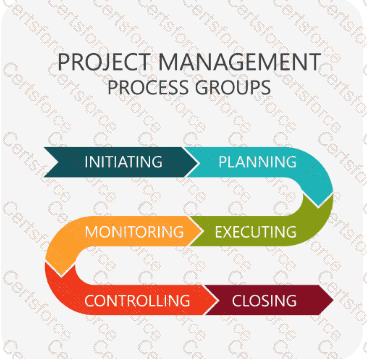
Planning (Process: Create WBS): This group involves processes required to establish the scope of the project, refine objectives, and define the course of action required to attain those objectives. Creating the Work Breakdown Structure (WBS) is a critical part of defining the scope baseline.
Executing (Process: Manage Quality): These processes are performed to complete the work defined in the project management plan to satisfy the project requirements. Manage Quality (sometimes called Quality Assurance) focuses on the processes used to ensure the project is on track to meet quality standards.
Monitoring and Controlling (Process: Monitor and Control Project Work): This group consists of processes required to track, review, and regulate the progress and performance of the project; identify any areas in which changes to the plan are required; and initiate the corresponding changes.
Closing (Process: Close Project or Phase): These processes are performed to formally complete or close the project, phase, or contract. It involves archiving information, completing lessons learned, and releasing team resources.
A common trick on the exam is confusing the Process Group (the " when/how " ) with the Knowledge Area (the " what " ). For example, while " Create WBS " is in the Scope Management Knowledge Area, it belongs strictly to the Planning Process Group.
Which of the following is a group decision-making technique?
Brainstorming
Focus groups
Affinity diagram
Plurality
According to the PMBOK® Guide, group decision-making techniques are used to reach a conclusion when multiple alternatives or requirements are being evaluated. These are primarily utilized in the Collect Requirements and Validate Scope processes.
Plurality: This is a decision-making technique where a decision is reached by the largest block in a group, even if a majority is not achieved. For example, if there are three options and the votes are split $40\%$, $35\%$, and $25\%$, the option with $40\%$ wins.
Other Group Decision-Making Techniques:
Unanimity: Everyone agrees on a single course of action.
Majority: Support from more than $50\%$ of the members of the group.
Dictatorship: One individual makes the decision for the entire group.
Analysis of Other Options:
A. Brainstorming: This is a Data Gathering technique used to identify a list of ideas in a short period of time. It is used to generate options, not to decide which option to pursue.
B. Focus groups: This is also a Data Gathering technique. It brings together prequalified stakeholders and subject matter experts to learn about their expectations and attitudes about a proposed product or service.
C. Affinity diagram: This is a Data Representation technique. It allows large numbers of ideas to be classified into groups for review and analysis. It organizes ideas but does not function as a decision-making mechanism.
The cost baseline and project funding requirements are outputs of which process in Project Cost Management?
Estimate Costs
Control Costs
Plan Cost Management
Determine Budget
According to the PMBOK® Guide (Project Management Body of Knowledge), specifically within the Project Cost Management knowledge area:
Determine Budget (Option D): This is the process of aggregating the estimated costs of individual activities or work packages to establish an authorized cost baseline. The two primary outputs of this process are the Cost Baseline (the approved version of the time-phased project budget, excluding any management reserves) and the Project Funding Requirements (total funding and periodic funding requirements, which include the cost baseline plus management reserves).
Estimate Costs (Option A): This process involves developing an approximation of the monetary resources needed to complete project work. Its primary outputs are Activity Cost Estimates and Basis of Estimates. It does not produce the baseline itself.
Control Costs (Option B): This is the process of monitoring the status of the project to update the project costs and managing changes to the cost baseline. Its outputs include Work Performance Information, Cost Forecasts, and Change Requests.
Plan Cost Management (Option C): This is the initial process that defines how the project costs will be estimated, budgeted, managed, monitored, and controlled. Its sole output is the Cost Management Plan.
In the PMI framework, the Cost Baseline is used as a basis for comparison to actual results. The Project Funding Requirements are often derived from the cost baseline but may include " step-increases " or management reserves to ensure the organization has sufficient cash flow to support project expenditures at various milestones.
Who selects the appropriate processes for a project?
Project stakeholders
Project sponsor and project stakeholder
Project manager and project team
Project manager and project sponsor
According to the PMBOK® Guide, specifically in the sections regarding Project Management Processes, a project is not a " one size fits all " endeavor. The act of choosing which processes are relevant to a specific project is known as Tailoring.
The Responsibility of Tailoring: The Project Manager and the Project Team are responsible for selecting the appropriate processes, inputs, tools, techniques, outputs, and life cycle phases to manage a project.
The Logic of Selection: Not every process, tool, or technique described in the PMBOK® Guide is required on every project. The PM and team must consider the project ' s size, complexity, risk, and organizational culture to determine what is " fit for purpose. "
Standard of Practice: While the Project Management Institute (PMI) provides the global standard, it explicitly states that the project management team is responsible for determining what is appropriate for the given project.
Collaboration: Although the Project Manager leads this effort, the Team provides the technical expertise and historical knowledge necessary to decide which processes (such as specific quality checks or risk analysis methods) are actually value-added for the project ' s unique constraints.
Comparison with other options:
A. Project stakeholders: While stakeholders have requirements and influences, they do not have the technical project management expertise to select the specific PMBOK® processes required to execute the work.
B. Project sponsor and project stakeholder: The sponsor provides resources and support, but they delegate the " how " of project management (the process selection) to the PM and the team.
D. Project manager and project sponsor: While the sponsor might sign off on the high-level approach (the Project Management Plan), the detailed selection of internal project processes is the functional responsibility of the PM and the team performing the work.
Which process involves aggregating the estimated costs of the individual schedule activities or work packages?
Estimate Costs
Estimate Activity Resources
Control Costs
Determine Budget
According to the PMBOK® Guide, the process of Determine Budget is defined as the process of aggregating the estimated costs of individual activities or work packages to establish an authorized cost baseline.
Mechanism of Aggregation: This process takes the Cost Estimates (which are an output of the Estimate Costs process) and rolls them up. First, activity costs are aggregated into work packages. Then, work package costs are aggregated into higher-level components of the WBS (such as control accounts), and finally, these are aggregated for the entire project.
Purpose: The goal of this aggregation is to determine the total cost required to complete the project and to produce the Cost Baseline.
Inclusion of Contingency: The process also involves adding Contingency Reserves (for " known-unknowns " ) to the cost estimates. When the cost baseline is combined with Management Reserves (for " unknown-unknowns " ), it results in the total Project Budget.
Analysis of other choices:
Choice A (Estimate Costs): This process involves developing an approximation of the monetary resources needed for each individual activity. It is the precursor to aggregation but is not the act of aggregating them into a total budget.
Choice B (Estimate Activity Resources): This process focuses on identifying the types and quantities of resources (people, equipment, materials) required, rather than the monetary value or the aggregation of those values into a budget.
Choice C (Control Costs): This is a monitoring and controlling process. It focuses on monitoring the status of the project to update the project costs and managing changes to the cost baseline. It uses the budget as a reference but does not create it through aggregation.
Which grid shows which resources are tied to work packages?
Work breakdown structure (WBS)
Responsibility assignment matrix (RAM)
Project assignment chart
Personnel assignment matrix
In accordance with the PMBOK® Guide (Project Resource Management), the Responsibility Assignment Matrix (RAM) is a grid that shows the project resources assigned to each work package. It is used to illustrate the connections between work packages or activities and project team members.
Function: The RAM ensures that there is only one person accountable for any one task to avoid confusion. On larger projects, RAMs can be developed at various levels. For example, a high-level RAM can define what a project team group or unit is responsible for within each component of the WBS, while lower-level RAMs are used within the group to designate roles, responsibilities, and levels of authority for specific activities.
RACI Chart: The most common type of RAM is the RACI (Responsible, Accountable, Consulted, and Informed) chart. In a RACI chart, the work is listed in the left-hand column as activities or work packages, and the resources are listed across the top as individuals or groups.
Analysis of Distractors:
A. Work breakdown structure (WBS): This is a hierarchical decomposition of the total scope of work to be carried out by the project team. While it defines the work packages, it does not inherently show the resources assigned to them.
C. Project assignment chart: This is not a standard PMI term. While " Project Team Assignments " is an output of the Acquire Resources process (documenting that the team is in place), it is not the grid used to map resources to specific work packages.
D. Personnel assignment matrix: Similar to option C, this is not a recognized term in the PMBOK® Guide. The standard term for this functional grid is the Responsibility Assignment Matrix (RAM).
Administer Procurements is part of which Process Group?
Planning
Executing
Monitoring and Controlling
Closing
According to the PMBOK® Guide, Administer Procurements (referred to as Control Procurements in the 5th, 6th, and 7th editions) is the process of managing procurement relationships, monitoring contract performance, and making changes and corrections as appropriate.
Process Group Alignment: This process is part of the Monitoring and Controlling Process Group. Its primary focus is ensuring that both the seller’s and the buyer’s performance meets the procurement requirements according to the terms of the legal agreement.
Key Activities:
Reviewing and documenting how a seller is performing (Performance Reviews).
Managing contract-related changes.
Monitoring payments to the seller.
Ensuring that all terms and conditions of the contract are being met by both parties.
Integration: While the work is being " executed " by the vendor, the project management team must " control " the interface to ensure the deliverables meet the project ' s quality and scope standards.
Analysis of Other Options:
A. Planning: The planning process for procurements is called Plan Procurement Management. This is where you decide what to buy and how to buy it.
B. Executing: The executing process for procurements is called Conduct Procurements. This is where you obtain seller responses, select a seller, and award a contract.
D. Closing: The closing process for procurements is called Close Procurements. This is where the contract is formally completed and settled. While Administer Procurements provides the data for closure, it is categorized as a controlling function.
The process of identifying and documenting project roles, responsibilities, required skills, and reporting relationships and creating a staffing management plan is known as:
Develop Project Team.
Manage Project Team.
Acquire Project Team.
Plan Human Resource Management.
According to the PMBOK® Guide (specifically within the Project Resource Management knowledge area, formerly known as Human Resource Management), Plan Human Resource Management is the process of identifying and documenting project roles, responsibilities, required skills, reporting relationships, and creating a staffing management plan.
Core Function: This process provides guidance on how project human resources should be defined, staffed, managed, and eventually released. It ensures that the project has sufficient human resources with the necessary skills for project success.
Key Outputs: The primary output is the Human Resource Management Plan (or Resource Management Plan), which includes:
Roles and Responsibilities: Defining who does what (often using a RACI chart).
Project Organization Charts: A visual display of project team members and their reporting relationships.
Staffing Management Plan: A document describing when and how team members will be acquired and how long they will be needed.
Why the other options are incorrect:
A. Develop Project Team: This is the process of improving competencies, team member interaction, and the overall team environment to enhance project performance. It happens during Execution after the team is already hired.
B. Manage Project Team: This is the process of tracking team member performance, providing feedback, resolving issues, and managing team changes to optimize project performance.
C. Acquire Project Team: This is the process of confirming human resource availability and obtaining the team necessary to complete project activities. This is the " hiring " or " assignment " phase, not the " planning " phase.
An input to the Collect Requirements process is the:
stakeholder register.
project management plan.
project scope statement.
requirements management plan.
According to the PMBOK® Guide, the Collect Requirements process is the process of determining, documenting, and managing stakeholder needs and requirements to meet project objectives.
Stakeholder Register: This is a critical input to the Collect Requirements process. Because requirements are essentially the needs and expectations of those involved in or affected by the project, the project manager must first identify who those people are. The stakeholder register provides the list of stakeholders from whom requirements should be elicited.
Other Key Inputs:
Project Charter: Used to provide the high-level description of the project and high-level requirements.
Project Management Plan: Specifically the Scope Management Plan (which dictates how requirements will be defined) and the Requirements Management Plan.
Business Documents: Such as the Business Case.
Agreements: If the project is part of a legal contract.
Analysis of Other Options:
B. Project management plan: While the Project Management Plan contains the Scope and Requirements Management Plans (which are inputs), the Stakeholder Register is a more specific and direct project document input required to identify the sources of the requirements.
C. Project scope statement: This is an output of the Define Scope process. The Define Scope process actually occurs after Collect Requirements. You must collect the requirements before you can write the detailed scope statement.
D. Requirements management plan: In newer editions of the PMBOK® Guide, this is indeed an input (as a component of the Project Management Plan). However, in many PMP exam contexts and older versions of the standard, the Stakeholder Register is emphasized as the primary document for identifying who to talk to, whereas the plan only tells you how to talk to them. In a " best answer " scenario for this specific question set, the Register is the foundational document for the action of collecting.
Which of the following is the key construction to controlling the costs and achieving the schedule in projects with high variability?
Learn methods
collaborative teams
Generalizing specialists
Knowledge sharing
According to the PMBOK® Guide and the Agile Practice Guide, projects characterized by high variability and uncertainty (such as research and development or complex construction with shifting requirements) require specialized approaches to remain within budget and on schedule. The most effective construction for this is the application of Lean methods.
Waste Elimination: Lean focuses on identifying and removing " waste " (Muda) within the project lifecycle. This includes reducing waiting times, minimizing rework, and optimizing processes to ensure that every activity adds direct value to the final deliverable.
Controlling Costs: By eliminating waste and focusing on value-added activities, Lean methods significantly reduce unnecessary expenditures. In high-variability environments, where traditional " fixed " planning often leads to expensive changes, Lean ' s focus on efficiency helps keep the budget under control.
Achieving Schedule: Lean techniques such as Just-in-Time (JIT) delivery and Small Batching allow the project to maintain a steady flow. In high-variability projects, breaking work into smaller, manageable increments prevents the " bottleneck " effect, allowing the team to meet schedule milestones more reliably even when conditions change.
Value Stream Mapping: Project managers use Lean tools like value stream mapping to visualize the entire process and identify where delays occur, allowing for proactive schedule management.
Why other options are incorrect:
Option B: Collaborative teams: While collaboration is a core tenet of agile and adaptive environments, it is a behavioral attribute. It supports the project, but " Lean methods " provide the actual structural methodology for controlling cost and schedule performance specifically.
Option C: Generalizing specialists: This refers to " T-shaped " individuals who have one deep area of expertise and broad knowledge in others. While they improve team flexibility and resource management, they are a resource type, not a method for controlling overall project costs and schedules.
Option D: Knowledge sharing: This is a critical component of Manage Project Knowledge and organizational learning. While it helps avoid repeating past mistakes, it is not the primary mechanism used to control the mechanical constraints of cost and time in a high-variability execution environment.
Select three elements that apply to agile/ adaptive environments
Frequent team checkpoints
Colocation
Access to information
Virtual team members
Geographically dispersed team
According to the PMBOK® Guide and the Agile Practice Guide, Agile and adaptive environments prioritize high-bandwidth communication and rapid feedback loops to manage uncertainty and change. The three elements that specifically support these goals are:
A. Frequent team checkpoints: Agile methodologies rely on regular synchronization to inspect and adapt. Examples include the Daily Stand-up (Daily Scrum), where the team discusses progress and impediments, and Sprint Retrospectives, which focus on process improvement.
B. Colocation: PMI emphasizes that " osmotic communication " occurs most effectively when team members are colocated in the same physical space. This allows for immediate problem-solving, reduced communication delays, and stronger team cohesion, which are critical for the fast pace of adaptive projects.
C. Access to information: Transparency is a pillar of Agile. This is achieved through Information Radiators (such as Kanban boards, Burndown charts, and Impediment lists) that are prominently displayed. High access to information ensures that every team member and stakeholder understands the current state of the project without needing to wait for formal reports.
Analysis of other options:
D and E (Virtual/Geographically dispersed teams): While Agile can be practiced by virtual or dispersed teams using digital tools, these are considered challenges or constraints to the ideal Agile environment. PMI standards suggest that dispersion requires additional effort and " virtual colocation " tools to mimic the efficiency of a colocated team. Therefore, they are not core " elements " that define or facilitate the Agile approach itself.
In summary, per PMI standards, the most effective adaptive environments are built on the foundation of constant synchronization (checkpoints), physical proximity (colocation), and total transparency (access to information).
An organizational structure that standardizes the project-related governance processes and facilitates the sharing of resources, methodologies, tools, and techniques is referred to as:
Project Management Information System
Project Management System
Project Management Office
Project Management Knowledge Area
According to the PMBOK® Guide (6th Edition), a Project Management Office (PMO) is an organizational structure that standardizes the project-related governance processes and facilitates the sharing of resources, methodologies, tools, and techniques.
The responsibilities of a PMO can range from providing project management support functions to actually being responsible for the direct management of one or more projects. There are three primary types of PMO structures:
Supportive: Provide a consultative role to projects by supplying templates, best practices, training, and access to information and lessons learned from other projects. This type of PMO serves as a project repository and has a low level of control.
Controlling: Provide support and require compliance through various means. Compliance may involve adopting project management frameworks or methodologies, using specific templates, forms, and tools, or conformance to governance. This type of PMO has a moderate level of control.
Directive: Take control of the projects by directly managing the projects. Project managers are assigned by and report to the PMO. This type of PMO has a high level of control.
Analysis of Distractors:
A (Project Management Information System - PMIS): This refers to the tools and techniques used to gather, integrate, and disseminate the outputs of project management processes. It is a set of software/automated tools (like scheduling software or a document repository), not an organizational structure.
B (Project Management System): This is the aggregation of the processes, tools, techniques, methodologies, and resources used to manage a project. It is the " how-to " framework rather than the " who " (the organizational entity).
D (Project Management Knowledge Area): This is a technical term for a group of processes related to a specific topic in project management (e.g., Scope, Cost, Risk). It is a classification of knowledge, not a structural body within a company.
Which of the following is an output of the Monitor and Control Project Work process?
Change requests
Performance reports
Organizational process assets
Project management plan
According to the PMBOK® Guide, the Monitor and Control Project Work process is the process of tracking, reviewing, and reporting the overall progress to meet the performance objectives defined in the project management plan.
Change Requests: As a result of comparing actual performance against the project management plan, variances may be identified. If these variances are significant or if the project manager identifies opportunities for improvement, Change Requests are issued as a primary output.
These requests may include corrective action (to realign performance with the plan), preventive action (to reduce the probability of negative impacts), or defect repair.
All change requests generated here are processed through the Perform Integrated Change Control process for approval or rejection.
Other Key Outputs:
Work Performance Reports: These are the physical or electronic representation of work performance information compiled into project documents, intended to generate decisions, actions, or awareness.
Project Management Plan Updates: Changes to any component of the plan.
Project Documents Updates: Such as the cost and schedule forecasts, issue logs, and the risk register.
Comparison with other options:
B. Performance reports: In older versions of the PMBOK® Guide, " Performance Reports " was a specific output. However, in current standards, the output is specifically termed Work Performance Reports. While similar, Change Requests remains the most definitive and functional output when performance deviates from the baseline.
C. Organizational process assets: These are typically inputs to this process (providing the reporting templates or monitoring policies). While the process might lead to " Updates " to OPAs (like lessons learned), the assets themselves are not an output created by the process.
D. Project management plan: This is the primary input that provides the baselines against which the project is monitored. While the plan may be updated as a result of this process, the plan itself is not a new output generated by monitoring.
Which contract type is least desirable to a vendor?
Fixed price with economic price adjustment (FPEPA)
Firm fixed price (FFP)
Cost plus fixed fee (CPFF >
Cost plus award fee (CPAF >
According to the PMBOK® Guide and the PMI Procurement Management standards, a Firm Fixed Price (FFP) contract is considered the least desirable for a vendor (seller) because it places the maximum risk on the seller.
In an FFP arrangement:
Financial Risk: The price for goods or services is set at the outset and is not subject to change unless the scope of work changes. If the vendor ' s costs increase due to inefficiency, inflation (unless an EPA clause is present), or market fluctuations, the vendor must absorb those costs, which directly reduces their profit.
Legal Obligation: The seller is legally obligated to complete the effort. If they fail to do so, they may be subject to damages.
Comparison with other options provided in the documents:
Fixed Price with Economic Price Adjustment (FPEPA): This is more desirable than FFP for a vendor during long-term projects because it contains a special provision allowing for predefined final adjustments to the contract price due to changed conditions, such as inflation or cost increases for specific commodities.
Cost Reimbursable Contracts (CPFF and CPAF): These are highly desirable for vendors because the buyer assumes the cost risk. The seller is reimbursed for all allowable costs, meaning the vendor is protected from losing money even if the project costs run over budget. In these cases, the " Buyer " carries the highest risk.
As per the Standard for Project Management, the selection of a contract type must align with the level of risk the performing organization is willing to assume. For a vendor, the goal is typically to move toward cost-reimbursable models when the scope is not well-defined to avoid the pitfalls of a Firm Fixed Price agreement.
What is the total float of the critical path?
Can be any number
Zero or positive
Zero or negative
Depends on the calendar
According to the PMBOK® Guide, specifically within the Develop Schedule process and the Critical Path Method (CPM), the total float is a measure of schedule flexibility.
The Definition of Critical Path: The critical path is the sequence of activities that represents the longest path through a project, which determines the shortest possible project duration.
Total Float on the Critical Path: By definition, activities on the critical path have zero total float. This means there is no flexibility; any delay in a critical path activity will delay the project finish date.
Negative Float: Negative float occurs when a constraint on a finish date (a " Must Finish By " date) is violated. If the calculated early finish of the network is later than the required constraint date, the critical path will show negative float. This indicates that the project is already behind schedule relative to its constraints.
Positive Float: Positive float exists only on non-critical paths. These are sequences of activities that have " slack, " meaning they can be delayed without affecting the project completion date.
Comparison with other options:
A. Can be any number: While float can be many values, it is mathematically constrained by the network logic and project targets. It cannot be " any " number in the context of the critical path ' s definition.
B. Zero or positive: This describes a healthy, unconstrained schedule. However, it ignores the reality of negative float, which is a standard PMI concept for schedules that have missed their mandatory deadlines.
D. Depends on the calendar: While calendars (working vs. non-working days) affect the calculation of dates, the definition of the critical path float is a mathematical result of the forward and backward pass, not the calendar itself.
Risk responses reflect an organization ' s perceived balance between:
risk taking and risk avoidance.
known risk and unknown risk.
identified risk and analyzed risk.
varying degrees of risk.
According to the PMBOK® Guide, the way an organization plans and implements risk responses is a direct reflection of its risk appetite and risk thresholds. These factors represent the organization ' s unique balance between the desire to pursue opportunities (risk taking) and the need to protect the project from threats (risk avoidance).
Risk Appetite: The degree of uncertainty an organization or individual is willing to accept in anticipation of a reward. High-growth or innovative firms may favor a " risk-taking " stance.
Risk Avoidance: The protective measures taken to ensure project objectives are not compromised. This is common in highly regulated industries or organizations with low financial reserves.
The Balancing Act: Effective risk management is not about eliminating all risk, but about finding the " sweet spot " where the level of risk exposure is aligned with the stakeholders ' tolerance. Every response selected (Avoid, Mitigate, Transfer, or Accept) is a tactical decision based on where that balance lies for a specific project.
Analysis of Other Options:
B. known risk and unknown risk: While the project manager deals with both (known-unknowns and unknown-unknowns), risk responses are specifically planned for known risks. Unknown risks are handled through management reserves, not a " balance " of perception.
C. identified risk and analyzed risk: Identification and Analysis are processes within Risk Management. They are steps taken to understand the risk, not the underlying organizational philosophy that determines the response strategy.
D. varying degrees of risk: This is too vague. While risks do have varying degrees of impact and probability, the core of the Plan Risk Responses philosophy is the organizational trade-off between the potential reward of taking a risk and the safety of avoiding it.
Most experienced project managers know that:
every project requires the use of all processes in the PMBOK® Guide.
there is no single way to manage a project.
project management techniques are risk free.
there is only one way to manage projects successfully.
According to the PMBOK® Guide, specifically within the introduction and the section on Tailoring, project management is not a " one size fits all " discipline.
The Concept of Tailoring: Most experienced project managers recognize that because each project is unique, the project manager and the project team must select the appropriate processes, inputs, tools, techniques, outputs, and life cycle phases to manage a project. This selection process is known as tailoring.
Factors Influencing Management: The way a project is managed depends on several variables, including:
Organizational Culture: How the performing organization operates.
Project Complexity: The size, budget, and technical difficulty of the work.
Stakeholder Needs: The varying expectations of those involved.
Development Approach: Whether the project uses a Predictive (Waterfall), Adaptive (Agile), or Hybrid methodology.
Professional Judgment: The PMBOK® Guide is a framework and a standard, not a rigid methodology. It provides a set of " generally recognized " good practices, but it is the responsibility of the project management team to determine what is appropriate for any given project.
Comparison with other options:
A. every project requires the use of all processes in the PMBOK® Guide: This is incorrect. The PMBOK® Guide explicitly states that not all processes are required for every project. The project team should only use the processes that are necessary to manage the project effectively.
C. project management techniques are risk free: This is false. Every technique has its own set of risks and limitations. For example, using a specific software tool or a particular estimation technique (like analogous estimating) carries inherent risks regarding accuracy and reliability.
D. there is only one way to manage projects successfully: This contradicts the fundamental principle of tailoring. Success can be achieved through various methodologies and approaches, provided they align with the project ' s goals and organizational environment.
Which process uses occurrence probability and impact on project objectives to assess the priority of identified risks?
Identify Risks
Perform Qualitative Risk Analysis
Plan Risk Management
Perform Quantitative Risk Analysis
According to the PMBOK® Guide, specifically within the Project Risk Management knowledge area, Perform Qualitative Risk Analysis is the process of prioritizing individual project risks for further analysis or action by assessing their probability of occurrence and impact.
The Probability and Impact Matrix: This is the primary tool used in this process. Each identified risk is evaluated against a scale (e.g., 0.1 to 1.0 for probability and low-to-high for impact). By multiplying these two factors, the project manager determines a Risk Score, which dictates the priority of the risk.
Subjective Assessment: Unlike quantitative analysis, which uses hard data and modeling, qualitative analysis is often faster and relies on the subjective perceptions of the project team and stakeholders. It is used to quickly filter out low-priority risks so the team can focus on the " high-threat " or " high-opportunity " items.
Data Quality Assessment: A critical component of this process is evaluating the quality of the data available about the risks. If the data is unreliable, the qualitative assessment may be flawed, requiring further research.
Urgency and Risk Categorization: Beyond probability and impact, this process also looks at Risk Urgency (how soon a response is needed) and categorizes risks by their source (using the Risk Breakdown Structure) to identify patterns or common causes.
Comparison with other options:
A. Identify Risks: This is the initial process of determining which risks may affect the project and documenting their characteristics in the Risk Register. It does not involve the formal scoring or prioritization of those risks.
C. Plan Risk Management: This is a Planning process that defines how to conduct risk management activities. It creates the framework and the scales for probability and impact but does not actually perform the assessment on specific risks.
D. Perform Quantitative Risk Analysis: This process follows qualitative analysis and uses numerical analysis (like Monte Carlo simulation or Decision Tree analysis) to provide a combined effect of identified risks on overall project objectives. While it uses probability, it is a much more complex, data-driven mathematical approach rather than a simple prioritization method.
What is the difference between verified and accepted deliverables?
Accepted deliverables have been completed and checked for correctness; verified deliverables have been formally approved by the customer or authorized stakeholder.
Accepted deliverables have been inspected by the quality team; verified deliverables are outputs from the Validate Scope process.
Accepted deliverables have been formally signed off and approved by the authorized stakeholder; verified deliverables have been completed and checked for correctness.
Accepted deliverables have been formally accepted by the project manager; verified deliverables are the outputs from the Control Quality process.
According to the PMBOK® Guide, there is a specific sequence and distinction between " Verified " and " Accepted " deliverables. This distinction is critical to understanding the flow between the Control Quality and Validate Scope processes.
Verified Deliverables: These are the outputs of the Control Quality process. A deliverable is " verified " when the project team or quality department inspects the work to ensure it is correct and meets the technical requirements/quality standards. The focus here is on correctness.
Accepted Deliverables: These are the outputs of the Validate Scope process. Once a deliverable is verified for correctness, it is presented to the customer or sponsor. When they formally sign off and approve the deliverable, it becomes " accepted. " The focus here is on formalized acceptance and meeting the business needs.
The Process Flow according to PMI:
Direct and Manage Project Work: Deliverables are produced.
Control Quality: Deliverables are checked for correctness $\rightarrow$ Verified Deliverables.
Validate Scope: Verified deliverables are reviewed by the customer $\rightarrow$ Accepted Deliverables.
Analysis of other options:
A. Inverted definitions: This option swaps the definitions of accepted and verified.
B. Incorrect process mapping: Accepted deliverables are the output of Validate Scope, but verified deliverables are inspected by the quality team (Control Quality), not the other way around.
D. Incorrect authority: Deliverables are not merely " accepted " by the project manager; they require formal approval from the customer or sponsor to be categorized as Accepted Deliverables in the final stages of a project or phase.
Per PMI standards, Verified Deliverables are about technical perfection, while Accepted Deliverables are about stakeholder satisfaction and formal project progression.
Which of the following can be used as an input for Define Scope?
Product analysis
Project charter
Scope baseline
Project scope statement
According to the PMBOK® Guide, the Define Scope process is the process of developing a detailed description of the project and product. Since this process occurs early in the Planning Process Group, it relies on high-level guidance to establish boundaries.
The Project Charter as an Input: The Project Charter is a key input because it provides the high-level project description, product characteristics, and approval requirements. It contains the " boundaries " set during the initiation phase that the project manager must now elaborate into a detailed scope.
Other Key Inputs:
Project Management Plan (specifically the Scope Management Plan).
Project Documents (such as the Requirements Documentation and Risk Register).
Enterprise Environmental Factors (EEF).
Organizational Process Assets (OPA).
The Goal: The goal of using these inputs in " Define Scope " is to transition from a high-level vision (the Charter) to a specific, detailed set of deliverables and work.
Analysis of Other Options:
A. Product analysis: This is a Tool and Technique used during the Define Scope process (used to translate high-level product descriptions into tangible deliverables), not an input.
C. Scope baseline: This is an Output of the Create WBS process. It consists of the approved scope statement, WBS, and WBS dictionary. It cannot be an input to Define Scope because Define Scope must happen first to create the scope statement.
D. Project scope statement: This is the primary Output of the Define Scope process. It documents the entire scope, including project and product scope, deliverables, and exclusions.
Which of the following are outputs of define scope process in project scope management
Requirements documentation and requirements traceability matrix
Scope management plan and requirements management plan
Project Scope statement and project documents updates
Scope baseline and project documents updates
According to the PMBOK® Guide, the Define Scope process is the process of developing a detailed description of the project and product. It is critical because it describes the product, service, or result boundaries and acceptance criteria.
Project Scope Statement (Choice C): This is the primary output of the Define Scope process. It includes the product scope description, deliverables, acceptance criteria, and project exclusions.
Project Documents Updates (Choice C): This is the second standard output. During this process, documents such as the Assumption Log, Requirements Documentation, Requirements Traceability Matrix, and Stakeholder Register may be updated as more detail is uncovered about the scope.
Requirements documentation and RTM (Choice A): These are the primary outputs of the Collect Requirements process, which precedes Define Scope.
Scope Management Plan and Requirements Management Plan (Choice B): These are outputs of the Plan Scope Management process.
Scope Baseline (Choice D): The Scope Baseline is an output of the Create WBS process. It is composed of the approved version of the Project Scope Statement, the WBS, and the WBS Dictionary.
The transition from the Collect Requirements process to Define Scope is where the project manager selects the final requirements from the requirements documentation to be included in the project, which are then documented in the Project Scope Statement.
What process is performed periodically throughout the project as needed?
Plan Risk Management
Plan Communications Management
Plan Resource Management
Plan Cost Management
According to the PMBOK® Guide, the process of Plan Risk Management—and the overall management of risks—is not a one-time event during the planning phase. Instead, it is a process that is performed periodically throughout the project as needed.
Continuous Nature of Risk: Risks are dynamic. New risks may emerge, and existing risks may change or disappear as the project progresses through different phases. Therefore, the approach to managing risk must be revisited to ensure it remains appropriate for the project ' s current context.
Process Frequency: While many planning processes are primarily focused at the start of a phase, the PMI framework explicitly identifies Risk Management processes as being iterative. The Plan Risk Management process defines how risk management activities will be structured and performed; as the project ' s complexity or stakeholder risk appetite changes, this plan may need adjustment.
Integration with Project Life Cycle: During phase transitions or after significant changes (such as a major scope change), the project manager must re-evaluate the risk management framework to ensure it is still robust enough to protect the project’s objectives.
Why other options are incorrect:
Option B: Plan Communications Management: This process is primarily performed at predefined points in the project (usually at the beginning or during phase starts). While it is updated if communication needs change, it is not characterized in the PMBOK® Guide as a process performed " periodically as needed " in the same iterative sense as risk management.
Option C: Plan Resource Management: Similar to communications, resource planning is typically focused at the start of the project or phase to establish the " how-to " for acquiring and managing the team.
Option D: Plan Cost Management: This is a foundational planning process performed at a discrete point early in the project to establish the policies for estimating, budgeting, and controlling costs. It is rarely revisited " periodically " unless there is a fundamental shift in the organization ' s financial policies or a total project re-baselining.
Updates to organizational process assets such as procurement files, deliverable acceptances, and lessons learned documentation are typical outputs of which process?
Close Project or Phase
Conduct Procurements
Control Procurements
Close Procurements
According to the PMBOK® Guide (Project Procurement Management), the Control Procurements process is responsible for managing procurement relationships, monitoring contract performance, making changes and corrections as appropriate, and closing out contracts.
In current PMI standards (specifically the 6th and 7th editions), the activities previously associated with a standalone " Close Procurements " process have been integrated into Control Procurements. This process ensures that both the seller’s and buyer’s performance meets the project’s requirements according to the terms of the legal agreement.
The specific outputs mentioned—procurement files, deliverable acceptances, and lessons learned documentation—are all components of Organizational Process Assets (OPA) Updates.
Procurement Files: An indexed set of standard documents (the contract, approved changes, technical documentation, etc.) that are part of the OPA updates.
Deliverable Acceptance: Documentation of the formal written notice that the buyer has accepted the project deliverables related to the contract.
Lessons Learned: Documentation of the challenges encountered, the process of resolving them, and what could have been improved during the procurement cycle.
Analysis of Distractors:
A. Close Project or Phase: While this process also outputs OPA updates (like the final project report and lessons learned), " procurement files " and specific " deliverable acceptances " for contracted work are technically finalized and archived as part of the procurement control cycle.
B. Conduct Procurements: This is the process of obtaining seller responses, selecting a seller, and awarding a contract. It focuses on the start of the relationship, not the archiving of files and final acceptances.
D. Close Procurements: In older versions of the PMBOK® Guide (4th and 5th editions), this was a separate process. However, in the current standards used for PMP/PfMP certification exams, this functionality is officially part of the Control Procurements process. If " Control Procurements " is an option, it is the correct modern process for these outputs.
What is the difference between the critical path and the critical chain?
Scope changes
Resource limitations
Risk analysis
Quality audits
According to the PMBOK® Guide, both the Critical Path Method (CPM) and the Critical Chain Method (CCM) are used to develop the project schedule, but they differ fundamentally in how they handle project constraints.
Critical Path Method (CPM): This technique calculates the theoretical shortest duration of the project based on logical dependencies (sequences) between activities. It assumes that resources are available when needed. The critical path is the longest sequence of activities in a network diagram and determines the shortest possible project duration.
Critical Chain Method (CCM): This is a schedule network analysis technique that modifies the project schedule to account for limited resources. It recognizes that a schedule is not just a sequence of tasks but also a sequence of resource assignments.
The Key Difference: While the critical path focuses only on task order (logic), the critical chain considers both logical dependencies and resource availability. If a resource is required by two tasks simultaneously, the critical chain will adjust the schedule to resolve the conflict, often changing the " path " of the project.
Buffers vs. Float: The critical path uses Total Float (slack) to manage flexibility. The critical chain uses Buffers (Project Buffers and Feeding Buffers) placed at strategic points to protect the project completion date from uncertainty and resource fluctuations.
Comparison with other options:
A. Scope changes: Both methods are affected by scope changes, but scope is not the distinguishing factor between the two mathematical models.
C. Risk analysis: While the Critical Chain Method is often considered a more " risk-aware " approach due to its use of buffers, the primary mechanical difference between the two is the inclusion of resource limitations.
D. Quality audits: This is a tool used in Manage Quality to ensure processes are being followed. It has no direct impact on the calculation of the critical path or critical chain.
Which quality tool incorporates the upper and lower specification limits allowed within an agreement?
Control chart
Flowchart
Checksheet
Pareto diagram
According to the PMBOK® Guide, specifically within the Control Quality process, a Control Chart is a graphic display of process data over time and against established control limits.
Specification Limits: These are based on the requirements of the agreement (contract) or the customer ' s needs. They represent the maximum and minimum values allowed. If a product or service falls outside these limits, it is considered nonconforming (a defect).
Control Limits vs. Specification Limits:
Control Limits (Upper and Lower Control Limits - UCL/LCL) are calculated statistically (usually $\pm3$ sigma) and show the natural variation of the process. They determine if the process is " in control. "
Specification Limits (Upper and Lower Specification Limits - USL/LSL) are provided by the customer or contract. A process can be " in control " (statistically stable) but still " out of spec " if the control limits fall outside the specification limits.
Purpose: The control chart allows the project manager to identify when a process is behaving unpredictably (out of control) or when it is in danger of violating the contractual specification limits.
Comparison with other options:
B. Flowchart: This is a graphical representation of a process showing how various elements of a system relate. It is used to identify where quality problems might occur but does not track data against specification limits.
C. Checksheet: Also known as a tally sheet, this is used to organize facts in a manner that will facilitate the effective collection of useful data about a potential quality problem. It is a data collection tool, not an analytical chart for limits.
D. Pareto diagram: This is a specific type of vertical bar chart used to identify the vital few sources that are responsible for causing most of a problem ' s effects. It follows the 80/20 rule and does not incorporate upper or lower specification limits.
In a demonstration meeting with a customer, the project team presented deliverables that were considered ready for customer use. The team based the results on a checklist of all the required criteria for the project.
Which of the following elements is the team using?
Definition of ready (DoR)
Burndown chart
Backlog refinement
Definition of done (DoD)
In Agile and Scrum frameworks, as outlined in the Agile Practice Guide and the Scrum Guide, a clear understanding of completion is required to ensure transparency and quality.
Why Choice D is correct:
The Definition of Done (DoD): This is a formal, shared understanding of the state an increment must be in to be considered complete and releasable. It serves as a comprehensive checklist of quality criteria, such as coding standards, testing (unit, integration, and regression), documentation, and peer reviews.
Application in Demos: During a Sprint Review (demonstration meeting), the team presents work that has met the DoD. By checking the deliverables against these criteria before the meeting, the team ensures that what they show the customer is actually " ready for use " and meets the project ' s quality standards.
Quality Gate: The DoD acts as a primary quality gate, preventing " half-done " work from being counted as progress or being pushed to the customer.
Analysis of other options:
A (Definition of Ready - DoR): This is a checklist used to determine if a user story is sufficiently defined (e.g., has clear acceptance criteria, dependencies resolved) to be brought into a sprint. It focuses on the " start " of work, not the " completion " for customer use.
B (Burndown chart): This is a graphical tool used to track the work remaining in a sprint over time. While it shows progress, it does not provide the criteria or checklists used to verify if a deliverable is complete.
C (Backlog refinement): This is an ongoing process where the Product Owner and the team add detail, estimates, and order to items in the Product Backlog. It is a planning activity, not a verification tool used during a customer demonstration.
Key Concept: The Project Management Institute (PMI) emphasizes that the Definition of Done (Choice D) is essential for maintaining a consistent level of quality across all increments. It ensures that when a team says something is " ready, " there is no ambiguity about the technical or functional state of that deliverable, providing the customer with confidence in the project ' s output.
What does leadership involve?
Working with others through discussion or debate to guide them from one point to another
Directing another person from one point to another using a known set of expected behaviors
Working with a person using expert judgment to develop the technical deliverables
Directing another person to develop the necessary expertise to establish technical deliverables
According to the PMBOK® Guide and the PMI Talent Triangle®, leadership is defined as the ability to guide, influence, and direct a team to achieve a goal. It is distinct from management, which focuses on the " known set of expected behaviors " and processes.
Guidance through Influence: Leadership involves the use of interpersonal skills to move a team toward a vision. This often requires discussion, debate, and negotiation to align diverse stakeholders and team members. It is about " guiding " rather than " directing " by command.
Developing Consensus: Effective leadership in a project environment requires the project manager to facilitate communication and collaborate with others to navigate through complex interpersonal dynamics.
Analysis of other options:
Option B: Describes Management. Management is more about maintaining the status quo and using a " known set of expected behaviors " (policies, procedures, and controls) to ensure tasks are completed.
Option C and D: These focus on Technical Project Management and Expert Judgment. While a project manager needs these skills to ensure deliverables are met, they are functional or technical competencies rather than the interpersonal essence of leadership.
As per the PMI Lexicon of Project Management Terms, leadership is a " soft skill " that focuses on the long-term vision and the people involved, utilizing communication and conflict resolution to guide the project to success.
Which role does the project manager resemble best?
Orchestra conductor
Facilities supervisor
Functional manager
School principal
According to the PMBOK® Guide, specifically in the section discussing the Role of the Project Manager, the most accurate analogy used by PMI to describe the project manager is that of an orchestra conductor.
The Analogy: Much like a conductor, a project manager is not expected to be an expert in every single technical skill (playing every instrument). Instead, their role is to provide the integration of all the individual parts. They ensure that the specialists (the musicians/team members) perform their specific tasks in a synchronized manner to produce a successful outcome (the music/project deliverables).
Key Responsibilities Highlighted:
Membership and Roles: The conductor ensures everyone knows their role and when to " play " their part.
Responsibility for the Result: The conductor is ultimately responsible for the performance of the whole, just as the project manager is responsible for the project ' s success.
Knowledge and Skills: While they don ' t need to play every instrument, they must possess the vision and leadership to guide the entire group toward a common goal.
Analysis of other options:
B. Facilities supervisor: This role is more focused on maintenance and operations within a specific physical environment, lacking the temporary, unique, and integrative nature of a project.
C. Functional manager: A functional manager typically focuses on providing management oversight for a functional or business unit (e.g., HR, Finance) and managing specialists within that specific domain. They are " owners " of resources, whereas the project manager is the " owner " of the project objective.
D. School principal: While a principal manages a complex environment, the role is heavily administrative and operational (ongoing) rather than focused on the completion of a specific, unique project with a defined beginning and end.
Per PMI standards, this analogy is used to underscore that the project manager’s primary value lies in Integration Management, balancing the technical, business, and leadership aspects of the project.
A program consists of four agile teams. Each team has a separate daily standup. Later each day, there is another standup meeting attended by one member from each team.
Which Scrum technique is this?
Scaled Agile Framework (SAFe®)
Disciplined Agile® (DA™)
Large Scale Scrum (LeSS)
Scrum of Scrums
As defined in the Agile Practice Guide and the Scrum Guide, scaling agile practices requires coordination between multiple teams working on the same product or program.
Why Choice D is correct: Scrum of Scrums (SoS) is a technique used when multiple teams (typically 3 to 9) need to coordinate their work.
Each team conducts its own Daily Standup to synchronize internal work.
A representative from each team (often the Scrum Master, but it can be any team member) then attends the Scrum of Scrums.
The focus of the SoS is on cross-team dependencies, integration issues, and blockers that affect more than one team. While a standard standup asks " What did I do? " , the SoS asks " What has my team done that might impact other teams? " and " What do we need from other teams? "
Analysis of other options:
A (SAFe®): While SAFe uses Scrum of Scrums as a component, SAFe is a massive, highly structured framework that includes many other elements like PI Planning and Release Train Engineers. The specific meeting described is the technique of SoS itself.
B (Disciplined Agile®): DA is a " toolkit " that helps teams choose their way of working (WoW). While it supports scaling, the specific meeting described is a standard Scrum pattern known as Scrum of Scrums.
C (LeSS): Large Scale Scrum (LeSS) is a specific framework for scaling. While it involves coordination, it emphasizes having a single Product Backlog and often uses " Overall Retrospectives " rather than the specific representative-based daily standup pattern described in the question.
Key Concept: The Scrum of Scrums is the most common and fundamental scaling technique. It ensures that even as a program grows, communication remains decentralized but coordinated, preventing the " silo effect " that can occur when four separate teams work on a single initiative.
What is a tailoring consideration for Project Scope Management ' ?
Life cycle approach
Continuous improvement
Validation and control
Project complexity
According to the PMBOK® Guide, tailoring is necessary because every project is unique. The project manager must customize the processes within the Project Scope Management knowledge area to fit the specific needs of the project.
The PMI standards specifically list the following tailoring considerations for Project Scope Management:
Knowledge and Content Management: Does the organization have formal or informal knowledge management systems?
Continuous Improvement: Does the organization have a formal process for continuous improvement (such as Kaizen or Six Sigma), and how does that influence the definition and management of scope?
Stability of Requirements: Are the requirements stable, or do they evolve (as in Agile environments)?
Governance: Does the organization have formal policies and procedures for scope oversight?
Analysis of other options:
Life cycle approach: This is a tailoring consideration for Project Integration Management or the project as a whole, rather than specifically listed under Scope Management tailoring.
Validation and control: These are core processes (Validate Scope and Control Scope) within the knowledge area, not the high-level factors used to tailor those processes.
Project complexity: While project complexity influences tailoring for many knowledge areas, it is a broad environmental factor. In the context of Scope Management specifically, Continuous improvement is explicitly cited in the PMBOK® Guide as a specific tailoring dimension regarding how requirements and scope are refined over time.
By considering Continuous improvement, the project manager determines how frequently the scope should be reviewed and updated to ensure it remains aligned with business value.
Which three of the following are key traits of a project leader? (Choose three)
Rely on control.
Focus on near-team goals.
Convey trust and inspire trust in other team members.
Challenge the status quo and do things differently.
Focus on the horizon.
According to the PMBOK® Guide and the PMI Talent Triangle®, there is a distinct difference between management and leadership. While management focuses on systems, structure, and control, leadership focuses on people, innovation, and the long-term vision.
Why Choices C, D, and E are correct:
C (Convey trust and inspire trust): Leadership is built on relationships. A project leader fosters an environment of psychological safety where team members feel empowered. According to PMI, inspiring trust is a core " Power Skill " that enables teams to collaborate effectively and take ownership of their work.
D (Challenge the status quo): Managers often strive to maintain the current state to ensure predictability. In contrast, leaders are change agents. They look for ways to improve processes, innovate, and do things differently to provide better value to the organization.
E (Focus on the horizon): While a manager is concerned with the immediate tasks and " bottom line, " a leader looks at the long-term goals and the " horizon. " They align the project’s trajectory with the organization’s future strategic objectives.
Analysis of other options:
A (Rely on control): This is a classic trait of a manager. Management relies on control and authority to ensure compliance with rules and procedures. Leaders rely on influence and inspiration rather than strict control.
B (Focus on near-term goals): This is also a management trait. Managers focus on the tactical, day-to-day operations and short-term results (the " bottom line " ). Leaders prioritize the long-term vision and overall impact of the project.
Key Concept: The Project Management Institute (PMI) emphasizes that modern project managers must move beyond just " managing " a schedule. By adopting the traits in Choices C, D, and E, a project manager becomes a Project Leader, capable of navigating complex stakeholder environments and driving the team toward a shared, visionary goal that extends beyond mere task completion.
Which project documents can determine the budget?
Procurement documents, contracts, requirements documentation, and basis of estimates
Basis of estimates, cost estimates, project schedule, and risk register
Business case, project charter, statement of work, and cost estimates
Scope baseline, resource management plan, activity list, and assumption log
According to the PMBOK® Guide, the Determine Budget process involves aggregating the estimated costs of individual activities or work packages to establish an authorized cost baseline. To do this accurately, the project manager must review specific project documents that provide the necessary data and context for those costs.
Basis of Estimates, Cost Estimates, Project Schedule, and Risk Register (Choice B): These are all primary Inputs to the Determine Budget process:
Cost Estimates: These provide the direct monetary requirements for each activity within a work package.
Basis of Estimates: This document provides the supporting detail behind the cost estimates, explaining how they were derived and what assumptions were made (e.g., current exchange rates, labor categories).
Project Schedule: The budget must be time-phased. The schedule contains the planned start and finish dates for activities, which determines when the funds will be expended.
Risk Register: This is reviewed to determine the necessary Contingency Reserves. Identified risks and their planned responses have associated costs that must be factored into the total budget.
Choice A: While Contracts and Procurement Documents are inputs, " Requirements Documentation " is a more indirect input. Choice B is more comprehensive regarding the core data needed to build the mathematical baseline.
Choice B: The Business Case and Project Charter are higher-level documents usually used during project initiation. While they provide the " ceiling " for the budget, they do not provide the granular data required to determine the detailed budget during the planning phase.
Choice D: The Scope Baseline is a critical input, but the Resource Management Plan and Activity List are typically used to create the cost estimates in the previous process (Estimate Costs). By the time you are determining the budget, you are using the outputs of those earlier steps.
By aggregating these specific documents, the project manager creates the Cost Baseline, which is the approved version of the time-phased project budget, excluding any management reserves.
What is the project manager ' s responsibility in Project Integration Management?
Ensuring that requirements-related work is clarified in the project management plan
Investing sufficient effort in acquiring, managing, motivating, and empowering the project team
Combining the results in all other knowledge areas, and overseeing the project as a whole
Developing a strategy to ensure effective stakeholder communication
According to the PMBOK® Guide (6th and 7th Editions), Project Integration Management is the core responsibility of the project manager. While other knowledge areas (like Scope, Schedule, or Cost) can be managed by specialists or functional leads, Integration cannot be delegated. It is the specific function where the project manager acts as the " integrator " of the project.
Key responsibilities within this domain include:
Unification and Consolidation: The project manager must pull together the outputs of all other Knowledge Areas (the subsidiary plans) to create a cohesive Project Management Plan.
Managing Interdependencies: Overseeing how a change in one area (e.g., a scope increase) impacts other areas (e.g., budget and schedule).
Resource and Objective Alignment: Ensuring that all project activities are aligned with the overall strategic goals and the Project Charter.
Balancing Competing Constraints: Making trade-offs among competing objectives and alternatives to ensure the project as a whole is successful.
Analysis of Distractors:
A (Requirements): This is the primary focus of Project Scope Management. While requirements are eventually integrated, clarifying them is a specialized task within the Scope domain.
B (Team Motivation): This is the primary focus of Project Resource Management. While vital, it describes the " people " side of management rather than the " integration " of the project ' s technical and administrative components.
D (Stakeholder Communication): This is the primary focus of Project Management. Like the other distractors, this is a specialized area that feeds into Integration but does not define the overarching integrative role of the project manager.
Which tool is used to develop technical details within the project management plan?
Expert judgment
Project management methodology
Project management information system (PMIS)
Project selection methods
According to the PMBOK® Guide, the process of Develop Project Management Plan involves defining, preparing, and coordinating all plan components. To develop the technical details and integrate them into a cohesive whole, the following tools and techniques are utilized:
Project Management Methodology: This refers to a defined system of practices, techniques, procedures, and rules used by those who work in a discipline. In the context of plan development, the methodology provides the framework and technical approach for how the project will be managed and controlled. It dictates how various technical details—such as lifecycle phases, change control procedures, and communication protocols—are structured within the plan.
Expert Judgment: While Expert Judgment (Choice A) is used to tailor the process and provide technical expertise, the methodology is the overarching tool that specifically organizes the development of those technical details into the formal document.
Project Management Information System (PMIS): Choice C is a tool used for providing access to IT software tools (like scheduling or configuration management) and for the collection/distribution of information, but it is not the primary tool for developing the technical logic or strategy of the plan itself.
Project Selection Methods: Choice D is used during the initiating phase or at the portfolio level to determine which projects should be authorized, long before the technical details of a project management plan are developed.
The methodology ensures that the technical details are consistent with organizational standards and the specific needs of the project ' s complexity and industry requirements.
Which tool or technique of Plan Quality involves comparing actual or planned practices to those of other projects to generate ideas for improvement and provide a basis by which to measure performance?
Histogram
Quality audits
Benchmarking
Performance measurement analysis
According to the PMBOK® Guide, specifically within the Plan Quality Management process, Benchmarking is a primary data gathering technique used to establish quality standards and identify improvements.
Definition: Benchmarking involves comparing actual or planned project practices or the project ' s quality standards to those of comparable projects to identify best practices, generate ideas for improvement, and provide a basis for measuring performance.
Source of Comparison: The projects used for benchmarking can be within the same organization, from another organization, or within the same application area. They can even be from a different industry (e.g., a construction project benchmarking its logistics against a retail company).
Objective: The goal is to set a " benchmark " or a standard of excellence. By seeing how others achieve high quality, the project team can adopt those methods to improve their own processes and deliverables.
Comparison with other options:
A. Histogram: This is a data representation tool (a bar chart) used to show the central tendency, dispersion, and shape of a statistical distribution. It is used to visualize data but not to compare practices against external projects for improvement ideas.
B. Quality audits: This is a tool used in the Manage Quality process (Executing phase). An audit is a structured, independent process to determine if project activities comply with organizational and project policies, processes, and procedures. It is an internal check of compliance rather than a comparison against external " best practices. "
D. Performance measurement analysis: This is a general term often associated with Control Costs or Control Schedule. It involves comparing the baseline to actual performance to determine if a variance exists. It does not inherently involve looking at other projects to generate new improvement ideas.
In a functional organization, the director of an important stakeholder business group expressed concern to a line manager about the progress of the project. What should the line manager do next?
Hold a face-to-face meeting with the project manager and warn them.
Point the director to a link where they can take a look at the reports.
Invite stakeholders to attend monthly progress review meetings.
Ask the project manager to update the monthly status report distribution list.
According to the PMBOK® Guide, specifically regarding the Monitor Communications and Manage Stakeholder Engagement processes, the goal is to ensure that information needs are met efficiently and transparently.
Self-Service Information (Pull Communication): In a functional organization, where lines of authority are often rigid, providing a director with direct access to existing reports is the most efficient and professional first step. This utilizes Pull Communication, which allows stakeholders to access information at their own discretion.
Transparency and Professionalism: Directing the stakeholder to the official project reports ensures they are receiving the same verified data as everyone else. This addresses their concern with facts rather than hearsay or emotional escalation.
Organizational Context: In a functional structure, the project manager often has limited authority. By providing a link to reports, the line manager supports the project ' s visibility without overstepping or causing unnecessary friction between departments.
Analysis of other options:
A. Hold a face-to-face meeting and warn them: This is an aggressive and reactive approach. A " warning " assumes the project manager is at fault before the data (the reports) has even been reviewed. It bypasses formal communication channels.
C. Invite stakeholders to attend monthly meetings: While engagement is good, this is a future-dated solution. It does not address the director ' s immediate concern about current progress.
D. Ask the project manager to update the distribution list: This is a Push Communication fix. While helpful for the future, the director expressed a concern now. Simply adding them to a list for next month does not provide them with the immediate clarity they are seeking.
Per PMI standards, the most effective way to manage stakeholder expectations and concerns is to ensure they have immediate access to the appropriate project performance data.
The project manager is dividing the project scope into smaller pieces, and repeating this process until no more subdivisions are required. At this point the project manager is able to estimate costs and activities for each element.
What are these elements called?
Project activities
Work packages
Planning packages
Project deliverables
According to the PMBOK® Guide, the process described is Decomposition, which is the primary technique used in the Create WBS (Work Breakdown Structure) process.
Definition of a Work Package: A work package is the lowest level of the Work Breakdown Structure. It is the point at which the cost and duration for the work can be reliably estimated and managed.
The Goal of Decomposition: The project manager subdivides project deliverables into smaller, more manageable components. This process continues until the work is defined at a level of detail that allows for:
Cost Estimation: Assigning a specific budget to the work.
Activity Definition: Breaking the work package further into schedule activities.
Monitoring and Control: Tracking progress against a specific baseline.
The 8/80 Rule: A common heuristic in project management is that a work package should be between 8 and 80 hours of effort. If it is larger, it may need further decomposition; if it is smaller, it might be too granular for the WBS level.
Analysis of Other Options:
A. Project activities: These are even smaller than work packages. Activities are the specific actions required to produce a work package. They are defined during the Define Activities process (part of Schedule Management), not during the creation of the WBS (Scope Management).
C. Planning packages: These are components of the WBS that are below the control account but above the work package level. They have known work content but lack detailed schedule activities. They are used for " Rolling Wave Planning " when details for a specific part of the project are not yet available.
D. Project deliverables: While work packages are deliverables, " deliverables " is a broad term that applies to any unique and verifiable product, result, or capability. The specific " elements " at the lowest level of the WBS resulting from decomposition are strictly defined as work packages.
Change request status updates are an output of which process?
Perform Integrated Change Control
Direct and Manage Project Execution
Close Project or Phase
Monitor and Control Project Work
According to the PMBOK® Guide, the process of Perform Integrated Change Control is the central point where all change requests are reviewed, approved, or rejected.
Process Definition: This process is conducted from the project ' s inception through to completion. It is the only process responsible for managing changes to deliverables, project documents, and the project management plan.
The Output: When a change request is submitted (typically as an output from various Monitoring and Controlling processes), it is processed here. The Change Request Status Updates are the formal output indicating whether the request was:
Approved: The change is authorized and will be implemented.
Deferred: The change is postponed for a later phase or version.
Rejected: The change is denied.
Communication: These status updates are then communicated to the stakeholders and used to update the Change Log, which tracks the progress and final disposition of all changes throughout the project life cycle.
Comparison with Other Options:
Direct and Manage Project Execution (B): This process (now called Direct and Manage Project Work) is where approved changes are actually implemented. It provides " Change Requests " as an output when the team identifies a need for a change, but it does not update the " status " of the request itself.
Close Project or Phase (C): This process involves finalizing all activities across all Process Groups to formally complete the project or phase. While it ensures all changes are closed out, it is not the process that generates status updates for active requests.
Monitor and Control Project Work (D): This process is focused on tracking, reviewing, and reporting the overall progress to meet the performance objectives defined in the project management plan. It generates " Change Requests " as an output when variances are detected, but the decision and status update happen in Integrated Change Control.
Which are the most important competencies required for a project manager?
Leadership, bilingualism, experience, and technical Knowledge
PMP certification, experience, technical Knowledge, and post-graduate education
Leadership, strategic and business management, project management knowledge, and technical knowledge
Communication skills, project management knowledge, PMP certification, and availability to travel
According to the PMBOK® Guide, specifically the section on the Role of the Project Manager, PMI defines the necessary skills through the PMI Talent Triangle®. This framework emphasizes that a project manager needs a balance of three key skill sets to be effective in today’s complex business environments:
Technical Project Management (Project Management Knowledge): The knowledge, skills, and behaviors related to the specific domains of Project, Program, and Portfolio Management. This is the technical core of the job.
Leadership: The knowledge, skills, and behaviors needed to guide, motivate, and direct a team to help an organization achieve its business goals.
Strategic and Business Management: The performance-enhancing knowledge and expertise in the industry and organization that improves performance and better delivers business outcomes. This allows the Project Manager to understand the " big picture " of why the project is being undertaken.
Why other options are incorrect:
Option A: While " bilingualism " and " experience " are valuable, they are not categorized as core " competencies " within the formal PMI Talent Triangle framework.
Option B: PMP certification and post-graduate education are credentials or qualifications, not competencies. A competency is the ability to do something effectively, whereas a degree is a formal recognition of study.
Option D: Communication skills are indeed a subset of leadership, and availability to travel is a job requirement/constraint, not a professional competency required by the global standard for project management.
How does a requirements traceability matrix help to determine whether a product is ready for delivery?
It captures assigned tasks and their estimated durations.
It confirms the completion of all stories in the backlog.
It assesses the quality of test cases and expected results.
It tracks links between the approved requirements and each work product.
According to the PMBOK® Guide, the Requirements Traceability Matrix (RTM) is a grid that links product requirements from their origin to the deliverables that satisfy them. It is a fundamental tool used in the Collect Requirements and Validate Scope processes.
Why Choice D is correct:
End-to-End Visibility: The RTM ensures that every approved requirement is accounted for by linking it directly to the corresponding design, development, and testing work products.
Verification of Delivery: By reviewing the RTM, a project manager can verify that no requirement was forgotten during execution. If a requirement in the matrix does not have a corresponding completed " work product " (such as a feature, module, or test result), the product is not yet ready for delivery.
Scope Management: It provides a structure for managing changes to the product scope, ensuring that the " business value " promised at the start of the project is actually delivered in the final product.
Analysis of other options:
A (Assigned tasks and durations): This information belongs in the Project Schedule or Activity Attributes, not the RTM. The RTM focuses on " what " is being built (requirements/deliverables), not " when " or " by whom " the work is being done.
B (Completion of all stories in the backlog): While a backlog tracks work in Agile, the RTM is a more formal mapping tool used to ensure compliance and traceability. Simply " finishing stories " doesn ' t necessarily prove they meet the original business requirements unless that mapping is formally tracked.
C (Quality of test cases): While the RTM often links requirements to test cases, its primary purpose is to track fulfillment (was it built and tested?), not to provide a qualitative assessment of the " quality " of the test cases themselves.
Key Concept: The Project Management Institute (PMI) emphasizes that the Requirements Traceability Matrix (Choice D) is the " glue " that holds the project scope together. It provides the necessary evidence to stakeholders that the final deliverables align perfectly with the original business needs, making it the definitive document to consult before declaring a product " ready for delivery. "
The project management processes presented in the PMBOK Guide® should:
always be applied uniformly.
be selected as appropriate by the sponsor.
be selected as appropriate by the project team.
be applied based on ISO guidelines.
According to the PMBOK® Guide, specifically in the introduction regarding the Standard for Project Management, the processes described are considered " good practice " on most projects most of the time. However, this does not mean they should be applied uniformly to every project.
Tailoring: This is the critical concept that project management is not a " one size fits all " endeavor. The project manager and the project team are responsible for determining which processes are appropriate, and what the appropriate degree of rigor for each process is, given the specific needs of the project.
Selection Criteria: When selecting processes, the team considers the project ' s size, complexity, risk, resources, and organizational culture. This ensures that the management effort is proportionate to the value and scale of the work.
Shared Responsibility: While the Project Manager often leads the effort, the PMBOK® Guide emphasizes that the project team should collaborate on these selections to ensure all functional areas of the project are adequately addressed.
Analysis of other choices:
Choice A (Always be applied uniformly): Applying all 47+ processes to every project would result in significant " gold plating " of management effort and unnecessary bureaucracy for smaller or simpler projects.
Choice B (Be selected as appropriate by the sponsor): While the sponsor provides the resources and the business case, they generally do not have the granular expertise or the day-to-day involvement required to select specific project management processes. That is the functional role of the project team.
Choice D (Be applied based on ISO guidelines): While PMI standards often align with ISO standards (like ISO 21500), the PMBOK® Guide is a self-contained framework. The decision on which processes to use is based on the project ' s specific context, not a mandate to follow ISO guidelines.
The degree, amount, or volume of risk that an organization or individual will withstand is known as its risk:
Analysis
Appetite
Tolerance
Response
According to the PMBOK® Guide (Project Management Body of Knowledge) and the PMI Lexicon of Project Management Terms, it is crucial to distinguish between " Appetite " and " Tolerance, " as they are often confused in practice:
Risk Tolerance: This is specifically defined as the specified range of acceptable results or the degree, amount, or volume of risk that an organization or individual is willing to withstand. It represents a measurable threshold. For example, a project might have a budget tolerance of plus or minus 10%. If the risk threatens to exceed that 10%, it is beyond the organization ' s tolerance.
Risk Appetite (Option B): This is the degree of uncertainty an organization or individual is willing to accept in anticipation of a reward. It is a more general, high-level guiding principle or " hunger " for risk rather than a specific measurable volume of withstandable risk.
Risk Analysis (Option A): This is the process of examining identified risks to estimate the probability and impact. It is a step in the Risk Management process, not a measurement of the capacity to withstand risk.
Risk Response (Option D): This refers to the specific actions or strategies (such as Avoid, Transfer, Mitigate, or Accept) taken to address risks once they have been analyzed.
In the context of the Standard for Risk Management in Portfolios, Programs, and Projects, " Tolerance " acts as the measurable boundary for " Appetite. " Because the question specifically asks for the " degree, amount, or volume " that can be withstood, Tolerance is the most precise and verified term.
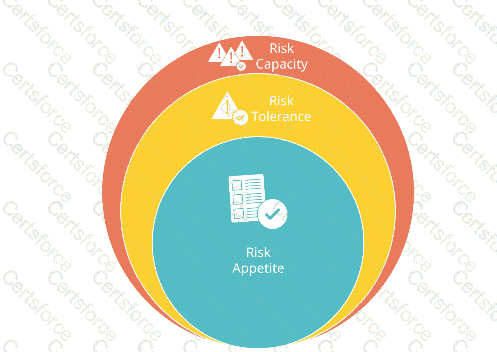
A project manager should communicate to stakeholders about resolved project issues by updating the:
project records
project reports
stakeholder notifications
stakeholder register
According to the PMBOK® Guide (Project Management Body of Knowledge), specifically within the Project Communications Management knowledge area and the Manage Communications process:
Project Records (Option A): These include correspondence, memos, meeting minutes, and other documents that describe the project. When project issues are resolved, the documentation of these resolutions becomes part of the permanent project records. According to PMI, the " Manage Communications " process results in updates to project records, which are then used to keep stakeholders informed of the project ' s status and resolved issues.
Project Reports (Option B): While project reports (like status reports or progress reports) are used to deliver information, they are a specific type of communication output. The broader category for the storage and archival of these resolved issues for stakeholder reference is project records.
Stakeholder Notifications (Option C): This is an output of the Manage Communications process that refers to the act of informing stakeholders about resolved issues, approved changes, or project status. However, the question asks where the information is updated/stored to facilitate this communication, which points to the records.
Stakeholder Register (Option D): This is a project document that contains information about project stakeholders, including their identification, assessment, and classification. It is not used to document or communicate the resolution of specific project issues.
In the PMI framework, maintaining accurate and thorough project records ensures that there is a " single source of truth " for all stakeholders regarding what issues were encountered, how they were analyzed, and how they were ultimately resolved.
A project is just beginning, and management creates a long list of potential stakeholders. Which statement about identifying and engaging stakeholders is correct?
The project manager should identify and deal with stakeholders only during the execution phase.
Stakeholder satisfaction should be identified immediately and managed as a project objective.
The project manager should focus on project objectives and deal with stakeholders as a secondary priority.
Stakeholder satisfaction is the most important goal, and project objectives should be considered a secondary priority.
According to the PMBOK® Guide (6th and 7th Editions) and the Standard for Project Management, stakeholder engagement is a critical success factor that begins at the very start of the project. The process of Identify Stakeholders occurs in the Initiating Process Group, often concurrently with the development of the Project Charter.
The rationale for this answer is supported by several PMI principles:
Proactive Engagement: Stakeholders should be identified and engaged as early as possible to ensure their requirements, expectations, and influence are understood before major decisions are finalized.
Stakeholder Satisfaction as an Objective: Modern project management defines success not just by the " Iron Triangle " (Scope, Schedule, Budget), but by the satisfaction of key stakeholders. Therefore, managing their needs and expectations is a primary project objective.
Continuous Process: While identification starts early, the Identify Stakeholders and Monitor Stakeholder Engagement processes are iterative and continue throughout the entire project life cycle.
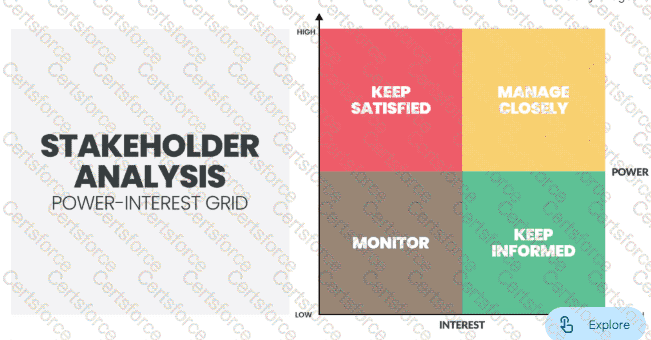
Analysis of Distractors:
A (Execution Phase Only): This is incorrect. Waiting until the execution phase to deal with stakeholders is a leading cause of project failure, as key requirements or risks held by those stakeholders would be missed during planning.
C (Secondary Priority): This is incorrect. Project objectives are often defined by the stakeholders. Ignoring stakeholders or making them a secondary priority leads to " scope creep " or the delivery of a product that does not meet the organization ' s actual needs.
D (Objectives as Secondary): This is incorrect because it represents an extreme imbalance. While stakeholder satisfaction is vital, it cannot be achieved by ignoring the project objectives (scope, quality, etc.). The project manager must balance these competing constraints; one does not make the other " secondary. "
What key component of the project charter defines the conditions for dosing a project phase?
Purpose
Approval requirements
Exit criteria
High-level requirements
According to the PMBOK® Guide, specifically within the Develop Project Charter process, the project charter documents high-level information that authorizes the project manager to begin work. One of the most critical elements for governance is the definition of " Exit Criteria. "
Defining Exit Criteria: These are the specific conditions or standards that must be met to officially close a project or, more commonly, to complete a specific Project Phase. Exit criteria ensure that all deliverables have been met, all activities are finished, and the project is ready to move to the next stage or final closure.
Purpose of Phase Gates: Exit criteria are often evaluated at " Phase Gates " (also known as kill points or stage gates). Without clearly defined exit criteria in the project charter, it becomes difficult to determine whether a phase has been successfully completed, leading to " project drift " or incomplete transitions.
Analysis of other options:
Purpose (Option A): The purpose (or Business Case) explains why the project was initiated and the strategic goals it intends to achieve. It does not provide the technical or procedural conditions for closing a phase.
Approval requirements (Option B): These define who has the authority to sign off on the project and what constitutes project success. While related, approval requirements focus on the " who, " whereas exit criteria focus on the " what " and the specific conditions of the work itself.
High-level requirements (Option D): These describe the characteristics of the product, service, or result that the project must deliver. While the fulfillment of requirements is often part of the exit criteria, requirements alone do not define the procedural steps or conditions for phase transition.
Per PMI standards, establishing Exit criteria early in the project charter provides the project manager and the sponsor with a objective framework for measuring progress and ensuring the project remains on track through each phase of its lifecycle.
