
A software development team is pulling work from its backlog to be performed immediately as they become available. What emerging practice for project scheduling is the team using?
Iterative
On-demand
Interactive
Quality
According to the PMBOK® Guide and the Agile Practice Guide, On-demand scheduling is an emerging practice used in adaptive environments, particularly those utilizing Kanban systems.
On-Demand Scheduling: This approach does not rely on a pre-defined schedule or " sprints " of a fixed duration. Instead, it pulls work from a backlog or a queue of outstanding tasks as resources become available. This is often based on Theory of Constraints and pull-based scheduling concepts to limit Work in Progress (WIP). The goal is to balance the demand for work against the team ' s delivery capacity.
Context: This is highly common in maintenance or operational environments where work is not easily grouped into iterations but must be addressed as it arises (e.g., bug fixes, support tickets, or continuous flow manufacturing).
Analysis of other options:
Iterative (Option A): Iterative scheduling (like Scrum) involves time-boxed periods (sprints) where a set amount of work is committed to and performed. It is " push-to-iteration " rather than a continuous " pull-as-available. "
Interactive (Option C): This is not a recognized PMI scheduling term. Interaction refers to communication methods or stakeholder engagement styles.
Quality (Option D): Quality is a project constraint and a knowledge area, but it is not a scheduling methodology.
Per PMI standards, on-demand scheduling is particularly effective when the work is highly variable and the team seeks to optimize the flow of value by reducing lead times and eliminating idle time.
In an agile or adaptive environment. when should risk be monitored and prioritized?
Only during the initiation and Closing phases
During the initiation and Planning phases
During each iteration as the project progresses
Throughout the Planning process group and retrospective meeting
The Perform Integrated Change Control process occurs in which Process Group?
Initiating
Executing
Monitoring and Controlling
Planning
According to the PMBOK® Guide and the Standard for Project Management, the Perform Integrated Change Control process is situated within the Monitoring and Controlling Process Group.
This process is a key component of Project Integration Management. It is the process of reviewing all change requests; approving changes and managing changes to deliverables, project documents, and the project management plan; and communicating the decisions.
Key characteristics of this process within the Monitoring and Controlling group include:
Continuity: It is conducted from project inception through completion.
Accountability: It ensures that only documented and approved changes are implemented.
Integration: It considers the impact of a change in one area (e.g., scope) on all other project constraints (e.g., schedule, cost, quality, and risk).
The other options are incorrect based on the PMI Process Group and Knowledge Area Mapping:
Initiating: This group only contains " Develop Project Charter " and " Identify Stakeholders. "
Planning: This group focuses on defining the project objective and the course of action needed to attain those objectives (e.g., Develop Project Management Plan).
Executing: This group involves the processes performed to complete the work defined in the project management plan. While changes are often identified during execution, they are processed and controlled in the Monitoring and Controlling group.
As per the PMI Lexicon of Project Management Terms, the Perform Integrated Change Control process is vital because it allows for a disciplined assessment of change, ensuring that the project remains aligned with its business objectives and baselines.
Development of the benefits management plan occurs in which stage of the project life cycle?
Starting the project
Organizing the project
Completing pre-project work
Executing the product
According to the PMBOK® Guide, the Project Benefits Management Plan is a key business document that is developed before the project is officially initiated. It describes how and when the benefits of the project will be delivered and establishes the mechanisms to measure those benefits.
Pre-Project Work: The Benefits Management Plan, along with the Project Business Case, are considered " Business Documents. " These are generally created during the pre-project phase (often by a business analyst and project sponsor) to justify the investment and provide a basis for the Project Charter.
Purpose: It outlines the target benefits (e.g., increased market share, improved efficiency), the alignment with strategic goals, the timeframe for realizing benefits (short-term vs. long-term), and the " benefit owner " who will be responsible for monitoring them after the project is closed.
Ownership: While the project manager may provide input or help maintain the document, the ultimate responsibility for the benefits management plan often lies with the organization or the sponsor, as many benefits are realized long after the project ' s physical deliverables are completed.
Why other options are incorrect:
Option A: Starting the project: This stage involves the creation of the Project Charter. By the time you are starting the project, the Benefits Management Plan should already exist as an input to help define the project ' s success criteria.
Option B: Organizing the project: This refers to the Planning phase. During this stage, the project manager develops the Project Management Plan. The Benefits Management Plan is an input to this process, not an output developed during it.
Option C: Executing the product: Execution focuses on creating the project ' s deliverables. While the project manager monitors the project to ensure it remains aligned with the intended benefits, the development of the plan occurred much earlier.
What can a requirements traceability matrix enable regardless of the project methodology being used?
Creation of a solid business case
Investigation of the viability of a new product
Identification of missing and superfluous requirements
Evaluation of solution and system performance
The Requirements Traceability Matrix (RTM) is a powerful tool used in both predictive (Waterfall) and adaptive (Agile) methodologies. Its primary function is to provide a link between the requirements and the deliverables, ensuring that the " Business Value " promised is the " Business Value " delivered.
Why Choice C is correct:
Identifying Missing Requirements: By tracing a high-level business need down to a specific technical requirement and then to a test case, the project manager can see if any " links " are broken. If a business need has no corresponding requirement or test case, it is a missing requirement.
Identifying Superfluous Requirements: Conversely, if there is a technical feature or a piece of code that cannot be traced back to an approved business objective, it is considered superfluous (also known as " Gold Plating " ). This helps the project manager remove unnecessary work that does not add value.
Methodology Neutral: Whether you are using a Product Backlog in Agile or a formal Requirements Document in Waterfall, the logic of " tracing " from origin to execution remains the same to ensure scope integrity.
Analysis of other options:
A (Creation of a solid business case): The Business Case is a pre-project document that justifies the investment. The RTM is created after the project has started and the business case has already been approved.
B (Investigation of the viability of a new product): This is typically done during the Feasibility Study or the Initiating Phase. The RTM is an execution and monitoring tool used once the requirements have already been defined to some degree.
D (Evaluation of solution and system performance): While the RTM tracks if a requirement was met, it doesn ' t typically measure how well the system performs (e.g., speed, stress testing, or latency). Those metrics are found in Quality Control Reports or Performance Testing documentation.
Key Concept: The Project Management Institute (PMI) emphasizes that the Requirements Traceability Matrix (Choice C) is the ultimate " audit trail " for project scope. It ensures that the project team builds exactly what was requested—preventing both omissions (missing requirements) and unauthorized additions (superfluous requirements)—thereby maintaining the integrity of the Scope Baseline.
How is the Project Scope Management process different in agile and adaptive projects then in traditional projects?
Less time spent on defining scope early on
More time spent on defining scope early on
Less time spent on scope management process
Project scope management is the same in all projects
According to the PMBOK® Guide and the Agile Practice Guide, the primary difference in scope management between these methodologies lies in the timing and the level of detail of scope definition.
Traditional (Predictive) Projects: These projects aim to define the entire scope as early as possible (during the planning phase) to create a fixed Scope Baseline. The goal is to minimize changes once execution begins. This requires a significant upfront investment of time in Requirement Collection and Scope Definition.
Agile/Adaptive Projects: These projects recognize that requirements are likely to evolve or that the final solution is not fully understood at the start. Therefore, less time is spent on defining scope early on. Instead, the scope is refined incrementally throughout the project life cycle.
Backlog Management: In agile, the scope is maintained in a Product Backlog. High-level requirements are identified at the start, but detailed specifications are only developed " just-in-time " for the iteration in which they will be built. This is often referred to as Rolling Wave Planning.
Evolutionary Discovery: This approach allows the project team and stakeholders to spend their time refining scope based on actual prototypes and feedback rather than hypothetical requirements at the project ' s inception.
Analysis of Other Options:
B. More time spent on defining scope early on: This is characteristic of traditional/waterfall projects, where " Scope Creep " is avoided by attempting to lock down all details at the beginning.
C. Less time spent on scope management process: This is incorrect. The total time spent on scope management may be the same or even more in agile, but it is distributed throughout the project (during backlog grooming, sprint planning, and reviews) rather than being front-loaded.
D. Project scope management is the same in all projects: This is fundamentally incorrect. The PMBOK® Guide explicitly provides " Tailoring Considerations " for different environments, highlighting that scope management must adapt to the project ' s level of uncertainty.
In which process might a project manager use risk reassessment as a tool and technique?
Perform Qualitative Risk Analysis
Monitor and Control Risk
Monitor and Control Project Work
Plan Risk Responses
According to the PMBOK® Guide, Risk Reassessment is a primary Tool and Technique used in the Monitor Risks process (formerly known as Monitor and Control Risk).
Definition: Risk reassessment is the identification of new risks, the reassessment of current risks, and the closing of risks that are outdated. Project risk reassessments should be scheduled regularly.
Application: Because projects are dynamic, the relevance and priority of risks change over time. The project manager and the team must periodically review the risk register to:
Determine if the probability or impact of existing risks has changed.
Identify new risks that have emerged due to project progression or environmental changes.
Remove risks that are no longer a threat (e.g., a risk associated with a phase that has been completed).
Frequency: This is often performed during project status meetings or dedicated risk review meetings.
Comparison with Other Options:
Perform Qualitative Risk Analysis (A): This is where the initial or first-time prioritization of identified risks occurs using probability and impact.
Monitor and Control Project Work (C): This is a high-level integration process. While it looks at overall project health, specific risk management tools like reassessment belong to the Risk Management knowledge area.
Plan Risk Responses (D): This process focuses on developing options and actions to enhance opportunities and reduce threats for the risks already assessed.
A project manager needs to develop a product roadmap. Which artifact category is a product roadmap?
Report artifact
Strategic artifact
Baseline artifact
Plan artifact
A product roadmap is a strategic artifact because it communicates direction, sequencing, intent, and high-level alignment for product development. It is not primarily a report artifact, because reports describe status, performance, issues, or forecasts after work is underway. It is not a baseline artifact, because a baseline is an approved reference point used for variance comparison and controlled through formal change control. It is also not merely a plan artifact, because a roadmap sits above detailed planning and links product evolution to business goals, milestones, releases, and decision points. PMI’s terminology defines a roadmap as “a high-level timeline” showing items such as milestones, significant events, reviews, and decision points, which fits strategic communication rather than execution-level planning. The CAPM-aligned course structure also places project fundamentals, development approaches, and delivery planning in a broader context of predictive, agile, and hybrid project execution. References/topics: Common Project Management Artifacts, Strategy Artifacts, Product Roadmap, Project Management Fundamentals and Core Concepts.
Which of the following is an example of an internal factor that influences the outcome of the project?
Legal restrictions
Financial considerations
Commercial database
Geographic distribution of facilities
According to the PMBOK® Guide, factors that influence a project are categorized as Enterprise Environmental Factors (EEFs). These are conditions, not under the immediate control of the project team, that can be either Internal or External to the organization.
Internal EEFs: These originate from within the organization itself. The Geographic distribution of facilities and resources is a prime example. If a project team is spread across different time zones or physical locations, it significantly impacts how the project manager plans for communications, resource allocation, and team development.
Other Internal Factors: These include organizational culture, structure, and governance; infrastructure (existing facilities and equipment); resource availability; and employee capability.
Analysis of other options:
A. Legal restrictions: These are External EEFs. They are imposed by government or regulatory bodies outside the organization and are not within the company ' s internal control.
B. Financial considerations: In the context of PMI ' s definitions, general " financial considerations " usually refer to External EEFs like currency exchange rates, interest rates, or inflation, which are dictated by the global or regional economy.
C. Commercial database: This is an External EEF. It refers to data that an organization must purchase from an external provider, such as benchmarking data, standardized cost-estimating data, or industry study results. (Note: A company ' s own internal database would be an OPA, but a commercial one is external).
Per PMI standards, understanding the Geographic distribution of facilities is essential for tailoring the project ' s infrastructure and communication management plans to ensure the internal environment supports the project ' s goals.
The project manager is working in the processes of Project Resource Management. Which process is the project manager developing if they are using parametric estimation?
Plan Resource Management
Estimate Activity Resources Communications
Estimate Costs
Acquire Resources
According to the PMBOK® Guide (6th Edition), the Estimate Activity Resources process is the process of estimating the team resources and the type and quantities of materials, equipment, and supplies necessary to perform project work.
Parametric Estimation is a specific Tool and Technique used in this process. It involves using an algorithm or a statistical relationship between historical data and other variables (e.g., square footage in construction, lines of code in software development) to calculate resource quantities.
Why Parametric Estimation is used here:
Scalability: If you know it takes one technician 2 hours to install one workstation, you can use that parameter to estimate the resources needed for 100 workstations.
Accuracy: When based on high-quality historical data, it provides a more accurate resource requirement than simple analogies.
Analysis of Distractors:
A (Plan Resource Management): This process is focused on establishing the approach and physical resource management strategies (the " how-to " document). It uses expert judgment and meetings rather than mathematical resource modeling like parametric estimation.
C (Estimate Costs): While Estimate Costs does use parametric estimation, the question specifically asks which process the project manager is developing within Project Resource Management. Estimate Costs belongs to the Project Cost Management knowledge area.
D (Acquire Resources): This is an executing process focused on obtaining the team members, facilities, equipment, and materials. The estimation should have been completed prior to this stage; here, the project manager uses negotiation, pre-assignment, and virtual team tools.
Activity resource requirements and the resource breakdown structure (RBS) are outputs of which Project Time Management process?
Control Schedule
Define Activities
Develop Schedule
Estimate Activity Resources
According to the PMBOK® Guide, the process of Estimate Activity Resources is responsible for identifying the types and quantities of resources (people, equipment, raw materials, etc.) required to perform the work.
Activity Resource Requirements: This primary output identifies the types and quantities of resources required for each work package or activity in a work package. These requirements are then aggregated to determine the total resources needed for the project.
Resource Breakdown Structure (RBS): This is a hierarchical representation of resources by category and type. It is useful for organizing and reporting project schedule data and resource utilization information. For example, categories might include Labor, Material, Equipment, and Supplies, with specific types listed under each category.
Analysis of other choices:
Choice A (Control Schedule): This is a monitoring and controlling process focused on managing changes to the schedule baseline; its outputs include work performance information and change requests.
Choice B (Define Activities): This process breaks down work packages into specific activities; its primary outputs are the activity list, activity attributes, and milestone list.
Choice C (Develop Schedule): This process analyzes activity sequences, durations, resource requirements, and schedule constraints to create the project schedule model. Its primary outputs are the schedule baseline and project schedule.
In the PMBOK® Guide (Sixth Edition and earlier), this process was part of the Project Schedule Management (formerly Project Time Management) knowledge area, though in the most recent standards, resource estimation is primarily housed within Project Resource Management. However, for certification purposes, these specific outputs are always tied to the estimation of resources.
When is a Salience Model used?
In a work breakdown structure (WBS)
During quality assurance
In stakeholder analysis
During quality control (QC)
According to the PMBOK® Guide, specifically within the Identify Stakeholders process, the Salience Model is a classification tool used during Stakeholder Analysis.
Definition and Purpose: The Salience Model is used to describe classes of stakeholders based on their assessments of three specific attributes:
Power: The level of authority or ability to influence the project outcome.
Urgency: The need for immediate attention or the time-sensitivity of the stakeholder ' s claim on the project.
Legitimacy: The perceived validity or appropriateness of the stakeholder’s involvement.
Application: This model is particularly useful in large, complex projects or where there are a vast number of stakeholders and complex networks of relationships. By mapping these three attributes, the project manager can identify which stakeholders have the highest priority ( " Definitive Stakeholders " ) and require the most engagement.
Classification: Stakeholders are grouped into categories such as Latent, Expectant, or Definitive, depending on which of the three attributes they possess. This helps the project manager tailor the Stakeholder Engagement Plan effectively.
Comparison with other options:
A. In a work breakdown structure (WBS): The WBS is a tool for scope management used to decompose project deliverables into smaller, manageable work packages. It does not involve stakeholder classification.
B. During quality assurance: Quality assurance (now called Manage Quality) is focused on the project ' s processes and ensuring that the project will satisfy the quality standards. It does not utilize stakeholder salience modeling.
D. During quality control (QC): Control Quality is the process of monitoring and recording results of executing the quality activities to assess performance. It is an inspection-driven process, not a stakeholder analysis process.
Who is responsible for initiating a project?
Project sponsor
Project manager
Program manager
Project management office (PMO)
According to the PMBOK® Guide, the Project Sponsor is the person or group who provides resources and support for the project and is accountable for enabling success.
Role in Initiation: The process of Develop Project Charter is the official start of a project. While the Project Manager often assists in drafting the charter, it is the Sponsor who is responsible for formally initiating the project. They do this by signing the charter, which provides the project manager with the authority to apply organizational resources to project activities.
Business Justification: The sponsor is typically the one who ensures the project is aligned with the organization ' s strategic goals and remains " sold " on the business case throughout the project ' s life cycle.
Authority: Because the sponsor is usually a high-level executive or a representative of the customer/organization, they have the financial and political authority to authorize the project ' s existence.
Analysis of Other Options:
B. Project manager: The PM is often assigned during the initiation phase (ideally during the creation of the charter), but they do not have the authority to " initiate " or " authorize " the project themselves. Their role is to lead the team and manage the work once authorized.
C. Program manager: A program manager manages a group of related projects. While they may oversee multiple project managers, the specific accountability for the authorization and funding of an individual project lies with the Sponsor.
D. Project management office (PMO): A PMO provides standardizing and support functions. While a PMO might facilitate the selection process or provide the template for the charter, the " responsibility " for triggering the project ' s start rests with the Sponsor.
Which of the following are an enterprise environmental factor that can influence the Identify Risks process?
Work performance reports
Assumptions logs
Network diagrams
Academic studies
According to the PMBOK® Guide, the Identify Risks process is the process of determining which risks may affect the project and documenting their characteristics. This process is influenced by various external and internal factors known as Enterprise Environmental Factors (EEFs).
Academic Studies: These are considered an external EEF. Industry studies, benchmarking data, and academic research provide a broader context of potential risks that have been identified in similar projects or industries. These studies can alert a project manager to " known-unknowns " that may not be immediately obvious within their specific organizational silo.
Other EEFs for Identify Risks:
Published Materials: Commercial databases, industry checklists, and benchmarking.
Marketplace Conditions: The economic environment or competitor actions.
Organizational Culture: How risk is perceived and tolerated within the company.
Risk Attitudes: The risk appetite and thresholds of stakeholders.
Analysis of Other Options:
A. Work performance reports: These are Project Documents (specifically, an output of Monitor and Control Project Work). While they provide data for risk identification, they are not categorized as " Environmental Factors. "
B. Assumptions logs: This is a Project Document that is created during initiation and updated throughout the project. It is a key input to the Identify Risks process, but it is a document created by the project, not an environmental factor surrounding it.
C. Network diagrams: These are Project Schedule Documents produced during the Sequence Activities process. They help identify risks related to path convergence or dependency logic, but they are internal project artifacts.
The Monitoring and Controlling Process Group includes processes that:
Establish the scope, objectives, and course of action of a project,
Define a new project or a new phase of an existing project.
Track, review, and regulate the progress and performance of a project.
Complete the work defined in the project management plan.
In accordance with the PMBOK® Guide, the Monitoring and Controlling Process Group consists of those processes required to track, review, and regulate the progress and performance of the project; identify any areas in which changes to the plan are required; and initiate the corresponding changes.
The key benefit of this process group is that project performance is measured and analyzed at regular intervals, appropriate events, or exception conditions to identify variances from the project management plan. It involves:
Comparing actual performance against the project management plan.
Assessing performance to determine whether any corrective or preventive actions are indicated.
Identifying new risks and analyzing, tracking, and monitoring existing risks.
Maintaining an accurate, timely information base concerning the project’s product(s) and their associated documentation through completion.
Providing forecasts to update current cost and current schedule information.
Monitoring implementation of approved changes as they occur.
Analysis of Distractors:
A. Establish the scope, objectives, and course of action of a project: This defines the Planning Process Group. Planning is about establishing the " road map, " whereas Monitoring and Controlling is about ensuring the team stays on that map.
B. Define a new project or a new phase of an existing project: This defines the Initiating Process Group, which involves obtaining authorization to start the project or phase.
D. Complete the work defined in the project management plan: This defines the Executing Process Group. Execution is the act of performing the work, while Monitoring and Controlling is the act of overseeing that performance to ensure it meets the defined standards and baselines.
What is the equation to calculate cost variance (CV)?
CV = EV / BAC
CV = EV - AC
CV = EV - BAC
CV = EV / AC
According to the PMBOK® Guide, specifically the Control Costs process, Cost Variance (CV) is the amount of budget deficit or surplus at a given point in time, expressed as the difference between earned value and the actual cost.
The Formula:
$$CV = EV - AC$$
(Where $EV$ is Earned Value and $AC$ is Actual Cost).
The Components:
Earned Value ($EV$): The value of the work actually performed to date.
Actual Cost ($AC$): The total cost actually incurred and recorded in accomplishing the work performed.
Interpreting the Result:
Positive CV ($ > 0$): The project is under budget. You have spent less than the value of the work you have accomplished.
Negative CV ($ < 0$): The project is over budget. You have spent more than the value of the work you have accomplished.
Zero CV ($= 0$): The project is exactly on budget.
Analysis of other options:
Option A: $EV / BAC$ (Budget at Completion) is not a standard performance index, though $EV / BAC$ is sometimes used to calculate the " percent complete " of the total project budget.
Option C: $EV - BAC$ is not a standard formula. Variance at Completion (VAC) is $BAC - EAC$, which measures the projected budget performance at the end of the project.
Option D: $EV / AC$ is the formula for the Cost Performance Index (CPI). While related to CV, it is an index (ratio) used to measure the cost efficiency of resources, not the variance (absolute currency value).
Per PMI standards, the Cost Variance (CV) is a critical metric for tracking the financial health of a project, and it is always calculated by subtracting the Actual Cost from the Earned Value.
Payback period, return on investment, internal rate of return, discounted cash flow, and net present value are all examples of:
Expert judgment.
Analytical techniques.
Earned value management.
Group decision-making techniques.
According to the PMBOK® Guide and the Standard for Project Management, financial metrics such as Payback Period, Return on Investment (ROI), Internal Rate of Return (IRR), Discounted Cash Flow (DCF), and Net Present Value (NPV) are categorized as Analytical techniques.
As per PMI standards, these techniques are primarily used during the Initiating and Planning phases—specifically within the Develop Project Charter and Plan Cost Management processes—to evaluate the financial viability of a project. They allow the organization to compare different project proposals and select the one that aligns best with strategic goals and financial constraints.
Net Present Value (NPV): Calculates the present value of future cash flows minus the initial investment. A positive NPV generally indicates a project is worth pursuing.
Internal Rate of Return (IRR): The interest rate at which the NPV of all cash flows from a project equals zero.
Payback Period: The length of time required to recover the cost of an investment.
Return on Investment (ROI): A performance measure used to evaluate the efficiency of an investment.
The other options are incorrect based on the following PMI definitions:
Expert judgment: This refers to the insight provided based on expertise in an application area, Knowledge Area, or industry. While an expert might perform these calculations, the formulas themselves are analytical tools.
Earned Value Management (EVM): This is a methodology used in Monitoring and Controlling to measure project performance and progress. It uses metrics like Schedule Variance (SV) and Cost Performance Index (CPI), rather than pre-project selection metrics like NPV or IRR.
Group decision-making techniques: These are used to reach a consensus or a decision among stakeholders (e.g., Unanimity, Majority). While a group might use analytical results to make a decision, the metrics themselves are not decision-making techniques.
As per the PMI Lexicon of Project Management Terms, analytical techniques provide the objective data required for " Data-Driven Decision Making, " ensuring that the project ' s economic feasibility is verified before significant resources are committed.
The project manager at an organization has just realized that some of the engineering staff has been allocated to project Y and will not be available to finish task X. The project manager has also discovered that at the current pace, it will not be possible to complete the project on time. Due to cost constraints, hiring more work force is not a viable option. Which tools are at the manager ' s disposal?
Resource leveling and fast tracking
Fast tracking and crashing
Crashing and applying leads and lags
Scheduling tools and applying leads and lags
According to the PMBOK® Guide, specifically within the Develop Schedule and Control Schedule processes, the project manager must use schedule compression and resource optimization techniques when faced with resource gaps and delays.
Resource Leveling: This is a resource optimization technique used when shared or critical required resources are available only at certain times or in limited quantities, or have been over-allocated (as seen with the engineering staff moved to Project Y).
Effect: It adjusts the start and finish dates based on resource constraints. While it balances the demand for resources, it often causes the original critical path to change, usually resulting in a delayed project finish date.
Fast Tracking: This is a schedule compression technique in which activities or phases normally done in sequence are performed in parallel for at least a portion of their duration.
Effect: Because the project manager cannot hire more staff (Crashing is not viable due to cost constraints), they must find ways to overlap existing work. Fast tracking does not increase costs but does increase risk and can lead to rework.
Comparison with Other Options:
Fast tracking and crashing (B): While these are both schedule compression techniques, the prompt explicitly states that hiring more workforce is not a viable option. Crashing almost always results in increased costs (overtime, extra resources), making this choice incorrect.
Crashing and applying leads and lags (C): Again, Crashing is ruled out by cost constraints. While leads and lags are used in sequencing, they do not address the resource over-allocation issue described.
Scheduling tools and applying leads and lags (D): These are general components of schedule management but do not provide a specific solution for the dual problem of resource unavailability and a failing timeline.
Whose approval may be required for change requests after change control board (CCB) approval?
Functional managers
Business partners
Customers or sponsors
Subject matter experts
According to the PMBOK® Guide, specifically within the Perform Integrated Change Control process, the Change Control Board (CCB) is a formally chartered group responsible for reviewing, evaluating, approving, delaying, or rejecting changes to the project.
Hierarchy of Approval: While the CCB has the authority to approve or reject changes within the scope of the project ' s baselines, certain changes may exceed the CCB ' s authority or have significant impacts on the project ' s strategic goals, funding, or contractual obligations.
Final Authorization: In many organizational frameworks, after the CCB provides its technical and impact-based approval, the customer (especially in external projects) or the sponsor (the person providing the financial resources) must provide the final sign-off. This is particularly true if the change requires additional funding from management reserves or alters the high-level requirements defined in the Project Charter.
Communication of Results: Once all required approvals are obtained, the Change Log is updated, and the project manager ensures that the changes are incorporated into the Project Management Plan and communicated to all stakeholders.
Comparison with other options:
A. Functional managers: While they may be consulted during the impact analysis (especially regarding resource availability), they do not typically sit above the CCB or the Sponsor for final project-level change approval.
B. Business partners: While they are stakeholders, they generally do not have formal approval authority over project change requests unless specifically stated in a joint venture agreement.
D. Subject matter experts (SMEs): SMEs provide the technical expertise needed to evaluate the change request, but they do not have the formal authority to approve it.
If the estimate at completion (EAC) is 25, and the budget at completion (BAC) is 17, what is the variance at completion (VAC)?
-8
425
1.4
8
In Earned Value Management (EVM), as defined in the PMBOK® Guide, the Variance at Completion (VAC) is a projection of the amount of budget deficit or surplus at the end of the project. It is expressed as the difference between the original budget and the current forecasted total cost.
The Formula:
$$VAC = BAC - EAC$$
Where:
$BAC$ (Budget at Completion) is the total planned budget for the project.
$EAC$ (Estimate at Completion) is the expected total cost of completing all work.
Calculation for this Question:
Given $BAC = 17$ and $EAC = 25$:
$$VAC = 17 - 25 = -8$$
Interpretation:
Negative VAC: Indicates a projected cost overrun. In this case, the project is expected to finish $8$ units over the original budget.
Positive VAC: Indicates a projected cost under-run (surplus).
Zero VAC: Indicates the project is expected to finish exactly on budget.
Analysis of other options:
B (425): This is the result of multiplying $25 \times 17$. Multiplication is not used in any standard EVM variance or index formula.
C (1.4): This is the result of dividing $25 / 17$ (or approximately $EAC / BAC$). While ratios like the Cost Performance Index (CPI) are used in EVM, $1.4$ does not represent the variance requested.
D (8): This is the absolute difference ($EAC - BAC$). While the magnitude is correct, the sign is vital in project management. A positive $8$ would incorrectly suggest the project is under budget, whereas the project is actually over budget.
Key Concept:
The Project Management Institute (PMI) emphasizes that Variance at Completion (VAC) (Choice A) is a critical forecasting tool for stakeholders. It allows the project manager to communicate the expected financial health of the project at its conclusion, enabling the organization to arrange for additional funding or adjust the scope to bring the project back toward its original financial goals.
A project lifecycle is defined as:
a collection of generally sequential and sometimes overlapping project phases.
a process required to ensure that the project includes all the work required, and only the work required, to complete the project successfully.
a recognized standard for the project management profession.
the application of knowledge, skills, tools, and techniques to project activities to meet the project requirements.
According to the PMBOK® Guide, the Project Life Cycle is the series of phases that a project passes through from its start to its completion.
Structure: It provides the basic framework for managing the project. These phases are generally sequential, meaning one starts after the previous one finishes, but they can be overlapping (a technique known as " fast-tracking " ) to compress the project schedule.
Phase Characteristics: Each phase is a collection of logically related project activities that culminates in the completion of one or more deliverables. Common phase names include Feasibility, Design, Build, Test, and Deploy.
Consistency: While every project has a start and an end, the specific life cycle used (Predictive, Iterative, Incremental, or Agile) will vary depending on the industry, the organization, and the nature of the project itself.
Analysis of Other Options:
B. a process required to ensure that the project includes all the work required...: This is the formal definition of Project Scope Management, not the project life cycle.
C. a recognized standard for the project management profession: This describes the PMBOK® Guide itself or other PMI standards, which document the " generally recognized " good practices in the field.
D. the application of knowledge, skills, tools, and techniques...: This is the formal definition of Project Management as a discipline.
What is the function of a Project Management Office (PMO)?
To focus on the coordinated planning, prioritization, and execution of projects and subprojects that are tied to the parent organizations or the client ' s overall business objectives.
To coordinate and manage the procurement of projects relevant to the parent organization ' s business objectives and to administer the project charters accordingly.
To administer performance reviews for the project manager and the project team members and to handle any personnel and payroll issues.
To focus on the specified project objectives and to manage the scope, schedule, cost, and quality of the work packages.
According to the PMBOK® Guide, a Project Management Office (PMO) is an organizational structure that standardizes the project-related governance processes and facilitates the sharing of resources, methodologies, tools, and techniques.
Strategic Alignment: The primary function of a PMO is to ensure that projects are not just completed, but that they are the right projects to meet the organization ' s strategic goals. This involves high-level prioritization and ensuring that the portfolio of projects aligns with business objectives.
Types of PMOs:
Supportive: Provides templates, best practices, and training (Low control).
Controlling: Provides support and requires compliance with frameworks and tools (Moderate control).
Directive: Actually manages the projects; project managers report directly to the PMO (High control).
Coordinated Management: The PMO facilitates the " big picture " view of resources. For example, if two projects need the same specialized engineer, the PMO coordinates that resource to prevent bottlenecks.
Knowledge Management: PMOs act as a central repository for " Lessons Learned, " ensuring that mistakes made on one project are not repeated on others within the organization.
Comparison with other options:
B. To coordinate and manage the procurement...: While a PMO might provide procurement templates or oversight, the actual administration of procurement and charters is usually handled by the Project Manager or the Legal/Procurement department.
C. To administer performance reviews...: This describes a Functional Manager or HR Department role. While a Directive PMO might review a PM, a PMO is not typically a payroll or general personnel office.
D. To focus on the specified project objectives...: This is the primary function of a Project Manager. The PMO focuses on the system of projects and the standardization of management, whereas the PM focuses on the specific scope, schedule, and cost of their assigned project.
Which of the following strategic considerations often results in project authorization?
Customer requests and/or issue resolution
Stakeholder expectations and/or strategic opportunity (business need)
Technological advancement and/or senior executive request
Market demand and/or legal requirements
According to the PMBOK® Guide, specifically within the Develop Project Charter process, projects are authorized by someone external to the project, such as a sponsor, program, or PMO. This authorization is typically the result of one or more specific strategic considerations (often called business cases).
The PMI standard lists several key factors that lead to the creation of a project:
Market Demand: For example, a car manufacturer authorizing a project to build more fuel-efficient cars in response to gasoline shortages.
Legal Requirements: A new regulation or law that requires an organization to change its processes or products (e.g., new data privacy laws requiring a software update).
Organizational Need: To improve efficiency or address a specific internal requirement.
Customer Request: A project initiated specifically because a customer asked for a unique product or service.
Technological Advancement: High-tech companies often authorize projects to stay ahead of the competition with new innovations.
Social Need: Projects aimed at improving public health, education, or infrastructure.
Comparison with Other Options:
A. Customer requests and/or issue resolution: While customer requests are a valid reason, " issue resolution " is generally considered part of Operations or Control Quality/Direct and Manage Project Work rather than a high-level strategic reason for new project authorization.
B. Stakeholder expectations and/or strategic opportunity: While these are related to project success, " stakeholder expectations " is a very broad term. The PMBOK® specifically points to " Market Demand " and " Legal Requirements " as primary, concrete business case drivers.
C. Technological advancement and/or senior executive request: Technological advancement is a valid driver, but a " senior executive request " is the mechanism of authorization, not the strategic consideration behind why the project is being done.
Which document describes the necessary information to determine if a project is worth the required investment?
Cost baseline
Service level agreement
Memorandum of understanding
Business case
According to the PMBOK® Guide and the Standard for Project Management, the Business Case is the primary economic feasibility study used to establish the validity of the benefits of a selected component which is used as a basis for the authorization of further project management activities.
The Business Case describes the necessary information from a business standpoint to determine whether the expected outcomes of the project justify the required investment. It typically includes:
Business Need: The reason why the project is being undertaken (e.g., market demand, legal requirement, or organizational need).
Analysis of the Situation: Identifying organizational goals, strategies, and objectives.
Recommendation: A statement of the recommended solution.
Evaluation: A statement describing the plan for measuring the benefits the project will deliver.
The other options are incorrect based on the following PMI definitions:
Cost Baseline: This is the approved version of the time-phased project budget, excluding any management reserves, which can be changed only through formal change control procedures. It is used as a basis for comparison to actual results.
Service Level Agreement (SLA): A contract between a service provider and a customer that defines the level of service expected. It is a functional document rather than a feasibility document.
Memorandum of Understanding (MOU): This is an agreement between two or more parties outlined in a formal document. It is not a financial justification document for investment.
As per the PMI Standard for Portfolio Management, the Business Case is a key input to the Develop Project Charter process, ensuring that the project aligns with the organization ' s strategic goals and financial capabilities.
Prioritizing risks for further analysis or action by assessing and combining their probability of occurrence and impact takes place in which process?
Monitor and Control Risks
Plan Risk Management
Perform Qualitative Risk Analysis
Perform Quantitative Risk Analysis
According to the PMBOK® Guide, the process of prioritizing individual project risks for further analysis or action by assessing their probability of occurrence and impact, as well as other characteristics, is the definition of Perform Qualitative Risk Analysis.
Core Objective: The primary goal is to reduce the level of uncertainty and focus on high-priority risks. Since it is impossible to give every identified risk the same amount of attention, this process allows the Project Manager to categorize risks as high, medium, or low.
The Probability and Impact Matrix: This is the key tool used in this process. It combines the probability of a risk occurring with the impact it would have on project objectives (such as schedule, cost, or quality) to assign a risk score.
Subjective Nature: Unlike quantitative analysis, qualitative analysis is often performed quickly and cost-effectively. It relies on the perceptions of the project team and stakeholders to gauge the severity of risks.
Comparison with Other Options:
Monitor and Control Risks (A): This process involves tracking identified risks, monitoring residual risks, and identifying new risks. It does not perform the initial prioritization.
Plan Risk Management (B): This is the planning process that defines how risk management activities will be structured and performed; it provides the templates and scales for the matrix but does not assess the specific risks.
Perform Quantitative Risk Analysis (D): This process numerically analyzes the combined effect of identified individual project risks on overall project objectives. It usually follows qualitative analysis and provides a more rigorous, data-driven assessment of project-level risk.
A special type of bar chart used in sensitivity analysis for comparing the relative importance of the variables is called a:
triangular distribution
tornado diagram
beta distribution
fishbone diagram
According to the PMBOK® Guide (Project Management Body of Knowledge), specifically within the Project Risk Management knowledge area and the Perform Quantitative Risk Analysis process:
Tornado Diagram (Option B): This is a special type of bar chart used in sensitivity analysis to compare the relative importance and impact of variables that have a high degree of uncertainty. In this diagram, the Y-axis contains the various uncertain variables, and the X-axis represents the correlation to the project outcome (such as cost or schedule). The bars are ordered by the size of the impact, with the largest impact at the top and the smallest at the bottom, giving the chart a " tornado " shape. It allows the project manager to quickly identify which risks have the most significant potential effect on the project ' s success.
Triangular Distribution (Option A): This is a type of continuous probability distribution often used in three-point estimating (Optimistic, Pessimistic, and Most Likely). It is a mathematical model for uncertainty, not a chart used for comparing the relative importance of variables.
Beta Distribution (Option C): Similar to the triangular distribution, the Beta distribution (often associated with PERT) is a probability distribution used to provide a weighted average for activity duration or cost estimates. It is an input to analysis, not the output chart for sensitivity.
Fishbone Diagram (Option D): Also known as an Ishikawa or Cause-and-Effect diagram, this is a tool used in Project Quality Management to identify the root causes of a problem. It does not measure the relative sensitivity of variables to a project objective.
In the PMI framework, the Tornado Diagram is an essential tool for quantitative analysis because it visually communicates where the project team should focus their risk response efforts. By highlighting the variables with the greatest " swing " or impact, the Project Manager can prioritize management of the most volatile elements of the project plan.
Change requests, project management plan updates, project document updates, and organizational process assets updates are all outputs of which project management process?
Plan Risk Responses
Manage Stakeholder Expectations
Define Scope
Report Performance
According to the PMBOK® Guide, the specific combination of Change Requests, Project Management Plan Updates, Project Document Updates, and Organizational Process Assets (OPA) Updates is the standard output set for the Plan Risk Responses process.
Process Context: Plan Risk Responses is the process of developing options and actions to enhance opportunities and to reduce threats to project objectives.
Why these Outputs?:
Change Requests: Implementing a risk response (like changing a vendor or modifying a design) often requires a formal change to the project ' s scope, schedule, or budget.
Project Management Plan Updates: Strategies such as " Avoid " or " Mitigate " may require updates to the Schedule Management Plan, Cost Management Plan, or Quality Management Plan.
Project Document Updates: The Risk Register must be updated with the chosen response strategies, owners, and symptoms/warning signs (triggers). The Assumption Log and Technical Documentation may also be revised.
OPA Updates: Lessons learned and templates used during the risk response planning are captured for the organization’s future use.
Comparison with Other Options:
Manage Stakeholder Expectations (B): While this process (now part of Manage Stakeholder Engagement) produces some of these updates, it is primarily focused on the Issue Log and Change Requests. It does not typically drive the comprehensive set of plan updates associated with risk strategy.
Define Scope (C): This process primarily produces the Project Scope Statement and project document updates. It occurs very early in the planning phase before change requests are generally applicable.
Report Performance (D): This process (now Monitor and Control Project Work) focuses on Work Performance Reports. While it can trigger change requests, it is a monitoring process rather than the planning process that generates the specific risk-based updates listed.
A benefit of using virtual teams in the Acquire Project Team process is the reduction of the:
cultural differences of team members
possibility of communication misunderstandings
costs associated with travel
costs associated with technology
According to the PMBOK® Guide (Project Management Body of Knowledge), specifically within the Project Resource Management knowledge area and the Acquire Resources process (formerly Acquire Project Team):
Reduction of Travel Costs (Option C): This is a primary and direct benefit of utilizing virtual teams. By allowing team members to work from different geographical locations, the organization eliminates the need for expensive airfare, lodging, and per diem expenses that would otherwise be required to bring a specialized team together in one physical office. This also allows for the inclusion of experts who may not be willing or able to relocate.
Cultural Differences (Option A): Using virtual teams actually tends to increase the diversity and cultural differences within a team, as members are often located in different countries or regions. Managing these differences becomes a task for the Develop Team process.
Communication Misunderstandings (Option B): Virtual teams generally face a higher risk of communication misunderstandings due to the lack of face-to-face interaction, body language cues, and potential time zone or language barriers. This requires a robust Communications Management Plan to mitigate.
Technology Costs (Option D): Utilizing virtual teams typically increases costs associated with technology, as the organization must invest in collaboration tools, video conferencing software, and high-speed internet infrastructure to ensure the team can work together effectively.
In the PMI framework, the use of virtual teams is a tool and technique that provides the Project Manager with more flexibility in acquiring the " best " resources regardless of geography. While it significantly reduces travel costs, the Project Manager must be prepared to spend more time on team building and communication to ensure the remote environment does not hinder performance.
Co-location is a tool and technique of:
Develop Human Resource Plan.
Manage Project Team.
Develop Project Team.
Acquire Project Team.
According to the PMBOK® Guide, Co-location (also referred to as " tight matrix " ) is a specific tool and technique used in the Develop Project Team process.
The rationale is as follows:
Definition: Co-location involves placing many or all of the most active project team members in the same physical location to enhance their ability to perform as a team.
Purpose: The primary goal is to improve communication, reduce conflict, and help build a sense of community. By being in the same room, team members can utilize informal communication channels and develop stronger working relationships, which is the core objective of the " Develop Project Team " process.
Distinction from other processes:
Develop Human Resource Plan (Planning): Focuses on identifying roles, responsibilities, and reporting relationships.
Acquire Project Team (Executing): Focuses on gaining the human resources necessary to complete project assignments.
Manage Project Team (Executing): Focuses on tracking team member performance, providing feedback, and managing changes to optimize project performance.
While co-location may influence how a team is managed, the act of physically bringing the team together to foster development is explicitly categorized under Develop Project Team.
It’s time to perform code review on a software project that has over three million lines of code written. Which management tool should the project manager use?
Pareto chart
Regression analysis
Statistical sampling
Automated testing tools
According to the PMBOK® Guide, when dealing with a very large volume of data—such as three million lines of code—it is physically and financially impractical to inspect every single item. In these scenarios, the project manager should use Statistical Sampling.
Efficiency in Large Data Sets: Statistical sampling involves selecting a subset (a " sample " ) of the population of interest (the code) for inspection. The results of this inspection are then used to infer the quality of the entire population.
Reduced Cost and Time: By reviewing a statistically significant sample rather than the full three million lines, the project team can identify systemic issues or high error rates much faster and at a lower cost.
Sample Frequency and Size: The sampling frequency and sizes are determined during the Plan Quality Management process so that the cost of quality (CoQ) is balanced with the level of confidence required in the results.
Why other options are incorrect:
Option A: Pareto chart: A Pareto chart is a histogram used to rank causes of problems from most significant to least significant (the 80/20 rule). While it helps prioritize which errors to fix first, it is not a method for conducting the review or inspection itself.
Option B: Regression analysis: This is an analytical technique used to determine the relationship between variables (e.g., how a change in one area affects another). It is used for forecasting and trend analysis, not for the primary inspection of code quality.
Option C: Automated testing tools: While automated tools are frequently used in software development to run tests, " Automated testing " is not a management tool defined under the standard Quality Management techniques in the PMBOK Guide. Furthermore, code reviews (which check for logic, readability, and standards) often require human or qualitative assessment that simple automated " tests " might miss, making statistical sampling the correct theoretical choice for a management-level inspection strategy.
A project manager is reviewing the change requests for project documents, deliverables, and the project plan. In which project management process does this review belong?
Monitor and Control Project Work
Direct and Manage Project Work
Close Project or Phase
Perform Integrated Change Control
According to the PMBOK® Guide, the Perform Integrated Change Control process is the specific process conducted from project inception through completion to review all change requests, approve changes, and manage changes to deliverables, project documents, and the project management plan.
Centralized Responsibility: This process is where the project manager and, in many cases, a Change Control Board (CCB), evaluate the impact of a requested change across all knowledge areas (Scope, Schedule, Cost, Quality, Risk, etc.).
Key Activities:
Reviewing, evaluating, and approving or rejecting change requests.
Ensuring that only approved changes are incorporated into a revised baseline.
Maintaining the integrity of the baselines by releasing only approved changes into the project work.
Documenting the complete impact of change requests in the Change Log.
The Workflow: A change request is typically generated in Monitor and Control Project Work or Direct and Manage Project Work, but it is officially reviewed and decided upon only within the Perform Integrated Change Control process.
Analysis of Other Options:
A. Monitor and Control Project Work: This process involves tracking, reviewing, and reporting the overall progress to meet the performance objectives defined in the project management plan. While it may identify the need for a change, the actual review and approval happens in Integrated Change Control.
B. Direct and Manage Project Work: This is an Executing process where the team performs the work defined in the project plan. If a change is approved, this is the process where that change is actually implemented.
C. Close Project or Phase: This process involves finalizing all activities for the project, phase, or contract. It occurs at the end of the project life cycle and does not involve the ongoing review of change requests for deliverables or plans.
Which of these is true project integration management?
Project Integration Management is mandatory and more effective in larger projects
Project Integration Management and Expert Judgement are mutually exclusive
Project Integration Management is the responsibility of the project manager
Project Integration Management excludes the triple constraints if cost performance index (CPI) equals zero
According to the PMBOK® Guide, specifically the chapter on Project Integration Management, this knowledge area is unique because it is the core responsibility of the project manager.
Responsibility of the Project Manager (Choice C): Unlike other knowledge areas (such as Schedule or Cost) which may be delegated to specialists or team members, Project Integration Management cannot be delegated. The project manager is the only one who has the holistic view of the project and is responsible for " tying it all together. " This involves balancing competing objectives, managing dependencies between different knowledge areas, and ensuring that the project remains aligned with the organizational strategy.
Mandatory Status (Choice A): While Integration Management is critical for all projects, the PMBOK® Guide states that it is necessary for all projects regardless of size, not just larger ones. The degree of formality may change, but the need for integration is constant.
Expert Judgment (Choice B): This is incorrect because Project Integration Management and Expert Judgment are not mutually exclusive; in fact, Expert Judgment is one of the most frequently used Tools and Techniques across all seven processes within Integration Management.
Triple Constraints (Choice D): Project Integration Management never excludes the triple constraints (Scope, Schedule, Cost). Furthermore, if the Cost Performance Index (CPI) equals zero, it usually indicates a lack of progress or a severe data error, which would actually require more integration and management attention, not less.
In the PMI Talent Triangle®, the ability to perform integration is a key component of technical project management, emphasizing that the project manager must orchestrate all moving parts of the project to ensure successful delivery.
Tools and techniques used in Direct and Manage Project Work include:
Process analysis and expert judgment
Analytical techniques and a project management information system
Performance reviews and meetings
Expert judgment and meetings
According to the PMBOK® Guide, the Direct and Manage Project Work process is the process of leading and performing the work defined in the project management plan and implementing approved changes to achieve the project’s objectives.
Tools and Techniques: The formal tools and techniques for this process are:
Expert Judgment: Used to evaluate the inputs and the execution of the project work. This includes technical knowledge of the industry, specialized skills for the product, and management expertise.
Project Management Information System (PMIS): An automated tool (such as scheduling software, configuration management systems, or information collection and distribution systems) used to support all aspects of the project.
Meetings: Used to discuss and address pertinent topics when directing and managing the project work. These include kickoff meetings, technical meetings, and progress updates.
Comparison with other options:
A. Process analysis: This is a tool and technique for Manage Quality (specifically identifying improvements in the process), not Direct and Manage Project Work.
B. Analytical techniques: While a PMIS is used, " Analytical Techniques " is specifically listed as a tool for Plan Procurement Management or Monitor and Control Project Work, but it is not a primary tool for the execution of the work itself in this specific process.
C. Performance reviews: These are tools used in Monitor and Control Project Work and Control Procurements to compare actual performance against the baseline, rather than the act of performing the work.
Which estimating technique uses the actual costs of previous similar projects as a basis for estimating the costs of the current project?
Analogous
Parametric
Bottom-up
Top-down
According to the PMBOK® Guide, specifically within the Estimate Costs and Estimate Activity Durations processes, Analogous Estimating is a technique used to estimate the duration or cost of an activity or a project using historical data from a similar activity or project.
Basis of Estimation: It uses values such as scope, cost, budget, and duration or measures of scale (such as size, weight, and complexity) from a previous, similar project as the basis for estimating the same parameter or measure for a current project.
When to Use: It is frequently used when there is a limited amount of detailed information about the project (e.g., in the early phases of a project).
Characteristics:
Cost and Time: It is generally less costly and time-consuming than other techniques.
Accuracy: It is generally less accurate than parametric or bottom-up estimating.
Reliability: It is most reliable when the previous projects are similar in fact and not just in appearance, and the project team members preparing the estimates have the needed expertise.
Top-Down Nature: Analogous estimating is a form of expert judgment and is often referred to as a top-down approach because it looks at the project as a whole rather than its individual components.
Comparison with other options:
B. Parametric: This technique uses a statistical relationship between historical data and other variables (e.g., square footage in construction) to calculate an estimate. It is more data-driven than analogous estimating.
C. Bottom-up: This involves estimating the cost or duration of individual work packages or activities and then summarizing (rolling up) these estimates to higher levels. It is the most accurate but also the most time-consuming.
D. Top-down: While analogous estimating is a type of top-down estimation, " Top-down " is a general category. In the context of specific PMI tools and techniques for estimating, Analogous is the formal term used to describe the use of previous similar projects as the primary basis.
When would resource leveling be applied to a schedule model?
Before constraints have been identified
Before it has been analyzed by the critical path method
After it has been analyzed by the critical path method
After critical activities have been removed from the critical path
According to the PMBOK® Guide, specifically within the Develop Schedule process, Resource Leveling is a resource optimization technique used to adjust the start and finish dates of activities to address resource constraints.
Sequential Application: In the standard flow of schedule development, the project manager first performs Critical Path Method (CPM) analysis to determine the theoretical shortest duration of the project based on logical dependencies and constraints.
Addressing Over-allocation: Once the critical path is identified, the project manager often finds that certain resources are " over-allocated " (assigned to multiple tasks at the same time) or that resource demand exceeds available supply. Resource leveling is then applied to resolve these conflicts.
Impact on the Schedule: Because resource leveling prioritizes resource availability, it often results in the original critical path changing or the project duration increasing. It is essentially the process of making the " ideal " schedule (the CPM) " realistic " based on the actual people and equipment available.
Resource Smoothing: A related technique, resource smoothing, is also applied after CPM analysis but only adjusts activities within their " float " so as not to affect the critical path or the completion date.
Comparison with other options:
A. Before constraints have been identified: This is illogical. Resource leveling is the response to resource constraints. You cannot level resources until you know what those constraints are.
B. Before it has been analyzed by the critical path method: If you level before CPM analysis, you won ' t know which activities are critical versus which ones have flexibility (float). You need the CPM " baseline " to understand the impact of your leveling decisions.
D. After critical activities have been removed from the critical path: Critical activities are not " removed " from the critical path; the path itself is a calculation of the longest sequence. While leveling might change which activities are on the critical path, you don ' t remove activities to perform leveling.
When cost variance is negative and schedule variance is positive, the project is:
under budget and behind schedule.
over budget and ahead of schedule.
on schedule.
complete; all planned values have been earned.
According to the PMBOK® Guide, Earned Value Management (EVM) uses specific formulas to determine the health of a project regarding cost and schedule. To answer this question, we must look at the definitions of Cost Variance (CV) and Schedule Variance (SV).
The formula for Cost Variance is:
$$CV = EV - AC$$
(Where EV = Earned Value and AC = Actual Cost)
Positive CV ( > 0): The project is under budget (you spent less than the value of the work performed).
Negative CV ( < 0): The project is over budget (you spent more than the value of the work performed).
Zero CV: The project is exactly on budget.
The formula for Schedule Variance is:
$$SV = EV - PV$$
(Where EV = Earned Value and PV = Planned Value)
Positive SV ( > 0): The project is ahead of schedule (you have completed more work than was planned for this point in time).
Negative SV ( < 0): The project is behind schedule (you have completed less work than planned).
Zero SV: The project is exactly on schedule.
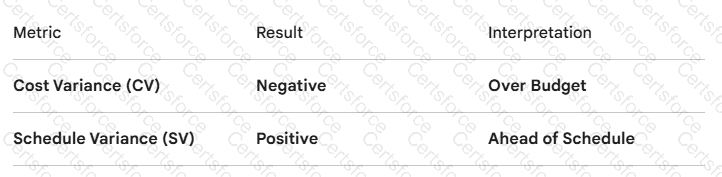
Analysis of Other Options:
A. under budget and behind schedule: This would require a Positive CV and a Negative SV.
C. on schedule: This would require an SV of zero (where $EV = PV$).
D. complete; all planned values have been earned: A project is complete when $EV = BAC$ (Budget at Completion). While a positive SV suggests progress, it does not inherently mean the project is finished; it just means it is moving faster than planned.
A business manager wants to start a project to launch a new product. How should the manager initiate the project?
Ask a small team to produce a prototype of the product before full-scale development.
Assign a project manager to the project and ask them to document the project scope.
Prepare a detailed business case to document project objectives and success criteria.
Discuss the project requirements with the team for alternative products in the market.
According to the PMBOK® Guide, specifically the Develop Project Charter process and the Initiating Process Group, a project should not begin in a vacuum. It must be preceded by a formal evaluation of its necessity and feasibility.
The Business Case: Before a project is officially authorized, a Business Case is developed. This document provides the economic feasibility study and the justification for the project. It outlines the project objectives, the required investment, and the success criteria (how the organization will measure if the project was worth the effort).
Foundation for the Charter: The business case is a critical input to the Project Charter. It ensures that the project aligns with the organization ' s strategic goals. Without a business case, the organization risks spending resources on a product that may not have a market or a positive Return on Investment (ROI).
Defining Success: By documenting success criteria during the initiation phase, the business manager ensures that all stakeholders have a shared understanding of what the " new product launch " is intended to achieve, whether that is market share, revenue targets, or brand expansion.
Analysis of other options:
Option A: Producing a prototype is a technical activity that usually occurs during the Planning or Execution phases (or during a " Spike " in Agile). It is too early to build a prototype before the project has been formally justified and authorized.
Option B: While a Project Manager will eventually document the scope, the Project Scope Statement is a result of the Planning process. A project must be initiated (authorized) before detailed scope documentation begins.
Option D: Discussing alternative products and requirements is part of market research or the " Collect Requirements " process. While important, it does not constitute the formal initiation of a project. Formal initiation requires the documentation of the business need and the authorization to proceed.
Per PMI standards, the formal initiation of a project begins with the creation of a Business Case to ensure strategic alignment and to provide the justification needed to move forward with a Project Charter.
Which of the following is an output of Define Scope?
Project scope statement
Project charter
Project plan
Project schedule
According to the PMBOK® Guide, the Define Scope process is the process of developing a detailed description of the project and product. This process builds upon the high-level deliverables, assumptions, and constraints documented during project initiation.
Project Scope Statement: This is the primary output of the Define Scope process. It provides a documented basis for making future project decisions and for confirming or developing a common understanding of project scope among the stakeholders. It includes:
Product scope description: The characteristics of the product, service, or result.
Acceptance criteria: A set of conditions that must be met before deliverables are accepted.
Deliverables: Any unique and verifiable product, result, or capability to perform a service.
Project exclusion: Explicitly stating what is out of scope to manage stakeholder expectations.
Constraints and Assumptions: Specific factors that limit the team ' s options or factors that are considered to be true for planning purposes.
Relationship to WBS: Once the Project Scope Statement is finalized, it serves as a critical input to the Create WBS process, where the work is subdivided into smaller components.
Analysis of Other Options:
B. Project charter: This is an input to the Define Scope process. The charter is created during the Develop Project Charter process in the Initiating Process Group.
C. Project plan: The " Project Management Plan " is a comprehensive document that integrates all subsidiary plans. While the scope statement is a component that eventually feeds into the plan, the " Project Plan " itself is the output of the Develop Project Management Plan process.
D. Project schedule: This is the output of the Develop Schedule process. While scope defines what will be done, the schedule defines when it will be done.
Which technique helps to determine the risks that have the most potential impact on a project?
Cost risk simulation analysis
Expected monetary value analysis
Modeling and simulation
Sensitivity analysis
In accordance with the PMBOK® Guide, specifically within the Perform Quantitative Risk Analysis process, Sensitivity Analysis is the primary technique used to determine which risks have the most potential impact on the project.
Mechanism: Sensitivity analysis helps to determine which risks have the most potential impact on the project by examining the extent to which the uncertainty of each project element affects the objective being studied when all other uncertain elements are held at their baseline values.
The Tornado Diagram: The typical display for this analysis is a Tornado Diagram. This bar chart is used to compare the relative importance and variables that have a high degree of uncertainty to those that are more stable. The variables are ranked by the width of the spread, with the " widest " bars (most sensitive) at the top and the " narrowest " at the bottom, giving it a funnel or tornado shape.
Application: It is particularly useful for prioritizing risks where a small change in a single variable (like the cost of a specific raw material) could result in a massive deviation in the overall project budget or schedule.
Comparison with Other Options:
Cost risk simulation analysis (A): This is a broader application of modeling (like Monte Carlo) to see the total potential cost of the project, but it doesn ' t isolate the individual risk with the most impact as clearly as sensitivity analysis.
Expected monetary value analysis (B): EMV ($EMV = P \times I$) is a statistical concept that calculates the average outcome when the future includes scenarios that may or may not happen. It is often used in Decision Tree Analysis.
Modeling and simulation (C): This is the overarching category (including Monte Carlo) that uses a model to translate specified uncertainties of the project into their potential impact on project objectives. Sensitivity analysis is a specific type of modeling used for prioritization.
The risk management team of a software project has decided that due to the lack of adequate talent in the company, development of a specific part of the system is under high risk, so the team has decided to outsource it. This is an example of which risk response?
Transfer
Share
Avoid
Accept
According to the PMBOK® Guide, specifically within the Plan Risk Responses process, there are several strategies for dealing with negative risks or threats. Transfer is the specific strategy used when the project team shifts the impact of a threat to a third party, together with ownership of the response.
Mechanism of Transfer: Risk transference nearly always involves the payment of a risk premium to the party taking on the risk. In project management, this is most commonly achieved through the use of contracts, insurance, or warranties.
The Outsourcing Example: By outsourcing the development to an external company that does have the adequate talent, the internal company is transferring the technical and performance risks associated with that specific component to the vendor. If the vendor fails to deliver, the contract typically includes penalties or clauses to protect the buyer.
Residual Risk: It is important to note that transferring a risk does not eliminate it; it simply makes another party responsible for its management.
Comparison with Other Options:
Share (B): This is a strategy for Opportunities (positive risks), not threats. It involves allocating some or all of the ownership of an opportunity to a third party who is best able to capture the benefit for the project (e.g., a joint venture).
Avoid (C): This involves changing the project management plan to eliminate the threat entirely. For example, changing the scope of the software to remove the requirement for that " high risk " part of the system altogether. Since the part is still being developed (just by someone else), the risk has been transferred, not avoided.
Accept (D): This occurs when the project team decides not to act on a risk, or is unable to identify any other suitable response strategy. It can be passive (doing nothing) or active (establishing a contingency reserve).
A stakeholder asked the project manager to add an additional feature to the project scope. The project manager is unsure whether the project budget will allow this additional scope.
What component of the project management plan should the project manager reference to determine whether the budget will allow a new feature to be added?
Risk management plan
Cost estimate
Risk register
Cost management plan
In the PMBOK® Guide, when a change to the project scope is proposed, the project manager must understand the " rules " for how financial changes are handled.
Why Choice D is correct:
The Framework for Costs: The Cost Management Plan is a subsidiary of the project management plan that describes how the project costs will be planned, structured, and controlled.
Thresholds and Procedures: It establishes control thresholds, which indicate the amount of variance allowed before some action needs to be taken. It also outlines the processes for managing contingency reserves and how to request additional funding.
Decision Making: While the plan doesn ' t contain the specific dollar amounts (that ' s the budget), it tells the Project Manager how to determine if a budget can be adjusted, who has the authority to approve a budget increase, and the protocol for integrating new features into the financial baseline.
Analysis of other options:
A (Risk management plan): This plan describes how risk management activities will be structured and performed. While adding scope involves risk, this document doesn ' t provide the guidance on budget availability or financial control.
B (Cost estimate): A cost estimate is a quantitative assessment of the likely costs of the resources required to complete project work. It is a data point for a specific activity, not a management document that dictates how to handle budget changes for new features.
C (Risk register): This is a document where results of risk analysis and risk response planning are recorded. It would tell you if " scope increase " was an identified risk, but it won ' t give you the management procedures for budget allocation.
Key Concept: The Project Management Institute (PMI) emphasizes that you should always look to the " Management Plan " (Choice D) when the question asks how to handle a situation or where to find the rules for a specific project constraint. The Cost Management Plan ensures that any addition to the scope is evaluated against the financial health of the project in a disciplined, pre-approved manner.
Which Develop Schedule tool and technique produces a theoretical early start date and late start date?
Critical path method
Variance analysis
Schedule compression
Schedule comparison bar charts
According to the PMBOK® Guide, specifically within the Develop Schedule process, the Critical Path Method (CPM) is the primary analytical tool used to calculate the theoretical start and finish dates for all activities.
Mechanism: The Critical Path Method performs a Forward Pass and a Backward Pass through the project schedule network diagram.
Forward Pass: Determines the Early Start (ES) and Early Finish (EF) dates for each activity by calculating from the project start date.
Backward Pass: Determines the Late Start (LS) and Late Finish (LF) dates by calculating from the project finish date.
Purpose: By comparing these dates, the tool identifies the Total Float (LS - ES or LF - EF) for each activity. Activities with zero total float are on the Critical Path, which represents the longest path through the project and determines the shortest possible project duration.
Theoretical Nature: These dates are considered " theoretical " because they do not account for resource limitations; they are based solely on logic, durations, and constraints. Resource leveling is typically applied after this analysis to create a realistic schedule.
Choice B (Variance analysis): This is a tool used in Control Schedule to compare actual progress against the baseline, not to generate theoretical start/late dates.
Choice C (Schedule compression): These techniques (Crashing and Fast Tracking) are used to shorten the schedule duration, often after the initial critical path has been identified.
Choice D (Schedule comparison bar charts): These are used to visualize the difference between two versions of a schedule (e.g., baseline vs. current), not to calculate the ES/LS dates.
Which three of the following are the most widely used techniques that a business analyst should implement to gather requirements? (Choose three)
Current state analysis
Facilitated workshops
Scheduled interviews
Shop floor observation
Brainstorming sessions
In the Collect Requirements process, as defined by the PMBOK® Guide and the PMI Guide to Business Analysis, elicitation techniques are used to draw out information from stakeholders. While many methods exist, the industry standard focuses on those that balance depth, speed, and consensus.
Why Choices B, C, and E are correct:
B (Facilitated Workshops): These are highly effective for bringing cross-functional stakeholders together to reach a consensus. Techniques like JAD (Joint Application Design) help resolve requirements conflicts quickly and are considered one of the most powerful tools for defining product scope.
C (Scheduled Interviews): This is the most common " one-on-one " technique. It allows the Business Analyst to dive deep into a specific stakeholder ' s needs, elicit confidential information, and build individual rapport. It is the primary method for gathering detailed, specific functional requirements.
E (Brainstorming Sessions): This is a data-gathering technique used to generate and collect multiple ideas related to project and product requirements in a short period. It encourages creative thinking and is often the first step in identifying a broad range of potential features.
Analysis of other options:
A (Current state analysis): While this is a critical part of Business Analysis, it is technically an analytical process used to understand the " as-is " environment. It is a prerequisite for or a result of elicitation, rather than a primary " gathering " technique itself in the context of standard PMI toolsets.
D (Shop floor observation): Also known as " Job Shadowing " or " Observation, " this is a valid technique, especially when stakeholders find it difficult to articulate their requirements. However, it is a specialized technique (often for process improvement) and is not considered as " widely used " or foundational as workshops, interviews, or brainstorming for general project requirements.
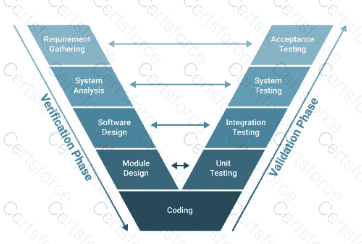
Key Concept: The Project Management Institute (PMI) categorizes these techniques under Data Gathering and Interpersonal and Team Skills. To build a robust Requirements Traceability Matrix, a Business Analyst typically starts with Brainstorming (Choice E) for ideas, conducts Interviews (Choice C) for detail, and uses Facilitated Workshops (Choice B) to align the group and finalize the scope.
Which schedule network analysis technique modifies the project schedule to account for limited resources?
Human resource planning
Fast tracking
Critical chain method
Rolling wave planning
According to the PMBOK® Guide, specifically within the Develop Schedule process, the Critical Chain Method (CCM) is a schedule network analysis technique that modifies the project schedule to account for limited resources.
Resource Constraints: Unlike the Critical Path Method (CPM), which focuses on logical dependencies (task sequences), the Critical Chain Method accounts for both logical dependencies and resource availability. If a resource is required for two different tasks at the same time, the Critical Chain Method will adjust the schedule to resolve this conflict.
Buffers: CCM adds non-work schedule activities called buffers to manage uncertainty.
Project Buffer: Placed at the end of the critical chain to protect the target finish date.
Feeding Buffers: Placed at points where non-critical chains merge into the critical chain to protect the critical chain from slippage in the feeding tasks.
Focus on Aggregated Risk: Instead of managing the " float " of individual activities, the project manager manages the remaining buffer durations against the remaining duration of the chain of activities.
Comparison with other options:
A. Human resource planning: This is part of the Plan Resource Management process. It involves identifying and documenting project roles, responsibilities, and reporting relationships, but it is not a schedule network analysis technique that modifies the schedule itself.
B. Fast tracking: This is a schedule compression technique where activities or phases normally done in sequence are performed in parallel for at least a portion of their duration. It usually increases risk and may require more resources, but it does not inherently " modify the schedule to account for limited resources " in the way CCM does.
C. Rolling wave planning: This is an iterative planning technique where the work to be accomplished in the near term is planned in detail, while the work in the future is planned at a higher level. It is a form of progressive elaboration, not a resource-constrained network analysis technique.
As the project progresses, which of the following is routinely collected from the project activities?
Communication management activities
Change requests
Configuration verification and audit
Work performance information
According to the PMBOK® Guide, as project activities are executed, various data points are collected to monitor progress. The framework distinguishes between three specific levels of performance reporting:
Work Performance Data: The raw observations and measurements identified during activities being performed to carry out the project work. Examples include actual cost, actual duration, and percent of work physically completed.
Work Performance Information: This is the data collected from various controlling processes, analyzed in context, and integrated based on relationships across areas. For instance, while " Work Performance Data " might say a task took 10 hours, " Work Performance Information " would clarify that those 10 hours represent a 2-hour variance from the original plan.
Routine Collection: This information is routinely collected and processed during the Monitoring and Controlling Process Group. It allows the project manager to communicate the status of the project to stakeholders and provides the foundation for decision-making.
Comparison with Other Options:
Communication management activities (A): This refers to the general tasks involved in the Manage Communications process. While these activities occur, they are not the specific " metric " or " data " routinely collected to measure project performance.
Change requests (B): While change requests are common as a project progresses, they are an output of identifying variances or improvements. They are not the information itself being collected from the activities, but rather a reaction to that information.
Configuration verification and audit (C): This is a specific activity within Configuration Management (part of Integrated Change Control) used to ensure that the project ' s product configuration is correct and that the product meets its functional requirements. It is an occasional audit rather than a routine data collection of activity progress.
A project manager Is addressing risks and potential concerns related to stakeholder management, and Is clarifying and resolving previously Identified issues. In which process is the project manager engaged?
Identify Stakeholders
Plan Stakeholder Engagement
Manage Stakeholder Engagement
Monitor Slakeholder Engagement
According to the PMBOK® Guide (6th Edition), the Manage Stakeholder Engagement process is the process of communicating and working with stakeholders to meet their needs and expectations, address issues, and foster appropriate stakeholder engagement involvement.
This process is part of the Executing Process Group. It is the stage where the project manager actually interacts with the stakeholders. Key activities include:
Engaging stakeholders at appropriate project stages to obtain, confirm, or maintain their continued commitment to the success of the project.
Managing stakeholder expectations through negotiation and communication.
Addressing any risks or potential concerns related to stakeholder management and anticipating future issues that may be raised by stakeholders.
Clarifying and resolving issues that have been identified.
Analysis of Distractors:
A (Identify Stakeholders): This is an Initiating process focused on creating the Stakeholder Register by identifying who is impacted by the project. It does not involve resolving active project issues.
B (Plan Stakeholder Engagement): This is a Planning process where the project manager develops the strategy for engagement. It results in the Stakeholder Engagement Plan (the " how-to " document), but it does not involve the actual " doing " or resolving of current issues.
D (Monitor Stakeholder Engagement): This is a Monitoring and Controlling process. It involves monitoring project stakeholder relationships and tailoring strategies for engaging stakeholders. While it might identify that an engagement strategy is failing, the actual work of " addressing concerns " and " resolving issues " is a function of the Manage (Execution) process.
Key Document Reference: The Issue Log is a primary input and update for this process. According to Section 13.3 of the PMBOK® Guide, " Manage Stakeholder Engagement " is specifically where the project manager uses communication skills to ensure that concerns are addressed before they become major issues.
Stakeholder satisfaction should be managed as a key project:
Benefit
Initiative
Objective
Process
In accordance with the PMBOK® Guide (Project Stakeholder Management), the success of a project is measured not only by the completion of the scope within time and budget but also by the satisfaction of the stakeholders. Therefore, stakeholder satisfaction is managed as a key project objective.
Strategic Alignment: Managing stakeholder satisfaction as an objective ensures that the project team remains focused on the needs, expectations, and requirements of those impacted by the project.
Success Criteria: Modern project management standards (including the PMI Standard for Project Management) explicitly state that a project can meet all technical requirements (the " iron triangle " of scope, time, and cost) and still be considered a failure if the key stakeholders are not satisfied with the end result.
Measurement: Because it is an objective, it should be clearly defined during the planning phase, and metrics (such as surveys, feedback loops, or Net Promoter Scores) should be used to track progress toward this goal throughout the project life cycle.
Analysis of Distractors:
A. Benefit: While stakeholder satisfaction is a positive outcome, a " Benefit " in PMI terms (specifically in Program Management) is typically a gain realized by the organization (e.g., increased revenue or reduced risk). Satisfaction is the goal or objective that leads to those benefits.
B. Initiative: An initiative usually refers to a specific project or a group of tasks designed to achieve a goal. Stakeholder satisfaction is the aim of the initiative, not the initiative itself.
D. Process: While there are processes used to manage stakeholders (e.g., Identify Stakeholders, Plan Stakeholder Engagement), the satisfaction itself is the end state or objective the project strives to reach.
What important leadership quality/qualities should project managers possess?
Skills and behaviors related to specific domains of project management
Skills and behaviors needed to guide a team and help an organization reach its goals
Industry expertise that helps to better deliver business outcomes
Industry and organizational expertise that enhances performance
According to the PMBOK® Guide and the PMI Talent Triangle®, leadership is one of the three essential skill sets required for project managers. While technical and strategic skills are vital, leadership specifically focuses on the human element and organizational alignment.
Defining Leadership in Project Management: PMI defines leadership as the ability to guide, motivate, and direct a team. It involves the use of " soft skills " to influence stakeholders, navigate politics, and inspire team members to achieve project objectives that ultimately support the organization ' s broader strategic goals.
The Difference from Technical Skills: Unlike domain-specific knowledge (which tells you how to build a schedule), leadership qualities focus on the vision and relationships. This includes empathy, conflict resolution, communication, and the ability to facilitate a team through change.
Organizational Alignment: A project does not exist in a vacuum. Leadership qualities allow a project manager to translate the organization ' s high-level strategy into actionable work for the team, ensuring that the project ' s success contributes to the organization reaching its intended business value.
Analysis of other options:
A. Skills and behaviors related to specific domains: This refers to Technical Project Management. These are the " hard skills " like Earned Value Management or WBS creation, rather than leadership.
C. Industry expertise: This is categorized under Strategic and Business Management. While understanding the industry helps in delivering outcomes, it is a business competency rather than a leadership quality.
D. Industry and organizational expertise: Similar to option C, this is a combination of business acumen and strategic knowledge. While it enhances performance, leadership is specifically about the " guiding and helping " behaviors described in option B.
Per PMI standards, the project manager must be a visionary who can look beyond the technical tasks to see how the team’s performance impacts the entire organization.
Which are the competing constraints that project manager should address when tailoring a project?
Cost, scope, schedule
Sponsorship, risk, quality
Schedule, sponsorship, scope
Resources, Quality, Communication
According to the PMBOK® Guide, project management is the application of knowledge, skills, tools, and techniques to project activities to meet project requirements. This is achieved through the effective management of several competing constraints.
While modern project management recognizes multiple constraints (including risk, resources, and quality), the traditional " Triple Constraint " often serves as the core foundation for tailoring decisions.
Scope, Schedule, and Cost: These are the primary technical constraints. A change in one typically impacts at least one of the others. When tailoring a project, a project manager must balance these three to meet the project ' s objectives. For example:
If the Scope increases, the Schedule or Cost (or both) will likely need to increase.
If the Schedule must be shortened (crashed), the Cost will usually increase or the Scope must be reduced.
Tailoring Context: During tailoring, the project manager looks at these constraints to decide which processes are " heavy " or " light. " A project with a very tight Cost constraint but flexible Schedule will be tailored differently than a high-priority, time-sensitive project.
Why other options are incorrect:
Options B and C: These include Sponsorship. While a sponsor is critical for project success and provides resources, " Sponsorship " is not considered a project constraint; rather, the sponsor is a stakeholder who helps manage the constraints.
Option D: While Resources and Quality are indeed constraints, Communication is a management process/knowledge area. In the context of the most fundamental " competing constraints " that define the project ' s boundaries during tailoring, the classic triad of Scope, Schedule, and Cost (Option A) is the standard PMI-recognized answer.
For what project management process is work performance information an output?
Implement Risk Responses
Plan Stakeholder Engagement
Monitor Stakeholder Engagement
Plan Quality Management
According to the PMBOK® Guide, the distinction between Work Performance Data, Work Performance Information, and Work Performance Reports is a critical flow of information within a project.
Work Performance Information (WPI): This is an Output of the Monitoring and Controlling process group. WPI is created when Work Performance Data (raw observations collected during execution) is analyzed in context and integrated based on relationships across areas.
Monitor Stakeholder Engagement: This is a Monitoring and Controlling process. Its purpose is to monitor project stakeholder relationships and tailor strategies for engaging stakeholders. During this process, the raw data regarding stakeholder engagement (e.g., which stakeholders attend meetings or support the project) is compared against the Stakeholder Engagement Plan. The result of this analysis is Work Performance Information, which describes how stakeholder engagement is actually performing compared to the plan.
Analysis of other options:
Implement Risk Responses (Option A): This is an Executing process. Its primary outputs are Change Requests and Project Document Updates. It typically takes Work Performance Reports as an input but does not output WPI.
Plan Stakeholder Engagement (Option B): This is a Planning process. Its primary output is the Stakeholder Engagement Plan.
Plan Quality Management (Option D): This is a Planning process. Its primary outputs are the Quality Management Plan and Quality Metrics.
As per PMI standards, almost every " Monitor " or " Control " process (e.g., Control Schedule, Control Costs, Monitor Communications) takes Work Performance Data as an input and produces Work Performance Information as an output.
