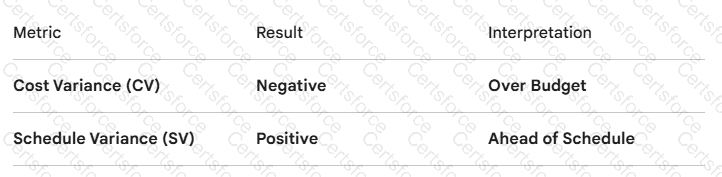
According to the PMBOK® Guide, Earned Value Management (EVM) uses specific formulas to determine the health of a project regarding cost and schedule. To answer this question, we must look at the definitions of Cost Variance (CV) and Schedule Variance (SV).
The formula for Cost Variance is:
$$CV = EV - AC$$
(Where EV = Earned Value and AC = Actual Cost)
Positive CV ( > 0): The project is under budget (you spent less than the value of the work performed).
Negative CV ( < 0): The project is over budget (you spent more than the value of the work performed).
Zero CV: The project is exactly on budget.
The formula for Schedule Variance is:
$$SV = EV - PV$$
(Where EV = Earned Value and PV = Planned Value)
Positive SV ( > 0): The project is ahead of schedule (you have completed more work than was planned for this point in time).
Negative SV ( < 0): The project is behind schedule (you have completed less work than planned).
Zero SV: The project is exactly on schedule.
Analysis of Other Options:
A. under budget and behind schedule: This would require a Positive CV and a Negative SV.
C. on schedule: This would require an SV of zero (where $EV = PV$).
D. complete; all planned values have been earned: A project is complete when $EV = BAC$ (Budget at Completion). While a positive SV suggests progress, it does not inherently mean the project is finished; it just means it is moving faster than planned.


Submit