
In project management, a temporary project can be:
Completed without planning
A routine business process
Long in duration
Ongoing to produce goods
According to the PMBOK® Guide (Project Management Body of Knowledge), the fundamental definition of a project is a temporary endeavor undertaken to create a unique product, service, or result. PMI clarifies the term " temporary " in the following ways:
Long in Duration (Option C): While a project is " temporary " (meaning it has a defined beginning and end), this does not mean it must be short. A project can last for several years (e.g., building a skyscraper or developing a new aircraft) and still be classified as temporary because it will eventually reach its conclusion.
Routine Business Process (Option B) / Ongoing (Option D): These options describe Operations. Operations are ongoing and repetitive (e.g., a manufacturing line or accounting services), whereas projects are unique and end when their objectives have been met or the project is terminated.
Completed without Planning (Option A): This contradicts all PMI standards. Every project requires a degree of planning (whether predictive/waterfall or adaptive/agile) to ensure that resources are used efficiently and objectives are met.
In the PMI framework, the temporary nature of a project indicates that the project team is disbanded and resources are reassigned once the project’s specific goals are achieved, regardless of how many years the project took to complete.
All testing on a project has been performed successfully and all acceptance criteria have been met. What is the next step?
Set up a meeting with the sponsor.
Set up a go/no-go meeting.
Wait for the next sprint.
Deliver the product.
According to the PMBOK® Guide and standard project governance frameworks, reaching the end of technical testing and meeting acceptance criteria does not automatically trigger the delivery of the product. There is a formal transition step required.
The Transition Phase: Once Control Quality (testing) and Validate Scope (acceptance criteria) are technically complete, the project enters a transition or readiness review phase.
The Go/No-Go Meeting: This is a critical governance gate where project leadership, the sponsor, and key stakeholders meet to review the project ' s readiness for release. While the technical criteria might be met, this meeting addresses non-technical factors, such as:
Organizational Readiness: Is the business ready to support the new product?
Operational Readiness: Are the support teams trained?
Risk Assessment: Are there any external factors (like market timing) that suggest holding the release?
Formal Approval: This meeting results in the formal authorization to proceed to the next stage—either " Go " (Deliver/Deploy) or " No-Go " (Wait or Rework).
Analysis of other options:
Option A: Setting up a meeting with the sponsor is part of the process, but " meeting with the sponsor " is too vague. The specific type of meeting required at this governance juncture is a Go/No-Go or Readiness Review.
Option C: " Waiting for the next sprint " applies only to ongoing Agile development. If all testing is performed and criteria are met for the project ' s output, the team should move toward release/closure rather than idle waiting.
Option D: Delivering the product is the result of a " Go " decision. In formal PMI methodology, you do not deliver until the formal decision-making gate has been passed.
Per PMI standards, the project manager must ensure that all transition activities are formally authorized. A Go/No-Go meeting serves as the final administrative control before the product is transitioned to operations or the customer.
Which provides the basic framework for managing a project?
Project life cycle
Work breakdown structure (WBS)
Enterprise environmental factors
Project initiation
According to the PMBOK® Guide, the Project Life Cycle provides the basic framework for managing a project, regardless of the specific work involved.
Definition: A project life cycle is the series of phases that a project passes through from its start to its completion. It provides the high-level map for project execution.
Structural Role: It defines the beginning and the end of a project, determines which transitional activities take place at the end of a phase (phase gates), and facilitates management and control. By breaking a project into phases (such as Starting, Organizing/Preparing, Carrying out the work, and Closing), the project manager can maintain better oversight of the project ' s health.
Flexibility: The life cycle can be managed through various methodologies, such as Predictive (Waterfall), Iterative, Incremental, or Adaptive (Agile), but the concept of the life cycle remains the essential framework.
Comparison with Other Options:
Work breakdown structure (B): While the WBS is a fundamental tool for defining and organizing the scope of the project, it does not provide the temporal framework or the phase-based management structure for the entire project life cycle.
Enterprise environmental factors (C): These are external or internal factors that influence or constrain project management (such as company culture or government regulations). They are inputs to processes, not the framework for management itself.
Project initiation (D): This is a specific phase or process group within the framework, but it is not the framework itself. Initiation is just the starting point of the broader life cycle.
In a typical project, project managers spend most of their time:
Estimating
Scheduling
Controlling
Communicating
According to the PMBOK® Guide (Project Management Body of Knowledge), specifically within the sections on the Role of the Project Manager and Project Communications Management:
Communicating (Option D): It is a well-established principle in the PMI framework that project managers spend the vast majority of their time—frequently cited as 75% to 90%—communicating. This includes formal and informal communication with the team, stakeholders, sponsors, and customers. Because a Project Manager acts as the central link between the strategy and the execution, their primary " tool " is the exchange of information to ensure alignment, resolve conflict, and manage expectations.
Estimating (Option A): This is a specific activity within the Project Cost and Project Schedule management areas. While critical during the planning phase and during change control, it is a task-oriented activity that does not consume the bulk of a Project Manager ' s daily schedule.
Scheduling (Option B): Developing and maintaining the project schedule is a core function, but in many modern project environments, much of the data entry and logic is handled by scheduling software or project coordinators. The Project Manager focuses more on the implications of the schedule, which requires communication.
Controlling (Option C): Controlling involves monitoring project performance and implementing changes. While it is a continuous process throughout the project life cycle, " controlling " is often executed through communication (meetings, reports, and negotiations).
In the PMI framework, Project Communications Management is often considered the " oil " that keeps the project engine running. A Project Manager who communicates effectively can often overcome technical or resource deficiencies, whereas a Project Manager with poor communication skills will likely struggle even with a perfect plan and unlimited resources. Success is heavily dependent on the ability to manage the Communications Management Plan effectively.
Which of the following is a conflict resolution technique that emphasizes areas of agreement rather than areas of difference?
Compromising
Collaborating
Smoothing
Problem Solving
According to the PMBOK® Guide, specifically within the Manage Team process, there are five general techniques for resolving conflict. Smoothing (also known as Accommodating) is the specific technique that emphasizes areas of agreement rather than areas of difference.
Definition of Smoothing/Accommodating: This technique involves de-emphasizing or avoiding the areas of conflict and instead focusing on the points where the parties agree. It is often used to maintain harmony in a relationship or when the issue is more important to the other party than to oneself.
The Goal: The primary objective is to maintain a friendly atmosphere and reduce the emotional intensity of the conflict. It is a " conceding " position where one party may sacrifice their own concerns to satisfy the concerns of the other.
Result: While it can provide temporary relief and keep the project moving, it is often a lose-win scenario. Because the underlying conflict is not actually addressed or solved, the issue may resurface later.
Comparison with Other Options:
Compromising (A): Also known as Reconcile. This involves searching for solutions that bring some degree of satisfaction to all parties in order to temporarily or partially resolve the conflict. It is a " give-and-take " approach (lose-lose).
Collaborating (B): Also known as Problem Solving. This involves incorporating multiple viewpoints and insights from differing perspectives. it requires a cooperative attitude and open dialogue that typically leads to consensus and commitment (win-win).
Problem Solving (D): As noted above, this is synonymous with Collaborating. It treats the conflict as a problem to be solved by examining alternatives; it does not simply " smooth over " differences but works through them.
Through whom do project managers accomplish work?
Consultants and stakeholders
Stakeholders and functional managers
Project team members and consultants
Project team members and stakeholders
According to the PMBOK® Guide (Project Management Body of Knowledge), specifically in the section detailing The Role of the Project Manager, the project manager’s primary function is to lead the project team and manage the engagement of stakeholders to achieve project objectives.
Project Team Members and Stakeholders (Option D): This is the most accurate and comprehensive answer according to PMI standards. The project manager does not perform all the work personally; instead, they facilitate the completion of work through the project team (those performing the tasks) and by managing the expectations and influence of stakeholders (anyone who can affect or be affected by the project).
Consultants and Stakeholders (Option A): While consultants are a type of stakeholder or team member, this option is too narrow. It excludes the internal project team which carries out the bulk of the project activities.
Stakeholders and Functional Managers (Option B): Functional managers are a specific subset of stakeholders. While a PM must negotiate with them for resources, the actual work is accomplished by the team members assigned, not just by managing the functional heads.
Project Team Members and Consultants (Option C): This is also too narrow. It misses the critical " Stakeholder " group. Stakeholders provide requirements, feedback, and support, and their involvement is essential for a project to be considered successful.
In the PMI framework, the Project Manager serves as the link between the strategy and the team. Success is achieved by balancing the needs and contributions of both the internal team and the broader stakeholder community.
Which type of dependency used in the Sequence Activities process is sometimes referred to as preferred logic, preferential logic, or soft logic?
Internal
External
Discretionary
Mandatory
According to the PMBOK® Guide, specifically the Sequence Activities process within Project Schedule Management, there are four types of dependencies used to define the logical relationship between activities.
Discretionary Dependencies: These are established based on knowledge of best practices within a particular application area or some unusual aspect of the project where a specific sequence is desired, even though there may be other acceptable sequences. They are also known as preferred logic, preferential logic, or soft logic.
Application: Project teams typically document discretionary dependencies because they can create arbitrary total float and may limit later scheduling options. During the process of Fast Tracking, these are the first dependencies to be reviewed for potential overlap or removal to shorten the schedule.
Source of Logic: These often come from " lessons learned " or specific technical preferences of the project team rather than a physical or legal requirement.
Comparison with other options:
A. Internal: This involves a precedence relationship between project activities and is generally within the project team ' s control (e.g., a team cannot test a machine until they assemble it).
B. External: This involves a relationship between project activities and non-project activities (e.g., a software project waiting for a government environmental hearing). These are usually outside the project team ' s control.
D. Mandatory: Also known as hard logic or hard dependencies. These are legally or contractually required or inherent in the nature of the work (e.g., you cannot build a roof until the foundation is set). Unlike discretionary logic, these cannot be moved or bypassed easily during schedule compression.
Which tasks should a project manager accomplish in order to manage project scope correctly?
Define. Validate, and Control Scope. Control Schedule; Control Costs and Manage Stakeholder Engagement
Collect Requirements. Define Scope. Create WBS. Develop Schedule, and Manage Stakeholder Engagement
Plan Scope Management; Collect Requirements; Define. Validate, and Control Scope; and Create WBS
Define. Validate, and Control Scope. Control Costs. Manage Stakeholder Engagement, and keep budget under control
According to the PMBOK® Guide, Project Scope Management includes the processes required to ensure that the project includes all the work required, and only the work required, to complete the project successfully. To manage scope correctly, a project manager must follow the specific sequence of processes defined within the Scope Management Knowledge Area.
The six core processes are:
Plan Scope Management: Creating a scope management plan that documents how the project and product scope will be defined, validated, and controlled.
Collect Requirements: Determining, documenting, and managing stakeholder needs and requirements to meet project objectives.
Define Scope: Developing a detailed description of the project and product.
Create WBS: Subdividing project deliverables and project work into smaller, more manageable components.
Validate Scope: Formalizing acceptance of the completed project deliverables.
Control Scope: Monitoring the status of the project and product scope and managing changes to the scope baseline.
Analysis of Other Options:
A. Control Schedule; Control Costs: These belong to the Schedule Management and Cost Management Knowledge Areas, respectively. While related to overall project health, they are not tasks used to manage scope specifically.
B. Develop Schedule: This is a Schedule Management process. Managing scope is the precursor to developing a schedule, but the schedule itself is not a scope management task.
D. Control Costs; Manage Stakeholder Engagement: These are processes from other Knowledge Areas. " Keeping budget under control " is a goal of Cost Management, not a defined process for managing Scope.
Which Define Activities output extends the description of the activity by identifying the multiple components associated with each activity?
Project document updates
Activity list
Activity attributes
Project calendars
In accordance with the PMBOK® Guide (Project Schedule Management), specifically within the Define Activities process, Activity Attributes serve as an extension of the activity list. While the activity list provides the names of the tasks, the activity attributes provide the detailed information required for scheduling and resource management.
Function and Components: Activity attributes identify the multiple components associated with each activity. This includes, but is not limited to:
Activity Identifiers (IDs) and codes.
Predecessor and Successor activities, including leads and lags.
Resource requirements and constraints.
Logical relationships (Finish-to-Start, Start-to-Start, etc.).
Imposed dates and assumptions.
Evolution of Detail: During the initial stages of the project, these attributes are limited. As the project progresses through Progressive Elaboration, the attributes become more detailed, providing the necessary data for the Sequence Activities and Develop Schedule processes.
Relationship to Activity List: The activity list is a documented tabulation of schedule activities, whereas the attributes provide the " meta-data " or descriptive depth for each item on that list.
Analysis of Distractors:
A. Project document updates: While the Define Activities process can result in updates to various project documents (such as the risk register), this is a general category of output and does not specifically describe the detailed components of an activity.
B. Activity list: This is a primary output of Define Activities, but it is merely a list of the schedule activities. It does not " extend the description " with multiple components in the way that the Activity Attributes do.
D. Project calendars: These are typically an output of the Develop Schedule process. They identify working days and shifts available for scheduled activities and are not a description of the activities themselves.
Which of the following describes the similarities of the process groups and project life cycle?
The life cycle involves three project management process groups.
Both provide a basic framework to manage the project.
Each project must have a life cycle and all processes in the five process groups.
The project life cycle is managed by executing the processes within the five process groups.
According to the PMBOK® Guide (6th Edition), understanding the relationship between Process Groups and the Project Life Cycle is fundamental to project management. While they are distinct concepts, their primary similarity lies in their purpose: providing structure.
Project Life Cycle: This is the series of phases that a project passes through from its start to its completion. It provides the basic framework for managing the project, regardless of the specific work involved.
Project Management Process Groups: These are logical groupings of project management inputs, tools and techniques, and outputs (Initiating, Planning, Executing, Monitoring and Controlling, and Closing). They also provide a basic framework by defining the " how-to " of managing project activities.
Analysis of Distractors:
A (The life cycle involves three process groups): This is incorrect. There are five process groups (Initiating, Planning, Executing, Monitoring and Controlling, and Closing), and they are all applicable across the project life cycle, not just three.
C (Each project must have all processes in the five process groups): This is incorrect because of tailoring. The PMBOK® Guide emphasizes that project managers should tailor the processes; not every single one of the 49 processes is required for every project.
D (The project life cycle is managed by executing the processes): While this statement is technically a true description of how a project is run, it describes the interaction between the two concepts rather than their similarities. The question asks what they have in common (their nature as structural frameworks).
The project team is inspecting the completed project scope to determine if the requirements have been satisfied. What is the result of this inspection?
Accepted deliverables
planning packages
Verified deliverables
Work packages
According to the PMBOK® Guide, the process described here is Validate Scope. This is the process of formalizing acceptance of the completed project deliverables.
The Inspection Process: During Validate Scope, the project manager and the customer (or sponsor) perform inspections to ensure that the work and deliverables meet the predefined requirements and acceptance criteria.
Accepted Deliverables: The primary output of this process is Accepted Deliverables. These are deliverables that meet the acceptance criteria and are formally signed off and approved by the customer or sponsor.
Why other options are incorrect:
Verified Deliverables (Option C): These are the results of the Control Quality process. While " verification " also involves inspection, it is performed by the project team to ensure correctness and quality standards before the deliverables are presented to the customer for " acceptance. "
Work Packages (Option D): These are the lowest level of the Work Breakdown Structure (WBS) used for estimation and management; they are an output of the Create WBS process, not the result of a final scope inspection.
Planning Packages (Option B): These are components of the WBS below the control account with known work content but without detailed schedule activities. They are also part of the planning phase, not the result of inspecting completed work.
" Tailoring " is defined as the:
effort of addressing each process to determine which are appropriate and their appropriate degree of rigor.
act of creating a project team with the specialized skills required to produce a required product or service.
action taken to bring a defective or nonconforming component into compliance with requirements or specifications.
adjustment of the respective influences of time, cost, and quality in order to most efficiently achieve scope.
According to the PMBOK® Guide, Tailoring is a necessary element of project management because every project is unique; not every process, tool, technique, input, or output identified in the standard is required on every project.
Definition: Tailoring is the deliberate adaptation of the selected project management processes, inputs, tools, techniques, outputs, and life cycle phases to create a management approach that is appropriate for the specific project environment and the work at hand.
The Project Manager ' s Role: The project manager, in collaboration with the project team, sponsor, or organizational governance, is responsible for tailoring. They must decide what is necessary to manage the project effectively without adding unnecessary " bureaucracy " or " overhead. "
Factors for Tailoring: When tailoring, the project manager considers:
Project size and complexity.
Organizational culture and governance.
Stakeholder needs.
Regulatory and safety requirements.
The project’s physical location.
Analysis of Other Options:
B. Act of creating a project team...: This describes Acquire Resources, which focuses on staffing the project with the right skill sets, not the adaptation of management processes.
C. Action taken to bring a defective...: This is the definition of Defect Repair, which is a type of change request specifically aimed at correcting nonconforming components.
D. Adjustment of the respective influences...: This describes the management of the Triple Constraint (Scope, Schedule, Cost/Quality). While related to decision-making, it does not define the systemic " tailoring " of the project management methodology itself.
In the project charter process, which three of the following are discussed during meetings held with stakeholders? (Choose three)
High-level deliverables
Phase transitions
Project objectives
Success criteria
Cost
According to the PMBOK® Guide, specifically the Develop Project Charter process, the project charter is the document that formally authorizes the existence of a project and provides the project manager with the authority to apply organizational resources to project activities.
During meetings to develop this document, the focus is on high-level strategic alignment rather than granular tactical details. The three correct elements discussed are:
Project Objectives (C): These are the measurable goals the project is intended to achieve. Meetings with stakeholders are crucial to ensure that the project ' s purpose is clearly defined and aligned with the business case and strategic goals of the organization.
Success Criteria (D): Stakeholders must agree on what constitutes project success. This includes defining the measurable standards (such as KPIs, quality levels, or specific business outcomes) that will be used to determine if the project has met its objectives upon completion.
High-level Deliverables (A): The charter outlines the main products, services, or results that the project will produce. While a detailed Work Breakdown Structure (WBS) comes later during planning, the " big picture " deliverables must be identified in the charter to define the project ' s boundaries.
Analysis of other options:
Phase transitions (Option B): Discussions regarding how to move from one phase to another (Kill Points or Stage Gates) are typically part of the Project Management Plan or the Project Life Cycle definition during the planning phase, not the initial chartering process.
Cost (Option E): While a High-level Budget or " Summary Budget " is included in a charter, " Cost " (the detailed estimation of all resources and activities) is a specific output of the Determine Budget process during planning. The charter deals with the " order of magnitude " funding, while detailed costs are discussed much later.
Per PMI standards, the meetings held during the initiation phase are designed to capture the Sponsor’s vision, define Project Objectives, and establish Success Criteria to ensure all key stakeholders are in agreement before the project moves into detailed planning.
Project or phase closure guidelines or requirements, historical information, and the lessons learned knowledge base are examples of which input to the Close Project or Phase process?
Organizational process assets
A work breakdown structure
The project management plan
Enterprise environmental factors
According to the PMBOK® Guide, specifically the Close Project or Phase process, Organizational Process Assets (OPAs) are the plans, processes, policies, procedures, and knowledge bases specific to and used by the performing organization.
Project or Phase Closure Guidelines: These are part of the " Processes and Procedures " category of OPAs. They provide the standardized requirements for administrative closure, such as contract closeout, project audits, and formal acceptance.
Historical Information and Lessons Learned: These are part of the " Corporate Knowledge Base " category. During closure, the project team retrieves historical data to ensure current goals are met and, conversely, updates the lessons learned repository with new insights to benefit future projects.
Significance in Closure: Because the Close Project or Phase process involves " finalizing all activities across all of the Project Management Process Groups, " the project manager must rely on these organizational assets to ensure the project is closed according to both legal and company-specific standards.
Comparison with other options:
B. A work breakdown structure (WBS): This is a tool used to define the total scope of the project. While it is used during the project life cycle to track work, it is not an input that provides " closure guidelines. "
C. The project management plan: While the Project Management Plan is indeed an input to this process (it tells you what the project was supposed to achieve), the specific items listed in the question—historical info, lessons learned bases, and company-wide guidelines—are explicitly categorized as OPAs.
D. Enterprise environmental factors (EEFs): These are conditions not under the immediate control of the project team (e.g., market conditions, organizational culture). While they can influence how a project is closed, they do not typically contain " lessons learned " or " closure requirements, " which are internal assets.
Inputs to the Plan Schedule Management process include:
Organizational process assets and the project charter,
Enterprise environmental factors and schedule tools.
Time tables and Pareto diagrams.
Activity attributes and resource calendars.
According to the PMBOK® Guide and the Standard for Project Management, the Plan Schedule Management process is the first process in the Project Schedule Management Knowledge Area. It establishes the policies, procedures, and documentation for planning, developing, managing, executing, and controlling the project schedule.
As per PMI standards, the inputs to this process are:
Project Charter: Provides the summary milestone schedule and project approval requirements that will influence the management of the project schedule.
Project Management Plan: Specifically the Scope Management Plan and Development Approach, which help define how the schedule will be developed.
Enterprise Environmental Factors (EEF): Includes organizational culture, resource availability, and scheduling software.
Organizational Process Assets (OPA): Includes historical information, schedule control-related policies, and templates.
The other options are incorrect based on the following PMI classifications:
B. Enterprise environmental factors and schedule tools: While EEFs are an input, Schedule tools (like MS Project or Primavera) are categorized as part of the Tools and Techniques (specifically Data Analysis or the Scheduling System), not a primary input.
C. Time tables and Pareto diagrams: These are not inputs to this process. Pareto diagrams are a quality management tool used in the Manage Quality and Control Quality processes. Time tables are generally an output of schedule development (the schedule itself).
D. Activity attributes and resource calendars: These are inputs to the Estimate Activity Durations and Develop Schedule processes, which occur after the Schedule Management Plan has been created.
As per the PMI Lexicon of Project Management Terms, the Plan Schedule Management process ensures that the " how-to " of scheduling is decided before the actual work of identifying and sequencing activities begins.
Select three processes that are associated with Project Schedule Management.
Define Activities
Plan Resource Management
Estimate Activity Durations
Develop Schedule
Acquire Resources
According to the PMBOK® Guide, the Project Schedule Management knowledge area includes the processes required to manage the timely completion of the project. There are six processes in this knowledge area, and the three correct options from your list are:
A. Define Activities: This is the process of identifying and documenting the specific actions to be performed to produce the project deliverables. It breaks down work packages into schedule activities.
C. Estimate Activity Durations: This is the process of estimating the number of work periods needed to complete individual activities with estimated resources. It uses inputs like the activity list and resource requirements.
D. Develop Schedule: This is the process of analyzing activity sequences, durations, resource requirements, and schedule constraints to create the project schedule model for project execution and monitoring and controlling.
Analysis of other options:
B. Plan Resource Management (Option B): This process belongs to the Project Resource Management knowledge area. It involves defining how to estimate, acquire, manage, and use team and physical resources.
E. Acquire Resources (Option E): This is also part of Project Resource Management. It is the process of obtaining team members, facilities, equipment, materials, supplies, and other resources necessary to complete project work.
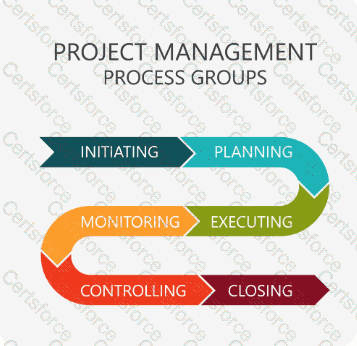
Per the PMI standards, the full sequence of Schedule Management involves Planning, Defining Activities, Sequencing Activities, Estimating Durations, Developing the Schedule, and finally, Controlling the Schedule.
Which of the following processes are part of the Project Integration Management Knowledge Area?
Develop Project Management Plan, Collect Requirements, Create WBS
Develop Project Management Plan, Control Scope, Develop Schedule
Develop Project Charter, Define Scope, Estimate Costs
Develop Project Charter, Direct and Manage Project Execution, Close Project or Phase
According to the PMBOK® Guide, Project Integration Management includes the processes and activities to identify, define, combine, unify, and coordinate the various processes and project management activities within the Project Management Process Groups. It is the " glue " that holds the project together.
The processes included in the Project Integration Management Knowledge Area are:
Develop Project Charter: Formally authorizes the existence of a project.
Develop Project Management Plan: Defines, prepares, and coordinates all plan components.
Direct and Manage Project Work: Leading and performing the work defined in the project management plan.
Manage Project Knowledge: Using existing knowledge and creating new knowledge to achieve objectives.
Monitor and Control Project Work: Tracking, reviewing, and reporting overall progress.
Perform Integrated Change Control: Reviewing all change requests and managing changes to deliverables and assets.
Close Project or Phase: Finalizing all activities for the project, phase, or contract.
Analysis of the choices:
Choice A is incorrect because Collect Requirements and Create WBS belong to the Project Scope Management Knowledge Area.
Choice B is incorrect because Control Scope belongs to Project Scope Management and Develop Schedule belongs to Project Schedule Management.
Choice C is incorrect because Define Scope belongs to Project Scope Management and Estimate Costs belongs to Project Cost Management.
Choice D is correct because all three listed processes—Develop Project Charter (Initiating), Direct and Manage Project Execution (Executing), and Close Project or Phase (Closing)—are core components of Project Integration Management.
How should the project manager obtain the maximum engagement from stakeholders that have recently changed to become more connected to social media?
Adopt co-creation, sharing responsibilities with stakeholders
Adopt participation of stakeholders in main meetings, listening to their opinion.
Adopt social media tools, improving communication with stakeholders
Adopt involvement of stakeholders in lessons learned sessions, sharing experiences with them
According to the PMBOK® Guide (specifically within the Trends and Emerging Practices for Project Stakeholder Engagement), the rise of social media and interconnectedness has shifted the way project managers interact with stakeholders.
Co-creation and Shared Responsibility: The most modern and desirable approach to maximize engagement is co-creation. This moves beyond simply " informing " or " consulting " stakeholders and instead treats them as active partners. By sharing responsibilities, stakeholders become more invested in the project ' s success.
Evolution of Engagement: Traditional engagement focused on one-way or two-way communication. Emerging practices emphasize a collaborative environment where stakeholders help define requirements, solve problems, and even share in the decision-making process.
Alignment with Modern Tools: While the prompt mentions social media, the goal isn ' t just to use the tool, but to leverage the behavioral shift that social media represents: a desire for transparency, rapid interaction, and a sense of " ownership " or " community " in the project’s outcomes.
Why other options are incorrect:
Option B: Adopt participation of stakeholders in main meetings: While listening to opinions is good, this is a standard, traditional practice. It does not represent the " maximum engagement " or the " emerging practice " of turning stakeholders into collaborative partners.
Option C: Adopt social media tools: This is a common " distractor " answer. While social media tools are a medium for communication, simply adding a new tool doesn ' t change the quality of the engagement. A project manager could use social media to broadcast one-way messages, which does not achieve " maximum engagement. "
Option D: Adopt involvement in lessons learned: Lessons learned typically happen at the end of a phase or project (retrospective). While valuable, this is a backward-looking activity and does not drive engagement during the active execution of the project where " co-creation " occurs.
Plan-do-check-act is also known as:
prevention over inspection.
statistical sampling.
management responsibility,
continuous improvement.
According to the PMBOK® Guide, the Plan-Do-Check-Act (PDCA) cycle is a fundamental concept in Project Quality Management. It was popularized by W. Edwards Deming and is the basis for continuous improvement (also known as Kaizen).
The PDCA Cycle:
Plan: Establish the objectives and processes necessary to deliver results in accordance with the expected output.
Do: Implement the plan, execute the process, and make the product.
Check: Study the actual results (measured and collected in " Do " ) and compare against the expected results to ascertain any differences.
Act: Request corrective actions on significant differences between actual and planned results. Analyze the differences to determine their root causes.
Relationship to Project Management: The PDCA cycle is highly compatible with the Project Management Process Groups. For example, the Planning process group corresponds to " Plan, " Executing to " Do, " Monitoring and Controlling to " Check " and " Act. "
Continuous Improvement: By repeatedly cycling through these four steps, an organization or project team can ensure that processes are constantly being refined, efficiency is increasing, and quality is consistently improving.
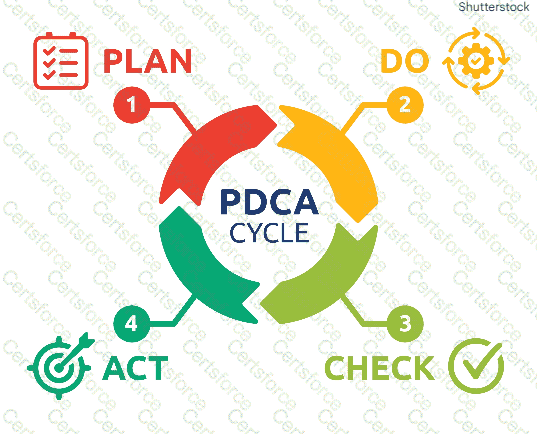
Analysis of Other Options:
A. prevention over inspection: This is a quality management principle which states that quality should be planned, designed, and built-in—not inspected-in. While PDCA helps achieve this, it is not the name for the PDCA cycle itself.
B. statistical sampling: This is a tool and technique used in Quality Control to choose part of a population of interest for inspection.
C. management responsibility: This is a concept emphasizing that the success of quality management requires the participation of all members of the team but remains the ultimate responsibility of management to provide the resources needed for success.
Which of the following sets are inputs to the Collect Requirements process?
Project charter and requirements documentation
Project charter and business documents
Project charter and stakeholder requirements
Business documents and requirements traceability matrix
According to the PMBOK® Guide (6th Edition), the Collect Requirements process is the process of determining, documenting, and managing stakeholder needs and requirements to meet project objectives. Because this process occurs early in the planning phase, it relies on high-level foundational documents to provide context.
The specific inputs for the Collect Requirements process include:
Project Charter: Used to provide the high-level project description and high-level requirements that will be used to derive detailed requirements.
Business Documents: Specifically the Business Case, which describes the required, desired, and optional criteria for meeting business needs.
Project Management Plan: (Specifically the Scope, Requirements, and Stakeholder Engagement management plans).
Project Documents: (Specifically the Stakeholder Register, Lessons Learned Register, and Assumption Log).
Agreements: If the project is under a contract.
EEFs and OPAs.
Analysis of Distractors:
A (Requirements documentation): This is an output of the Collect Requirements process, not an input. You cannot use the finished documentation to start the process of collecting them.
C (Stakeholder requirements): This is a category of requirements that are identified during the process. The input used to find these stakeholders is the Stakeholder Register.
D (Requirements traceability matrix): Like requirements documentation, the matrix is a primary output of this process. It is used later in the project to track requirements, but it does not exist until the Collect Requirements process is performed.
Key Concept: The Project Charter provides the " why " and the high-level " what, " while the Business Documents provide the economic and strategic justification. Together, they form the boundary within which detailed requirements are gathered.
Responsible, accountable, consult and inform (RACI) is an example of which of the following?
Text-oriented formal
Resource management plan
Organization chart
Responsibility assignment matrix (RAM)
According to the PMBOK® Guide (6th Edition), the RACI chart is a common type of Responsibility Assignment Matrix (RAM). A RAM uses a matrix format to show the relationship between work packages (or activities) and project team members.
The RACI model is specifically designed to ensure clear division of roles and responsibilities by using the following four statuses:
Responsible: The person who performs the work.
Accountable: The person ultimately answerable for the correct and thorough completion of the deliverable or task (only one person can be accountable for each task).
Consult: The people whose opinions are sought (two-way communication).
Inform: The people who are kept up-to-date on progress (one-way communication).
Analysis of Distractors:
A (Text-oriented format): These are used for documenting team member responsibilities that require detailed descriptions. Usually in paragraph form, they provide information such as responsibilities, authority, and qualifications. A RACI is a matrix, not text-oriented.
B (Resource management plan): The RACI chart is a component or an output used to help develop the Resource Management Plan, but it is not the plan itself. The plan is the broader document describing how all resources will be acquired and managed.
C (Organization chart): This is a hierarchical graphic display of project team members and their reporting relationships (e.g., an Organizational Breakdown Structure - OBS). It shows who reports to whom, but it does not map individuals to specific work activities like a RAM/RACI does.
Which type of contract gives both the seller and the buyer flexibility to deviate from performance with financial incentives?
Cost Plus Incentive Fee (CPIF)
Fixed Price Incentive Fee (FPIF)
Cost Pius Award Re (CPAF)
Time and Material (TandM)
In accordance with the PMBOK® Guide (Project Procurement Management), the Fixed Price Incentive Fee (FPIF) contract is a type of fixed-price contract that provides the buyer and seller with flexibility by allowing for deviations from performance, with financial incentives tied to achieving specific metrics.
Financial Incentives: In an FPIF contract, the buyer and seller agree on a target cost, a target profit, and a price ceiling. Financial incentives are typically related to cost, schedule, or technical performance of the seller.
Flexibility and Risk Sharing: This contract type allows for some flexibility in performance. If the seller performs more efficiently (e.g., underruns the target cost), both the buyer and seller share in the savings based on a pre-negotiated sharing formula (e.g., an 80/20 split).
Price Ceiling: To protect the buyer, a price ceiling is established. Any costs above this ceiling are the sole responsibility of the seller, who is then obligated to complete the work.
Point of Total Assumption (PTA): This is the cost point in the FPIF contract where the seller assumes all responsibility for cost overruns.
Analysis of Distractors:
A. Cost Plus Incentive Fee (CPIF): While this also uses financial incentives and a sharing formula, it is a Cost-Reimbursable contract. The buyer bears more risk because the seller is reimbursed for all allowable costs plus a fee. It does not have a " price ceiling " in the same way an FPIF does, making FPIF the primary choice for " fixed price " flexibility.
C. Cost Plus Award Fee (CPAF): In this type, the majority of the fee is earned based on the satisfaction of certain subjective performance criteria. The " Award " is determined solely by the buyer and is not usually a mathematical incentive formula for performance deviation.
D. Time and Material (TandM): These are hybrid contracts used for staff augmentation or when a precise statement of work cannot be quickly prescribed. They do not inherently use " incentive fees " for performance deviations; they simply pay a per-hour or per-item rate.
What quantitative risk analysis technique is used to select the optimum course of action from a number of alternatives?
Sensitivity analysis
Simulation
Decision tree analysis
Influence diagram
According to the PMBOK® Guide, specifically the Perform Quantitative Risk Analysis process, certain mathematical tools are used to evaluate uncertainty and make informed choices when faced with multiple paths.
Decision Tree Analysis: This is a diagramming and calculation technique used to evaluate several alternate courses of action. It uses Expected Monetary Value (EMV) to calculate the average outcome when the future includes uncertain scenarios.
Optimum Course of Action: By calculating the EMV for each " branch " of the tree (multiplying the probability of an event by its financial impact), the project manager can mathematically determine which path provides the highest value or the lowest cost to the organization.
Evaluation of Alternatives: It is particularly effective for " Make-vs-Buy " scenarios or " Upgrade-vs-Replace " decisions where different paths have different costs, risks, and potential rewards.
Why other options are incorrect:
Option A: Sensitivity analysis: This tool (often visualized as a Tornado Diagram) is used to determine which individual risks have the most potential impact on project outcomes. It identifies the " most sensitive " variables but does not help in choosing between different strategic paths.
Option B: Simulation: This usually refers to Monte Carlo analysis, which uses a computer model to simulate the project many times to show the probability of completing the project on a certain date or at a certain cost. It measures overall project risk rather than selecting between specific discrete alternatives.
Option D: Influence diagram: While these are used in risk analysis, they are graphical representations of situations showing causal influences, time ordering of events, and other relationships between variables. They help in modeling risk but are not the primary tool for calculating the " optimum course of action " among alternatives in the same way a Decision Tree is.
The definition of when and how often the risk management processes will be performed throughout the project life cycle is included in which risk management plan component?
Timing
Methodology
Risk categories
Budgeting
According to the PMBOK® Guide and the Standard for Project Management, specifically within the Plan Risk Management process, the Timing component of the Risk Management Plan defines when and how often the risk management processes will be performed throughout the project life cycle.
As per PMI standards, the Risk Management Plan is a subsidiary of the project management plan that describes how risk management activities will be structured and performed. The Timing section specifically addresses:
Frequency: How often risk identification, analysis, and monitoring will occur (e.g., weekly status meetings, monthly deep dives).
Project Life Cycle Integration: Establishing risk management activities at specific milestones or phases.
Timeline for Responses: Establishing how quickly a risk response must be implemented once a trigger is identified.
The other options are incorrect based on the following PMI definitions of Risk Management Plan components:
Methodology: This defines the specific approaches, tools, and data sources that will be used to perform risk management. It answers " how " the work will be done technically, rather than " when. "
Risk categories: This provides a means for grouping potential causes of risk. This is often documented using a Risk Breakdown Structure (RBS).
Budgeting: This establishes a budget for the project risk management activities and defines the specific protocols for the application of contingency and management reserves.
As per the PMI Lexicon of Project Management Terms, the Timing component ensures that risk management is not a one-time event but a continuous, integrated process that evolves as the project moves through its various stages.
Which basic quality tool explains a change in the dependent variable in relationship to a change observed in the corresponding independent variable?
Cause-and-effect diagram
Histogram
Control chart
Scatter diagram
According to the PMBOK® Guide, specifically within the Project Quality Management knowledge area, the Scatter Diagram is one of the seven basic quality tools used to analyze data.
Definition and Purpose: A scatter diagram (also known as a correlation chart) is used to explain a change in a dependent variable ($Y$) in relationship to a change observed in a corresponding independent variable ($X$). It plots pairs of numerical data, with one variable on each axis, to look for a relationship between them.
Correlation: If the variables are correlated, the points will fall along a line or curve. The better the correlation, the tighter the points will hug the line.
Positive Correlation: Both variables increase together.
Negative Correlation: One variable increases while the other decreases.
No Correlation: No apparent relationship exists between the variables.
Application: In project management, this tool is frequently used during the Manage Quality and Control Quality processes to identify the root cause of issues by seeing if a specific factor (like temperature, training hours, or pressure) is actually causing the observed defects or performance variations.
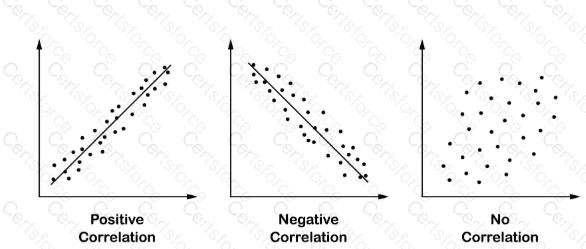
Comparison with other options:
A. Cause-and-effect diagram: Also known as a Fishbone or Ishikawa diagram. It is used to identify the various factors that might be causing a problem (root cause analysis), but it does not mathematically plot the relationship between two specific variables.
B. Histogram: A special form of a bar chart used to describe the central tendency, dispersion, and shape of a statistical distribution. it shows the frequency of occurrences but not the relationship between two different variables.
C. Control chart: Used to determine whether or not a process is stable or has predictable performance. It tracks a single variable over time against upper and lower control limits, rather than comparing two different variables against each other.
Which of the following are outputs of Develop Project Team?
Human resources plan changes and project staff assignment updates
Project management plan updates and enterprise environmental factor updates
Resource calendars and project management plan updates
Team performance assessments and enterprise environmental factor updates
According to the PMBOK® Guide, specifically the Develop Team process (part of the Resource Management knowledge area), the primary goal is to improve competencies, team member interaction, and the overall team environment to enhance project performance.
When a project manager successfully develops a team through training, team-building, and establishing ground rules, the following outputs are generated:
Team Performance Assessments: As the project team’s effectiveness increases, the project management team makes formal or informal assessments of the team ' s effectiveness. These measure improvements in skills, competencies, reduced staff turnover, and increased team cohesiveness.
Enterprise Environmental Factors (EEF) Updates: The " culture " or " climate " of the organization is an EEF. By developing the team, you are effectively updating the organization ' s internal factors, such as employee development records and skill updates.
A. Human resources plan changes...: " Human Resource Plan " is a term from older PMBOK versions; the current term is Resource Management Plan. While staff assignment updates are common in other resource processes, they are not the primary output of developing the existing team.
B. Project management plan updates...: While the Project Management Plan can be updated as a result of Develop Team, this option omits the most critical output (Team Performance Assessments).
C. Resource calendars...: Resource calendars are primarily an output of the Acquire Resources process, as they document when specific resources are available for work.
To reach these outputs, the project manager uses:
Colocation (Tight Matrix)
Virtual Teams
Communication Technology
Interpersonal and Team Skills (Conflict management, influencing, motivation)
Recognition and Rewards
Training
Which project document is updated in the Control Stakeholder Engagement process?
Project reports
Issue log
Lessons learned documentation
Work performance information
According to the PMBOK® Guide (Project Management Body of Knowledge), specifically within the Project Stakeholder Management knowledge area and the Monitor Stakeholder Engagement process (referred to as " Control Stakeholder Engagement " in some exam versions):
Issue Log (Option B): This is a primary project document updated during this process. As stakeholders are engaged and their concerns or requirements are addressed, new issues may be identified or existing issues may be resolved. The Issue Log is used to document and track these items, ensuring that someone is assigned to resolve them and that the resolution is communicated back to the relevant stakeholders.
Project Reports (Option A): While communication is a key part of stakeholder engagement, " Project Reports " are typically an input to the process (providing information to share) or an output of Monitor and Control Project Work. They are not classified as a " Project Document Update " in the specific context of this process ' s standardized outputs.
Lessons Learned Documentation (Option C): While lessons learned are captured throughout the project, the formal update to the Lessons Learned Register is more characteristic of the Manage Project Knowledge or Close Project or Phase processes.
Work Performance Information (Option D): This is a Work Performance Data transformation that occurs during the process, but it is classified as a Process Output, not a " Project Document Update. " Project document updates refer specifically to existing files like the Issue Log, Stakeholder Register, or Project Schedule.
In the PMI framework, the Issue Log serves as a critical tool for maintaining trust with stakeholders. By actively documenting and addressing their concerns, the Project Manager can manage expectations and ensure that project objectives remain aligned with stakeholder needs.
Which term describes an assessment of correctness?
Accuracy
Precision
Grade
Quality
According to the PMBOK® Guide (Project Management Body of Knowledge), specifically within the Project Quality Management knowledge area, it is critical to distinguish between several closely related terms used to describe the characteristics of project deliverables:
Accuracy (Option A): This is defined as an assessment of correctness. In the context of quality management, accuracy indicates how close a measured value is to the true or target value. If a project deliverable is " accurate, " it means it meets the specific requirement or intended measurement exactly.
Precision (Option B): This refers to consistency. Precision is a measure of exactness or how close successive measurements are to each other. It is possible to be precise (getting the same result every time) without being accurate (the result is consistently wrong).
Grade (Option C): This is a category assigned to deliverables having the same functional use but different technical characteristics (e.g., a " low-grade " software with limited features vs. a " high-grade " software with many features). Low grade is not necessarily a problem, but low quality always is.
Quality (Option D): This is the degree to which a set of inherent characteristics fulfills requirements. While accuracy is a component of quality, " Quality " itself is the over-arching category rather than the specific term for an assessment of correctness.
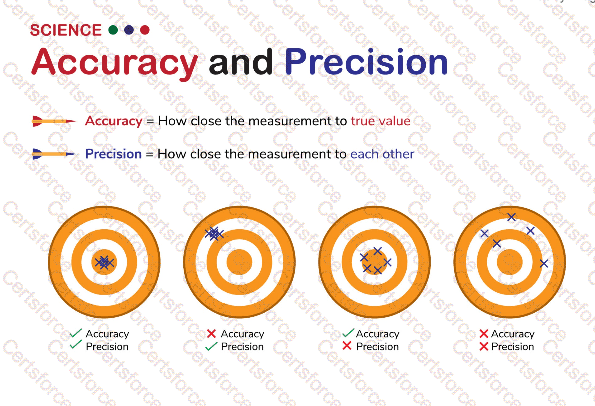
In the PMI framework, the Project Manager and the project team are responsible for determining the appropriate levels of accuracy and precision for the project. High accuracy is often required to ensure that the final product functions as intended and meets the stakeholder ' s " correctness " criteria defined in the Quality Management Plan.
Which type of management focuses on ensuring that projects and programs are reviewed to prioritize resource allocation?
Project
Functional
Program
Portfolio
According to the Standard for Portfolio Management by PMI, Portfolio Management is the centralized management of one or more portfolios to achieve strategic objectives. It focuses on ensuring that projects, programs, and other related work are reviewed to prioritize resource allocation and align with the organization ' s strategic goals.
Strategic Alignment: The primary goal of a portfolio is to ensure that the " right " work is being done. This involves identifying, prioritizing, authorizing, managing, and controlling projects and programs to ensure they align with the business strategy.
Resource Prioritization: Unlike project or program management, which focus on execution and " doing the work right, " portfolio management focuses on resource optimization across the entire organization. It ensures that limited resources (financial, human, and material) are allocated to the highest-priority initiatives that provide the most value.
Performance Review: Portfolio management involves continuous monitoring of the aggregate performance of all components. If a project no longer aligns with the shifting strategic goals of the company, portfolio management provides the framework to de-prioritize or terminate it to reallocate those resources elsewhere.
Comparison with Other Options:
Project Management (A): Focuses on achieving specific project objectives and deliverables within constraints like time, cost, and scope.
Functional Management (B): Focuses on providing oversight to a specific administrative or functional area of the business (e.g., Human Resources, Finance, or Engineering).
Program Management (C): Focuses on managing a group of related projects in a coordinated way to obtain benefits and control not available from managing them individually. While it involves resource coordination, it does not have the broad strategic prioritization authority of a portfolio.
Which of the following is an example of an organizational system that is arranged based on the job being performed?
Simple
Multi-divisional
Functional
Project-oriented
According to the PMBOK® Guide, organizational structures (part of the Organizational System) define how authority, roles, and responsibilities are assigned. A Functional organization is the classic structure where the hierarchy is arranged based on specialized departments or the " job being performed. "
Characteristics of a Functional Structure:
Staff are grouped by specialty, such as production, marketing, engineering, or accounting.
Each department has its own manager (Functional Manager) who has clear authority.
Project Managers in this environment typically have little to no authority and are often referred to as " Project Coordinators " or " Project Expeditors. "
The " Job Performed " Logic: Because the organization is segmented by expertise (e.g., all engineers in one silo, all HR professionals in another), work is funneled through these functional silos. Communication typically follows the hierarchy from the project manager up to the functional manager and across to other functional managers.
Analysis of Other Options:
A. Simple: This is often found in small businesses or startups where the structure is very flat. The project manager ' s authority might be high, but the organization isn ' t necessarily segmented by specialized job functions.
B. Multi-divisional: This structure consists of multiple self-contained divisions (e.g., by product line or geography). While divisions might contain functional departments, the structure itself is arranged by division rather than just by job function.
D. Project-oriented: In this structure, the organization is arranged by projects rather than functions. Most of the organization ' s resources are involved in project work, and project managers have a great deal of independence and authority.
Deciding the phases of a project life cycle would be considered a part of which of these knowledge areas?
Project Schedule Management
Project Scope Management
Project Resource Management
Project Integration Management
According to the PMBOK® Guide, deciding on the project life cycle and the phases that will make up that cycle is a fundamental task of Project Integration Management.
While phases naturally impact the schedule and the scope, the high-level decision regarding the " framework " of the project belongs to Integration because:
The Big Picture: Integration Management is responsible for the coordination of all other knowledge areas. Determining the life cycle (Predictive, Adaptive, or Hybrid) sets the stage for how all other processes (Scope, Schedule, Cost, etc.) will be managed.
Develop Project Management Plan: The selection of the project life cycle is a primary output of the tailoring process and is documented within the Project Management Plan. This plan is the central deliverable of the Integration Management knowledge area.
Phase Transitions: Integration Management involves managing the transition between phases (Phase Gates or Kill Points), ensuring that the project remains aligned with business objectives before moving from one phase to the next.
Analysis of other options:
A. Project Schedule Management: This area focuses on the specific timing of activities and milestones within the phases, but it does not define the overarching life cycle itself.
B. Project Scope Management: This area defines the work required to complete the project, but the phases represent the management structure around that work.
C. Project Resource Management: This area focuses on acquiring and managing the team and physical resources, which are utilized within the phases but do not define them.
Per PMI standards, the project manager acts as the primary integrator to ensure that the chosen Project Life Cycle is appropriate for the project ' s complexity, risk, and delivery requirements.
Inputs to the Plan Risk Management process include the:
cost management plan.
risk management plan,
activity list,
risk register.
According to the PMBOK® Guide, the Plan Risk Management process is the process of defining how to conduct risk management activities for a project. Because risk management requires resources and impacts the project ' s finances, it must be integrated with other management plans.
Cost Management Plan: This is a key input to Plan Risk Management. It provides processes and controls that can be used to help define how the risk budget will be allocated, how contingency reserves will be established, and how financial risks will be reported.
Other Key Inputs to Plan Risk Management:
Project Charter: Provides high-level boundaries and risks.
Project Management Plan: Includes other subsidiary plans like the Schedule Management Plan and Communications Management Plan.
Stakeholder Register: Identifies who the stakeholders are, which helps in determining their risk appetite and thresholds.
Enterprise Environmental Factors (EEFs): Such as the organization ' s risk attitudes and thresholds.
Organizational Process Assets (OPAs): Risk categories, templates, and lessons learned from past projects.
Analysis of Other Options:
B. risk management plan: This is the output of the Plan Risk Management process, not an input. It is the document that describes how risk management will be structured and performed.
C. activity list: This is an input to processes like Identify Risks, but it is too granular for the high-level Plan Risk Management process, which focuses on the methodology rather than individual tasks.
D. risk register: This is an output of the Identify Risks process. Since Plan Risk Management happens before you start identifying specific risks, the register does not yet exist.
The project manager is distributing project communications, collecting and storing project information, and retrieving documents when required. In which process is the project manager involved?
Monitor Communications
Plan Communications Management
Manage Communications
Manage Stakeholder Engagement
According to the PMBOK® Guide, the Manage Communications process is the stage where the project manager ensures that project information is collected, created, distributed, stored, retrieved, managed, controlled, and ultimately disposed of in an appropriate and timely manner.
This process is part of the Executing Process Group and focuses on the active movement of information. Key activities include:
Distribution: Getting the right information to the right stakeholders using the methods defined in the Communications Management Plan (e.g., emails, portals, or presentations).
Information Management: Ensuring that project artifacts are not just sent, but also organized and stored so they can be easily retrieved for audits, future phases, or lessons learned.
Effective Communication: Tailoring the message to the audience, including the choice of media, tone, and technical level.
Analysis of Other Options:
A. Monitor Communications: This is a Monitoring and Controlling process. Its purpose is to ensure the communication needs of the project and its stakeholders are met. It involves checking if the plan is working, rather than the act of distributing and storing the information itself.
B. Plan Communications Management: This is a Planning process. It involves developing the strategy and " rulebook " for how communications will be handled. The actual execution of that plan happens in Manage Communications.
D. Manage Stakeholder Engagement: While communication is a tool used here, this process specifically focuses on communicating and working with stakeholders to meet their needs/expectations and fostering appropriate stakeholder involvement. It is more about relationship management than the mechanical storage and retrieval of project documents.
The following is a network diagram for a project.
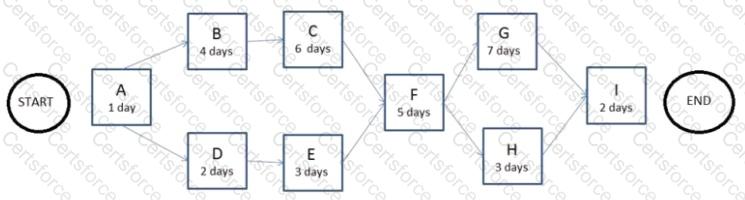
What is the critical path for the project?
A-B-C-F-G-I
A-B-C-F-H-I
A-D-E-F-G-I
A-D-E-F-H-I
The Critical Path Method (CPM) is used to estimate the minimum project duration and determine the amount of scheduling flexibility on the logical network paths within the schedule model.
Definition of Critical Path: According to PMI, the critical path is the longest sequence of activities through a project network diagram that determines the shortest possible project duration.
Total Float: Activities on the critical path have zero total float. Any delay in a critical path activity will delay the project finish date.
Calculation Steps:
Identify all possible paths from the start node (A) to the finish node (I).
Sum the durations of the activities along each specific path.
The path with the highest numerical total is the Critical Path.
How to solve this specific question:
Path A: A + B + C + F + G + I
Path B: A + B + C + F + H + I
Path C: A + D + E + F + G + I
Path D: A + D + E + F + H + I
To verify the answer, simply add the numbers associated with each letter in your diagram. The option (A, B, C, or D) that results in the largest sum is the verified critical path.
An intentional activity to modify a nonconforming product or product component is called:
defect repair
work repair
corrective action
preventive action
According to the PMBOK® Guide, specifically within the Perform Integrated Change Control and Direct and Manage Project Work processes, change requests are categorized into four types. The specific activity described is a defect repair.
Defect Repair: This is a formal, intentional activity to modify a nonconforming product or product component. It addresses a specific failure in quality where the deliverable does not meet the requirements or specifications.
The Change Process: Defect repairs typically result from the Control Quality process, where inspections identify that a result is incorrect. To fix the issue, a change request is issued and processed through the change control system.
Purpose: The goal of defect repair is to bring the nonconforming component into compliance with the original requirements.
Comparison with other options:
B. Work repair: This is not a formal term used in PMI standards; " defect repair " is the specific terminology for nonconforming products.
C. Corrective action: This is an intentional activity that realigns the performance of the project work with the project management plan. While similar, corrective action usually refers to fixing a process or a trend (e.g., getting the schedule back on track) rather than a physical nonconforming product.
D. Preventive action: This is an intentional activity that ensures the future performance of the project work is aligned with the project management plan. It is proactive and happens before a nonconformance occurs.
A team has been tasked with designing a product to address a problem they have never faced before. The project team is struggling to get traction as the solutions are not clear. What should the project manager do next?
Add the risk to the project risk register, as the lack of solutions could impact how the product is built.
Add the issue to the project issue log, as it will impact the project performance.
Facilitate a brainstorming session for the team to discuss ideas to solve the problem.
Meet with the project sponsor to understand their vision on how to address the problem.
According to the PMBOK® Guide, specifically the Collect Requirements and Develop Team processes, the project manager acts as a facilitator when the team faces technical ambiguity or " wicked problems " that lack clear solutions.
Facilitation and Brainstorming: When a team is " struggling to get traction " on a new problem, the Project Manager should utilize data-gathering techniques like Brainstorming. This creates a collaborative environment where diverse ideas can be surfaced without immediate judgment. It is the most effective way to jump-start the creative process and move from stagnation to action.
The Power of the Team: In both adaptive and predictive environments, the technical experts (the team) are best positioned to develop solutions. The PM’s role is not to provide the answer, but to provide the structure (the session) that allows the answer to emerge.
Divergent Thinking: Brainstorming encourages divergent thinking, which is essential when facing a problem the team has " never faced before. " Once a wide array of ideas is generated, the team can then use tools like Affinity Diagrams or Multicriteria Decision Analysis to narrow them down.
Analysis of other options:
Option A: While it is technically a risk, simply adding it to a Risk Register does nothing to solve the immediate problem of the team being stuck. Documentation is a secondary action to active problem-solving.
Option B: Adding it to the Issue Log tracks the problem but doesn ' t resolve it. The prompt asks what the PM should do next to get the team moving.
Option D: The Project Sponsor provides the " what " (the vision and funding) but generally should not be responsible for the " how " (the technical solution). Meeting with the sponsor for technical direction undermines the team ' s autonomy and expertise.
Per PMI standards, when a project hits a creative or technical roadblock, the project manager should immediately employ interpersonal and team skills to facilitate a Brainstorming session, empowering the team to innovate and find a path forward.
The activity tailoring is necessary because:
the members of the project team need to select the appropriate order of every tool, technique, input, and output listed in the PMBOK Guide, this is required for all projects
each project is unique, and the members of the project team should select the appropriate tools, techniques, inputs, and outputs from the PMBOK Guide
the members of the project team need to understand the PMBOK Guide processes, which are applied to all projects
each project is unique, and the project team must plain how to apply all the tools, techniques, inputs, and outputs in the PMBOK Guide
According to the PMBOK® Guide, Tailoring is the deliberate adaptation of the selected project management processes, inputs, tools, techniques, outputs, and life cycle phases to make them fit the specific environment and the work of the project.
Uniqueness of Projects: Every project is unique due to its specific objectives, stakeholders, complexity, risks, and organizational context. Because of this, it is neither practical nor efficient to use every single process or tool described in the PMBOK Guide for every project.
Team Responsibility: It is the responsibility of the project manager and the project management team to select only what is necessary to manage the project effectively. This prevents " over-management " and ensures that project resources are focused on activities that add value.
Framework vs. Methodology: The PMBOK Guide is a global standard and framework, not a rigid methodology. It provides a " menu " of best practices from which the team must choose based on the project’s needs.
Why other options are incorrect:
Option A: Tailoring is not about selecting a specific " order " for every single item in the guide for every project; it is about deciding what to include and what to exclude.
Option C: While the team needs to understand the processes, simply " understanding " them does not explain why tailoring is necessary. Furthermore, the processes are not applied to all projects in the same way.
Option D: This is incorrect because the team should not apply all tools, techniques, inputs, and outputs. Applying everything would result in unnecessary bureaucracy and wasted effort. Tailoring is the act of omitting unnecessary elements just as much as it is about selecting necessary ones.
Variance and trend analysis is a tool and technique used in which process?
Perform Qualitative Risk Analysis
Perform Quantitative Risk Analysis
Control Risks
Plan Risk Responses
According to the PMBOK® Guide, the process of Monitor Risks (referred to as Control Risks in earlier editions) involves tracking identified risks, monitoring residual risks, identifying new risks, and evaluating risk process effectiveness throughout the project.
Variance and Trend Analysis: This is a key Tool and Technique used to monitor the health of the project ' s risk status.
Variance Analysis: Compares the actual project results (in terms of cost, schedule, or technical performance) to the planned baselines. A significant deviation may indicate that an identified risk has occurred or that an unidentified risk is impacting the project.
Trend Analysis: Examines project performance over time to determine if performance is improving or deteriorating. In risk management, trends in performance can predict the likelihood of future risks or the effectiveness of current risk responses.
Purpose: By using these analyses, the project manager can determine if the project ' s risk profile is changing and if the contingency reserves for schedule or cost are still adequate.
Comparison with other options:
A. Perform Qualitative Risk Analysis: This process uses tools like the Probability and Impact Matrix and Risk Data Quality Assessment to prioritize risks.
B. Perform Quantitative Risk Analysis: This process uses computational tools like Monte Carlo Simulation, Decision Tree Analysis, and Sensitivity Analysis to numerically analyze the effect of identified risks.
D. Plan Risk Responses: This process focuses on developing options and actions to enhance opportunities and reduce threats, using techniques like Strategies for Threats (Escalate, Avoid, Transfer, Mitigate, Accept).
Which process uses expert judgment to manage project resources?
Plan Resource Management
Estimate Activity Resources
Manage Team
Both A and B
According to the PMBOK® Guide, Expert Judgment is a primary tool and technique used across multiple processes within the Project Resource Management knowledge area to ensure that resource planning and estimation are based on specialized knowledge and historical experience.
Plan Resource Management (Choice A): Expert judgment is used here to determine the best approach for identifying and managing resources. Experts provide insight into the organizational culture, the need for specialized skills, the legal requirements for labor, and the most effective ways to structure the Resource Management Plan.
Estimate Activity Resources (Choice B): Expert judgment is critical in this process to determine the specific types and quantities of material, human resources, equipment, or supplies required for each activity. Experts with experience in similar technical work can accurately predict how many resources are needed and what specific competencies are required to complete a task successfully.
Manage Team (Choice C): While a project manager uses interpersonal skills to manage a team, Expert Judgment is not formally listed as a primary tool/technique for the Manage Team process in the same way it is for the planning and estimation phases. Manage Team focuses more on Interpersonal and Team Skills (like conflict management and leadership).
Since both Plan Resource Management and Estimate Activity Resources officially utilize Expert Judgment as a defined Tool and Technique in the PMI framework, Choice D is the most accurate and comprehensive answer.
Managing procurement relationships and monitoring contract performance are part of which process?
Conduct Procurements
Plan Procurements
Administer Procurements
Close Procurements
According to the PMBOK® Guide, the process of managing procurement relationships, monitoring contract performance, and making changes and corrections as appropriate is defined as Administer Procurements (referred to as Control Procurements in more recent editions).
Core Functions: This process ensures that both the seller’s and buyer’s performance meets the procurement requirements according to the terms of the legal agreement.
Key Activities:
Monitoring Contract Performance: Verifying that the vendor is delivering what was promised within the agreed timeline and budget.
Managing Relationships: Maintaining a professional and functional working relationship between the buyer and the seller.
Financial Management: Managing payments to the seller (accounts payable).
Change Control: Processing contract amendments or change requests through the project’s integrated change control system.
Risk Monitoring: Identifying new risks arising from the procurement and monitoring existing ones.
Analysis of Other Options:
A. Conduct Procurements: This is the process of obtaining seller responses, selecting a seller, and awarding a contract. It is the " execution " of the procurement plan but occurs before administration/monitoring begins.
B. Plan Procurements: This is the initial planning process where the team decides what to buy, how to buy it, and identifies potential sellers.
D. Close Procurements: This is the process of completing each project procurement, including resolving open claims and finalizing the administrative aspects of the contract. It occurs after the administration/monitoring phase is complete.
An organization that is being interviewed online has recently experienced a severe network outage. Consequently, the organization has stated that it is required to have a working data network.
Which classification should be assigned to data network requirements?
Customer requirement
Transition requirement
Solution requirement
Business requirement
In the PMI Guide to Business Analysis and the PMBOK® Guide, requirements are categorized into a hierarchy to help the project team understand the " why, " the " what, " and the " how " of a project.
Why Choice D is correct:
High-Level Need: Business requirements describe the higher-level needs of the organization as a whole. They focus on the goals, objectives, and outcomes the organization wants to achieve.
Business Value: In this scenario, the organization " requires a working data network " to function and avoid the losses associated with severe outages. This is a foundational business need that justifies the existence of a project to upgrade or secure the network.
Strategic Alignment: Unlike technical specs, business requirements provide the rationale. For example: " The business must maintain 99.9% network uptime to ensure continuous operations. "
Analysis of other options:
A (Customer requirement): These are the needs and expectations of the external customer who will use the final product. While a working network benefits them, the prompt specifies the organization ' s own internal requirement following an outage.
B (Transition requirement): These are temporary capabilities needed to move from the " current state " to the " future state " (e.g., data migration or training). Once the transition is complete, these requirements are no longer needed. A " working data network " is a permanent operational need, not a temporary transition step.
C (Solution requirement): These are detailed descriptions of the features and functions of the product or service. They are divided into Functional (what the system does) and Non-functional (how the system performs, e.g., security, reliability). While " network uptime " is a solution requirement, the need for the network itself stems from the Business Requirement level.
Key Concept: The Project Management Institute (PMI) emphasizes that Business Requirements (Choice D) act as the " North Star. " They define the problem the organization is trying to solve (the network outage). All subsequent stakeholder and solution requirements must be traced back to this business requirement to ensure the project remains aligned with the organization ' s strategic health.
A project was sent for early customer testing and the customer reported that some of the features do not features do not meet the requirements. What should the project manager have done to avoid this scenario?
Engage customer earlier
Conduct quality audits
Validate Scope
Validate quality requirements
According to the PMBOK® Guide, the scenario describes a situation where deliverables reached the customer but failed to meet the specified requirements. This indicates a breakdown in the Manage Quality and Control Quality processes. To avoid this, the project manager should have conducted Quality Audits.
The Role of Quality Audits: A quality audit is a structured, independent process used to determine if project activities comply with organizational and project policies, processes, and procedures. It is a key tool in the Manage Quality process.
Prevention of Non-conformance: Audits help identify inefficient or ineffective policies being used on the project. By conducting these audits early and often, the project manager can ensure that the " process " of building the features is correct, which results in a product that actually meets the requirements.
Closing the Gap: Audits confirm the implementation of approved change requests and ensure that the team is following the Quality Management Plan. If the team was deviating from requirements, a quality audit would have flagged this internal inconsistency before the product ever reached the customer for testing.
Why other options are incorrect:
Option A: Engage customer earlier: While stakeholder engagement is important, the prompt specifies that the features did not meet requirements. This is a technical quality issue, not necessarily a communication issue. If the requirements were already documented, the team failed to build to those standards.
Option C: Validate Scope: This is the process of formalizing acceptance of the completed project deliverables by the customer. Validate Scope is where the customer found the problem. You cannot " Validate Scope " to avoid the problem; validation is the point where the failure is officially recognized.
Option D: Validate quality requirements: This is not a standard PMI process name. While you " Plan Quality Management " to define requirements, " validating " them usually refers to the internal verification of the deliverables themselves (Control Quality), which is governed by the processes checked during a Quality Audit.
What is the risk rating if the probability of occurrence is 0.30 and the impact if it does occur is moderate (0.20)?
0.03
0.06
0.10
0.50
According to the PMBOK® Guide (Project Management Body of Knowledge), specifically within the Project Risk Management knowledge area and the Perform Qualitative Risk Analysis process, risks are prioritized by calculating a risk score or rating.
The Calculation: The risk rating (also known as the risk score) is determined by multiplying the probability of the risk occurring by the impact it would have on project objectives if it does occur. The formula used is:
$$\text{Risk Rating} = \text{Probability} \times \text{Impact}$$
$$\text{Risk Rating} = 0.30 \times 0.20 = 0.06$$
Probability and Impact Matrix (Option B): This calculation is a standard component of the Probability and Impact Matrix, a tool used to rank risks as low, medium, or high. In this specific case, the mathematical result is 0.06.
PMI Context: The values for probability and impact are usually defined in the Risk Management Plan. By quantifying these qualitative descriptors (like " Moderate " ), the Project Manager can objectively compare different risks and focus the team ' s attention on the most critical threats or opportunities.
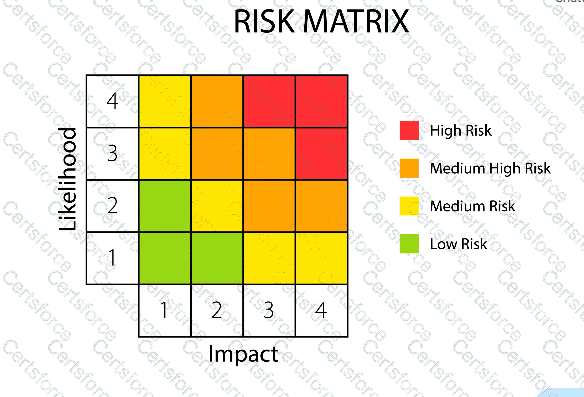
In the PMI framework, the Perform Qualitative Risk Analysis process allows for a quick and cost-effective way to prioritize risks, ensuring that the project team allocates resources to the most significant risks identified in the Risk Register.
The chart below is an example of a:
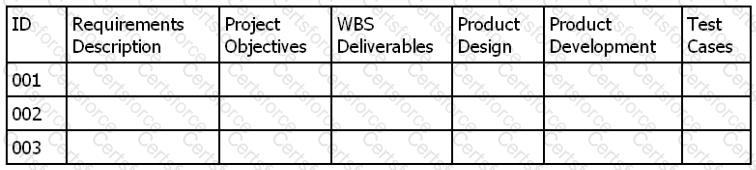
Responsibility assignment matrix (RAM)
Work breakdown structure (WBS)
RACI chart
Requirements traceability matrix
According to the PMBOK® Guide (Project Management Body of Knowledge), specifically within the Project Scope Management knowledge area and the Collect Requirements process:
Requirements Traceability Matrix (Option D): The image provided is a textbook example of a Requirements Traceability Matrix (RTM). An RTM is a grid that links product requirements from their origin to the deliverables that satisfy them. As shown in the chart, it tracks the ID and Requirements Description through various stages of the project life cycle, including Project Objectives, WBS Deliverables, Product Design, Product Development, and Test Cases. This ensures that each requirement adds business value and that all requirements are accounted for at the end of the project.
Responsibility Assignment Matrix (RAM) / RACI Chart (Options A and C): These are tools used in Project Resource Management. They map project work packages to the individuals or groups responsible for them (Responsible, Accountable, Consulted, Informed). They do not track technical requirements or product design stages.
Work Breakdown Structure (WBS) (Option B): A WBS is a hierarchical decomposition of the total scope of work to be carried out by the project team. It is typically displayed as a tree diagram or an indented list of work packages, not a horizontal matrix tracking the development lifecycle of specific requirements.
In the PMI framework, the Requirements Traceability Matrix is essential for managing scope creep. It provides a means to track requirements throughout the project life cycle, ensuring that requirements approved in the charter and scope statement are actually delivered and tested.
One of the outputs of the project schedule is a detailed plan. What is the main purpose of that detailed plan?
It represents how and when the project will deliver the products, services, and results defined in the project scope
It creates a formal record of the project and shows the organizational commitment to the project
It describes how the scope will be defined, developed, monitored, controlled and validated
It provides the needs of a stakeholder or stakeholder group
Based on the PMBOK® Guide, specifically the Develop Schedule process, the resulting schedule (the detailed plan) serves as a communication tool and a model for executing the project.
Primary Purpose (Choice A): The Project Schedule is an output of the schedule model that presents linked activities with planned dates, durations, milestones, and resources. Its core function is to provide a timeline that demonstrates how and when the project will deliver the objectives and scope defined in the project scope statement. It acts as a roadmap for the project team and a baseline for tracking progress.
Project Charter (Choice B): This description refers to the Project Charter. The charter is the document that formally authorizes the existence of a project and provides the project manager with the authority to apply organizational resources to project activities.
Scope Management Plan (Choice C): This describes the Scope Management Plan. This plan is a component of the project management plan that establishes how the scope will be defined, developed, monitored, controlled, and validated.
Requirements Documentation (Choice D): This describes Requirements Documentation, which captures the business, stakeholder, and solution requirements necessary to meet the project objectives.
The Project Schedule is distinct from the Schedule Management Plan. While the plan dictates how the schedule will be managed, the schedule itself (the output of Develop Schedule) provides the specific dates and sequences required for delivery.
Which schedule method allows the project team to place buffers on the project schedule path to account for limited resources and project uncertainties?
Critical path method
Critical chain method
Resource leveling
Schedule network analysis
The Critical Chain Method (CCM) is a schedule method that focuses on the management of remaining project durations and resources. According to the PMBOK® Guide and related PMI standards, it differs from the Critical Path Method by accounting for resource availability and uncertainties through the use of buffers.
Buffers: Instead of adding safety margins to every individual task (which often leads to " student syndrome " or procrastination), CCM aggregates the uncertainty into specific buffers.
Project Buffer: Placed at the very end of the critical chain to protect the target delivery date from slippage along the main sequence of tasks.
Feeding Buffers: Placed at points where non-critical chains of tasks merge into the critical chain, ensuring that delays in supporting tasks do not stall the primary schedule.
Resource Constraints: While the Critical Path Method (CPM) focuses on logical dependencies, the Critical Chain Method develops a schedule that is both logically and resource-constrained. The " critical chain " is defined as the longest sequence of tasks that considers both task dependencies and resource limitations.
Comparison with other options:
A. Critical path method: This calculates the theoretical early and late start/finish dates based on logical paths but does not inherently account for resource limitations or use buffers in this specific manner.
C. Resource leveling: This is a technique used to adjust start and finish dates based on resource constraints, often resulting in the critical path changing or lengthening, but it is not a " method " defined by the placement of buffers for uncertainty.
D. Schedule network analysis: This is the overarching technique of identifying the project ' s schedule, which includes methods like CPM and CCM, but is not the specific method described in the prompt.
Based on a previous project that has been completed, a project manager decides the best way to estimate costs is through historical data. What kind of estimating is this?
Three-point
Bottom-up
Parametric
Analogous
According to the PMBOK® Guide, specifically the Estimate Costs and Estimate Activity Durations processes, project managers have several techniques at their disposal to predict the resources required for a project.
Why Choice D is correct: Analogous Estimating (also known as top-down estimating) uses the actual values (such as cost, budget, duration, or size) from a previous, similar project as the basis for estimating the same parameter for the current project.
Historical Data: It relies heavily on historical information and expert judgment.
Speed and Cost: It is generally less costly and time-consuming than other techniques, making it ideal for the early phases of a project when there is a limited amount of detailed information.
Accuracy: While faster, it is typically less accurate than bottom-up estimating and is most reliable when the previous projects are truly similar in nature and not just in appearance.
Analysis of other options:
A (Three-point): This technique improves accuracy by considering uncertainty and risk. It uses three estimates: Most Likely ($cM$), Optimistic ($cO$), and Pessimistic ($cP$). It does not rely solely on a single historical project ' s data.
B (Bottom-up): This involves estimating the cost of individual work packages or activities and then " rolling them up " to higher levels. It is the most accurate but also the most time-consuming and requires a fully decomposed WBS.
C (Parametric): This uses a statistical relationship between historical data and other variables (e.g., square footage in construction, lines of code in software) to calculate an estimate. For example, if it cost $100 per square foot in a previous project, and the current project is 1,000 square feet, the estimate is $100,000. It is a calculation-based method rather than just a direct comparison.
Key Concept:
The Project Management Institute (PMI) emphasizes that Analogous Estimating (Choice D) is a form of expert judgment. It is the go-to method when the project manager needs a quick " ballpark " figure based on organizational process assets (historical project files) before more granular data is available for a bottom-up approach.
Which of the following schedule network analysis techniques is applied when a critical path method calculation has been completed and resources availability is critical?
Applying calendars
Resource leveling
Resource planning
Resource conflict management
According to the PMBOK® Guide, specifically within the Develop Schedule process, Resource Leveling is a schedule network analysis technique used after the initial Critical Path Method (CPM) has been performed.
Definition and Purpose: Resource leveling is a technique in which start and finish dates are adjusted based on resource constraints with the goal of balancing the demand for resources with the available supply. It is used when shared or critical required resources are only available at certain times, in limited quantities, or have been over-allocated.
The Critical Path Connection: Unlike Resource Smoothing (which does not change the critical path), Resource Leveling can often cause the original critical path to change, usually resulting in a longer project duration. It is specifically applied when " resource availability is critical. "
Key Characteristics:
It is used to address resource over-allocation.
It may result in a change (usually an extension) of the project ' s finish date.
It is a " resource optimization technique. "
Analysis of Other Options:
A. Applying calendars: Project and resource calendars are inputs to the scheduling process that define when work can occur, but they are not the analytical technique used to balance resource-constrained schedules.
C. Resource planning: This is a general term often associated with the Plan Resource Management process (identifying what is needed), rather than a specific schedule network analysis technique applied to a completed CPM.
D. Resource conflict management: This is a " Soft Skill " or " Interpersonal Skill " used to handle disagreements among team members; it is not a mathematical or technical scheduling method.
Outputs of the Control Communications process include:
expert judgment and change requests
work performance information and change requests
project management plan updates and work performance information
issue logs and organizational process assets updates
According to the PMBOK® Guide, the Monitor Communications process (referred to in earlier versions as Control Communications) is the process of ensuring the information needs of the project and its stakeholders are met.
Work Performance Information (WPI): This is a primary output. It involves taking the raw work performance data collected during execution and comparing it against the communications management plan. For example, it might include data on the effectiveness of communication activities, such as whether stakeholders are receiving and understanding the reports as planned.
Change Requests: If the monitoring process identifies that the current communication strategy is ineffective—perhaps a stakeholder is not receiving critical updates or the chosen medium is causing delays—the project manager will issue a change request. This could lead to updates in the Communications Management Plan or other components of the Project Management Plan.
Other Outputs: These include updates to the Project Management Plan (specifically the Communications Management Plan and Stakeholder Engagement Plan) and updates to Project Documents (such as the Issue Log and Stakeholder Register).
Comparison with other options:
A. Expert judgment: This is a Tool and Technique used to assess the communication requirements and the influence of stakeholders, not an output.
C. Project management plan updates and work performance information: While both are technically outputs, the standard pair often emphasized in PMI examinations for the " Control " or " Monitor " phase of any knowledge area is the generation of Work Performance Information and the resulting Change Requests.
D. Issue logs and organizational process assets updates: These are Project Document Updates and OPA Updates, respectively. While they can occur, they are secondary to the primary functional outputs of WPI and Change Requests that drive the project ' s corrective actions.
What purpose does the hierarchical locus of stakeholder communications serve?
Maintains the focus on project and organizational stakeholders
Preserves the tocus on external stakeholders—such as customers and vendors—as well as on other projects
Sustains the focus on general communication activities using email, social media, and websites
Keeps the focus on the position of the stakeholder or group with respect to the project team
According to the PMBOK® Guide (6th Edition), specifically within the Project Communications Management knowledge area, communication must be tailored based on the direction and position of the stakeholders. The term " hierarchical locus " refers to the position or " place " a stakeholder occupies in relation to the project team within the organizational or project hierarchy.
Effective communication management requires the project manager to recognize these different directions to ensure the tone, level of detail, and delivery method are appropriate. These directions include:
Upward: Communication with senior management, sponsors, and steering committees.
Downward: Communication with the team members and experts who are contributing to the project.
Outward: Communication with stakeholders outside the project team, such as customers, vendors, and regulators.
Sideward: Communication with the project manager’s peers or middle management who are competing for the same resources.
Why Answer D is correct: The " hierarchical locus " is essentially a mapping of where the stakeholder sits. By keeping the focus on the position of the stakeholder or group with respect to the project team, the project manager can adjust their communication strategy to be more effective (e.g., providing high-level summaries for upward communication vs. detailed technical tasks for downward communication).
Analysis of Distractors:
A and B: These describe specific subsets of stakeholders (internal vs. external). While the hierarchical locus includes these, the purpose of the locus itself is the broader classification of their position/direction relative to the team, not just focusing on one group.
C: This describes communication channels or media (social media, websites). These are the methods used to communicate, but they do not define the hierarchical relationship or " locus " of the stakeholder.
