
Impacts to other organizational areas, levels of service, and acceptance criteria are typical components of which document?
Business case
Work breakdown structure
Requirements documentation
Risk register
According to the PMBOK® Guide, specifically within the Collect Requirements process, the Requirements Documentation describes how individual requirements meet the business need for the project.
Components of Requirements Documentation: Requirements can start at a high level and become progressively more detailed as more information is known. A well-structured requirements document typically includes:
Business requirements: Higher-level organizational needs.
Stakeholder requirements: Needs of a stakeholder or stakeholder group.
Solution requirements (Functional and Non-functional): Functional requirements describe the behaviors of the product, while non-functional requirements describe the environmental conditions or qualities required for the product to be effective (e.g., levels of service, performance, safety, security).
Project requirements: These include acceptance criteria and transition requirements.
Impacts to other organizational areas: This identifies how the project ' s result will affect other entities within the organization, such as the help desk, sales department, or existing infrastructure.
Comparison with other options:
A. Business case: This document focuses on the economic feasibility of the project and the cost-benefit analysis. While it justifies the project, it does not typically contain detailed acceptance criteria or specific levels of service.
B. Work breakdown structure (WBS): This is a deliverable-oriented hierarchical decomposition of the work to be executed. It shows " what " is being built but does not describe the qualitative requirements or impacts like levels of service.
D. Risk register: This document records identified risks, their analysis, and response plans. While an impact to another area could be a risk, the formal definition of these elements (especially service levels and acceptance criteria) resides in the requirements documentation.
Which Knowledge Area is concerned with the processes required to ensure timely and appropriate generation, collection, distribution, storage, retrieval, and ultimate disposition of project information?
Project Integration Management
Project Communications Management
Project Information Management System (PIMS)
Project Scope Management
According to the PMBOK® Guide, Project Communications Management is the Knowledge Area that includes the processes required to ensure that the information needs of the project and its stakeholders are met through the development of artifacts and the implementation of activities designed to achieve effective information exchange.
Core Responsibilities: This Knowledge Area consists of three primary processes:
Plan Communications Management: Developing an appropriate approach and plan for project communications based on stakeholders’ information needs and requirements.
Manage Communications: The process of ensuring timely and appropriate collection, creation, distribution, storage, retrieval, management, monitoring, and ultimate disposition of project information.
Monitor Communications: The process of ensuring the information needs of the project and its stakeholders are met.
The " Information Life Cycle " : The definition provided in the question—covering generation, collection, distribution, storage, retrieval, and disposition—is the formal PMI definition of the scope of Communications Management. It ensures that the right message reaches the right person at the right time via the right channel.
Comparison with other options:
A. Project Integration Management: This Knowledge Area is focused on identifying, defining, combining, unifying, and coordinating the various processes and project management activities. While it coordinates information, it is not specifically dedicated to the mechanics of information " distribution and storage. "
C. Project Information Management System (PIMS): This is not a Knowledge Area. It is a tool and technique (often part of the wider Project Management Information System or PMIS) used within the Communications and Integration Knowledge Areas to facilitate the storage and retrieval of information.
D. Project Scope Management: This Knowledge Area is concerned with ensuring that the project includes all the work required, and only the work required, to complete the project successfully. It deals with " what " is being built, not " how " information about it is distributed.
How is program success measured?
By delivering the benefit of managing the program ' s projects in a coordinated manner
By the quality, timeliness, cost-effectiveness, and customer satisfaction of the product or service
By completing the right projects to achieve objectives rather than completing projects the right way
By aggregating the successes of the individual projects in the program
According to the PMBOK® Guide and the Standard for Program Management, a program is defined as a group of related projects, subprograms, and program activities managed in a coordinated way to obtain benefits not available from managing them individually. Consequently, the measurement of its success is fundamentally different from project success.
Benefit Realization: The primary measure of program success is its ability to deliver the intended strategic benefits and the degree of efficiency achieved by the coordinated management of its components.
Coordinated Effort: If three projects are managed under a program, success isn ' t just finishing all three; it is the synergy created between them—such as shared resources reducing overall costs or integrated deliverables creating a new organizational capability that a single project could not produce.
Strategic Impact: Program success is often measured by how well the program realized the " Business Case " and how effectively it transitioned those benefits into the organization ' s ongoing operations.
Why other options are incorrect:
Option B: By the quality, timeliness, cost-effectiveness, and customer satisfaction: This is the traditional definition of Project Success. Projects are measured by " Triple Constraint " (scope, time, cost) and meeting specific technical requirements.
Option C: By completing the right projects to achieve objectives: This describes Portfolio Success. Portfolios focus on high-level strategic alignment—choosing the " right work " to do—rather than the coordinated delivery of related work.
Option D: By aggregating the successes of the individual projects: This is a common trap. A program can have several successful projects but still be a " failure " if the projects were not coordinated effectively or if the overarching strategic benefit (the reason the program existed) was never realized.
The project leam is brainstorming on approaches to deliver the upcoming product launch for which the project has been chartered. The project manager is laying out hybrid, adaptive, iterative methods. What is the team trying to address?
Co-location
Lite-cycle
Diversity
Management
According to the PMBOK® Guide, the choice between hybrid, adaptive (agile), iterative, and predictive (waterfall) methods refers to the Project Life Cycle. A life cycle is the series of phases that a project passes through from its start to its completion. It provides the basic framework for managing the project.
When a project manager is evaluating these specific methods, they are determining the Development Life Cycle best suited for the product, service, or result:
Predictive (Waterfall): Scope, time, and cost are determined in the early phases of the life cycle.
Iterative: Scope is generally determined early, but time and cost estimates are routinely modified as the team ' s understanding of the product increases.
Adaptive (Agile): Change-driven or agile; the detailed scope is defined and approved before the start of an iteration.
Hybrid: A combination of a predictive and an adaptive life cycle.
Why Option B is correct: The terms " hybrid, " " adaptive, " and " iterative " are the standard classifications used to describe the nature and cadence of the project ' s life cycle. Selecting the correct life cycle ensures the project management approach aligns with the complexity and uncertainty of the project ' s requirements.
Analysis of Distractors:
A (Co-location): This refers to the physical placement of team members (working in the same room or office) to improve communication. It is a resource management technique, not a delivery methodology.
C (Diversity): This usually refers to the composition of the project team or stakeholder group regarding different backgrounds and perspectives. While important for team performance, it does not describe delivery methods.
D (Management): While the project manager " manages " the project, this term is too broad. The specific technical term for the structure of delivery (hybrid/adaptive) is the " Life-cycle. "
Which technique is commonly used for the Perform Quantitative Risk Analysis process?
Brainstorming
Strategies for opportunities
Decision tree analysis
Risk data quality assessment
According to the PMBOK® Guide, the Perform Quantitative Risk Analysis process is the process of numerically analyzing the effect of identified risks on overall project objectives. This process uses mathematical models to provide a quantitative approach to making decisions in the presence of uncertainty.
Decision Tree Analysis: This is a core tool and technique of Quantitative Risk Analysis. It is a diagramming and calculation technique for evaluating the implications of a chain of multiple options in the presence of uncertainty. It uses Expected Monetary Value (EMV) analysis to help the project manager calculate the average outcome when the future includes scenarios that may or may not happen.
Other Quantitative Techniques:
Monte Carlo Simulation: Used to project the probability of achieving specific cost or schedule targets.
Sensitivity Analysis: Often displayed as a Tornado Diagram to determine which risks have the most potential impact on the project.
Distinction from Qualitative Analysis: Quantitative analysis is more complex and data-driven than Qualitative analysis. It is often reserved for large, complex projects or risks that require a high degree of confidence in the contingency reserves.
Analysis of Other Options:
A. Brainstorming: This is a tool used primarily in Identify Risks, not the numerical analysis of the risks.
B. Strategies for opportunities: These (Exploit, Share, Enhance, Accept) are used in the Plan Risk Responses process.
D. Risk data quality assessment: This is a technique used in Perform Qualitative Risk Analysis to evaluate the degree to which the data about risks is useful for risk management.
Which is the correct formula for calculating expected activity cost for three-point estimating?
Ce = (C0 + 6Cm + Cp)/4
Ce = (6C0 + Cm + Cp)/4
Ce = (C0 + 4Cm + Cp)/6
Ce = (C0 + C„, + 4Cp) / 6
According to the PMBOK® Guide, specifically within the Estimate Costs process, Three-point estimating is used to define an approximate range for an activity ' s cost, thereby improving the accuracy of the estimate by factoring in uncertainty and risk.
The formula provided in option C is the Beta Distribution, which is historically derived from the Program Evaluation and Review Technique (PERT). This is the most commonly used formula in PMI-based exams when " Three-point estimating " is mentioned without specifying a simple average.
The variables are defined as:
$C_e$ (Expected Cost): The calculated " weighted " average.
$C_o$ (Optimistic Cost): The cost based on a best-case scenario.
$C_m$ (Most Likely Cost): The cost based on a realistic appraisal of the work and expenses.
$C_p$ (Pessimistic Cost): The cost based on a worst-case scenario.
In the Beta Distribution, the Most Likely ($C_m$) estimate is given a weight of 4, while the Optimistic and Pessimistic estimates are given a weight of 1 each. The total weight is 6 ($1 + 4 + 1$), which is why the sum is divided by 6. This " weights " the result toward the most realistic outcome while still allowing the risks (pessimistic) and opportunities (optimistic) to influence the final number.
A, B, and D: These represent mathematically incorrect weightings that do not align with the standard Beta (PERT) or Triangular distribution formulas recognized by PMI.
Triangular Distribution (Alternative): While not listed as an option here, the other common three-point formula is the simple average: $C_e = (C_o + C_m + C_p) / 3$. This is used when there is less historical data available.
This formula is identical to the one used for Three-point Duration Estimating, simply swapping " Time " ($t$) for " Cost " ($c$). It is a primary tool for reducing the bias that often occurs with single-point estimates.
Which of the following correctly explains the term " progressive elaboration ' ?
Changing project specifications continuously
Elaborate tracking of the project progress
Elaborate tracking of the project specifications with a change control system
Project specifications becoming more explicit and detailed as the project progresses
According to the PMBOK® Guide, Progressive Elaboration is a fundamental characteristic of projects that integrates the concepts of temporary and unique.
Definition: It is the process of continuously improving and detailing a plan as more detailed information and more accurate estimates become available. It allows a project management team to define work and manage it to a greater level of detail as the project evolves.
Mechanism: In the early stages of a project, the project scope is defined broadly. As the project team better understands the objectives and the deliverables, the specific requirements and work packages are " elaborated " or broken down further. This is most commonly seen in the development of the WBS and Rolling Wave Planning.
Distinction from Scope Creep: It is important to distinguish progressive elaboration from " Scope Creep " (Option A). Progressive Elaboration is a planned, systematic refinement of the existing scope, whereas Scope Creep is the uncontrolled expansion of project scope without adjustments to time, cost, and resources.
Analysis of Other Options:
A. Changing project specifications continuously: This describes " Scope Creep " or lack of change control, which is a negative project state.
B. Elaborate tracking of the project progress: This refers to " Monitoring and Controlling " activities, such as using Earned Value Management, but is not progressive elaboration.
C. Elaborate tracking of the project specifications with a change control system: This describes " Configuration Management " or " Change Control, " which manages changes to the baseline rather than the natural refinement of project details.
A project management office manages a number of aspects including the:
Project scope, schedule, cost, and quality of the products of the work packages.
Central coordination of communication management across projects.
Assignment of project resources to best meet project objectives.
Overall risk, overall opportunity, and interdependencies among projects at the enterprise level.
According to the PMBOK® Guide, a Project Management Office (PMO) is an organizational structure that standardizes the project-related governance processes and facilitates the sharing of resources, methodologies, tools, and techniques.
While the specific responsibilities of a PMO can range from providing project management support functions to actually being responsible for the direct management of one or more projects, a primary function is the central coordination of communication management across projects.
Coordination Role: The PMO acts as a bridge between the strategic level of the organization and the project execution level. It ensures that communication flows consistently across various projects to maintain alignment with organizational goals.
Support and Governance: PMOs often manage shared resources, identify and develop project management methodologies, and provide coaching, mentoring, and oversight.
Types of PMOs:
Supportive: Provides templates and best practices but has low control.
Controlling: Requires compliance with frameworks and tools; has moderate control.
Directive: Actually manages the projects; has high control.
Analysis of other choices:
Choice A (Project scope, schedule, cost, etc.): These are the primary responsibilities of the Project Manager, not necessarily the PMO. While a " Directive PMO " might handle these, it is not the defining characteristic of PMOs in general.
Choice C (Assignment of project resources): While a PMO might facilitate resource sharing, the actual assignment of resources to specific project objectives is typically a negotiation between the Project Manager and Functional Managers.
Choice D (Overall risk and interdependencies at the enterprise level): This more accurately describes Portfolio Management or Enterprise Project Management (EPM). While a PMO may support this, managing enterprise-level interdependencies is a broader strategic function.
Enterprise environmental factors are an input to which process?
Control Scope
Define Scope
Plan Scope Management
Collect Requirements
According to the PMBOK® Guide, specifically the mapping of inputs, tools, techniques, and outputs (ITTOs), Enterprise Environmental Factors (EEFs) serve as a formal input to the Plan Scope Management process.
Plan Scope Management: This is the process of creating a scope management plan that documents how the project and product scope will be defined, validated, and controlled.
Role of EEFs: Because this process sets the framework for all other scope activities, it must account for external and internal factors such as the organization ' s culture, infrastructure, personnel administration, and marketplace conditions. These factors influence how scope will be managed (e.g., a highly bureaucratic organization will require more formal scope change procedures than a startup).
Consistency across Planning: In PMI methodology, EEFs are standard inputs to almost all Planning processes across different Knowledge Areas, as they provide the context and constraints within which the plans must be developed.
Why the other options are incorrect:
A. Control Scope: This is a Monitoring and Controlling process. The inputs here are typically the Project Management Plan, project documents, work performance data, and Organizational Process Assets (OPAs). EEFs are generally not an input to the " Control " phase of scope.
B. Define Scope: The inputs for this process include the Project Charter, Project Management Plan, and various project documents (like the Requirements Documentation). While EEFs influence the project, they are not listed as a standard formal input for the specific process of writing the Project Scope Statement.
D. Collect Requirements: Similar to Define Scope, this process relies on the Project Charter, Project Management Plan, and Project Documents. It focuses on gathering stakeholder needs rather than the environmental constraints provided by EEFs.
What is the primary purpose of Project Scope Management?
Determining and managing stakeholder needs
Contorting the status of the product scope and managing changes to its be seine
Defining and controlling what is and is not included in the project
Differentiating between the product scope and project scope
According to the PMBOK® Guide, the primary purpose of Project Scope Management is to ensure that the project includes all the work required, and only the work required, to complete the project successfully.
Defining Boundaries: This knowledge area is primarily concerned with defining and controlling what is and is not included in the project. By establishing clear boundaries, the project manager prevents " Scope Creep, " which is the unauthorized expansion of the project scope without adjustments to time, cost, and resources.
Work Containment: It focuses on managing the project ' s perimeter. This involves the creation of a Project Scope Statement, the Work Breakdown Structure (WBS), and the WBS Dictionary, which collectively form the Scope Baseline.
Analysis of other options:
Option A: Determining and managing stakeholder needs is a part of the Collect Requirements process. While it is a process within Scope Management, it is not the overarching purpose of the entire knowledge area.
Option B: This likely contains a typo (intended to be " Controlling " ). While controlling the status and managing changes is part of the Control Scope process, it is a subset of the primary goal of defining the scope in the first place.
Option D: While the knowledge area does differentiate between product scope (features/functions) and project scope (work to be done), this differentiation is a requirement for successful management, not the primary purpose of the management itself.
Per PMI standards, effective Scope Management provides the foundation for schedule and cost estimates. If the project manager does not clearly define what is out of scope, the project risks failure due to uncontrolled growth and resource exhaustion.
A project manager has the task of determining the deliverables for a six-month project using a predictive approach. How should the project manager determine which processes to include in the project management plan?
Follow organizational methodology and produce all required deliverables.
Discuss the processes and deliverables needed to meet the project objectives with the team.
Identify the processes and deliverables for only the current phase first.
Integrate hybrid approach processes and deliverables to meet the short delivery timeline.
According to the PMBOK® Guide, specifically within the Develop Project Management Plan and Plan Scope Management processes, determining the right " fit " for a project is a collaborative effort known as Tailoring.
The Importance of Tailoring: Even in a predictive (waterfall) approach, project management is not a " one size fits all " endeavor. The project manager should not blindly follow every possible process. Instead, they must determine which processes, inputs, tools, techniques, and outputs are necessary to manage the specific project at hand.
Team Collaboration: The project manager works with the project team to determine the work required and the deliverables needed to meet the project objectives. Because the team members are the subject matter experts (SMEs) who will actually perform the work, their input is vital to ensuring that the deliverables are realistic and that the processes selected add value rather than unnecessary bureaucracy.
Meeting Objectives: The ultimate goal of the project management plan is to define how the project will be executed, monitored, and controlled to achieve its specific goals. Discussing this with the team ensures alignment and commitment to the project’s success.
Analysis of other options:
Option A: While following organizational methodology is important, simply producing " all required deliverables " without tailoring can lead to inefficiency. The project manager must first determine which deliverables are truly required for this specific six-month scope.
Option C: This describes Rolling Wave Planning or a multi-phase approach. While useful for long-term projects, the prompt asks how to determine processes for the project management plan (which typically covers the entire project scope in a predictive approach), not just the immediate phase.
Option D: The prompt explicitly states the project is using a predictive approach. Forcing a hybrid approach solely because of a " short delivery timeline " (six months is often a standard duration for predictive projects) contradicts the premise of the question.
Per PMI standards, the project manager is responsible for Tailoring the project management processes. This is best done by leveraging the expertise of the project team to ensure the most efficient path toward meeting the project ' s strategic objectives.
Which process involves identifying and documenting the logical relationships between project activities?
Develop Schedule
Sequence Activities
Create WBS
Applying leads and lags
According to the PMBOK® Guide, the process of identifying and documenting the logical relationships between project activities is the formal definition of Sequence Activities.
Core Objective: The primary purpose of this process is to define the logical sequence of work to obtain the greatest efficiency given all project constraints. Every activity and milestone (except the first and last) should be connected to at least one predecessor and one successor.
Logical Relationships (Dependencies): This process identifies how tasks relate to one another using four types of dependencies:
Finish-to-Start (FS): The successor activity cannot start until the predecessor activity has finished (the most common type).
Finish-to-Finish (FF): The successor activity cannot finish until the predecessor activity has finished.
Start-to-Start (SS): The successor activity cannot start until the predecessor activity has started.
Start-to-Finish (SF): The successor activity cannot finish until the predecessor activity has started (rarely used).
Tools and Techniques: The main tool used here is the Precedence Diagramming Method (PDM), which is used to create a project schedule network diagram.
Comparison with Other Options:
Develop Schedule (A): This is the subsequent process that analyzes activity sequences, durations, resource requirements, and schedule constraints to create the actual project schedule model.
Create WBS (C): This is a scope management process that breaks down deliverables into work packages; it does not deal with the timing or logical order of tasks.
Applying leads and lags (D): While this is a tool/technique used within the Sequence Activities process to refine the relationships, it is not the name of the process itself.
Tailoring considerations for project scope management may include:
requirements management, stability of requirements, development approach, and validation and control.
WBS guidelines, requirements templates, deliverable acceptance forms, and verified deliverables.
business needs, product descriptions, project restrictions, and project management plan.
issues defining and controlling what is included in the project, vended deliverables, and quality reports.
According to the PMBOK® Guide, tailoring is the deliberate adaptation of project management processes, inputs, tools, techniques, outputs, and life cycle phases to make them fit the specific project environment. For Project Scope Management, the guide identifies four specific tailoring considerations:
Knowledge and Requirements Management: Does the organization have systems in place for managing requirements? Are there formal or informal requirements management tools?
Stability of Requirements: How stable are the requirements? If requirements are highly unstable and expected to evolve, an adaptive/agile approach is more appropriate than a predictive one.
Development Approach: Does the project use a predictive, iterative, incremental, or agile/adaptive approach? The method used to build the product significantly changes how scope is defined and managed.
Validation and Control: What is the organization’s culture regarding validation and control? Are there formal sign-off procedures, or is it handled through informal stakeholder reviews?
Analysis of Other Options:
B. WBS guidelines, requirements templates, deliverable acceptance forms, and verified deliverables: These are Organizational Process Assets (OPAs) or specific outputs/tools. While they are part of the process, they are not the high-level considerations used to decide how to tailor the scope management processes.
C. Business needs, product descriptions, project restrictions, and project management plan: These are standard inputs to many planning processes (like the Project Charter or Scope Statement), but they do not represent the strategic tailoring factors for the Scope Management knowledge area.
D. Issues defining and controlling what is included in the project, vended deliverables, and quality reports: These describe operational issues or components of different processes (Quality, Procurement), rather than the framework for tailoring scope management.
Which of the following is an output of Direct and Manage Project Execution?
Project management plan
Change request status updates
Organizational process assets updates
Work performance information
According to the PMBOK® Guide, the Direct and Manage Project Execution (now commonly referred to as Direct and Manage Project Work) process is the stage where the project team performs the work defined in the project management plan to achieve the project ' s objectives.
Work Performance Information: This is a primary output of this process. It includes data on the status of project activities being performed to accomplish the project work. This information covers deliverables status, schedule progress, and costs incurred.
Other Key Outputs: Other critical outputs of this process include Deliverables (the actual products or results), Change Requests, and updates to the Project Management Plan and Project Documents.
Analysis of Other Options:
A. Project management plan: This is the primary input to this process. While updates to the plan can be an output, the plan itself is created during the planning phase.
B. Change request status updates: This is typically an output of the Perform Integrated Change Control process, where change requests are approved, deferred, or rejected.
C. Organizational process assets updates: While these can occur in many processes, they are more common as outputs in the Closing phase or specific Monitoring and Controlling processes rather than the core " Execution " output highlighted in this context.
How can you describe the role of the project.... of influence concept?
The proiect manager proactivnly interacfS with other project managers creating a positive influence Km fulfilling project needs, working with other managers and sponsor to address internal political and strategic issues and ensunng that the project managemenl plan aligns with the portfolio or program plan
The project manager leads the team, performs communication roles between stakeholders, and uses interpersonal sills to balance conflicting goals
The proiect manager stays informed about current technology developments lakes into account new quality management standards, and uses relevant technical support tools
The proiect manager participates in project management trainings, contributes to the organization professional community sharing knowledge, and maintains subied matter expertise
According to the PMBOK® Guide, the Project Manager ' s Sphere of Influence describes the various groups and entities with which the project manager interacts and the reach of their influence within the organization and the industry.
The Sphere of Influence (Choice A): This choice accurately summarizes the multi-layered influence of a project manager. Beyond leading the immediate project team, the PM operates within a broader organizational context. This includes:
Other Project Managers: Interacting to share or compete for limited resources and to coordinate dependencies between projects.
Sponsors and Governance: Working with the project sponsor and steering committees to navigate internal politics, secure support, and address strategic hurdles.
Portfolio/Program Alignment: Ensuring that the project ' s tactical execution remains aligned with the higher-level strategic goals of the program or portfolio to which it belongs.
Team Leadership and Communication (Choice B): While these are core activities of a project manager, this description is limited primarily to the " Project Team " and " Stakeholders " layers of the sphere. It does not fully capture the organizational and strategic " influence " aspect described in Choice A.
Technology and Standards (Choice C): This refers to the Technical Project Management and Continuous Improvement aspects of the role. While a PM should stay informed, this is more about personal competency than the " Sphere of Influence " concept.
Professional Development (Choice D): This relates to the Industry and Professional Discipline layers of the sphere of influence. While important, it represents only the outermost layer and ignores the critical internal organizational influence required to manage a project successfully.
By understanding and navigating this sphere, the project manager acts as an integrator, ensuring that the project does not exist in a vacuum but is supported by and aligned with the entire organization.
Regression analysis, failure mode and effect analysis (FMEA), fault tree analysis (FTA), and trend analysis are examples of which tool or technique?
Expert judgment
Forecasting methods
Earned value management
Analytical techniques
According to the PMBOK® Guide, specifically within the Monitor and Control Project Work process, these specific methods are categorized under Data Analysis, which falls under the broader umbrella of Analytical techniques.
Analytical Techniques: These are used to evaluate, study, or forecast potential outcomes based on variations of project or environmental variables and their relationships with other variables.
Regression Analysis: Used to examine the relationship between a dependent variable and one or more independent variables to predict future performance.
Failure Mode and Effect Analysis (FMEA): A procedure in which each potential failure mode in every component of a product is analyzed to determine its effect on the reliability of that component and on the system.
Fault Tree Analysis (FTA): A top-down, deductive failure analysis in which an undesired state of a system is analyzed using Boolean logic to combine a series of lower-level events.
Trend Analysis: Uses mathematical models to forecast future outcomes based on historical results.
Why the other options are incorrect:
A. Expert judgment: While experts may perform these analyses, the specific mathematical and logical models listed (Regression, FMEA, FTA) are defined as techniques of data analysis, not the judgment itself.
B. Forecasting methods: While trend and regression analysis can be used for forecasting, FMEA and FTA are primarily risk and quality analysis tools used to identify failures, not necessarily to forecast project completion dates or costs.
C. Earned value management (EVM): EVM is a specific methodology that combines scope, schedule, and resource measurements. While it uses some analytical logic (like CPI and SPI), it does not encompass the structural failure or logical deduction models like FTA or FMEA.
Processes in the Initiating Process Group may be completed at the organizational level and be outside of the project ' s:
Level of control.
Communication channels.
Scope.
Strategic alignment.
According to the PMBOK® Guide (Project Management Body of Knowledge), specifically the section regarding the Initiating Process Group, the relationship between the organization and the project boundaries is defined as follows:
Level of Control (Option A): The PMBOK® Guide states that the processes in the Initiating Process Group (such as Developing the Project Charter) often start at the organizational, program, or portfolio level. Because these high-level decisions—such as the initial business case or the decision to fund a project—occur before the project is formally authorized, they are considered to be outside of the project ' s level of control. The project manager is often assigned during or after these processes have been initiated by the organization.
Communication Channels (Option B): While communication channels are vital, they are established within the project and are not the limiting factor for where the Initiating processes reside. The organization and the project share communication channels; they are not " outside " them.
Scope (Option C): While the project scope is defined during planning, the initial project boundaries are set during Initiating. Saying a process is " outside the scope " usually implies it is not part of the work, but Initiating is the work required to define that scope. The key distinction in the PMI standard is the authority and control over those processes.
Strategic Alignment (Option D): This is the opposite of the truth. Projects must be inside or perfectly aligned with the organization ' s strategic alignment. Processes in the Initiating group are specifically designed to ensure the project aligns with the organization ' s strategy.
In the PMI framework, the Project Boundary is defined as the point in time that a project or a project phase is authorized to its completion. Processes occurring before this authorization (pre-project work) are technically outside the project ' s direct control.
When paying a consultation fee to a technical expert, what type of contract is often used ' ?
Time and materials (TandM)
Cost plus incentive fee (CPIF)
Fixed price incentive fee (FPIF)
Cost plus award fee (CPAF)
According to the PMBOK® Guide and the Standard for Procurement Management, the selection of a contract type is determined by the nature of the work, the degree of risk, and how well the scope is defined.
Time and Materials (TandM) contracts are a hybrid type of contractual arrangement that contains aspects of both cost-reimbursable and fixed-price contracts. They are frequently used for technical experts, consultants, or professional services when the specific scope of work cannot be quickly prescribed at the time of the agreement. Since a consultation fee is typically based on the expert ' s time spent and their specific hourly or daily rate, TandM is the most appropriate fit. It allows for flexibility when the precise number of hours required to reach a solution is unknown.
Fixed Price Incentive Fee (FPIF) is used when the scope is very well defined and the buyer wants to provide a financial incentive for meeting specific metrics (like cost or schedule). It is rarely used for simple expert consultations due to the administrative complexity of the incentive calculations.
Cost Plus Incentive Fee (CPIF) and Cost Plus Award Fee (CPAF) are cost-reimbursable contracts used primarily in large-scale, high-risk projects (like RandD or complex construction) where the buyer assumes the cost risk. These require a sophisticated accounting system to track every cost incurred by the seller, which is over-engineered and impractical for paying a simple consultation fee.
As per the PMI standards, when the requirement is for " staff augmentation " or " expert acquisition " where the duration is uncertain, Time and Materials is the industry-standard choice.
Which Process Group and Knowledge Area include the Sequence Activities process?
Executing Process Group and Project Time Management
Executing Process Group and Project Cost Management
Planning Process Group and Project Time Management
Planning Process Group and Project Cost Management
In accordance with the PMBOK® Guide (Process Groups and Knowledge Areas Mapping), the Sequence Activities process is the process of identifying and documenting relationships among the project activities.
Knowledge Area: This process belongs to Project Schedule Management (referred to as Project Time Management in earlier versions of the PMBOK® Guide). It focuses on the logical sequencing of work to achieve the greatest efficiency given all project constraints.
Process Group: It is a critical component of the Planning Process Group. After the activities are defined (in the Define Activities process), they must be sequenced using logical relationships (Finish-to-Start, Start-to-Start, etc.) to create a network diagram, which eventually leads to the development of the project schedule.
Key Purpose: The primary benefit of this process is that it defines the logical sequence of work to achieve the greatest efficiency given all project constraints.
Analysis of Distractors:
A and B (Executing Process Group): The Executing Process Group involves carrying out the work defined in the project management plan. Sequencing is a foundational planning activity that must occur before execution begins.
B and D (Project Cost Management): Project Cost Management is concerned with budgeting, estimating, and controlling costs (e.g., Determine Budget, Control Costs). While the sequence of activities affects the cash flow, the process itself is a function of schedule (Time) management.
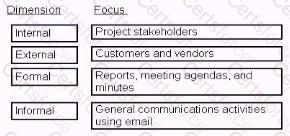
Match each dimension of the communications management plan to its corresponding focus.
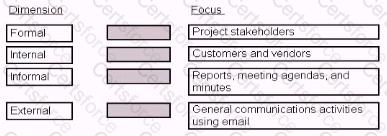
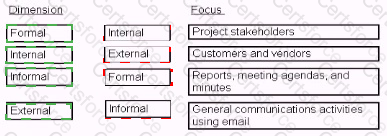
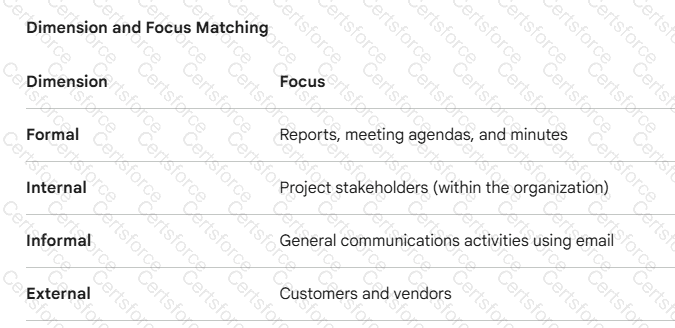
According to the PMBOK® Guide, effective communication requires the project manager to recognize and manage the different dimensions of communication to ensure the right information reaches the right person.
Formal Communication: This involves structured and documented information. It is essential for maintaining the project ' s " official record. "
Focus: Reports, meeting agendas, and minutes. These are formal artifacts that may be used for audits or legal documentation.
Internal Communication: This refers to communication within the project and the performing organization.
Focus: Project stakeholders. While customers are stakeholders, in this specific categorization, " Internal " refers to the team, senior management, and functional departments within the company.
Informal Communication: This involves less structured, daily interactions that help build relationships and solve minor issues quickly.
Focus: General communications activities using email. While email can be formal, general daily emails, ad-hoc conversations, and social media activities are classified as informal dimensions.
External Communication: This refers to communication with entities outside the performing organization.
Focus: Customers and vendors. Since these parties are outside the legal boundary of the company, communication with them often requires specific protocols (contracts, formal statements, or specialized account management).
Internal vs. External: The key differentiator is the organizational boundary. Employees and internal managers are internal; anyone else (contractors, government regulators, clients) is external.
Formal vs. Informal: The key differentiator is the level of structure and permanence. If it belongs in the project archives as a record of a decision, it is formal. If it is a tool for coordination and team bonding, it is likely informal.
Which tool or technique used in the Control Procurements process can be conducted during the execution of the project to verify compliance with deliverables?
Procurement documents
Inspection and audits
Estimate budget
Risk register
According to the PMBOK® Guide (Project Management Body of Knowledge), specifically within the Project Procurement Management knowledge area and the Control Procurements process:
Inspection and Audits (Option B): This is a key tool and technique used to verify compliance in the seller’s work. While " Inspections " focus on the product or deliverable itself (physically verifying that the work meets requirements), " Audits " focus on the procurement process and the seller ' s adherence to the agreed-upon procedures. Both are conducted during the project ' s execution and monitoring phases to identify any non-compliance before the final handover.
Procurement Documents (Option A): These are considered Inputs to the Control Procurements process (such as the contract, statement of work, and bid documents). They provide the basis for the requirements but are not the " tool " used to perform the verification itself.
Estimate Budget (Option C): This is part of the Project Cost Management knowledge area (specifically the Determine Budget process). While costs are monitored during procurement, " estimating " the budget is a planning activity, not a compliance verification tool.
Risk Register (Option D): This is a project document (Input) that contains information on identified risks. While procurement involves significant risk, the register is used to track and monitor those risks, not to verify the physical compliance of a vendor ' s deliverables.
In the PMI framework, Control Procurements is the process of managing procurement relationships, monitoring contract performance, and making changes and corrections as appropriate. Inspections and audits are the primary mechanisms for the buyer to ensure the seller is fulfilling their contractual obligations regarding quality and process.
Which of the following is an example of schedule compression?
Activity sequencing
Resource leveling
Lead and lag adjusting
Crashing
According to the PMBOK® Guide, specifically within the Develop Schedule process, Schedule Compression techniques are used to shorten the project schedule duration without reducing the project scope. There are two primary techniques recognized by PMI: Crashing and Fast Tracking.
Crashing is a technique used to shorten the schedule duration for the least incremental cost by adding resources.
Adding Resources: Examples include approving overtime, bringing in additional vendors, or adding more team members to activities on the critical path.
Cost-Schedule Trade-off: Crashing almost always results in increased costs. It is only effective for activities on the Critical Path where additional resources will actually shorten the duration.
Risk: While it shortens the timeline, it may increase risk or lead to diminishing returns if too many resources are added to a single task (the Law of Diminishing Returns).
A. Activity sequencing: This is the process of identifying and documenting relationships among the project activities. It defines the logical order of work but is not a technique used to " compress " or shorten an established duration.
B. Resource leveling: This is a resource optimization technique in which start and finish dates are adjusted based on resource constraints. Resource leveling often causes the original critical path to increase (lengthen), which is the opposite of compression.
C. Lead and lag adjusting: While adjusting leads (advancing an activity) can sometimes help overlapping, " Lead and lag adjusting " is a general refinement of dependencies. Fast Tracking is the specific compression technique that involves overlapping phases or activities that are normally done in sequence.
Crashing: Adds resources to shorten duration. Increases Cost.
Fast Tracking: Performs activities in parallel that were originally planned in sequence. Increases Risk.
A project manager requesting industry groups and consultants to recommend project intervention is relying on:
Communication models.
Stakeholder participation.
Expert judgment
Enterprise environmental factors.
According to the PMBOK® Guide, Expert Judgment is defined as judgment provided based upon expertise in an application area, knowledge area, discipline, industry, etc., as appropriate for the activity being performed.
Sources of Expertise: Expert judgment can come from many sources, including:
Other units within the organization.
Consultants and professional/technical associations.
Industry groups and subject matter experts (SMEs).
Customers or sponsors.
Application in Project Intervention: When a project manager faces a situation requiring " intervention " (such as a significant variance, technical failure, or strategic shift), they seek specialized knowledge to evaluate the inputs and provide recommendations. This is a primary tool used across almost all Process Groups, particularly in Develop Project Charter, Monitor and Control Project Work, and Perform Integrated Change Control.
Role of Industry Groups: Industry groups provide benchmarking data and best practices that are considered expert-level insights to ensure the intervention is aligned with current professional standards.
Comparison with other options:
A. Communication models: These are descriptions or schemas used to facilitate the exchange of information (e.g., sender-receiver models). They describe how information is sent, not the source of the professional recommendation.
B. Stakeholder participation: While consultants are stakeholders, the act of asking for a specific, knowledgeable recommendation is a technical application of " Expert Judgment " rather than just a general engagement or participation activity.
D. Enterprise environmental factors (EEFs): EEFs are the conditions, not under the immediate control of the project team, that influence, constrain, or direct the project (such as market conditions or organizational culture). While an industry group ' s standards might be an EEF, the act of requesting a recommendation is the use of the expert judgment tool.
Which is a tool or technique used in Define Scope?
Templates, forms, and standards
Change requests
Product analysis
Project assumptions
According to the PMBOK® Guide, the Define Scope process is the process of developing a detailed description of the project and product. To do this effectively, the project manager and team must move from high-level requirements to specific technical deliverables.
Product Analysis: This is a critical tool and technique for projects that have a product as a deliverable (as opposed to a service or result). It includes techniques such as product breakdown, systems analysis, requirements analysis, systems engineering, value engineering, and value analysis.
Translating Requirements: Product analysis helps the team translate high-level descriptions into meaningful deliverables. It asks questions like: " What are the components of this product? " and " How will it function to meet the customer ' s needs? "
Scope Definition: By performing product analysis, the team can define the boundaries of the project more clearly, ensuring that all necessary work—and only the necessary work—is included in the Project Scope Statement.
Integration with Technical Teams: This tool often requires the involvement of subject matter experts (SMEs) who understand the technical specifications required to build the product.
Comparison with other options:
A. Templates, forms, and standards: These are examples of Organizational Process Assets (OPAs). While they are used as an input to the Define Scope process to provide a framework, they are not categorized as a " tool or technique " in the PMI methodology.
B. Change requests: These are a common output of many monitoring and controlling processes. While defining scope might trigger a change to the charter or requirements, it is not a " tool " used to define the scope itself.
C. Project assumptions: Assumptions are factors that, for planning purposes, are considered to be true, real, or certain without proof. These are documented in the Project Scope Statement (an output) or analyzed as part of a data analysis technique, but " assumptions " themselves are not a tool.
A newly developed project team is working together, building trust and adjusting its work habits to support the team What stage of the Tuckman ladder does this describe?
Forming
Norming
Storming
Performing
According to the PMBOK® Guide and the Tuckman Ladder model of team development, teams go through a predictable series of stages as they grow, face challenges, and deliver results.
Norming: This stage is characterized by team members beginning to work together, building trust, and adjusting their work habits and behaviors to support the team. During this phase, team members resolve their differences, appreciate colleagues ' strengths, and respect the authority of the leader. The team develops a sense of cohesion and a common goal.
Focus on Collaboration: In the Norming stage, communication becomes more open and constructive. The team establishes " norms " (internal rules and expectations) for how they will function, which leads to increased productivity compared to previous stages.
Why other options are incorrect:
Option A: Forming: This is the initial stage where the team meets and learns about the project and their formal roles. Team members tend to be independent and not very open. Trust has not yet been established.
Option C: Storming: In this stage, the team begins to address the work, but there is often conflict or competition as individual personalities and work styles clash. If the team cannot resolve these conflicts, they remain stuck in this stage.
Option D: Performing: Teams that reach this stage function as a well-organized unit. They are interdependent and work through issues smoothly and effectively. In " Performing, " the focus is on over-achieving goals rather than the " habit-adjusting " and " trust-building " found in Norming.
A project manager is working with the project sponsor to identify the resources required for the project. They use a RACI chart to ensure that the team members knows their roles and responsibilities.
What are the four elements of a RACI chart?
Recommend, approve, coordinate, and inform
Responsible, accountable, consult, and inform
Recommend, accountable, consult, and inform
Responsible, accountable, coordinate, and inform
The RACI chart is a common type of Responsibility Assignment Matrix (RAM) used in project management to clarify roles and responsibilities. According to the PMBOK® Guide, it is essential for ensuring that there is no ambiguity regarding who is doing the work and who is making the decisions.
Why Choice B is correct: The acronym RACI stands for:
Responsible (R): The person who actually performs the work to complete the task. There is typically at least one " R " for every task.
Accountable (A): The " owner " of the work who must sign off or approve the deliverable. Crucially, only one person can be accountable for each task to ensure clear lines of authority.
Consult (C): People whose opinions are sought (two-way communication). These are usually subject matter experts (SMEs) who provide input.
Inform (I): People who are kept up-to-date on progress or completion (one-way communication).
Analysis of other options:
A, C, and D: These options are incorrect because they substitute the standard PMI definitions with words like " Recommend " or " Coordinate. " While these are actions that happen in a project, they are not the formal components of a RACI matrix. For example, " Recommend " is often part of the " Consult " phase, and " Coordinate " is a general management activity rather than a specific role assignment.
Key Concept: The RACI chart is particularly useful when a project involves cross-functional teams or multiple departments. It prevents " ownership gaps " (where no one is doing the work) and " duplication of effort " (where two people think they are accountable). By following the Choice B definitions, the Project Manager ensures that every task in the Work Breakdown Structure (WBS) is assigned to a specific individual or group with a clearly defined level of involvement.
The process of identifying the stakeholders ' information needs is completed during:
Plan Communications.
Manage Stakeholder Expectations.
Stakeholder Analysis.
Identify Stakeholders.
According to the PMBOK® Guide, specifically within the Communications Management knowledge area, the determination of stakeholder information needs is a core activity of the Plan Communications Management process.
Communication Requirements Analysis: This is the primary tool and technique used in this process. It identifies the information needs of the project stakeholders by combining the type and format of information required with an analysis of the value of that information.
Key Considerations: During this process, the project manager identifies:
Who needs what information.
When they will need it.
How it will be delivered (email, meetings, reports).
By whom the information will be delivered.
The Output: These needs are documented in the Communications Management Plan, which becomes a subsidiary part of the Project Management Plan.
Analysis of Other Options:
B. Manage Stakeholder Expectations: This is an execution process (now often part of Manage Stakeholder Engagement) where the project manager communicates and works with stakeholders to meet their needs and address issues; it is not where the initial identification of needs occurs.
C. Stakeholder Analysis: This is a technique used in both Identify Stakeholders and Plan Stakeholder Management to identify their interests, expectations, and influence, but it is not the specific process for mapping out their detailed communication requirements.
D. Identify Stakeholders: This is the initial process of identifying the people, groups, or organizations that could impact or be impacted by a decision, activity, or outcome of the project. While it identifies who they are, the specific information needs are detailed in the planning phase.
Status of deliverables, implementation status for change requests, and forecasted estimates to complete are examples of:
Earned value management.
Enterprise environmental factors.
Organizational process assets.
Work performance information.
In accordance with the PMBOK® Guide (Project Integration Management) and the Monitoring and Controlling Process Group, project data is transformed into information and reports through a specific hierarchy. Work performance information consists of the performance data collected from various controlling processes, analyzed in context, and integrated based on relationships across areas.
Contextual Analysis: While " Work Performance Data " is the raw observation (e.g., " the cost is $100 " ), Work Performance Information is the result of comparing that data against the project management plan (e.g., " the cost is $100, which is $20 over the baseline " ).
Examples in Practice:
Status of Deliverables: Knowing if a deliverable is started, in progress, or completed relative to the schedule.
Implementation Status for Change Requests: Tracking which approved changes have been successfully integrated into the project.
Forecasted Estimates: Calculated values such as Estimate to Complete (ETC) and Estimate at Completion (EAC) which predict future performance based on current trends.
Data Flow: Work Performance Data (Input) $\rightarrow$ Data Analysis (Tool) $\rightarrow$ Work Performance Information (Output) $\rightarrow$ Work Performance Reports (Output of Monitor and Control Project Work).
Analysis of Distractors:
A. Earned value management: This is a specific methodology or tool used to generate work performance information (like CV, SV, CPI, and SPI). It is the calculation method, not the category of the items listed.
B. Enterprise environmental factors: These are internal or external factors, not under the control of the project team, that influence, constrain, or direct the project (e.g., marketplace conditions or organizational culture).
C. Organizational process assets: These are the plans, processes, policies, procedures, and knowledge bases specific to and used by the performing organization (e.g., templates or lessons learned). While status reports might eventually become OPAs, the active status and forecasts during the project are categorized as performance information.
A project manager is working in an environment where requirements are not very clear and may change during the project. In addition, the project has several stakeholders and is technically complex.
Which strategies should the project manager take into account for risk management in this environment?
Occasionally identify, evaluate, and classify risks.
Review requirements and cross-functional project teams.
Include contingency reserves and update the project management plan frequently.
Frequently review incremental work products and update the requirements for proper prioritization.
In environments characterized by unclear requirements, high stakeholder density, and technical complexity, the PMBOK® Guide and the Agile Practice Guide recommend an adaptive or iterative approach to risk management.
Risk Reduction through Increments: In complex projects, the greatest risk is building the wrong product or failing to meet stakeholder expectations. By " frequently reviewing incremental work products " (e.g., through Sprint Reviews or Demos), the project manager uncovers risks related to technical feasibility and requirement alignment early.
Dynamic Prioritization: Risks in these environments are often tied to the product backlog. Constant " proper prioritization " ensures that the team addresses high-risk, high-value items first (often called a Risk-Adjusted Backlog). This allows the team to fail fast or pivot before significant resources are spent.
Stakeholder Feedback Loops: Frequent reviews engage stakeholders directly, reducing the risk of " expectation gap " and ensuring that the technical complexity is being managed in a way that provides actual business value.
Analysis of Other Options:
A. Occasionally identify, evaluate, and classify risks: In a highly complex and changing environment, " occasional " reviews are insufficient. Risk management must be continuous and integrated into every iteration.
B. Review requirements and cross-functional project teams: While having a cross-functional team is a good practice, simply " reviewing " them does not constitute a risk management strategy that addresses technical complexity or shifting requirements as effectively as incremental delivery does.
C. Include contingency reserves and update the project management plan frequently: This is a more traditional/predictive response to risk. While reserves are important, they are a reactive measure (Acceptance). In a complex/adaptive environment, the proactive strategy is to reduce uncertainty through incremental validation (Option D).
Which of the following response strategies are appropriate for negative risks or threats?
Share, Accept, Transfer, or Mitigate
Exploit, Enhance, Share, or Accept
Mitigate, Share, Avoid, or Accept
Avoid, Mitigate, Transfer, or Accept
According to the PMBOK® Guide, specifically within the Plan Risk Responses process, there are distinct strategies for dealing with negative risks (threats) versus positive risks (opportunities).
Negative Risk Strategies (Threats):
Avoid: Changing the project management plan to eliminate the threat entirely (e.g., extending the schedule, changing the strategy, or reducing scope).
Mitigate: Taking action to reduce the probability of occurrence or the impact of a risk (e.g., using less complex processes, performing more tests, or choosing a more stable supplier).
Transfer: Shifting the impact of a threat to a third party, together with ownership of the response (e.g., insurance, performance bonds, or warranties). This usually involves paying a risk premium.
Accept: Acknowledging the risk but not taking any proactive action. Passive acceptance requires no action except documenting the strategy, while active acceptance usually involves establishing a contingency reserve.
Analysis of Other Options:
A. Share, Accept, Transfer, or Mitigate: " Share " is a strategy for positive risks (opportunities), not threats.
B. Exploit, Enhance, Share, or Accept: Exploit, Enhance, and Share are all strategies specifically for positive risks.
C. Mitigate, Share, Avoid, or Accept: Again, " Share " is an opportunity strategy, making this combination incorrect for a list of purely negative risk responses.
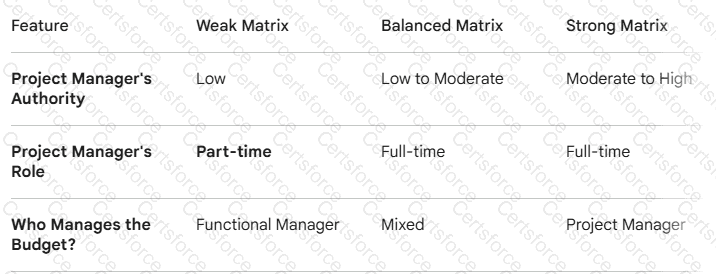
In a weak matrix, the project managers role is:
part-time
full-time
occasional
unlimited
According to the PMBOK® Guide, the level of authority and the specific role of a project manager are heavily influenced by the Organizational Structure of the performing organization. PMI classifies matrix structures into three categories: Weak, Balanced, and Strong.
In a Weak Matrix organizational structure, the project manager maintains many of the characteristics of a functional organization.
Role Definition: The project manager ' s role is typically part-time. They often function more as a Project Expediter or Project Coordinator rather than a true manager.
Authority: Their authority is very low to non-existent. The functional manager retains most of the power, including control over the budget and resources.
Staffing: The project team members also work part-time on the project, with their primary loyalty and reporting line remaining with their functional department.
B. full-time: This is a characteristic of a Strong Matrix or a Projectized organization. In these structures, the project manager is a designated professional with a full-time commitment to the project and significant authority.
C. occasional: While a project manager in a weak matrix has limited hours, " occasional " is not a formal PMI term used to describe the role. The standard designation is " part-time. "
D. unlimited: This is incorrect in any organizational structure. All project managers operate within defined constraints of authority, budget, and schedule as outlined in the Project Charter.
What internal enterprise environmental factor (EEF) can impact a project?
Cultural influences
Physical environmental elements
Commercial databases
Infrastructure
According to the PMBOK® Guide, Enterprise Environmental Factors (EEFs) refer to conditions, not under the control of the project team, that influence, constrain, or direct the project. These can be internal or external to the organization.
The PMI standards classify Infrastructure as a primary Internal EEF. Internal EEFs arise from the organization itself and include:
Infrastructure: This includes existing facilities, equipment, organizational telecommunications channels, information technology hardware, availability, and capacity. For example, the quality of a company ' s server network directly impacts a software project ' s development speed.
Organizational Culture, Structure, and Governance: Vision, mission, values, beliefs, cultural norms, and hierarchy.
Geographic Distribution of Facilities and Resources: Factory locations, virtual teams, and shared systems.
Resource Availability: Physical and team resource constraints.
Employee Capability: Existing human resources ' expertise, skills, and specialized knowledge.
Analysis of other options:
Cultural influences (Option A): While culture is an EEF, the PMBOK® Guide specifically lists " Organizational Culture " as the internal factor. " Cultural influences " is often used in a broader context that can imply external societal cultures, making " Infrastructure " a more definitive internal technical EEF in PMI terminology.
Physical environmental elements (Option B): These are considered External EEFs. They include working conditions, weather, and constraints imposed by the physical geography of the project location.
Commercial databases (Option C): These are considered External EEFs. They include benchmarking results, standardized cost estimating data, and industry risk study information provided by third parties.
Per PMI standards, understanding the internal Infrastructure is vital during the planning phase to ensure the project management plan is realistic regarding the tools and facilities available to the team.
Which procurement management process includes obtaining seller response, seller selection, and contract awarding?
Plan Procurement
Manage Procurement
Conduct Procurements
Perform Procurement
According to the PMBOK® Guide, the process of obtaining seller responses, selecting a seller, and awarding a contract is defined as Conduct Procurements.
Obtaining Seller Responses: This involves activities such as holding bidder conferences and receiving bids or proposals from prospective providers.
Seller Selection: During this stage, the project team applies evaluation criteria to the proposals received to select one or more sellers who are qualified to perform the work and provide the best value.
Contract Awarding: This is the final step of the process where negotiations are completed, and a formal written contract is signed by both the buyer and the seller.
Why other options are incorrect:
Option A: Plan Procurement: This is the initial planning process where the team decides what to buy, how to buy it, and identifies potential sellers. It documents the procurement approach but does not involve active selection or awarding.
Option B: Manage Procurement: While " Control Procurements " is a formal process for managing the relationship and contract performance, " Manage Procurement " is not the standard PMI term for the execution phase where sellers are selected.
Option D: Perform Procurement: This is not a formal process name within the PMI Project Procurement Management knowledge area. The execution-phase process is strictly titled Conduct Procurements.
In a project, the cost performance indicator (CPI) is less than 1 and the schedule performance indicator (SPI) is more than 1. What is the status of the project?
The project is over budget and behind schedule.
The project is over budget and ahead of schedule.
The project is under budget and behind schedule.
The project is under budget and ahead of schedule.
The project is over budget and ahead of schedule . In earned value management, the Cost Performance Index is calculated as earned value divided by actual cost. PMI defines CPI as a measure of cost efficiency expressed as the ratio of earned value to actual cost. A CPI less than 1 means the project is earning less value than the money being spent; therefore, cost efficiency is unfavorable and the project is over budget. The Schedule Performance Index is calculated as earned value divided by planned value. PMI defines SPI as a measure of schedule efficiency expressed as the ratio of earned value to planned value. An SPI greater than 1 means the project has earned more value than planned by the measurement date; therefore, schedule efficiency is favorable and the project is ahead of schedule. The combination is mixed performance: schedule is positive, cost is negative. This is a classic earned value interpretation question and should be solved by remembering the threshold value of 1.0: below 1 is unfavorable, equal to 1 is on target, and above 1 is favorable. References/topics: Earned Value Management, CPI, SPI, Cost Control, Schedule Control.
A sponsor asks a project manager to provide a project ' s expected total costs based on its progress. What formula should the project manager use to determine this?
Earned value (EV) / actual cost (AC)
Estimate at completion (EAC) - AC
Budget at completion (BAC) / cost performance index (CPI)
EV - planned value (PV)
The sponsor is asking for the Estimate at Completion (EAC), which represents the " expected total costs based on its progress. " This is a core component of Earned Value Management (EVM) as described in the PMBOK® Guide.
Forecasting with EAC: The Estimate at Completion (EAC) is the forecasted total cost of the project at its conclusion. When the sponsor asks for this " based on progress, " they are assuming that the project ' s past performance (represented by the CPI) will continue into the future.
The Formula ($EAC = BAC / CPI$ ): This is the most common formula used to determine the total expected cost if the current cost performance is expected to persist for the remainder of the project.
BAC (Budget at Completion): The original total budget.
CPI (Cost Performance Index): A measure of cost efficiency ($EV / AC$).
Alternative Assumptions: If the remaining work is expected to be performed at the budgeted rate (regardless of past performance), the formula would be $EAC = AC + (BAC - EV)$. However, the question specifically mentions " based on its progress, " which points toward using the performance index (CPI).
Analysis of Other Options:
A. Earned value (EV) / actual cost (AC): This is the formula for the Cost Performance Index (CPI). While it measures progress/efficiency, it is a ratio, not the " expected total cost. "
B. Estimate at completion (EAC) - AC: This formula results in the Estimate to Complete (ETC), which represents the expected cost of the remaining work, not the total cost.
D. EV - planned value (PV): This is the formula for Schedule Variance (SV), which measures schedule performance in currency units, not expected costs.
A project manager has recently been assigned a new agile project and needs to determine an appropriate leadership style. The project manager aims to empower the team members so they feel committed and motivated to deliver value.
Which leadership style should be used for this project?
A servant leadership style
A laissez-faire leadership style
A collaborative leadership style
A directive leadership style
In Agile project management, the role of the leader shifts from " command and control " to support and facilitation. This philosophy is encapsulated in the concept of Servant Leadership.
Why Choice A is correct:
Empowerment: Servant leadership focuses on the growth and well-being of the team. By putting the team ' s needs first, the project manager empowers them to make decisions, which fosters the commitment and motivation mentioned in the prompt.
Removing Impediments: A servant leader’s primary job is to clear the path for the team—removing " roadblocks " or " impediments " —so the team can focus on delivering high-value work.
Agile Alignment: The Agile Practice Guide (developed by PMI and Agile Alliance) explicitly recommends servant leadership because it promotes self-organization and accountability, which are the engines of Agile delivery.
Characteristics: Key traits include listening, empathy, stewardship, and a commitment to the professional development of team members.
Analysis of other options:
B (Laissez-faire): This style is " hands-off, " where the leader allows the team to make all decisions without much interference or support. While it offers freedom, it lacks the proactive support and guidance a servant leader provides to help a team succeed.
C (Collaborative): While Agile leaders are collaborative, " Collaborative Leadership " is a general management term. " Servant Leadership " is the specific, recognized framework within the PMI-ACP and PMP domains for Agile projects.
D (Directive): Also known as " Autocratic, " this style involves the leader telling the team exactly what to do. This is the opposite of empowering the team and is generally ineffective in Agile environments where self-organization is required.
Key Concept: The Project Management Institute (PMI) emphasizes that in Agile, the project manager (or Scrum Master) does not manage the people, they manage the environment. By adopting a Servant Leadership style (Choice A), the leader creates a safe space for the team to experiment, learn from failure, and ultimately take ownership of the project ' s value delivery.
What risk technique is used to quantify the probability and impact of risks on project objectives?
Expert judgment
Risk registry
Risk response planning
Interviewing
According to the PMBOK® Guide, specifically within the Perform Quantitative Risk Analysis process, Interviewing is a key tool and technique used to gather data for quantifying the probability and impact of risks.
Mechanism: Interviewing techniques are used to quantify the probability and impact of risks on project objectives. The project manager or risk analyst interviews project stakeholders and subject matter experts to gather optimistic (low), pessimistic (high), and most likely scenarios.
Data Modeling: The information gathered during these interviews is often used to develop probability distributions (such as triangular or beta distributions) which are then used in modeling techniques like Monte Carlo analysis.
Purpose: While qualitative analysis uses subjective scales (Low, Medium, High), quantitative analysis requires discrete data points. Interviewing is the primary method to extract these numerical values from experts who have experience with similar project elements.
Comparison with Other Options:
Expert Judgment (A): This is a general tool used across almost all processes to provide a high-level opinion, but Interviewing is the specific, structured technique listed in the PMBOK® Guide for the data-gathering step of quantification.
Risk Registry (B): This is a document (Output), not a tool or technique. It is the place where risk information is stored.
Risk Response Planning (C): This is a separate process (Plan Risk Responses) that occurs after risks have been quantified and prioritized.
A new game development process must have three versions. Each version is to be developed in approximately five iteration cycles with a duration of one month each. This will help this small enterprise to have a return on investment (ROI) as the project runs from the first cycle. Which methodology should the project manager adopt and implement in the project?
Feature-driven development (FDD) as it will deliver product segments and the milestones are controlled by the development manager.
Kanban as it will provide flexibility to the team for working at their own pace in the time frame requested.
Scrum as it uses sprints and retrospectives, maximizing time delivery and the value of the product.
Extreme Programming (XP) as it will help deliver more quickly since developers will work in pairs.
According to the Agile Practice Guide and the PMBOK® Guide, the scenario describes a project that requires a high degree of structure within an adaptive environment to ensure early and continuous delivery of value (ROI).
Iterative and Incremental Delivery: The request for " five iteration cycles " of " one month each " perfectly aligns with the Scrum framework’s definition of a Sprint. Sprints are timeboxed to one month or less to create consistency and reduce complexity.
Maximizing ROI: Scrum is specifically designed to deliver a Potentially Shippable Product Increment at the end of every sprint. This allows the small enterprise to release versions of the game early, satisfying the requirement to see a return on investment " as the project runs from the first cycle. "
Empirical Process Control: Through ceremonies like the Sprint Review and Retrospective, the project manager and the team can inspect the product and the process, ensuring that the most valuable features are prioritized (via the Product Backlog) to maximize the product ' s market value.
Analysis of other options:
Option A: While Feature-driven development (FDD) does deliver segments, it is more focused on specific " features " and is often more hierarchical. Scrum is the industry standard for timeboxed, iteration-based game development where ROI is a primary driver.
Option B: Kanban is a flow-based methodology, not necessarily an iteration-based one. It does not natively use the fixed " five iteration cycles " mentioned in the prompt. Kanban focuses on reducing Work in Progress (WIP) rather than fixed-duration cycles.
Option C: Extreme Programming (XP) focuses heavily on engineering practices (like pair programming). While it is fast, the prompt specifically highlights the structure of iterations and the goal of ROI/Value, which are core tenets emphasized in the Scrum framework.
Per PMI standards, Scrum is the most appropriate methodology when a project requires fixed-duration iterations (Sprints) to ensure the frequent delivery of value and the achievement of early ROI for the organization.
Which statement describes the various purposes of project scheduling?
Define the policies, rules, and techniques to run a schedule; serve as a tool to manage stakeholder expectations; and serve as a base for backlog management
Define how and when deliverables will be completed, serve as communication tool, and serve as a base for performance reporting
Define the life cycle, traditional or agile approach, and tools to control schedule; serve as a reference for scope management; and serve as a base for risk management
Define activities, sequences, duration, and dependencies, serve as a reference for resource allocation, serve as a base for earned value analysis.
According to the PMBOK® Guide, specifically the Project Schedule Management knowledge area, the project schedule is more than just a list of dates; it is a dynamic tool used throughout the project life cycle for multiple strategic purposes.
Defining Delivery and Timing (Choice B): The primary purpose of the schedule is to provide a detailed plan that represents how and when the project will deliver the products, services, and results defined in the project scope. It links activities, durations, and resources to a timeline.
Communication Tool: The schedule serves as a vital communication vehicle. It provides a common language for the team and stakeholders to discuss progress, milestones, and dependencies. It manages stakeholder expectations by showing when specific benefits will be realized.
Base for Performance Reporting: Without a schedule, there is no baseline. The schedule baseline is used to measure actual progress against the plan. This allows for variance analysis and provides the data necessary for status reports, such as determining if the project is ahead of or behind schedule (Schedule Variance).
Choice A: This partially describes the Schedule Management Plan (the " how-to " guide) rather than the schedule itself. While the schedule helps manage expectations, " base for backlog management " is a specific agile technique rather than a general purpose for all project scheduling.
Choice C: Defining the life cycle and approach is a function of the Project Management Plan and Development Approach, not the schedule itself.
Choice D: While this lists the steps to create a schedule (activities, sequences, etc.), it describes the inputs and methods rather than the overarching purposes described in Choice B.
By utilizing the project schedule for these purposes, the project manager ensures that the team remains focused on time-sensitive objectives and that stakeholders are kept informed through data-driven reporting.
Which Control Quality tool is also known as an arrow diagram?
Matrix diagram
Affinity diagram
Tree diagram
Activity network diagram
According to the PMBOK® Guide (Project Quality Management), the Activity Network Diagram is a tool and technique used in both Quality Management (specifically within the Manage Quality and Control Quality contexts) and Schedule Management. It is also commonly known as an arrow diagram.
In the context of quality and process improvement, activity network diagrams (such as the Program Evaluation and Review Technique (PERT), Critical Path Method (CPM), and Precedence Diagramming Method (PDM)) are used to visualize the sequence of steps and the logical relationships between them.
Function: They help in understanding the flow of a process, identifying potential bottlenecks, and determining the impact of delays on the overall timeline.
AOA vs. AON: When referred to specifically as an arrow diagram, it often points to the Activity-on-Arrow (AOA) format, where activities are represented by arrows that connect nodes (events) to show the project ' s sequence.
Analysis of Distractors:
A. Matrix diagram: This is a quality management tool used to perform data analysis within the organizational structure created in the matrix. It shows the relationship between different factors, causes, and objectives in a table (rows and columns) format.
B. Affinity diagram: This is a tool used to gather and organize large amounts of data (such as ideas from a brainstorming session) into logical groupings based on natural relationships.
C. Tree diagram: Also known as a systematic diagram, this is used to represent hierarchies, such as the WBS, RBS, or OBS. While it shows decomposition, it does not use the " arrow " logic to represent a sequential flow of activities in the same way an activity network diagram does.
During which process of Project Cost Management does a project manager produce the cost baseline?
Estimate Costs
Control Schedule
Determine Budget
Develop Project Charter
According to the PMBOK® Guide, the Cost Baseline is the specific version of the time-phased project budget that excludes management reserves. It is the primary output of the Determine Budget process.
The Process Logic:
Estimate Costs: In this preceding process, the project manager develops an approximation of the monetary resources needed for each individual activity or work package.
Determine Budget: The project manager aggregates the estimated costs of individual activities or work packages to establish an authorized cost baseline.
Components of the Cost Baseline: The baseline includes all authorized budgets for the work packages and planning packages, plus contingency reserves (for " known-unknowns " ).
Difference from Total Project Budget: The Cost Baseline plus the Management Reserve (for " unknown-unknowns " ) equals the Total Project Budget. While the project manager can typically authorize the use of contingency reserves, the management reserve often requires a formal change request for access.
Performance Measurement: Once established, the cost baseline is used as a basis for comparison to actual results. It is typically displayed as an S-curve, showing the cumulative costs over the project ' s duration.
Analysis of Other Options:
A. Estimate Costs: This process produces Activity Cost Estimates and the Basis of Estimates. It is the " input " to the Determine Budget process, but it does not yet produce the consolidated, time-phased baseline.
B. Control Schedule: This is part of the Schedule Management knowledge area, not Cost Management. Its purpose is to monitor the status of the project to update project progress and manage changes to the schedule baseline.
D. Develop Project Charter: This process occurs during the Initiation phase. While it may include a " high-level summary budget " or " pre-approved financial resources, " it does not contain the detailed, decomposed cost baseline required for project execution.
What do top project managers do to maximize their sphere of influence within a project team?
Consider management standards, economic factors, and sustainability strategies
Contribute knowledge and expertise to others within the profession
C Address political and strategic issues that impact the project ' s viability or quality
D Demonstrate superior relationship and communication skills while displaying a positive attitude
According to the PMBOK® Guide, a project manager’s sphere of influence starts with the project team and extends outward to the organization and the industry. To maximize influence specifically within the project team, the project manager relies heavily on interpersonal skills and emotional intelligence.
Relationship and Communication Skills: Top project managers understand that projects are delivered by people. By demonstrating superior communication—active listening, transparency, and clarity—and building strong relationships based on trust, they gain the respect and cooperation of the team.
Positive Attitude: Leadership is contagious. A project manager who displays a positive attitude, especially during challenging phases, helps maintain team morale and fosters a collaborative environment where team members feel empowered to contribute.
Leading by Example: Influence within the team is rarely about formal authority (legitimate power); it is about referent power (the team following because they respect the leader) and expert power. Consistently demonstrating these soft skills allows the PM to guide the team toward project objectives more effectively than rigid management alone.
Why other options are incorrect:
Option A: Consider management standards, economic factors, and sustainability strategies: These are elements of Strategic and Business Management. While important for the project ' s overall success, they relate more to how the PM interacts with the organization or environment, not specifically how they influence the project team.
Option B: Contribute knowledge and expertise to others within the profession: This describes how a project manager influences the Industry/Profession. It involves mentoring, contributing to standards (like PMI), and staying current with trends, but it is external to the daily team dynamic.
Option C: Address political and strategic issues that impact viability: This describes the PM’s role in influencing the Organization and Sponsors. While critical for protecting the project from external threats, it is a " governance " or " political " focus rather than a team-focused leadership behavior.
An international company that is starting to practice an adaptive approach has several development teams located globally. They are having problems with multiple time zones and repetitive project schedule slippage.
What effective tools should the project teams use to collaborate?
Adopt an iterative development approach and conduct virtual meetings.
Arrange frequent colocated meetings and let the teams work together.
Focus on developing products by only using teams that are colocated.
Benchmark and adopt best practices that are being used by the competition.
Managing globally distributed teams in an Adaptive (Agile) environment requires a shift in how communication and coordination are handled. According to the Agile Practice Guide and the PMBOK® Guide, when physical colocation is impossible, the project manager must implement " Virtual Colocation " (or " Fishbowl Windows " ).
Why Choice A is correct:
Iterative Development: By breaking work into short cycles (iterations/sprints), the teams can synchronize their outputs more frequently. This reduces the " slippage " because issues are identified every 2–4 weeks rather than at the end of a long waterfall phase.
Virtual Meetings: To bridge the time zone gap, teams must use asynchronous communication tools (like wikis or boards) combined with strategic Virtual Meetings (like video conferencing or chat) scheduled during " overlap " hours. This facilitates the necessary face-to-face interaction—even if digital—required for Agile ceremonies like Daily Standups and Retrospectives.
Global Collaboration: This approach acknowledges the reality of a global workforce while providing the structure needed to keep disparate teams aligned.
Analysis of other options:
B (Frequent colocated meetings): While physically working together is the " gold standard " for Agile, it is often financially and logistically impossible for an international company with multiple teams. " Frequent " international travel would likely blow the project budget and cause further delays.
C (Use only colocated teams): This is a regression. It ignores the strategic benefits of a global workforce (such as 24/7 development " follow-the-sun " models or local market expertise) and may not be possible if the required talent is distributed globally.
D (Benchmarking competition): Benchmarking helps with quality or process standards, but it doesn ' t solve the immediate, practical problem of time zone synchronization and team coordination.
Key Concept: The Project Management Institute (PMI) emphasizes that for distributed teams, the Communication Management Plan must be robust. By adopting an iterative approach (Choice A), the project manager creates a " heartbeat " for the project that keeps all global teams moving at the same pace, regardless of their physical location.
Which of the following is an estimating technique that uses the values of parameters from previous similar projects for estimating the same parameter or measure for a current project?
Reserve analysis
Three-point estimating
Parametric estimating
Analogous estimating
According to the PMBOK® Guide, Analogous Estimating is a technique for estimating the duration or cost of an activity or a project using historical data from a similar activity or project.
The Methodology: It uses the values of parameters—such as scope, cost, budget, and duration—or measures of scale (such as size, weight, and complexity) from a previous, similar project as the basis for estimating the same parameter or measure for a current project.
When to Use It: It is frequently used when there is a limited amount of detailed information about the project (e.g., in the early phases).
Characteristics:
Top-Down Approach: It is generally less costly and time-consuming than other techniques.
Accuracy: It is generally less accurate than bottom-up or parametric estimating.
Reliability: It is most reliable when the previous projects are similar in fact and not just in appearance, and the project team members preparing the estimates have the needed expertise.
Analysis of Other Options:
A. Reserve analysis: This is used to determine the amount of contingency and management reserves needed for the project to account for cost or schedule uncertainty (risk).
B. Three-point estimating: This technique improves accuracy by considering estimation uncertainty and risk. It uses three estimates (Most Likely, Optimistic, and Pessimistic) to define an approximate range for an activity’s cost or duration.
C. Parametric estimating: While this also uses historical data, it uses a statistical relationship between historical data and other variables (e.g., square footage in construction, lines of code in software) to calculate an estimate. It is more quantitative than analogous estimating.
