
What is a tool to improve team performance?
Staffing plan
External feedback
Performance reports
Co-location
According to the PMBOK® Guide, Co-location is a primary tool and technique used within the Develop Project Team process to improve team performance.
Mechanism of Improvement: Co-location involves placing the most active project team members in the same physical location. This " tight matrix " strategy improves the team ' s ability to perform by enhancing communication, facilitating the rapid exchange of information, fostering a sense of community, and reducing technical or interpersonal conflict.
Team Dynamics: By working in the same environment, team members develop trust more quickly and can engage in " osmotic communication, " where they pick up relevant information simply by being near their colleagues. This is a direct contributor to increased synergy and overall team effectiveness.
Analysis of Other Options:
A. Staffing plan: This is a component of the Human Resource Management Plan (now known as the Resource Management Plan). It is a document that describes when and how human resource requirements will be met, rather than a tool used to actively improve performance.
B. External feedback: While feedback is useful, it is not listed as a standard, formal tool/technique for team development in the PMI framework compared to internal strategies like co-location or training.
C. Performance reports: These are an input to the Manage Project Team process, used to compare actual project results against the project management plan. They are used for monitoring and controlling, but they do not inherently " improve " the team ' s performance; they simply report on it.
A team is working on a project using an adaptive approach. During project execution, the project gets delayed by one month due to an unforeseen risk. What should the team do next to deliver this project?
Stop working on the project completely, even if the team can continue working on the tasks with the identified risk.
Accept the project delay and add the risk to the lessons learned document for the next project.
Change the delivery date and deliver the initially agreed-upon scope after mitigation of the identified risk.
Reprioritize the work based on the increased visibility of the current risks.
According to the Agile Practice Guide and the PMBOK® Guide, the primary strength of an adaptive (Agile) approach is the ability to respond to change and manage risks dynamically.
Continuous Prioritization: In adaptive environments, the backlog is not static. When a delay occurs due to an unforeseen risk, the team and the Product Owner must re-evaluate the remaining work. This involves Reprioritizing the Product Backlog to ensure that the most valuable and high-risk items are addressed immediately or deferred as necessary.
Risk-Adjusted Backlog: Agile teams use the concept of a " risk-adjusted backlog, " where work is prioritized not only by business value but also by the urgency of addressing risks. By reprioritizing, the team can focus on delivering the " Minimum Viable Product " (MVP) or the most critical features within the remaining timeframe, even if the total project duration has been impacted.
Inspect and Adapt: Rather than sticking to a rigid plan that has already been compromised, the team uses the " Inspect and Adapt " pillar. They analyze the impact of the risk and reorganize the flow of work to maximize value delivery despite the one-month delay.
Analysis of other options:
Option A: Stopping the project completely is an extreme reaction and usually unnecessary. Project management is about navigating obstacles, not abandoning the project at the first sign of a significant delay unless the business case is no longer viable.
Option B: While capturing lessons learned is a mandatory part of any project, simply " accepting the delay " without taking action to optimize the remaining work is passive and does not align with the proactive nature of project management.
Option C: Changing the delivery date to maintain the original scope is a Predictive (Waterfall) mindset. In an adaptive environment, we often prefer to keep the date fixed (timeboxing) and adjust the scope (flexibility) to ensure continuous delivery of value.
Per PMI standards, the best course of action in an adaptive project facing a disruption is to Reprioritize the work. This ensures the team remains agile, addresses the most critical needs first, and adapts the project plan to the new reality created by the identified risk.
A technique used to determine the cause and degree of difference between baseline and actual performance is:
Product analysis.
Variance analysis.
Document analysis,
Decomposition.
According to the PMBOK® Guide, specifically within the Monitoring and Controlling Process Group, Variance Analysis is a key data analysis technique used across multiple knowledge areas (Scope, Schedule, Cost).
Cause and Degree of Difference: The primary purpose of variance analysis is to review the difference (or variance) between planned performance (the Baseline) and actual performance. It involves:
Determining the cause: Investigating why the variance occurred (e.g., resource shortages, scope creep, or underestimated durations).
Determining the degree: Quantifying how far off the project is from its baseline (e.g., $5,000 over budget or 3 days behind schedule).
Decision Making: By understanding the cause and degree, the project manager can determine if corrective or preventive actions are required to bring the project back into alignment with the management plan.
Why the other options are incorrect:
A. Product analysis: This is a tool used in the Define Scope process to translate high-level product descriptions into meaningful deliverables. It does not measure performance against a baseline.
C. Document analysis: This is a data gathering technique used in Collect Requirements or Identify Stakeholders to elicit requirements by analyzing existing documentation.
D. Decomposition: This is a technique used in Create WBS and Define Activities. It involves breaking down project scope and deliverables into smaller, more manageable components. It is a planning tool, not a performance measurement tool.
A collection of projects managed as a group to achieve strategic objectives is referred to as a:
plan
process
program
portfolio
According to the PMBOK® Guide and The Standard for Portfolio Management, the relationship between portfolios, programs, and projects is defined by their focus on organizational strategy.
Portfolio Definition: A portfolio is defined as a collection of projects, programs, subsidiary portfolios, and operations managed as a group to achieve strategic objectives.
Strategic Focus: The components of a portfolio may not necessarily be interdependent or directly related. However, they are linked to the organization ' s strategic plan by the way they compete for the same resources and contribute to the same high-level business goals.
Portfolio Management: This involves the centralized management of one or more portfolios to identify, prioritize, authorize, manage, and control projects and programs. The primary goal is to ensure the organization is doing the " right " work to maximize the value of its investments.
Comparison with other options:
A. Plan: A plan (such as the Project Management Plan) is a formal document used to guide execution and control. It is a tool for a specific project or program, not a collection of them.
B. Process: A process is a systematic series of activities directed toward causing an end result where one or more inputs will be acted upon to create one or more outputs.
C. Program: A program is a group of related projects, subprograms, and program activities managed in a coordinated way to obtain benefits not available from managing them individually. Wile it is a collection of projects, its focus is on synergy and coordination between related works, whereas a portfolio is focused specifically on strategic objectives.
What does the creation of a project management plan accomplish?
Defines the basis of all project work and how it will be performed
Acknowledges the existence of a project and defines its high-level information
Authorizes the project manager to apply organizational resources to project activities
Provides the project manager with organizational standards, policies, processes, and procedures
According to the PMBOK® Guide, the Project Management Plan is the primary document used to manage the project. It is a single, formal, approved document that defines how the project is executed, monitored, controlled, and closed.
Basis of All Work: The plan integrates and consolidates all subsidiary management plans and baselines (Scope, Schedule, Cost) into a cohesive whole. It acts as the " source of truth " for the team, ensuring everyone understands the methodology, the work to be done, and the processes for handling changes.
Execution and Performance: It doesn ' t just list what is being built; it explains how the project will be managed. This includes communication protocols, risk management strategies, and quality standards.
Living Document: While it is baselined, it is also progressively elaborated throughout the project life cycle, meaning it is updated as more information becomes available.
Why other options are incorrect:
Option B: Acknowledges the existence of a project and defines its high-level information: This is the purpose of the Project Charter, not the Project Management Plan. The Charter is a high-level document that precedes the detailed planning phase.
Option C: Authorizes the project manager to apply organizational resources to project activities: This is also a key function of the Project Charter. Without a signed Charter, a Project Manager has no formal authority to spend money or assign staff.
Option D: Provides the project manager with organizational standards, policies, processes, and procedures: These are known as Organizational Process Assets (OPAs). While the Project Management Plan incorporates these standards, it is not the source of them; rather, it uses them as inputs to create the project-specific strategy.
Which is the Define Scope technique used to generate different approaches to execute and perform the work of the project?
Build vs. buy
Expert judgment
Alternatives identification
Product analysis
According to the PMBOK® Guide, specifically within the Define Scope process, Alternatives Identification is a technique used to generate different approaches to execute and perform the work of the project.
Purpose and Function: The primary goal of this technique is to find different ways to achieve the project ' s objectives and satisfy the requirements. It is a brainstorming and analytical exercise that looks for diverse methods of project execution.
Brainstorming and Lateral Thinking: Alternatives identification often employs various general management techniques, such as brainstorming, lateral thinking, and analysis of alternatives. For example, a project team might evaluate whether to use a traditional waterfall approach versus an agile approach for a specific phase, or compare different technical solutions to reach the same end-state.
Link to Project Scope: By identifying different ways to perform the work, the project manager can select the most efficient and effective path, which then dictates the specific tasks that will be included in the Project Scope Statement.
Comparison with other options:
A. Build vs. buy: While this is a form of looking for alternatives, it is a specific tool used within the Plan Procurement Management process to determine whether a particular product or service can be produced by the project team or should be purchased from outside sources.
B. Expert judgment: This is a technique used in almost all project management processes where individuals or groups with specialized knowledge or training provide input. While experts might suggest alternatives, " Alternatives Identification " is the specific name of the technique defined for generating different execution approaches.
D. Product analysis: This technique is used to define the features and functions of the product itself (Product Scope). It includes tools like product breakdown and value engineering, but its focus is on the what (the product) rather than the how (the different approaches to execute the work).
Which of the following processes audits the quality requirements and the results from quality control measures to ensure appropriate quality standards and operational definitions are used?
Perform Quality Control
Quality Metrics
Perform Quality Assurance
Plan Quality
According to the PMBOK® Guide, the process of auditing the quality requirements and the results from quality control measurements is the core definition of Manage Quality (historically and in some study guides referred to as Perform Quality Assurance).
Core Function: Quality Assurance (QA) is an execution-phase process that focuses on the processes used to create the deliverables. It ensures that the project team is following the defined organizational policies and project-specific quality management plan.
The Audit Mechanism: A key tool in this process is the Quality Audit. This is a structured, independent process to determine if project activities comply with organizational and project policies, processes, and procedures.
The Feedback Loop: QA uses the data generated by Quality Control (which measures the attributes of specific deliverables) to see if the overall process is working or if it needs improvement. If Quality Control shows frequent defects, Quality Assurance audits the process to find out why and implements corrective actions.
Comparison with Other Options:
Perform Quality Control (A): This process focuses on the deliverables. it monitors and records results of executing the quality activities to assess performance and ensure the project outputs are complete and correct.
Quality Metrics (B): This is an Output (attribute) of the Planning process, not a process itself. It describes a project or product attribute and how the control quality process will measure it.
Plan Quality (D): This is the Planning process where you identify which quality standards are relevant to the project and determine how to satisfy them.
An output of the Plan Quality Management process is:
A process improvement plan,
Quality control measurements.
Work performance information,
The project management plan.
According to the PMBOK® Guide and the Standard for Project Management, the Process Improvement Plan is a formal output of the Plan Quality Management process (notably in the 5th and 6th editions, though integrated into the Quality Management Plan and process documentation in the 7th edition).
As per PMI standards, the Plan Quality Management process identifies quality requirements and/or standards for the project and its deliverables, and documents how the project will demonstrate compliance. The Process Improvement Plan is a subsidiary plan of the project management plan that details the steps for analyzing project management and product development processes to identify activities that enhance their value. It typically includes:
Process boundaries: Describing the purpose, start and end, and inputs/outputs of processes.
Process configuration: A graphic depiction of processes (flowcharts).
Process metrics: Maintaining control over status.
Targets for improved performance: Specific goals for efficiency and quality.
The other options are incorrect based on their classification in the PMI framework:
Quality control measurements: These are the outputs of the Control Quality process (Monitoring and Controlling). They represent the documented results of control quality activities to demonstrate compliance with quality requirements.
Work performance information: This is an output of various Monitoring and Controlling processes (like Control Quality or Control Schedule). It consists of performance data collected from various controlling processes, analyzed in context.
The project management plan: While the Quality Management Plan becomes a component of the Project Management Plan, the " Project Management Plan " as a whole is an input to the Plan Quality Management process, not its output.
As per the PMI Lexicon of Project Management Terms, the Plan Quality Management process ensures that the project team is proactive rather than reactive, focusing on preventing defects through robust process design.
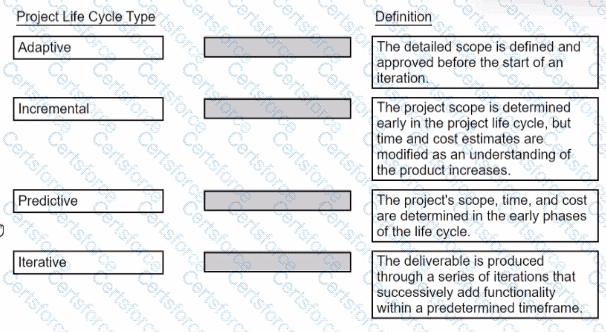
Match the life cycle type to when its requirements are defined.


 A screenshot of a login box Description automatically generated
According to PMI standards, the choice of life cycle determines how the project scope is managed and when the " What " of the project is finalized.
Predictive (Waterfall): This lifecycle is used when the product is well understood. Requirements are locked in during the planning phase. Any changes later usually require a formal change request. This provides high predictability but low flexibility.
Iterative: The goal here is to arrive at the correct solution through successive prototypes or versions. Requirements are revisited and refined based on feedback from the previous iteration. It focuses on the " correctness " of the solution.
Incremental: This life cycle delivers a finished, usable portion of the product in each interval. Requirements for a specific " slice " of the project are defined and delivered, with subsequent increments adding more features until the total scope is met.
Adaptive (Agile): In highly uncertain environments, requirements are never " finished " until the project is. They are maintained in a Product Backlog and refined/prioritized just before the start of a sprint or iteration. This allows the team to respond to change and deliver value quickly.
Understanding these distinctions is crucial for the Project Integration Management knowledge area. The Project Manager must choose the life cycle that best fits the project ' s level of uncertainty, complexity, and the need for frequent delivery.
Cost baseline is an output of which of the following processes?
Control Costs
Determine Budget
Estimate Costs
Estimate Activity Resources
According to the PMBOK® Guide, the Cost Baseline is the approved version of the time-phased project budget, excluding any management reserves, which can be changed only through formal change control procedures. It is the primary output of the Determine Budget process.
Process Context: The Determine Budget process aggregates the estimated costs of individual activities or work packages to establish an authorized cost baseline.
Components: The cost baseline includes all authorized budgets but excludes management reserves. Management reserves are intended to cover " unknown unknowns " and are not part of the performance measurement baseline (PMB) but are part of the total project budget.
Usage: It is used as a basis for comparison to actual results to measure and monitor cost performance. In an S-curve graph, the cost baseline represents the cumulative values of the project ' s expected spending over time.
Analysis of other choices:
Choice A (Control Costs): This is a monitoring and controlling process. Its primary outputs include work performance information, cost forecasts, and change requests. It uses the cost baseline as an input to measure variance.
Choice C (Estimate Costs): This process develops an approximation of the monetary resources needed to complete project work. Its primary output is Cost Estimates, which are then used as an input to the Determine Budget process to create the baseline.
Choice D (Estimate Activity Resources): This process identifies the types and quantities of material, human resources, equipment, or supplies required. While this impacts cost, it is a resource management process, not the budget-setting process.
Which of the following is a tool and technique used in the Develop Schedule process?
Three-point estimates
Resource leveling
Precedence diagramming method
Bottom-up estimating
According to the PMBOK® Guide, the Develop Schedule process is the process of analyzing activity sequences, durations, resource requirements, and schedule constraints to create the project schedule model. Resource leveling is a specific tool and technique categorized under Resource Optimization.
Resource leveling is a technique in which start and finish dates are adjusted based on resource constraints with the goal of balancing the demand for resources with the available supply.
Scenario: It is used when shared or critical required resources are available only at certain times or in limited quantities, or when they have been over-allocated.
Impact: Unlike resource smoothing, resource leveling can often cause the original critical path to change, usually by increasing the project duration.
A. Three-point estimates: This is a tool and technique used in the Estimate Activity Durations process. While it provides the data used to build a schedule, the act of developing the schedule itself uses those durations as inputs.
C. Precedence diagramming method (PDM): This is a tool and technique used in the Sequence Activities process. PDM is used to create the project schedule network diagram by showing the logical relationships between activities.
D. Bottom-up estimating: This is a tool and technique used in Estimate Activity Resources and Estimate Costs. It involves estimating the components of work and then aggregating them to reach a total.
To build a robust schedule, a Project Manager also uses:
Critical Path Method (CPM): To identify the sequence of activities that represents the longest path.
Schedule Compression: Including Crashing (adding resources) and Fast Tracking (performing activities in parallel).
Leads and Lags: Adjusting the timing between successor and predecessor activities.
What-If Scenario Analysis: Using simulation (like Monte Carlo) to see how different variables affect the deadline.
Which tools or techniques will a project manager use for Develop Project Team?
Negotiation
Roles and responsibilities
Recognition and rewards
Prizing and promoting
According to the PMBOK® Guide, the Develop Team process (formerly Develop Project Team) uses several specific tools and techniques to improve the competencies, team member interaction, and overall team environment.
Recognition and Rewards: This is a formal tool and technique used to promote and reinforce desirable behavior. The process involves recognizing and rewarding people for their performance and contributions to the project.
Application: To be effective, rewards must be based on activities and performance under a person ' s control. For example, rewarding a team member for meeting a challenge or reaching a specific milestone encourages continued high performance.
Cultural Sensitivity: The project manager must consider cultural differences when determining rewards (e.g., some cultures value individual praise, while others prefer team-based recognition).
Other Tools and Techniques for Develop Team:
Colocation (Tight Matrix): Placing team members in the same physical location.
Virtual Teams: Using technology to bring together people in different locations.
Communication Technology: Tools like email, portals, and video conferencing.
Interpersonal and Team Skills: Including conflict management, influence, motivation, negotiation, and team building.
Individual and Team Assessments: Tools like surveys or structured interviews to understand team strengths and weaknesses.
Training: Activities designed to enhance the competencies of the project team members.
Comparison with other options:
A. Negotiation: While negotiation is an interpersonal skill used in many processes, it is a primary tool and technique for the Acquire Resources process (used to " negotiate " for staff from functional managers or other teams).
B. Roles and responsibilities: This is an output of the Plan Resource Management process (documented in the Resource Management Plan). It is a definition of what people do, not a technique used to develop the team ' s capabilities or cohesion.
D. Prizing and promoting: These are not formal terms used in the PMBOK® Guide. While " promoting " might happen in a general business sense, the specific PMI-standard term for reinforcing behavior within a project is Recognition and Rewards.
The key benefit of the Monitoring and Controlling Process Group is the ability to:
establish and manage project communication channels, both external and internal to the project team.
influence the stakeholders that want to circumvent integrated change control so that their changes are implemented.
monitor the ongoing project team against the team performance assessments and the project performance baseline.
observe and measure project performance regularly and consistently to identify variances from the project management plan.
According to the PMBOK® Guide, the Monitoring and Controlling Process Group consists of those processes required to track, review, and orchestrate the progress and performance of the project.
The core philosophy of this process group is " Plan vs. Actual. " It acts as the project ' s feedback loop.
Measurement: It involves collecting Work Performance Data (raw observations) and converting it into Work Performance Information (analyzed data).
Variance Analysis: By comparing the current status against the Project Performance Baselines (Scope, Schedule, and Cost), the project manager can identify where the project is drifting.
Actionable Insight: Once a variance is identified, the project manager can determine if a Change Request (corrective or preventive action) is necessary to bring the project back in line with the plan.
A. establish and manage project communication channels...: This is primarily a function of the Planning (Plan Communications Management) and Executing (Manage Communications) process groups. While Monitoring and Controlling includes Monitor Communications, its " key benefit " is broader than just communication.
B. influence the stakeholders that want to circumvent integrated change control...: This is fundamentally incorrect. The project manager ' s goal is to ensure stakeholders follow the integrated change control process, not to help them circumvent it.
C. monitor the ongoing project team against the team performance assessments...: This is a specific activity within the Manage Team process (Executing) and Monitor Resources (Monitoring and Controlling). While important, it is a subset of project performance, not the overarching key benefit of the entire process group.
Monitoring and Controlling occurs concurrently with Executing. As the team carries out the work, the project manager is constantly observing (Monitoring) and taking action to ensure the project stays within its defined boundaries (Controlling). This ensures that the project does not deviate so far from the plan that it becomes impossible to recover.
What tool or technique can improve a products final characteristics?
Design for X (DfX)
Problem solving
Process analysis
Risk report
According to the PMBOK® Guide (6th Edition), specifically within the Manage Quality process, Design for X (DfX) is a set of technical guidelines that may be applied during the design of a product to optimize a specific aspect of the design.
The " X " in DfX can represent different variables of product development, such as reliability, deployment, assembly, manufacturing, cost, service, or usability. The primary goal of using DfX is to improve the product ' s final characteristics and performance.
Why DfX is the correct tool:
Optimization: It allows engineers and project teams to focus on the most critical characteristics of a product early in the life cycle.
Cost Reduction: By designing for excellence in a specific area (like manufacturability), the project can reduce costs and improve quality simultaneously.
Product Improvement: It ensures that the final product is fit for use and meets the specific quality standards defined in the Quality Management Plan.
Analysis of Distractors:
B (Problem solving): While problem-solving is used to deal with issues that have already occurred or to find solutions to identified gaps, it is a reactive or general corrective technique rather than a specific design tool meant to improve final characteristics from the outset.
C (Process analysis): This technique focuses on identifying opportunities for process improvements. It looks at the " how " of the work rather than the technical design " characteristics " of the product itself.
D (Risk report): The risk report is a project document that summarizes information on individual project risks and the level of overall project risk. It is used for communication and documentation, not as a technical tool for product design improvement.
Which of the following is a tool and technique used to monitor risk?
Technical performance measurement
Cost performance baseline
Benchmarking
Cost of quality
According to the PMBOK® Guide, the Monitor Risks process involves tracking identified risks, monitoring residual risks, identifying new risks, and evaluating risk process effectiveness throughout the project.
Technical Performance Measurement: This is a specific tool and technique used in monitoring risks. It compares technical accomplishments during project execution to the schedule of technical achievement. It requires the definition of objective, quantifiable measures of technical performance (such as weight, transaction processing time, or number of delivered defects).
The " Warning Signal " : If the technical performance is not meeting the plan (e.g., a software module is taking more memory than allocated), it indicates that a risk (such as failing to meet the final technical requirements) may be occurring or is more likely to occur than previously thought.
Other Tools in Monitor Risks:
Data Analysis: Including Reserve Analysis and Trend Analysis.
Audits: To examine the effectiveness of the risk response processes.
Meetings: Specifically Risk Reviews, which should be scheduled regularly.
Analysis of Other Options:
B. Cost performance baseline: This is an Output of the Determine Budget process and serves as an Input to various monitoring and controlling processes. It is a document, not a tool or technique.
C. Benchmarking: This is a tool and technique typically used in Plan Quality Management or Plan Stakeholder Engagement. It involves comparing actual or planned project practices to those of comparable projects to identify best practices and provide a basis for measuring performance.
D. Cost of quality (COQ): This is a tool and technique used in Plan Quality Management to find the total cost of all efforts to achieve product/service quality. While it relates to risk, it is specifically a quality planning tool.
The most commonly used type of precedence relationship in the precedence diagramming method (PDM) is:
start-to-start (SS)
start-to-finish (SF)
finish-to-start (FS)
finish-to-finish (FF)
According to the PMBOK® Guide, specifically within the Sequence Activities process of Project Schedule Management, the Precedence Diagramming Method (PDM) is a technique used for constructing a schedule model in which activities are represented by nodes and are graphically linked by one or more logical relationships to show the sequence in which the activities are to be performed.
Finish-to-Start (FS): This is the most commonly used type of precedence relationship. In this relationship, a successor activity cannot start until a predecessor activity has finished.
Example: The " Install Hardware " (Successor) activity cannot start until the " Build Foundation " (Predecessor) activity is finished.
Logical Significance: FS relationships are the default in most project management software because they represent the most intuitive and frequent flow of work in both traditional and agile projects.
Comparison with other options:
A. Start-to-start (SS): A successor activity cannot start until a predecessor activity has started. This is often used for overlapping activities but is less common than FS.
B. Start-to-finish (SF): A successor activity cannot finish until a predecessor activity has started. This is the least commonly used relationship and is rarely seen in standard project schedules.
D. Finish-to-finish (FF): A successor activity cannot finish until a predecessor activity has finished. This is used when activities must conclude at the same time (e.g., " Documentation " cannot finish until " Coding " finishes).
What characteristic of servant leadership supports resource management in an agile environment?
Lecturing
Construing
Measuring
Coaching
According to the Agile Practice Guide and the PMBOK® Guide, servant leadership is the foundational leadership style for agile environments. It shifts the focus from " command and control " to supporting and developing the team.
Coaching as a Characteristic: In the context of resource management (specifically human resources), coaching is a vital skill. A servant leader doesn ' t just manage tasks; they focus on the development of the individuals. By coaching team members, the leader helps them improve their technical skills and collaborative abilities, which directly optimizes the " resource " performance and team velocity.
Supportive Environment: Coaching fosters a safe environment for learning and growth. Instead of penalizing mistakes, the servant leader uses them as coaching moments to ensure the team becomes more self-organizing and cross-functional over time.
Empowerment: This approach empowers the team to make their own decisions. The leader acts as a facilitator, removing " impediments " (roadblocks) so the team can focus on delivering value.
Analysis of other options:
Lecturing (Option A): This is the opposite of servant leadership. It implies a top-down, one-way communication style that stifles the collaborative and self-organizing nature of agile teams.
Construing (Option B): This means interpreting or explaining the meaning of something. While a leader may interpret requirements, it is not a defining characteristic of servant leadership that specifically supports resource management.
Measuring (Option C): While agile teams use metrics (like burn-up or burn-down charts), a servant leader ' s primary focus is on the people and the process, not just the rigid measurement of output. Measuring without coaching often leads to " command and control " behavior.
Per PMI standards, the primary role of a servant leader is to provide the team with what they need to be successful. Coaching is the primary mechanism used to develop the team ' s capabilities and ensure they can manage their own work effectively.
Based on the following metrics: EV= $20,000, AC= $22,000, and PV= $28,000, what is the project CV?
-8000
-2000
2000
8000
Based on the principles of Earned Value Management (EVM) found in the PMBOK® Guide, the Cost Variance (CV) is a measure of cost performance on a project.
Formula: $CV = EV - AC$
Calculation: Given the metrics:
Earned Value ($EV$) = $\$20,000$
Actual Cost ($AC$) = $\$22,000$
$CV = 20,000 - 22,000 = -2,000$
Interpretation:
A negative CV ($-2,000$ in this case) indicates that the project is over budget. It means the actual cost spent to date is higher than the value of the work performed.
A positive CV would indicate that the project is under budget.
A CV of zero would indicate that the project is exactly on budget.
Note: The Planned Value ($PV$) of $\$28,000$ is used for calculating Schedule Variance ($SV = EV - PV$), but it is not used in the calculation for Cost Variance.
A project manager has joined the sponsor to verify the last deliverable of the project. The sponsor is measuring and examining the deliverable to determine whether it meets the requirements and product acceptance criteria. Which activity is being performed?
Inspection
Prototyping
Decision making
Brainstorming
According to the PMBOK® Guide, specifically within the Validate Scope process, Inspection is the primary tool and technique used to ensure that deliverables meet the documented requirements and acceptance criteria.
Definition of Inspection: Inspection includes activities such as measuring, examining, and validating to determine whether work and deliverables meet requirements and product acceptance criteria.
The Validate Scope Process: This process is the formal acceptance of the completed project deliverables by the customer or sponsor. It differs from Control Quality because while quality control is about " correctness, " Validate Scope is about " acceptance. "
Alternative Names: Depending on the industry and the nature of the work, inspections may also be called reviews, product reviews, audits, or walkthroughs. In this scenario, the sponsor ' s act of " measuring and examining " is a textbook definition of an inspection to confirm the deliverable is ready for formal sign-off.
Analysis of other options:
Prototyping (Option B): This is a tool used during the Collect Requirements process to obtain early feedback on requirements by providing a working model of the expected product. It occurs at the beginning of development, not at the final verification stage.
Decision making (Option C): While a decision (accept or reject) will be made based on the inspection, the specific activity of examining the deliverable is called inspection. Decision-making techniques (like voting or multicriteria decision analysis) are the methods used to reach a conclusion.
Brainstorming (Option D): This is a data-gathering technique used to generate and collect multiple ideas related to project and product requirements. It is not used for verifying technical deliverables against criteria.
Per PMI standards, Inspection is critical to the Validate Scope process as it provides the objective evidence needed for the sponsor to formally accept the project ' s output, leading toward project closure.
One of the objectives of a quality audit is to:
highlight the need for root cause analysis.
share the process documentation among stakeholders.
offer assistance with non-value-added activities.
identify all of the gaps or shortcomings.
According to the PMBOK® Guide, a Quality Audit is a structured, independent process used to determine if project activities comply with organizational and project policies, processes, and procedures. It is a key tool and technique of the Manage Quality process (formerly Perform Quality Assurance).
Objectives of a Quality Audit: The primary goal is to identify inefficient and ineffective policies, manuals, and procedures being used on the project. By identifying all of the gaps or shortcomings, the audit ensures that the project team is following the required standards and that any non-compliance is documented.
Continuous Improvement: Beyond just finding gaps, quality audits aim to:
Identify all good and best practices being implemented.
Share best practices introduced or implemented in similar projects in the organization and/or industry.
Proactively offer assistance in a positive manner to improve the implementation of processes to help raise team productivity.
Highlight the need for Corrective Actions or Preventive Actions to bridge the identified gaps.
Analysis of Other Options:
A. highlight the need for root cause analysis: While an audit might uncover a problem that eventually requires a Root Cause Analysis (RCA), the audit ' s direct objective is to find the gap (non-compliance), whereas RCA is a separate technique used to understand why the gap occurred.
B. share the process documentation among stakeholders: This is a function of the Communications Management Plan or general project transparency, rather than a specific objective of a formal Quality Audit.
C. offer assistance with non-value-added activities: This is a distractor. The objective of an audit is actually to identify non-value-added activities so they can be eliminated, not to assist with them. Quality audits help " lean " the process by removing waste.
Which Define Activities tool or technique is used for dividing and subdividing the project scope and project deliverables into smaller, more manageable parts?
Decomposition
Inspection
Project analysis
Document analysis
According to the PMBOK® Guide (Project Management Body of Knowledge), specifically within the Project Schedule Management knowledge area and the Define Activities process:
Decomposition (Option A): This is the primary tool and technique used for dividing and subdividing the project scope and project deliverables into smaller, more manageable parts. While decomposition is also used in the Create WBS process to create work packages, in the Define Activities process, it is used to further break down those work packages into specific activities, which represent the actual effort required to complete the work.
Inspection (Option B): This is a tool used in Control Quality and Validate Scope. It involves examining work products to determine if they conform to standards and requirements. It is not used for planning or breaking down work.
Project Analysis (Option C): This is a general term and not a specific PMBOK tool or technique for this process. Related terms like " Product Analysis " are used in Define Scope to translate high-level descriptions into tangible deliverables.
Document Analysis (Option D): This is a data gathering technique used in the Collect Requirements and Identify Stakeholders processes. It involves eliciting requirements by analyzing existing documentation and identifying information relevant to the requirements.
In the PMI framework, Decomposition ensures that the project team has a clear understanding of the work that needs to be performed. By breaking work packages down into activities, the Project Manager can more accurately provide estimates for schedule and cost, which are then used to develop the Schedule Baseline.
Which of the Perform Quality Assurance tools and techniques may enhance the creation of the work breakdown structure (VVBS) to give structure to the decomposition of the scope?
Activity network diagrams
Affinity diagrams
Matrix diagrams
Interrelationship digraphs
According to the PMBOK® Guide, specifically the Manage Quality process (formerly known as Perform Quality Assurance), several quality management and control tools are used to organize and visualize data.
Affinity Diagrams: This tool is used to generate ideas that can be linked to form organized patterns of thought about a problem or a project. In the context of the Work Breakdown Structure (WBS), affinity diagrams allow the project team to take a large number of ideas or requirements and group them into natural categories.
Structuring Decomposition: By grouping related requirements or tasks together, the project manager can more effectively " give structure to the decomposition of the scope. " This makes it significantly easier to create a logical WBS where the deliverables are clearly categorized and nested.
Brainstorming Linkage: It is often used after a brainstorming session to sort a high volume of data into a manageable hierarchy, which is exactly the goal when moving from a raw requirements list to a structured WBS.
Comparison with other options:
A. Activity network diagrams: These are used primarily in the Sequence Activities process to show the logical relationships and dependencies between schedule activities (e.g., Finish-to-Start). They deal with timing, not the hierarchical decomposition of scope.
C. Matrix diagrams: These are used to perform data analysis within the quality organizational structure. They show the strength of relationships between factors, causes, and objectives (like a Responsibility Assignment Matrix), but they do not provide the " structure for decomposition " required for a WBS.
D. Interrelationship digraphs: These provide a process for creative problem-solving in moderately complex scenarios that possess intertwined logical relationships. While they show how different ideas influence one another, they are not designed for the hierarchical " parent-child " structure inherent in a WBS.
Match the project life cycle type with its corresponding definition.
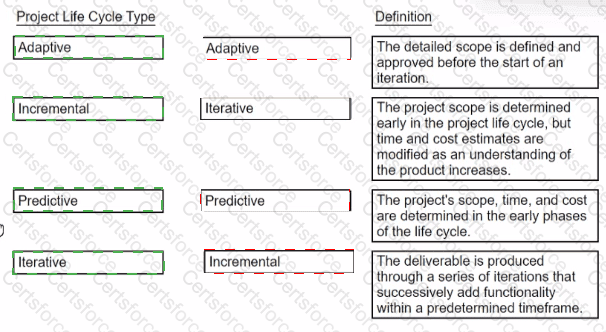
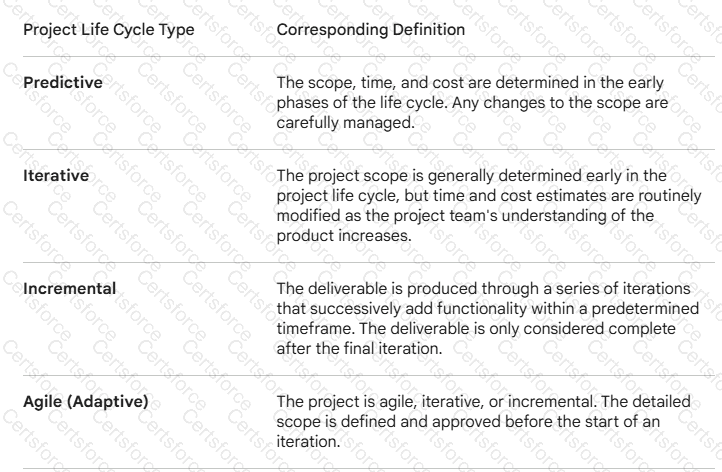
The PMBOK® Guide (6th Edition), Section 1.2.4.1, and the Agile Practice Guide define these life cycles based on how they handle change and the frequency of delivery:
Predictive (Waterfall): This is the traditional approach where the project is planned in detail from the start. It is best used when the product to be delivered is well understood and there is a stable environment. The focus is on following the plan and managing deviations.
Iterative: This approach develops the product through a series of repeated cycles (iterations). It is best used when the scope is known but the best way to implement it needs to be discovered through feedback. It focuses on getting the " correctness " of the solution right.
Incremental: This approach provides a finished deliverable that the customer can use immediately after each increment. Each increment adds a functional layer to the previous one. The focus is on the " speed of delivery " of functional parts.
Agile/Adaptive: These life cycles are both iterative and incremental. They are designed to handle high levels of change and require ongoing stakeholder involvement. The scope is decomposed into a backlog of requirements that are prioritized and delivered in short, fixed-length bursts (sprints/iterations).
During what project management process does the project manager invest the most effort into creating the work breakdown structure (WBS)?
Initiating
Planning
Executing
Monitoring and Controlling
According to the PMBOK® Guide, the Work Breakdown Structure (WBS) is a fundamental tool created within the Project Scope Management knowledge area, specifically during the Create WBS process.
The Planning Process Group: This group consists of those processes performed to establish the total scope of the effort and define the course of action. Creating the WBS is a core planning activity because it involves decomposing the total scope of work into smaller, more manageable components called work packages.
Purpose of the WBS: The WBS provides the framework for everything that follows in the planning phase, including cost estimation, scheduling, resource allocation, and risk identification. Without a finalized WBS, a project manager cannot establish an accurate Scope Baseline.
Analysis of other Process Groups:
Initiating (Option A): This group focuses on the Project Charter and high-level requirements. While the " what " is defined here, the " how-to-break-it-down " (WBS) does not happen until the project is officially authorized and moves into planning.
Executing (Option C): This phase involves " doing the work. " The team uses the WBS created during planning to guide their activities, but they do not typically " create " it during this stage.
Monitoring and Controlling (Option D): This phase involves comparing actual performance against the plan. While the WBS is used here to track progress at the work package level, the effort spent is on tracking, not creating.
Per PMI standards, the WBS is the " heart " of the project plan. It ensures that the project manager and the team have a shared understanding of the project ' s deliverables and the work required to produce them.
In which of the Risk Management processes is the project charter used as an input?
Plan Risk Responses
Implement Risk Responses
Plan Risk Management
Perform Quantitative Risk Responses
According to the PMBOK® Guide, the Project Charter is a foundational document that provides high-level boundaries for the project. In the context of Project Risk Management, it is specifically used as an input to the very first process: Plan Risk Management.
Why the Project Charter is used: The charter contains high-level project descriptions, boundaries, and requirements. Most importantly, it often outlines high-level risks, project objectives, and the pre-approved financial resources.
Context for Risk: To develop a Risk Management Plan, the project manager needs to understand the high-level risks already identified during the initiation phase (contained in the charter) and the overall project complexity to decide how much time and effort should be spent on risk management activities.
Analysis of other options:
A, B, and D: These processes (Plan Risk Responses, Implement Risk Responses, and Perform Quantitative Risk Analysis) occur later in the planning and execution stages. By the time these processes are reached, the project manager relies on the Risk Register, Risk Report, and the Project Management Plan (which includes the Risk Management Plan) rather than the high-level Project Charter.
As per PMI standards, the Plan Risk Management process is the only risk process that utilizes the Project Charter as a primary input to ensure the risk approach is aligned with the high-level goals established at the project ' s inception.
An output of the Manage Stakeholder Engagement process is:
change requests
enterprise environmental factors
the stakeholder management plan
the change log
According to the PMBOK® Guide (Project Stakeholder Management), the Manage Stakeholder Engagement process is the process of communicating and working with stakeholders to meet their needs/expectations, address issues as they occur, and foster appropriate stakeholder engagement in project activities throughout the project life cycle.
A primary output of this process is Change Requests. As the project manager interacts with stakeholders, their needs or expectations may evolve, or issues may be identified that require modifications to the project ' s scope, schedule, or budget. These requests are processed through the Perform Integrated Change Control process for approval or rejection.
Other key outputs include:
Project Management Plan Updates (specifically the Communications Management Plan and Stakeholder Engagement Plan).
Project Document Updates (such as the Change Log, Issue Log, Lessons Learned Register, and Stakeholder Register).
Analysis of Distractors:
B. enterprise environmental factors: These are typically inputs to the process (e.g., organizational culture, personnel administration) rather than outputs produced by managing engagement.
C. the stakeholder management plan: This is the primary output of the Plan Stakeholder Engagement process. While it may be updated during Manage Stakeholder Engagement, the document itself is created during the planning phase.
D. the change log: The Change Log is an input to this process. It is used to communicate to stakeholders which changes have been approved, deferred, or rejected. While it might be updated as an output, " Change Requests " is the more definitive output when new requirements or adjustments arise from stakeholder interaction.
A technical project manager uses a directive approach with the team. Some team members are growing increasingly frustrated when their recommendations are not adopted by the project manager.
What should the project manager do to address this issue?
Apply emotional intelligence (El) skills, such as active listening, to understand the team ' s issues.
Instruct the team members to self-organize and resolve any outstanding issues.
Ask the team members to record their concerns in the lessons learned log for future action.
Encourage the team to follow the project plan that was developed with team input.
According to the PMBOK® Guide (7th Edition) and the PMI Standard for Project Management, leadership is not a " one size fits all " activity. While a directive approach (Command and Control) may be useful in a crisis, it often leads to decreased morale and stifled innovation in technical teams.
Why Choice A is correct: The Project Manager is currently experiencing a breakdown in Team Management. By applying Emotional Intelligence (EI), the PM can recognize the emotional state of the team (frustration) and regulate their own leadership style to be more collaborative.
Active Listening: This specific EI skill involves seeking to understand the " why " behind the team ' s recommendations. Even if the PM ultimately chooses a different path, making the team feel heard and valued significantly reduces friction and improves buy-in.
Relationship Management: This allows the PM to transition from a purely directive style to a more participative or servant-leadership style, which is essential for retaining high-performing technical talent.
Analysis of other options:
B (Instruct to self-organize): You cannot simply " tell " a team to self-organize if the current environment is strictly directive. Self-organization requires a foundation of trust and empowerment that the PM must first build through better interpersonal skills.
C (Lessons learned log): This is a passive-aggressive way to dismiss current concerns. Lessons learned are primarily for the end of a phase or project; the team ' s frustration is an active issue that requires immediate resolution to prevent project slippage.
D (Encourage following the plan): This ignores the human element of the problem. If the team feels their expertise is being ignored, simply pointing at a document will likely increase their frustration rather than solve it.
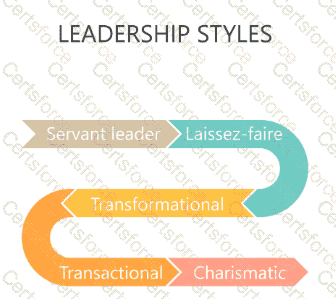
Key Concept: The Project Management Institute (PMI) emphasizes that modern Project Managers must balance technical skills with " Power Skills " (soft skills). In this scenario, the PM’s technical directive style has become a bottleneck. Using EI (Choice A) is the first step in diagnosing the conflict and adapting the leadership approach to meet the team ' s professional needs.
What should be the frequency for meetings when transitioning from Scrum to Kanban?
Weekly
Daily
When required
Monthly
According to the Agile Practice Guide and literature regarding Kanban (such as the Kanban Method by David J. Anderson), transitioning from Scrum to Kanban involves a shift from time-boxed iterations to a continuous flow model.
Why Choice C is correct: In Scrum, meetings (ceremonies) are strictly scheduled according to the cadence of the Sprint (e.g., Daily Stand-ups, Sprint Planning, Sprint Reviews). In Kanban, the philosophy is to " evolve " rather than " replace, " and it prioritizes just-in-time activity. While many Kanban teams choose to keep a daily stand-up to manage flow, the formal Kanban framework allows for cadences to be " decoupled. " This means meetings like replenishment or service delivery reviews happen when required—based on the system ' s needs, such as when the " Ready " column hits a minimum threshold or when a particular work item is completed.
Analysis of other options:
B (Daily): While common, Kanban does not mandate a daily meeting in the same rigid way Scrum defines the " Daily Scrum. " Kanban focuses on the board; if the board is clear and the flow is healthy, a meeting might not be necessary every single day.
A and D (Weekly/Monthly): These are arbitrary time boxes. Kanban avoids forced cadences that do not align with the actual flow of work (the " Pull " system).
Key Differences in Cadence: In a Scrum-to-Kanban transition, the team moves away from the " end-of-sprint " rush. The PMBOK® Guide notes that Kanban focuses on managing Lead Time and Cycle Time. Therefore, the team meets to resolve bottlenecks or replenish work based on the actual state of the workflow rather than a calendar date. This flexibility allows the team to be more responsive to changes in demand.
Which input provides suppliers with a clear set of goals, requirements, and outcomes?
Procurement statement of work
Purchase order
Source selection criteria
Bidder conference
According to the PMBOK® Guide, the Procurement Statement of Work (SOW) is a critical document developed during the Plan Procurement Management process.
Definition and Purpose: The Procurement SOW describes the procurement item in sufficient detail to allow prospective sellers to determine if they are capable of providing the products, services, or results. It is derived from the project scope baseline and defines only that portion of the project scope that is to be included within the related contract.
Content: A well-drafted SOW provides suppliers with a clear set of goals, requirements, and outcomes. It typically includes specifications, quantity desired, quality levels, performance data, period of performance, work location, and other requirements.
Clarity for Sellers: Its primary function is to ensure that the " buy " side of the project is clearly understood by the " sell " side, reducing the risk of project delays or cost overruns due to misunderstood requirements.
Why the other options are incorrect:
B. Purchase order: While a purchase order is a formal contract, it is typically used for commodity-type items and is an output of the procurement process. It confirms an order rather than providing the initial detailed set of goals and requirements used to solicit a bid.
C. Source selection criteria: These are used to rate or score seller proposals. They define how the buyer will evaluate the bidders (e.g., technical capability, cost, experience), not the specific work the seller needs to perform.
D. Bidder conference: This is a Tool and Technique (a meeting) used to ensure that all prospective sellers have a clear, common understanding of the procurement. While the SOW is discussed here, the conference itself is not the " input " or " document " that provides the requirements.
Which task will a project manager undertake while conducting Project Resource Management?
Identity the different aspects of me team to manage and control physical resources efficiently.
Procure equipment, materials, facilities, and infrastructure for the project.
Train the team members in project skill sets.
Define the roles and responsibilities of each team member.
According to the PMBOK® Guide, Project Resource Management includes the processes to identify, acquire, and manage the resources needed for the successful completion of the project. A key evolution in the 6th and 7th editions is the explicit distinction and integration of both Team Resources (human) and Physical Resources (equipment, materials, facilities, and infrastructure).
Integrated Management: The project manager must identify various aspects of the team—such as specialized skills, availability, and reporting structures—not only to lead people but to ensure that the physical resources they use are managed and controlled efficiently.
Control Physical Resources: This specific task involves ensuring that the assigned physical resources are available to the project at the right time and are released when no longer needed. Efficiently managing the " team aspects " (who needs what and when) is the primary driver for successful physical resource control.
Scope of Knowledge Area: This knowledge area covers:
Plan Resource Management: Defining how to estimate, acquire, manage, and use resources.
Estimate Activity Resources: Quantifying what is needed.
Acquire Resources: Obtaining the team and physical assets.
Develop/Manage Team: Improving competencies and tracking performance.
Control Resources: Ensuring physical assets are utilized as planned.
Analysis of Other Options:
B. Procure equipment, materials, facilities, and infrastructure for the project: While these are physical resources, the act of " procuring " (contracting with external vendors) specifically belongs to Project Procurement Management. Resource Management focuses on the assignment and internal management of those assets once obtained.
C. Train the team members in project skill sets: This is an activity within the Develop Team process. While it is a task within Resource Management, it is a sub-activity rather than the overarching management and control aspect described in the primary objective of the knowledge area.
D. Define the roles and responsibilities of each team member: This is part of the Plan Resource Management process (specifically the Resource Management Plan). However, identifying team aspects to control physical resources (Option A) better represents the modern, holistic view of the knowledge area which balances human and material logistics.
The Project Management Process Group in which performance is observed and measured regularly from project initiation through completion is:
Executing.
Initiating,
Monitoring and Controlling.
Planning.
According to the PMBOK® Guide, the Monitoring and Controlling Process Group consists of those processes required to track, review, and regulate the progress and performance of the project.
This process group is unique because it is not a sequential phase that happens once; rather, it is a continuous set of activities that occurs concurrently with all other process groups throughout the project life cycle.
Observation and Measurement: It involves comparing actual performance against the Project Management Plan.
Regularity: It starts at the very beginning (project initiation) and continues through project closure to ensure the project stays within the approved baselines.
Purpose: The primary benefit is that project performance is measured and analyzed at regular intervals, appropriate events, or exception conditions to identify variances from the plan and initiate corrective or preventive actions.
A. Executing: This process group focuses on completing the work defined in the project management plan to satisfy the project requirements. While data is collected here, the observation and measurement against the plan is a function of Controlling.
B. Initiating: These processes are performed to define a new project or phase and obtain authorization. While monitoring starts here (e.g., ensuring the charter is followed), it is not the primary purpose of this group.
D. Planning: This group is focused on establishing the scope and defining the course of action. You cannot measure performance against a plan until the plan is being executed and monitored.
Control Scope/Schedule/Costs: Comparing actual progress against the baselines.
Perform Integrated Change Control: Reviewing and approving/rejecting change requests.
Monitor Risks: Tracking identified risks and identifying new ones.
Control Quality: Monitoring specific project results to determine if they comply with quality standards.
In adaptive projects, who should approve the prioritization of the backlog?
Project manager
Project sponsor
Business analyst
Product owner
According to the Agile Practice Guide and the Scrum Guide, the accountability for the value delivered by the team rests with a specific role responsible for managing the product ' s requirements.
The Product Owner (PO): In adaptive (Agile) frameworks, the Product Owner is the sole person responsible for managing the Product Backlog. This includes clearly expressing backlog items and, most importantly, prioritizing those items to best achieve goals and missions.
Value Maximization: The PO ' s primary goal is to maximize the value of the product resulting from the work of the Development Team. By deciding the order of the backlog, they ensure that the team is always working on the most valuable features or " highest priority " items first.
Stakeholder Representation: While the PO may listen to the project sponsor, customers, or business analysts, they are the final authority on the backlog ' s priority. For the team to work effectively, the entire organization must respect the Product Owner’s decisions regarding prioritization.
Analysis of other options:
Option A: In a purely adaptive environment, the Project Manager role is often evolved into a Scrum Master or Team Lead. These roles focus on facilitation and removing impediments, not on deciding what business value should be prioritized.
Option B: The Project Sponsor provides the funding and high-level vision. While they influence the Product Owner, they do not manage the day-to-day prioritization of the backlog.
Option C: The Business Analyst helps define and refine requirements. While they provide the data and analysis that inform priority, the ultimate decision-making authority belongs to the Product Owner.
Per PMI standards, the Product Owner is the person accountable for the " what " and the " when " of the product features, making them the only role authorized to approve the backlog prioritization.
When can we say that a project is completed?
When the planned time duration is completed
When the project objectives have been reached
When the project manager has left the team
When the project team decides to stop the work on the project
According to the PMBOK® Guide, a project is defined as a temporary endeavor undertaken to create a unique product, service, or result. The " temporary " nature of a project indicates that it has a definite beginning and end.
The end of a project is reached when one or more of the following conditions are met:
Objectives Met: The primary condition for completion is that the project objectives have been achieved. This means the specific goals, results, or products defined in the project charter and scope statement have been delivered and accepted.
Objectives Cannot Be Met: The project is also considered ended if it is determined that the objectives cannot be met (e.g., due to lack of funding, technical impossibility, or shifting organizational strategy).
Need No Longer Exists: If the original reason for the project is no longer valid (e.g., the market changed, or a competitor released a superior product first), the project is terminated.
Termination for Cause: The project may be ended for legal or convenience reasons before the objectives are reached.
Why other options are incorrect:
Option A: When the planned time duration is completed: Reaching the end date of a schedule does not mean the project is " completed " if the deliverables have not been produced. If time runs out but work remains, the project is considered behind schedule, not finished.
Option C: When the project manager has left the team: The presence or absence of a specific individual does not define the status of the project. A project manager may be replaced, but the project continues until its objectives are met or it is formally closed.
Option D: When the project team decides to stop the work: The project team does not have the unilateral authority to declare a project completed. Completion is a formal status determined by the achievement of objectives and the formal sign-off from the project sponsor or customer.
Which group of inputs will a project manager use during the Monitor Stakeholder Engagement process?
Project charter, business documents, and project management plan
Agreements, scope baseline, and project management plan
Project charter, business case, and project management plan
Work performance data, enterprise environmental factors, and project management plan
According to the PMBOK® Guide, Monitor Stakeholder Engagement is the process of monitoring project stakeholder relationships and tailoring strategies for engaging stakeholders through the modification of engagement strategies and plans.
Because this is a Monitoring and Controlling process, its primary goal is to compare actual engagement levels against the planned levels to identify variances.
Work Performance Data: This is a critical input for any monitoring process. It contains raw data on project status, such as which stakeholders are attending meetings, the level of support or resistance encountered during activities, and the effectiveness of communication channels.
Project Management Plan: Specifically, the Resource Management Plan, Communications Management Plan, and the Stakeholder Engagement Plan. These provide the " baseline " or the intended strategy against which actual performance is measured.
Enterprise Environmental Factors (EEF): The project manager must consider organizational culture, political climate, and global/regional trends that may influence stakeholder behavior or the project ' s ability to engage them effectively.
Project Documents: Other inputs include the Issue Log, Lessons Learned Register, and Stakeholder Register.
Analysis of Other Options:
A. Project charter, business documents, and project management plan: These are primary inputs for Identify Stakeholders (Initiating) and Plan Stakeholder Engagement (Planning). The Project Charter is used to identify initial stakeholders, not to monitor ongoing engagement.
B. Agreements, scope baseline, and project management plan: While Agreements and the Scope Baseline are important documents, they are not the primary drivers for monitoring the human element of stakeholder engagement.
C. Project charter, business case, and project management plan: Similar to Option A, the Project Charter and Business Case are used at the very beginning of the project to define the " why " and " who, " but they do not provide the dynamic work performance data needed to monitor current engagement.
A project manager is reviewing a few techniques that can be used to evaluate solution results. The intent is to uncover whether the solution responds properly to unintended cases.
Which evaluation technique should be used here?
Exploratory testing
Integration testing
User acceptance testing
Day-in-the-life testing
In both the PMI Guide to Business Analysis and the Agile Practice Guide, software and solution evaluation techniques are categorized based on their intent—whether they are checking against known requirements or searching for unknown risks.
Why Choice A is correct:
Defining Exploratory Testing: This is an unscripted testing technique where the tester " explores " the solution without following a predetermined set of test cases.
Unintended Cases: The specific goal of exploratory testing is to find " edge cases " or " unintended behaviors " that documented requirements and automated scripts might have missed. It relies on the tester’s intuition and experience to try to " break " the system in ways the developers didn ' t anticipate.
Adaptive Learning: As the tester discovers how the system handles weird inputs or unexpected sequences, they learn more about the solution ' s limits, making it the perfect tool for uncovering hidden defects in complex logic.
Analysis of other options:
B (Integration testing): This focuses on the interfaces between modules to ensure they communicate correctly. It is usually scripted and technical, aimed at data flow rather than testing " unintended " user scenarios.
C (User acceptance testing): UAT is conducted to confirm the system meets the agreed-upon requirements (the " Happy Path " ). It is used to prove the system works as intended for the end-user, not necessarily to investigate how it fails under unintended conditions.
D (Day-in-the-life testing): This is a form of observational testing where the solution is tested in a real-world environment following a typical workday. While it tests the flow, it is generally focused on " normal " operations rather than intentionally probing for " unintended cases. "
Key Concept: The Project Management Institute (PMI) emphasizes that while scripted testing ensures the product does what it should do, Exploratory Testing (Choice A) ensures the product doesn ' t do what it shouldn ' t do. It is an essential risk-mitigation technique for complex solutions where the range of user inputs is vast and unpredictable.
A business manager wants to start a project to launch a new product and submits a business case to the Portfolio Steering Committee for review. The committee asks the manager for details about the expected business value of the project.
How can the manager document the business value for the Portfolio Steering Committee?
Conduct a feasibility study to determine the business impact of the new product.
Prepare a benefits management plan to capture target benefits and strategic alignment.
Execute a market study for similar products and demonstrate a market need.
Create a presentation outlining the business benefits of the new product.
According to the PMBOK® Guide and the Standard for Program Management, the transition from a business case to a tangible project requires a structured way to define and track success.
Why Choice B is correct: While a Business Case provides the " why " (the economic justification), the Benefits Management Plan provides the " how " and " when " regarding the business value.
Strategic Alignment: It formally documents how the project outcomes will align with the organization ' s strategic goals.
Target Benefits: It defines the specific, measurable gains (tangible or intangible) that the project is expected to deliver.
Metrics and Timeline: It outlines the Key Performance Indicators (KPIs) to measure benefit realization and specifies the timeframe for when these benefits will be realized (short-term vs. long-term).
Accountability: It identifies the " Benefit Owners " —those responsible for ensuring the value is captured after the project is closed.
Analysis of other options:
A (Feasibility study): This determines if a project can be done (technical or financial possibility). While it supports the business case, it is a binary assessment (Yes/No) rather than a plan for documenting and tracking ongoing business value.
C (Market study): This provides data on external demand. It is a tool used within the creation of a business case to justify the project, but it does not serve as a formal management document for the internal business value the committee is asking for.
D (Create a presentation): While a presentation is a communication tool, it is not a formal project management document or artifact. The Steering Committee requires a structured plan that can be used for governance and performance measurement throughout the project lifecycle.
Key Concept: The Project Management Institute (PMI) emphasizes that " Project success is measured by the realization of benefits. " For a Portfolio Steering Committee, the Benefits Management Plan (Choice B) is the essential document that moves beyond simple profit projections to show a comprehensive, managed approach to creating and sustaining value for the organization.
Activity cost estimates and the project schedule are inputs to which Project Cost Management process?
Estimate Costs
Control Costs
Plan Cost Management
Determine Budget
According to the PMBOK® Guide (Project Management Body of Knowledge), specifically within the Project Cost Management knowledge area, it is essential to distinguish between the individual processes and their respective inputs:
Determine Budget (Option D): This is the process of aggregating the estimated costs of individual activities or work packages to establish an authorized cost baseline. The primary inputs required to perform this aggregation include the Activity Cost Estimates (the cost of each specific task) and the Project Schedule (which provides the timing of when these costs will be incurred, allowing for the calculation of time-phased budget requirements).
Estimate Costs (Option A): This is the preceding process where the Activity Cost Estimates are actually created. Therefore, the estimates are an output of this process, not an input.
Control Costs (Option B): This process involves monitoring the status of the project to update the project costs and managing changes to the cost baseline. While it uses the budget, its primary inputs are Work Performance Data and the Cost Baseline itself.
Plan Cost Management (Option C): This is the initial planning process that establishes the policies, procedures, and documentation for planning, managing, expending, and controlling project costs. It occurs before any specific activity costs have been estimated.
In the PMI framework, the Determine Budget process is what transforms individual task-level data into the Cost Baseline, which is the version of the budget used to measure and monitor cost performance throughout the project.
A project manager needs to demonstrate that the project meets quality standards and success criteria. For that reason, the project manager is defining the quality objectives of the project, the quality tools that will be used, and quality metrics for the project deliverables.
Which process is the project manager executing?
Manage Quality
Plan Quality Management
Control Quality
Plan Scope Management
According to the PMBOK® Guide (6th Edition), the Plan Quality Management process is the process of identifying quality requirements and/or standards for the project and its deliverables, and documenting how the project will demonstrate compliance with quality requirements and/or standards.
The scenario explicitly describes the project manager defining the foundational elements of quality for the project. These activities are key components of the planning phase:
Defining Quality Objectives: Establishing the standards and success criteria the project must meet.
Quality Tools: Identifying which specific tools (e.g., flowcharts, check sheets, or statistical sampling) will be applied during the project.
Quality Metrics: Defining the specific attributes (e.g., defect rate, reliability, or on-time performance) that will be measured to ensure the project is successful.
Analysis of Distractors:
A (Manage Quality): Often referred to as Quality Assurance, this is an Executing process. It focuses on using the quality plan to ensure the project processes are being followed and that the project is using the appropriate quality standards. It is about " managing " the work, not " defining " the metrics and tools.
C (Control Quality): This is a Monitoring and Controlling process. It is the process of monitoring and recording results of executing the quality management activities to assess performance and ensure the project outputs are complete, correct, and meet customer expectations. It uses the metrics defined in planning to measure the actual deliverables.
D (Plan Scope Management): This process is focused on defining how the project scope will be defined, validated, and controlled. While quality and scope are related (quality is the degree to which a set of inherent characteristics fulfills requirements), the specific tasks of defining quality tools and metrics belong to the Quality Management knowledge area.
Which is used to solicit proposals from prospective sellers?
Procurement statement of work
Resource calendars
Procurement document
Independent estimates
According to the PMBOK® Guide, specifically within the Plan Procurement Management process, the project manager and the procurement department create specific documents to communicate project needs to the market.
" Procurement documents " is a collective term used in the PMI framework to describe the formal instruments used to solicit proposals from prospective sellers. Depending on the complexity and nature of the requirement, these may include:
Request for Proposal (RFP): Used when there is a problem in the project and the solution is not clear. It solicits the seller ' s methodology and ideas.
Request for Quotation (RFQ): Used when the deliverables are standard or commodities, and the primary focus is on price.
Invitation for Bid (IFB): Often used in government procurement for highly standardized work.
These documents ensure that all prospective sellers have a clear and consistent understanding of the work to be performed, the terms and conditions, and the criteria by which they will be evaluated.
A. Procurement statement of work (SOW): While the SOW is a critical part of the procurement document, it is not the solicitation instrument itself. The SOW defines the portion of the project scope to be included within a related contract, providing enough detail for prospective sellers to determine if they are capable of providing the products or services.
B. Resource calendars: These are documents that identify the working days and shifts on which each specific resource is available. They are an input to several processes but are not used to solicit external sellers.
C. Procurement document: As stated, this is the overarching term for the solicitation packages (RFP, RFQ, etc.) sent to providers.
D. Independent estimates: These are often developed by the procuring organization or an outside professional to serve as a " benchmark " or " sanity check " to evaluate the reasonableness of the bids or proposals submitted by sellers. They are a Tool and Technique of Conduct Procurements, not a solicitation document.
In the PMI standard, the flow generally follows:
Requirement $\rightarrow$
Procurement SOW $\rightarrow$
Procurement Documents (Solicitation) $\rightarrow$
Seller Proposals.
Projects can be divided into phases to provide better management control. Collectively, what are these phases known as?
Complete project phase
Project life
The project life cycle
Project cycle
According to the PMBOK® Guide, a project is a temporary endeavor with a definite beginning and end. To provide better management control and appropriate links to the ongoing operations of the performing organization, projects are often divided into several project phases.
Definition of Project Life Cycle: The project life cycle is the series of phases that a project passes through from its start to its completion. It provides the basic framework for managing the project, regardless of the specific work involved.
Phase Characteristics: Each phase is a collection of logically related project activities that culminates in the completion of one or more deliverables. Breaking a project into phases allows the project manager and the organization to perform " phase gates " or " kill points, " where the project ' s performance is reviewed against the business case before moving to the next phase.
Generic Structure: While specific life cycles vary by industry (e.g., software development vs. construction), the PMBOK® Guide identifies a generic life cycle structure:
Starting the project (Initiating).
Organizing and preparing (Planning).
Carrying out the work (Executing).
Ending the project (Closing).
Adaptability: The project life cycle can be predictive (plan-driven), iterative, incremental, or adaptive (agile/change-driven), depending on the degree of certainty regarding the scope and the frequency of delivery.
Comparison with other options:
A. Complete project phase: This is not a standard PMI term. While a project has phases, the collective group of phases is not called a " complete phase. "
B. Project life: While colloquially used, " Project Life " is incomplete. The formal standard term for the management framework is the Project Life Cycle.
D. Project cycle: This is a vague term. PMI specifically uses " Life Cycle " to denote the progression from initiation to closure.
Which of the following factors within a company cloud trigger the creation of a project?
Need to lower production costs to remain competitive
Need to submit a warranty claim for a faulty product
Need to submit the monthly production report
Need to define next month ' s production goals
According to the PMBOK® Guide, projects are initiated in response to factors that influence an organization. These factors are often categorized as " Project Initiation Contexts. " A project is a temporary endeavor undertaken to create a unique product, service, or result, and it is usually launched to achieve a specific strategic objective or to solve a problem.
Market Demand / Competition: The need to lower production costs to remain competitive is a classic strategic trigger. This would typically involve a project to improve processes (e.g., Six Sigma), implement new technology, or redesign a manufacturing line. This creates a unique change or improvement, which is the hallmark of a project.
Strategic Opportunity: Organizations often initiate projects to align with their business strategies. Reducing costs to maintain a competitive edge directly supports the organization ' s long-term viability and market position.
Why other options are incorrect:
Option B: Need to submit a warranty claim: This is a routine administrative or customer service task. It does not create a unique product or result; it is part of the ongoing operations of a business.
Option C: Need to submit the monthly production report: This is a repetitive, ongoing activity. Monthly reporting is a functional operational task required to maintain the business, not a project.
Option D: Need to define next month ' s production goals: This is a standard management or operational planning activity. Setting recurring short-term goals for existing lines of work is part of operations management, not a project initiation trigger.
The process of identifying and documenting the specific actions to be performed to produce the project deliverables is known as:
Define Activities.
Sequence Activities.
Define Scope.
Control Schedule.
According to the PMBOK® Guide, specifically within the Project Schedule Management knowledge area, Define Activities is the process of identifying and documenting the specific actions to be performed to produce the project deliverables.
Key Purpose: The primary benefit of this process is that it decomposes work packages into schedule activities that provide a basis for estimating, scheduling, executing, monitoring, and controlling the project work.
Decomposition: This is the primary tool and technique used in this process. While the Create WBS process identifies the deliverables at the work package level, the Define Activities process takes those work packages and further breaks them down into the individual activities required to complete them.
Outputs: The main outputs of this process include the Activity List, Activity Attributes, and a Milestone List. These documents provide the necessary detail for the subsequent processes of sequencing and estimating durations.
Comparison with other options:
B. Sequence Activities: This is the process of identifying and documenting relationships among the project activities (e.g., determining which task must come first). It happens after the activities have been defined.
C. Define Scope: This is the process of developing a detailed description of the project and product. It focuses on what will be delivered (the boundaries of the project), whereas Define Activities focuses on the work (the actions) required to create those deliverables.
D. Control Schedule: This is a monitoring and controlling process. It is concerned with monitoring the status of the project to update the project schedule and managing changes to the schedule baseline, rather than the initial identification of activities.
A project manager has to share a status report with a new stakeholder and is trying to determine the level of detail to include in the report. Which document best details the information the project manager needs lo make this decision?
Organizational process assets
Change management plan
Communications management plan
Resource management plan
According to the PMBOK® Guide (6th Edition), the Communications Management Plan is the primary document used to define how project communications will be planned, structured, implemented, and monitored.
When a project manager needs to determine the specific level of detail, format, frequency, and audience for a status report, they refer to this plan. It acts as the " playbook " for all information exchange within the project and specifically addresses:
Stakeholder communication requirements: Identifying who needs what information.
Information to be communicated: Including the language, format, content, and level of detail.
Reason for the distribution: Why that specific information is being shared with that specific stakeholder.
Timeframe and frequency: How often the reports should be sent.
Analysis of Distractors:
A (Organizational process assets - OPAs): While OPAs might provide the template for a status report or historical data on how reports were handled in the past, they do not dictate the specific requirements for a new stakeholder on the current project. The specific requirements are tailored and stored in the project ' s management plans.
B (Change management plan): This document describes how changes to the project (scope, schedule, or budget) will be formally authorized and incorporated. It does not govern the distribution or detail level of routine status reports.
C (Resource management plan): This plan provides guidance on how project resources (human and physical) should be categorized, allocated, and managed. It does not contain instructions for stakeholder communication or reporting depth.
The procurement requirements for a project include working with several vendors. What should the project manager take into consideration during the Project Procurement Management processes?
Work performance information
Bidder conferences
Complexity of procurement
Procurement management plan
According to the PMBOK® Guide, specifically in the section regarding Trends and Emerging Practices and Tailoring Considerations for Project Procurement Management, the project manager must evaluate the unique environment of the project to determine how to apply procurement processes.
When working with several vendors, the project manager must consider:
Complexity of Procurement: This is a critical tailoring consideration. The project manager must ask: Is there one main procurement, or are there multiple procurements at different times with different sellers that add to the complexity of the project? Managing multiple vendors simultaneously increases the integration risk and requires a more robust approach to coordination and contract management.
Physical Location: Determining whether the buyers and sellers are in the same location or different time zones/countries.
Governance and Regulatory Environment: Ensuring all procurements comply with local and international laws.
Availability of Sellers: Assessing if there are enough qualified sellers to perform the work.
Analysis of Other Options:
A. Work performance information: While this is an output of the Control Procurements process, it is a result of the process rather than a fundamental consideration used to design or tailor the procurement approach.
B. Bidder conferences: This is a specific Tool and Technique used during the Conduct Procurements process to ensure all prospective sellers have a clear, common understanding of the procurement requirements. It is an activity, not a high-level tailoring consideration.
D. Procurement management plan: This is the output of the Plan Procurement Management process. While the PM follows this plan, the consideration mentioned in the question refers to the factors that influence the creation of the plan and the management of the vendors.
At the end of the project, what will be the value of SV?
Positive
Zero
Negative
Greater than one
According to the PMBOK® Guide, specifically within the Earned Value Management (EVM) framework used in the Control Costs and Control Schedule processes, the Schedule Variance (SV) is a measure of schedule performance expressed as the difference between the earned value and the planned value.
The Formula:
$$SV = EV - PV$$
Behavior at Project Completion:
Planned Value (PV): This is the authorized budget assigned to scheduled work. At the end of the project, all work is scheduled to be finished, so the $PV$ equals the Budget at Completion (BAC).
Earned Value (EV): This is the measure of work actually performed. At the end of the project, all work has been completed, so the $EV$ also equals the Budget at Completion (BAC).
The Result: Because both $EV$ and $PV$ equal the total budget ($BAC$) when the project is finished, the calculation becomes $BAC - BAC = 0$.
Analysis of Other Options:
A. Positive: A positive $SV$ during the project indicates that the project is ahead of schedule. However, once the project is closed, the " ahead " status is reconciled because no more work is planned.
C. Negative: A negative $SV$ during the project indicates that the project is behind schedule. Similar to a positive $SV$, this value resets to zero once all planned work is eventually completed.
D. Greater than one: This describes a Schedule Performance Index (SPI) ($EV / PV$), not the Schedule Variance ($SV$). While an $SPI$ of 1.0 is achieved at the end of a project, $SV$ is a numerical value (currency or hours), not a ratio.
Which of the following is a project constraint?
Twenty-five percent of staff turnover is expected.
The technology to be used is cutting-edge.
Project leadership may change due to a volatile political environment.
The product is needed in 250 days.
According to the PMBOK® Guide, a Constraint is a limiting factor that affects the execution of a project, program, portfolio, or process. Constraints are often imposed by the organization or by external factors and must be managed by the project manager.
Schedule Constraint: A specific deadline or milestone, such as " The product is needed in 250 days, " is a classic example of a schedule constraint. It limits the project team ' s options regarding duration and resource allocation.
Common Constraints (The Triple Constraint):
Scope: What must be done.
Time/Schedule: Deadlines (like the 250-day requirement).
Cost/Budget: Spending limits.
Other constraints include resources, quality, and risk.
Contrast with Assumptions: While a constraint is a known limitation, an Assumption is a factor that is considered to be true, real, or certain without proof or demonstration.
Analysis of Other Options:
A. Twenty-five percent staff turnover is expected: This is an Assumption or a Risk. It is a factor the team expects to be true, but it is not a predefined limit on how the project must be run.
B. The technology to be used is cutting-edge: This is a Project Characteristic or a Risk. While it influences the project, the " newness " itself isn ' t a restrictive boundary like a budget or a deadline.
C. Project leadership may change...: This is a Risk. It is an uncertain event or condition that, if it occurs, has a positive or negative effect on one or more project objectives.
A graphic display of project team members and their reporting relationships is known as a:
Resource calendar.
Project organization chart.
Resource breakdown structure (RBS).
Responsibility assignment matrix (RAM).
According to the PMBOK® Guide (Project Management Body of Knowledge), specifically within the Project Resource Management knowledge area and the Plan Resource Management process, different tools are used to document team roles and relationships:
Project Organization Chart (Option B): This is a graphic display of project team members and their reporting relationships. It can be formal or informal, highly detailed or broadly framed, depending on the needs of the project. Its primary purpose is to show the hierarchy and how information flows between team members and the project manager.
Resource Calendar (Option A): This is a document that identifies the working days and shifts on which each specific resource is available. it tracks " when " a resource can work, not " who " they report to.
Resource Breakdown Structure (RBS) (Option C): This is a hierarchical list of resources related by category and resource type. It is used for planning and controlling project work (e.g., listing all " Engineers " or " Laptops " needed), but it does not typically show the reporting or command structure of the personnel.
Responsibility Assignment Matrix (RAM) (Option D): A RAM (such as a RACI chart) shows the project resources assigned to each work package. It illustrates the connections between work packages or activities and project team members, ensuring that there is only one person accountable for any single task, but it is a matrix, not an organizational hierarchy chart.
In the PMI framework, the Project Organization Chart is a subset of the Resource Management Plan and is vital for reducing confusion regarding authority and communication channels within the project team.
Which of the following is an output of the Define Activities process?
Activity list
Project plan
Activity duration estimates
Project schedule
According to the PMBOK® Guide, specifically within the Project Schedule Management knowledge area, the Define Activities process is the process of identifying and documenting the specific actions to be performed to produce the project deliverables.
The Activity List: This is a primary output of the process. It is a comprehensive list that includes all schedule activities required on the project. It includes the activity identifier and a scope of work description for each activity in sufficient detail to ensure that project team members understand what work is required to be completed.
Decomposition: The activity list is created by decomposing the Work Packages from the WBS into smaller components called activities. While a work package is a deliverable, an activity is the actual effort/work required to create that deliverable.
Other Key Outputs of Define Activities:
Activity Attributes: These provide additional details for each activity, such as predecessor activities, successor activities, logical relationships, leads and lags, and resource requirements.
Milestone List: A list identifying all project milestones and indicating whether the milestone is mandatory (required by contract) or optional (based on historical information).
Change Requests: As the work is decomposed, the team may discover work that was not previously identified, necessitating a change to the scope baseline.
Comparison with other options:
B. Project plan: The Project Management Plan is a high-level document. While it contains the schedule management plan, the " Project Plan " as a whole is not a direct output of defining individual activities.
C. Activity duration estimates: This is the primary output of the Estimate Activity Durations process. You must first define the activities (this process) before you can estimate how long they will take.
D. Project schedule: The Project Schedule is the final result of several processes, including defining activities, sequencing them, estimating resources, and estimating durations. It is the primary output of the Develop Schedule process.
Which of the following tasks is related to perform the qualitative risk analysis process?
Identify the project risks and assign a probability of occurrance
Perform a sensitivity analysis to determine which risk has the most potential for impacting the project
Analyze the effect of identified project risks as numerical data
Prioritize each project risk and assign the probability of occurrence and impact for each one
According to the PMBOK® Guide, the Perform Qualitative Risk Analysis process is the process of prioritizing individual project risks for further analysis or action by assessing their probability of occurrence and impact.
Risk Prioritization: The primary goal of this process is to rank risks to determine which ones require the most immediate attention or a more detailed quantitative analysis.
Assessment of Probability and Impact: This is a subjective assessment where the project manager and stakeholders assign values (often on a scale of Low-Medium-High or 1-5) to each risk. By multiplying the Probability (likelihood) and Impact (consequence), the team calculates a risk score.
Strategic Focus: Qualitative analysis is performed quickly and cost-effectively to focus project resources on high-priority risks. This is distinct from quantitative analysis, which is more data-intensive.
Why other options are incorrect:
Option A: Identifying risks is the primary task of the Identify Risks process. While probability is discussed later, the initial act of identification belongs to its own process.
Option B: Sensitivity Analysis is a specific tool and technique used in the Perform Quantitative Risk Analysis process, not qualitative. It is used to determine which risks have the most potential impact by varying one uncertain element at a time.
Option C: Analyzing risks as numerical data (such as specific dollar amounts or exact days of delay) is the defining characteristic of Perform Quantitative Risk Analysis. Qualitative analysis uses descriptive or relative scales rather than precise numerical values.
The item that provides more detailed descriptions of the components in the work breakdown structure (WB5) is called a WBS:
dictionary.
chart.
report.
register.
According to the PMBOK® Guide, the WBS Dictionary is a document that provides detailed deliverable, activity, and scheduling information about each component in the Work Breakdown Structure (WBS).
The Purpose of the Dictionary: Because the WBS itself is a graphical or hierarchical chart, it often lacks the space to provide specific details. The WBS dictionary supports the WBS by providing the " narrative " or definition for each work package.
Contents of a WBS Dictionary: Information in the WBS dictionary may include, but is not limited to:
Code of account identifier.
Description of work.
Assumptions and constraints.
Responsible organization or individual.
Schedule milestones.
Associated schedule activities.
Resources required.
Cost estimates.
Quality requirements.
Acceptance criteria.
Technical references.
Scope Baseline: Together, the Project Scope Statement, the WBS, and the WBS Dictionary form the Scope Baseline for the project.
Analysis of Other Options:
B. chart: A WBS chart is simply the visual representation (the tree structure) of the work. It shows the hierarchy but does not typically contain the " detailed descriptions " required to execute the work.
C. report: While WBS information can be included in various project reports, there is no formal PMBOK® document called a " WBS report " that serves as the repository for component descriptions.
D. register: A register is typically used for tracking dynamic lists that change throughout the project (e.g., Risk Register, Stakeholder Register, Issue Log). The WBS details are considered static baseline information and are housed in the dictionary.
