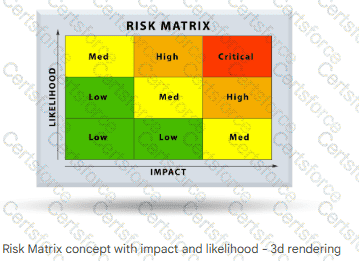
According to the PMBOK® Guide, the Perform Qualitative Risk Analysis process is the process of prioritizing individual project risks for further analysis or action by assessing their probability of occurrence and impact.
Risk Prioritization: The primary goal of this process is to rank risks to determine which ones require the most immediate attention or a more detailed quantitative analysis.
Assessment of Probability and Impact: This is a subjective assessment where the project manager and stakeholders assign values (often on a scale of Low-Medium-High or 1-5) to each risk. By multiplying the Probability (likelihood) and Impact (consequence), the team calculates a risk score.
Strategic Focus: Qualitative analysis is performed quickly and cost-effectively to focus project resources on high-priority risks. This is distinct from quantitative analysis, which is more data-intensive.
Why other options are incorrect:
Option A: Identifying risks is the primary task of the Identify Risks process. While probability is discussed later, the initial act of identification belongs to its own process.
Option B: Sensitivity Analysis is a specific tool and technique used in the Perform Quantitative Risk Analysis process, not qualitative. It is used to determine which risks have the most potential impact by varying one uncertain element at a time.
Option C: Analyzing risks as numerical data (such as specific dollar amounts or exact days of delay) is the defining characteristic of Perform Quantitative Risk Analysis. Qualitative analysis uses descriptive or relative scales rather than precise numerical values.
Contribute your Thoughts:
Chosen Answer:
This is a voting comment (?). You can switch to a simple comment. It is better to Upvote an existing comment if you don't have anything to add.


Submit