
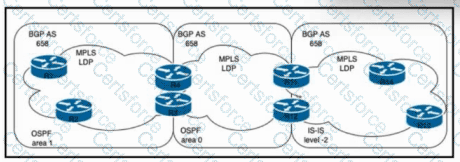
Refer to the exhibit. ISP_A is a Tier-1 ISP that provides private Layer 2 and Layer 3 VPN services across the globe using an MPLS-enabled backbone network. Routers R1, R2, R13, and R14 are PE devices. ASRs R3 and R4 and ASBRs R11 and R12 are acting as route reflectors with preconfigured next-hop-self for all BGP neighbors. After the network experienced IGP RIB overflow with multiple routes, a network engineer is working on a more scalable network design to minimize the impact on local RIBs. The solution should be based on RFC 3107 and maintain existing QoS capabilities.
Which task must the engineer perform to achieve the goal?
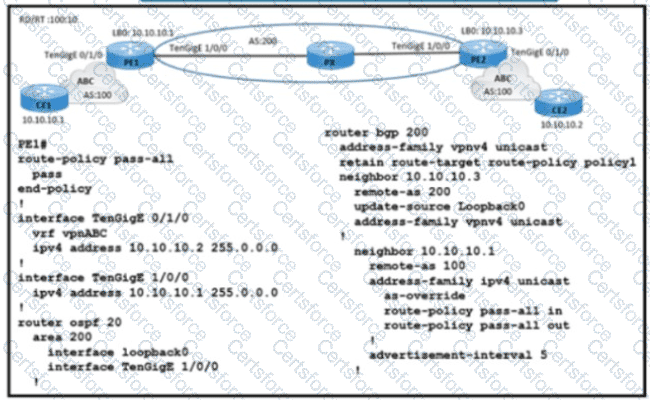
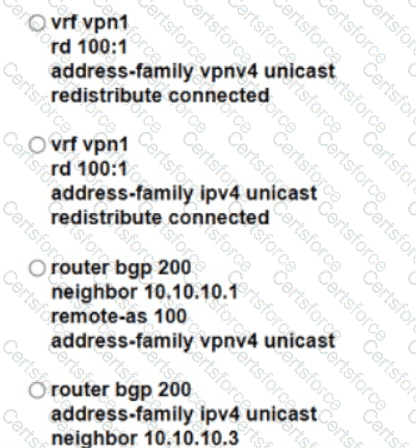
Refer to the exhibit. A service provider engineer Is configuring the connection between CE1 and CE2. AS 200 of the service provider and AS 100 of enterprise ABC should connect using BGP. The engineer already completed the configuration of VRF RT 100:10 of enterprise ABC. Which configuration must the engineer apply on PE1 to meet the requirement?
A company uses PIM-SM multicast with IGMPv2 to stream training videos from a server in one network to hosts in a different network. As the company has grown, the networking team decided to implement SSM to improve efficiency for multicast within Layer 2. Which action must the team take to begin the process?
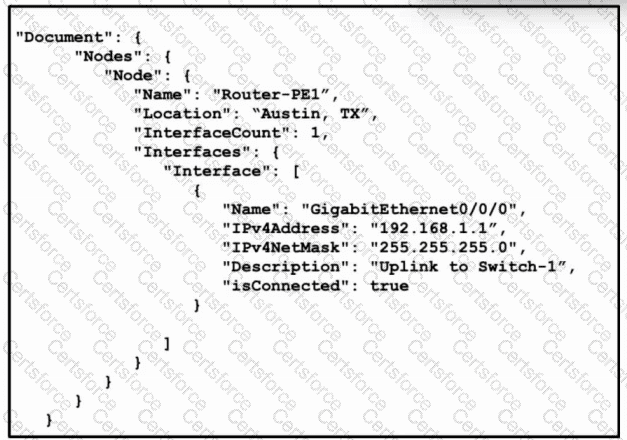
Refer to the exhibit. PE1 is a router connected to a major ISP that provides connectivity for multiple enterprises in several different geographic locations. The ISP networking team uses REST APIs to configure the network devices. A senior engineer retrieved the given script from the library and provided it to a junior engineer to deploy. What effect does the script produce when deployed?
Refer to the exhibit.
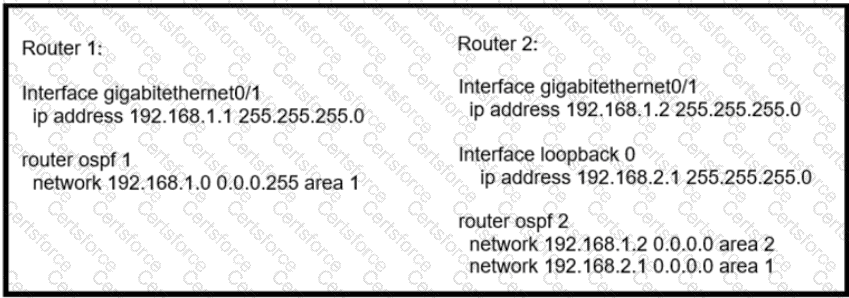
Router 1 is missing the route for the router 2 loopback 0. What should the engineer change to fix the problem?
An engineer Is implementing NSR with OSPF on a large campus that requires high availability. Which task must an engineer perform to complete the process with minimal disruption to traffic?
An engineer is moving all of an organization’s Cisco IOS XE BGP routers to the address-family identifier format. Which command should be used to perform this upgrade quickly with the minimum service disruption?
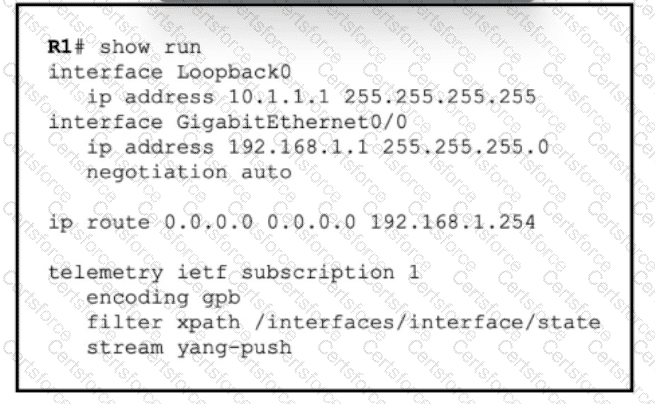
Refer to the exhibit. A regional company is implementing a network-health monitoring solution on their Cisco ISR routers to monitor network performance metrics and gather real-time data. The router R1 Ethernet interface, GigabitEthernet0/0, is assigned IP address 192.168.1.1/24, and basic IP addressing and connectivity to the data-collection server have already been configured. A network engineer must update R1 to ensure secure and reliable data transmission to the monitoring server, which is located at IP address 192.168.50.50 on port 50051. To achieve secure communication, the configuration must comply with RFC 5246, and to ensure reliable data transmission, it must follow RFC 793. Which command must the engineer execute to configure data collection?
Refer to the exhibit.
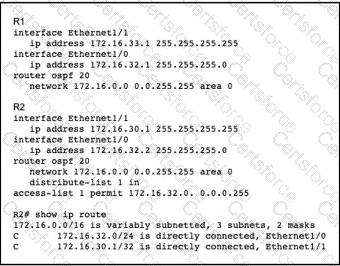
A network engineer notices that router R2 is failing to install network 172.16.33.1/32 in the routing table. Which configuration must the engineer apply to R2 to fix the problem?
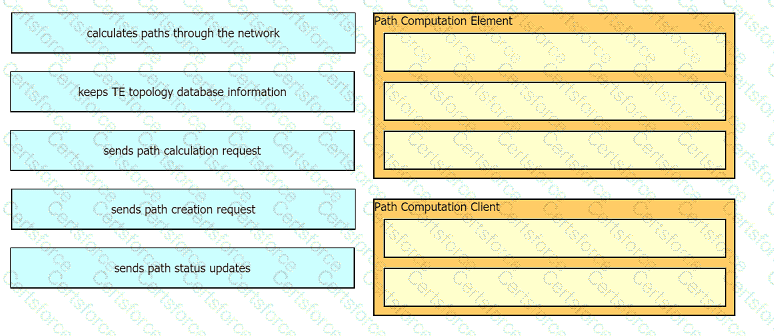
Drag and drop the functions from the left onto the Path Computation Element Protocol roles on the right.
Which service is a VNF role?
Refer to the exhibit:
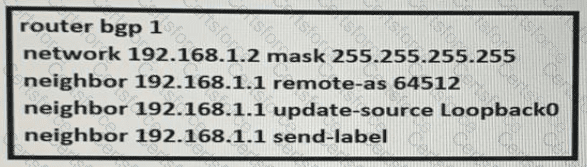
Which statement about the neighbor statements for 192.168.1.1 is true?
What is an enhancement that Cisco IOS XE Software has over Cisco IOS Software?
A service provider requires continuous real-time network monitoring to provide reliable SLAs to its customers. To satisfy this requirement, a network administrator is implementing gRPC dial out on an ASR with TLS. Receiver 192.168.10.2 will be assigned one of the subscriptions, and it will manage the ASR. Which configuration must the engineer apply to the router as part of the configuration process?
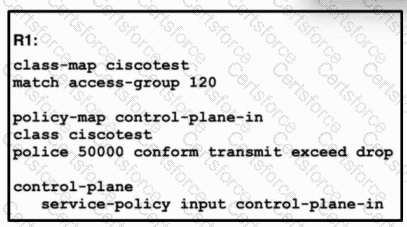
Refer to the exhibit. A network engineer installed router R1 as the new core router and must secure the control plane. The configuration has been applied, and now the engineer is creating ACL 120. Only hosts 192.168.1.1 and 192.168.2.2 should be allowed to access the router using Telnet. All other hosts should be rate-limited, with excess traffic dropped. Which configuration accomplishes this goal?

