New Year Sale Limited Time 70% Discount Offer - Ends in 0d 00h 00m 00s - Coupon code: simple70

Pass the Cisco CCNP Service Provider 350-501 Questions and answers with CertsForce

Viewing page 5 out of 11 pages
Viewing questions 61-75 out of questions
Questions # 61:

What happens when a segment-routing TE tunnel loses the link and there is no secondary path in place?

Options:

A.

The headend router generates a new path to the tail-end router using bandwidth to determine the best path.


B.

The tail-end router sends an alert to the syslog server that the tunnel and the secondary route are inaccessible.


C.

The headend router starts the invalidation timer to bring the tunnel down.


D.

The headend and tail-end routers revalidate SID hops to determine the proper label stack to reroute the traffic.


Expert Solution
Questions # 62:

Refer to the exhibit.

Question # 62

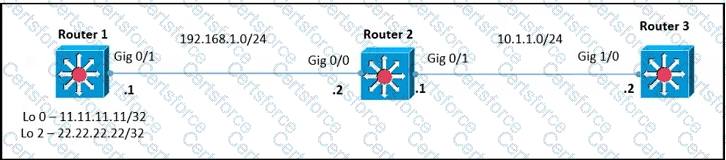
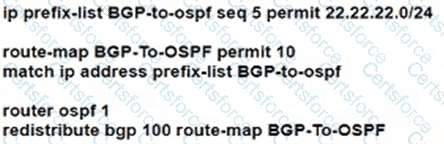
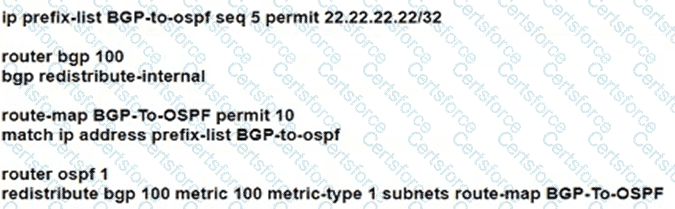
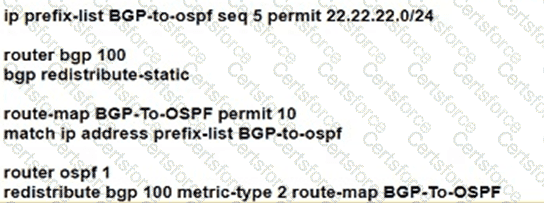
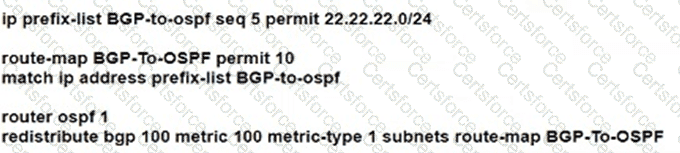
Router 1 and router 2 are running IBGP. and router 2 and router 3 are running OSPF Area 0. Router 1 is advertising loopback interlaces Lo0 and Lo2 and router 2 is redistributing BGP into OSPF Area 0. Which configuration must an administrator apply so that router 2 uses a route map to redistribute only the internal route from Lo 2?

A)
Question # 62

B)

Question # 62

C)

Question # 62

D)

Question # 62

Options:

A.

Option A


B.

Option B


C.

Option C


D.

Option D


Expert Solution
Questions # 63:

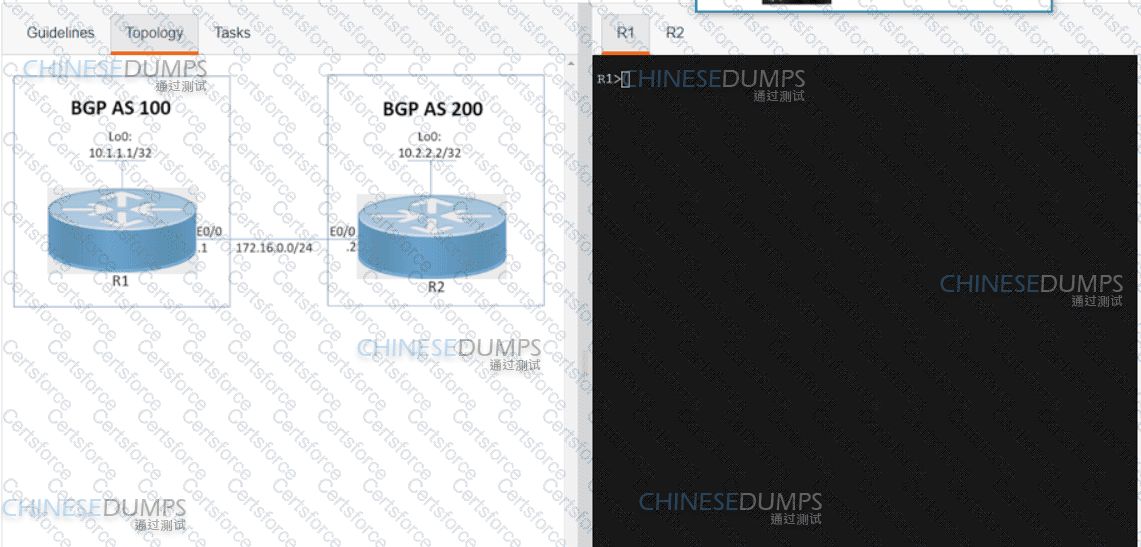
Simulation 6

Question # 63

Question # 63


Expert Solution
Questions # 64:

Refer to the exhibit.

Question # 64

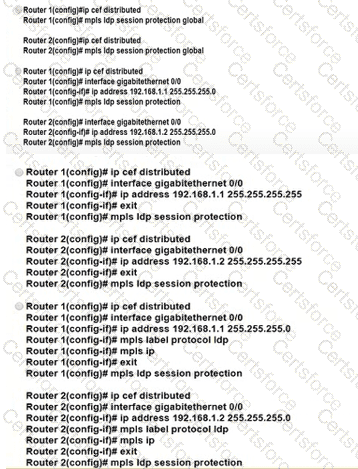
Router 1 and router 2 are running OSPF Area 0. The router logs on both routers show that the LDP link has flapped. Which configuration must the engineer apply to the two routers to implement session protection on the link?
Question # 64

Options:

A.

Option A


B.

Option B


C.

Option C


D.

Option D


Expert Solution
Questions # 65:

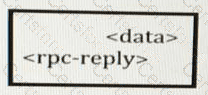
Refer to the exhibit:

Question # 65

This output is included at the end of an output that was provided by a device using NETCONF.

What does the code show?
Options:

A.

It shows the hostname of the device as rpc-reply


B.

It shows that the running configuration is blank


C.

It shows NETCONF uses remote procedure calls.


D.

It shows that the full configuration is being modeled by VANG


Expert Solution
Questions # 66:

Question # 66

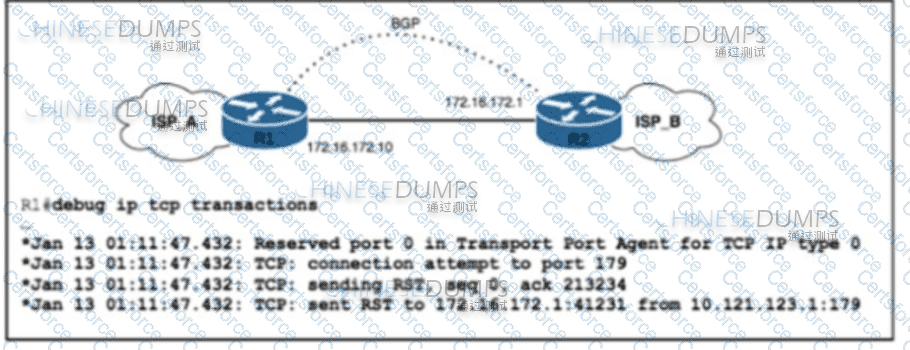
Refer to the exhibit. ISP_A and ISP_B use AS numbers 38321 and 16213 respectively. After a network engineer reloaded router R1, the BGP session with R2 failed to establish. The engineer confirmed BGP next-hop availability with a connectivity test between the router loopback addresses 10.121.123.2 and 10.121.123.1, as well as between interfaces Gi1/1 and Gi1/2. EBGP multihop has been configured on both routers. Which action must the engineer take to resolve the issue?

Options:

A.

Configure transport connection-mod© passive on R2.


B.

Configure neighbor 172.16.172.1 authentication on R1


C.

Configure neighbor update-source lo0 on R2


D.

Configure remote-as 16213 on R1.


Expert Solution
Questions # 67:

After troubleshooting multiple outages on the network due to repeated configuration errors, the network architect asked an engineer to enable NETCONF to facilitate future configurations. The configuration must enable syslog messaging to record NETCONF notifications from each of the numerous devices on the network. Which configuration must the engineer apply?

Options:

A.

username cisco test taker privilege 15 password 0 cisco test

aaa new-model

aaa authorization exec default local

snmp-server community cisco test RW

netconf-yang cisco-ia snmp-community-string ciscotest

logging history warnings


B.

username cisco test taker privilege 15 password 0 ciscotest

aaa new-model

aaa authorization exec default local

snmp-server community ciscotest RW

netconf-yang cisco

logging history critical


C.

netconf-yang

username ciscotesttaker privilege 15 password 0 ciscotest

aaa new-model

aaa authorization exec default local

snmp-server community ciscotest RW

netconf-yang cisco-ia snmp-community-string ciscotest

logging history debugging


D.

netconf-yang

username ciscotesttaker privilege 15 password 0 ciscotest

snmp-server community ciscotest RW

netconf-yang cisco-ia snmp-community-string ciscotest

logging history informational


Expert Solution
Questions # 68:

Question # 68Question # 68

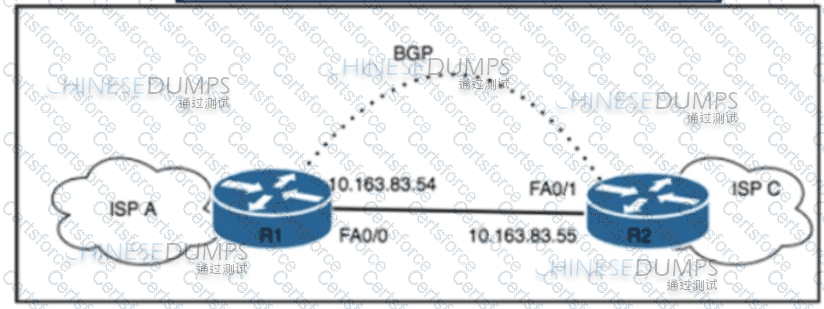
Refer to the exhbit. ISP A has a BGP peering with ISP C with the maximum-prefix 150 configuration on R1. After a recent security breach on the ISP A network, a network engineer has been asked to enable a lightweight security mechanism to protect the R1 CPU and BGP membership from spoofing attacks. Which solution must ISP A implement?

Options:

A.

Configure bgp maxas-limit 1 in the IPv4 address family urateUhe global BGP configuration.


B.

Configure neighbor 10.163.83.54 enable-connected-check under the BGP IPv4 address family.


C.

Configure neighbor 10.163.83.55 password Cisco under the global BGP IPv4 address family.


D.

Configure neighbor 10.163.83.55 ttl-stcurity hops 2 under the global BGP configuration.


Expert Solution
Questions # 69:

A network engineer is implementing NetFlow to observe traffic patterns on the network. The engineer is planning to review the patterns to help plan future strategies for monitoring and preventing congestion as the network grows. If the captures must include BGP next-hop flows, which configuration must the engineer apply to the router?

Options:

A.

ip cef

ip flow-export version 5 bgp-nexthop

ip flow-export destination 192.168.1.1 9995

interface gigabitethernet 1/0/1

ip flow egress


B.

ip cef

ip flow-export version 9 bgp-nexthop

ip flow-export destination 192.168.1.1 9996

interface gigabitethernet 1/0/1

ip flow ingress


C.

ip cef

ip flow-export version 5

ip flow-export destination 192.168.1.1 9995

interface gigabitethernet 1/0/1

ip flow ingress

cdp enable


D.

no ip cef

ip flow-export version 9

ip flow-export destination 192.168.1.1 9996

interface gigabitethernet 1/0/1

ip flow ingress

ip flow egress


Expert Solution
Questions # 70:

Refer to the exhibit:

Question # 70

Which effect of this configuration is true?

Options:

A.

it creates a pseudowire class named Cisco


B.

It enables tagging for VLAN 12 on the interface


C.

It enables MPLS on the interface


D.

It enables AToM on interface gigabitethemet1/0


Expert Solution
Questions # 71:

Refer to the exhibit.

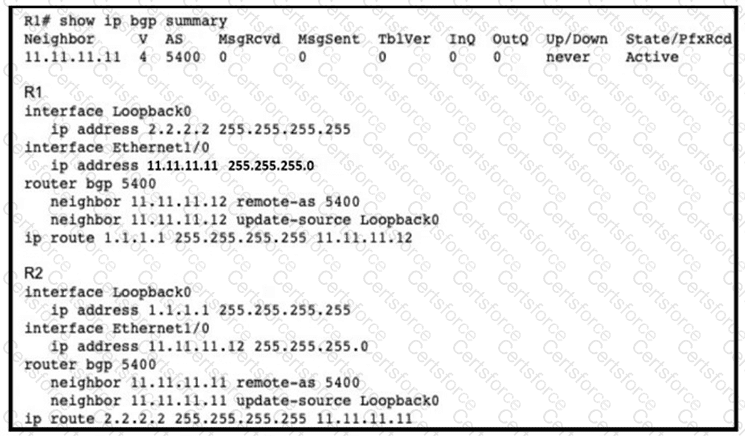
Question # 71

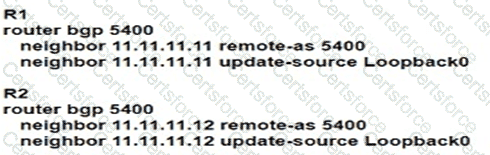
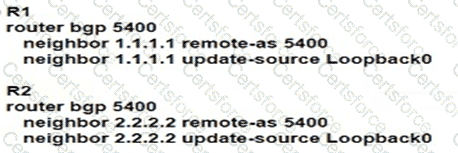
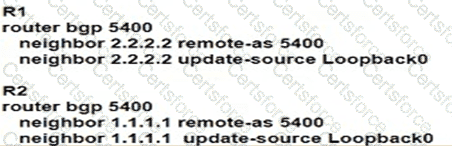
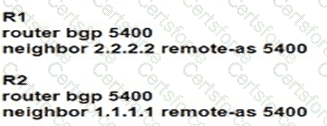
Router R1 is reporting that its BGP neighbor adjacency to router R2 is down, but its state is Active as shown. Which configuration must be applied to routers R1 and R2 to fix the problem?

A)
Question # 71

B)

Question # 71

C)

Question # 71

D)

Question # 71

Options:

A.

Option A


B.

Option B


C.

Option C


D.

Option D


Expert Solution
Questions # 72:

Which additional feature does MPLS DiffServ tunneling support?

Options:

A.

matching EXP and DSCP values


B.

interaction between MPLS and IGP


C.

using GRE tunnels to hide markings


D.

PHB layer management


Expert Solution
Questions # 73:

Refer to the exhibit.

Question # 73

What does the number 2 mean in the configuration?
Options:

A.

It dictates the number of sessions that will be open with the SNMP manager


B.

It represents the version of SNMP running.


C.

It indicates two SNMP managers are able to read and write with the agent using community string ciscotest.


D.

It is the numeric name of the ACL that contains the list of SNMP managers with access to the agent.


Expert Solution
Questions # 74:

Question # 74

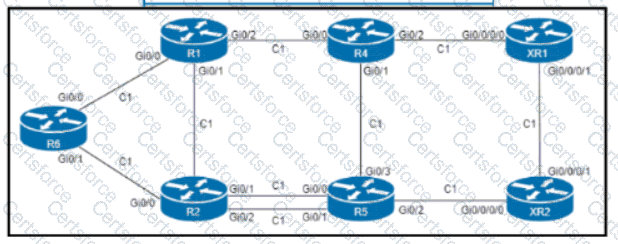
Refer to the exhibit. An engineer configured R6 as the headend LSR of an RSVP-TE LSP to router XR2, with the dynamic path signaled as R6-R2-R5-XR2. and set the OSPF cost of all links to 1. MPLS autotunnel backup Is enabled on all routers to protect the LSP. Which two NNHOP backup tunnels should the engineer use to complete the implementation? (Choose two.)

Options:

A.

The R6 backup tunnel path R6-R1-R4-R5.


B.

The R2 backup tunnel path R2-R5 across the alternate link.


C.

The R2 backup tunnel path R2-R1-R4-XR1-XR2.


D.

The R6 backup tunnel path R6-R2-R5


E.

The R6 backup tunnel path R6-R1-R2.


Expert Solution
Questions # 75:

A network team has failed to implement IS-IS multitopology. What is the reason for it?

Options:

A.

The router did not support VRFs.


B.

The routing process did not support extended metrics.


C.

The router did not have Cisco Discovery Protocol and Cisco Express Forwarding disabled.


D.

The routing process supported Level 1 only.


Expert Solution
Viewing page 5 out of 11 pages
Viewing questions 61-75 out of questions