Cisco Implementing and Operating Cisco Service Provider Network Core Technologies (350-501 SPCOR) 350-501 Question # 71 Topic 8 Discussion
350-501 Exam Topic 8 Question 71 Discussion:
Question #: 71
Topic #: 8
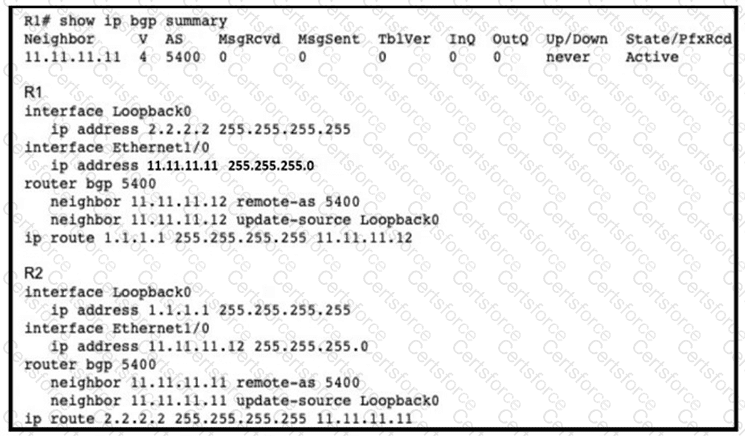
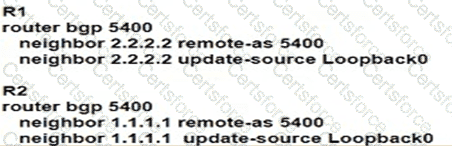
Refer to the exhibit.
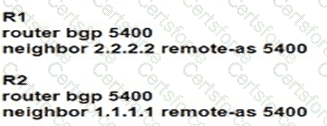
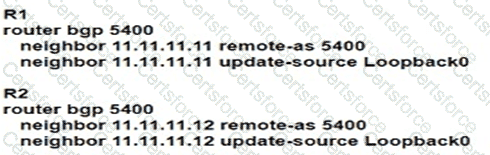
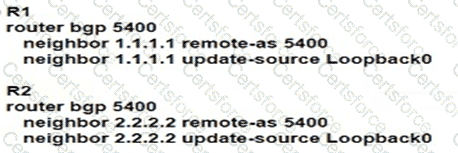
Router R1 is reporting that its BGP neighbor adjacency to router R2 is down, but its state is Active as shown. Which configuration must be applied to routers R1 and R2 to fix the problem?
In OSPF, the election of the designated router (DR) and backup designated router (BDR) is based on the OSPF network type. The network types include:
Broadcast: This is the default network type for Ethernet interfaces. In a broadcast network, OSPF elects a DR and BDR. All other routers become DROTHERs. To prevent the election of a DR/BDR, you can configure the interface as non-broadcast (NBMA) using the ip ospf network non-broadcast command.
Point-to-Point: This network type is used for point-to-point links (e.g., serial links). There is no DR/BDR election in point-to-point networks.
Point-to-Multipoint: This network type is used for point-to-multipoint links (e.g., Frame Relay). There is no DR/BDR election in point-to-multipoint networks.
Point-to-Multipoint Non-Broadcast: Similar to point-to-multipoint, but explicitly configured as non-broadcast. There is no DR/BDR election in point-to-multipoint non-broadcast networks.
Loopback: Loopback interfaces are always treated as point-to-point.
Virtual-Link: Used for OSPF virtual links.
Sham-Link: Used for OSPF sham links.
Demand Circuit: Used for demand circuits (e.g., ISDN).
Non-Broadcast: Explicitly configured as non-broadcast. There is no DR/BDR election in non-broadcast networks.
[:, Implementing and Operating Cisco Service Provider Network Core Technologies (SPCOR) v1.0, ]
Contribute your Thoughts:
Chosen Answer:
This is a voting comment (?). You can switch to a simple comment. It is better to Upvote an existing comment if you don't have anything to add.


Submit