New Year Sale Limited Time 70% Discount Offer - Ends in 0d 00h 00m 00s - Coupon code: simple70

Pass the Cisco CCNP Service Provider 350-501 Questions and answers with CertsForce

Viewing page 9 out of 11 pages
Viewing questions 121-135 out of questions
Questions # 121:

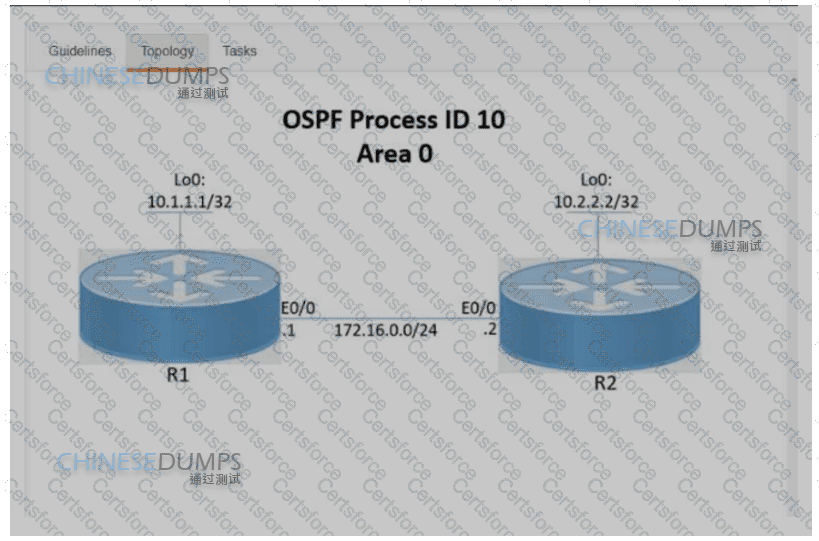
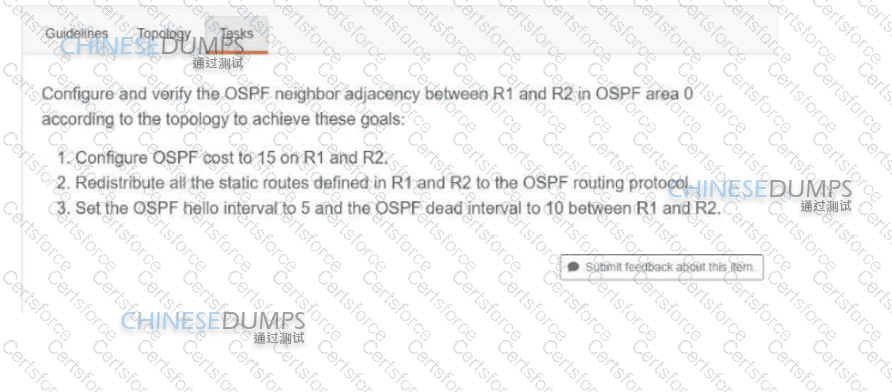
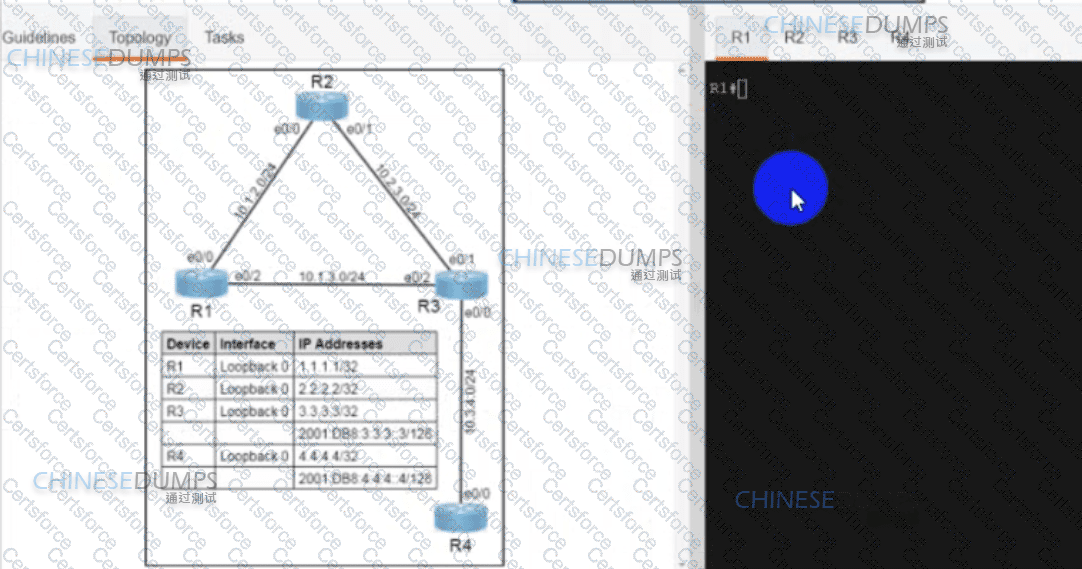
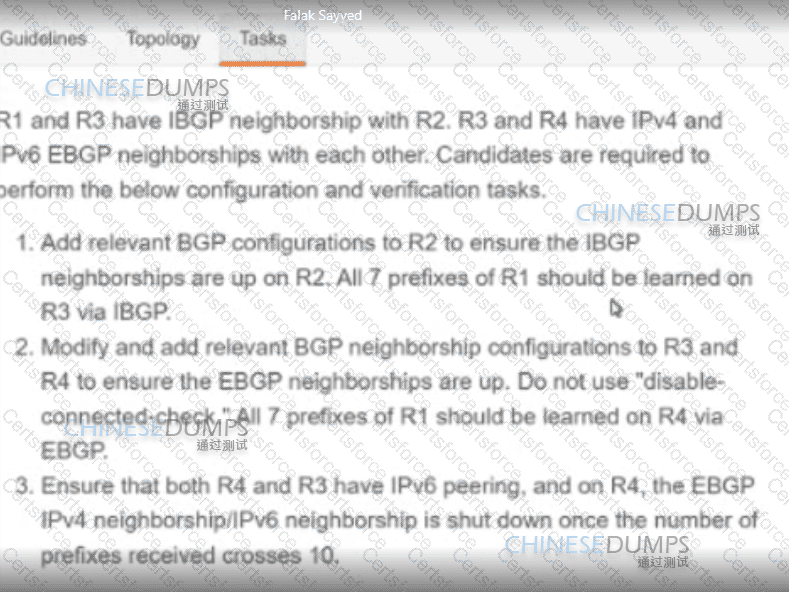
Simulation 8

Question # 121Question # 121

Question # 121


Expert Solution
Questions # 122:

Which two actions describe ISP delegation to PCE servers? (Choose two)

Options:

A.

adding a new PCE server with lower precedence than the primary PCE


B.

changing the precedence of any of the PCE servers


C.

removing TE re-optimization timer timeouts


D.

entering the mpls traffic-eng reoptimize command


E.

adding a new PCE server with higher precedence than the primary PCE


Expert Solution
Questions # 123:

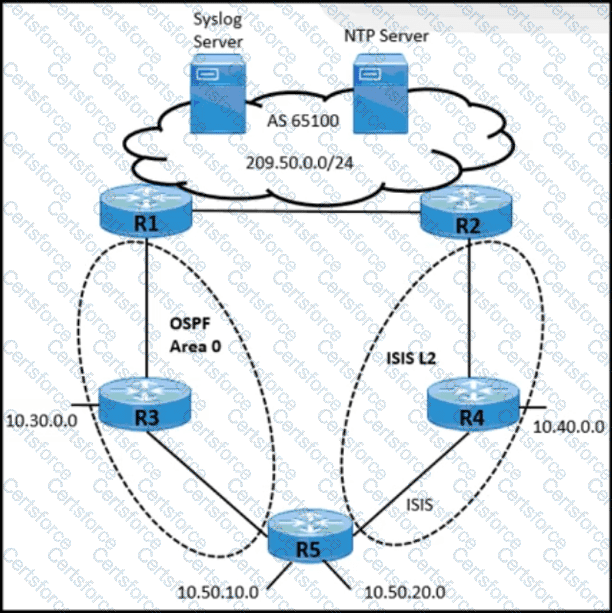
Refer to the exhibit.

Question # 123

A network operator working for a telecommunication company with an employee ID: 4350:47:853 must implement an IGP solution based on these requirements:

• Subnet 10.50.10.0 traffic must exit through the R1 router to connect with the Syslog server.

• Subnet 10.50.20.0 traffic must exit through the R2 router to connect with the NTP server.

• In case of link failure between R2 and R4, traffic must be routed via R1 and R3.

Which two configurations must be implemented on R5 to meet these requirements? (Choose two.)

Options:

A.

Apply a route policy to redistribute 10.50.0.0 prefixes in OSPF to ISIS and ISIS to OSPF.


B.

Apply a route policy to redistribute 10.50.20.0 from ISIS-L2 to OSPF Area 0 at a higher cost.


C.

Enable a route policy to advertise 10.50.20.0 in ISIS-L2 at a higher cost.


D.

Apply a route policy to redistribute 10.50.10.0 from OSPF Area 0 to ISIS-L2 at a lower cost.


E.

Enable a route policy to advertise 10.50.10.0 In OSPF Area 0 at a low cost.


Expert Solution
Questions # 124:

What is the characteristic of the Tl-LFA?

Options:

A.

It guarantees a loop-free path for all interfaces in the OSPf- super backbone .


B.

It applies on each area and instance and makes all the interfaces inherit the configuration


C.

It guarantees a loop-free path for all areas configured m OSPF


D.

It applies only on the instance and makes at the interfaces inherit the configuration


Expert Solution
Questions # 125:

A network engineer is implementing BFD configuration changes on a customer's equipment. How is the bfd interval configuration on the interface disconnected?

Options:

A.

The status of the interface changes.


B.

The IPv4 or IPv6 address configuration on the interface changes.


C.

It is automatically disconnected when the BFD-configured subinterface is removed.


D.

It is automatically disconnected when the BFD main interface is removed.


Expert Solution
Questions # 126:

What is a role of NSO?

Options:

A.

It automates the deployment of access points with its built-in wireless LAN controller.


B.

It manages WAN infrastructure using a virtual switch.


C.

It provides full lifecycle management of a device.


D.

It resides on a hypervisor that runs the Windows OS.


Expert Solution
Questions # 127:

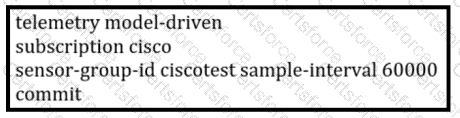
Refer to the exhibit:

Question # 127

What is significant about the number 2 in the configuration?

Options:

A.

It is the numeric name of the ACL that contains the list of SNMP managers with access to the agent


B.

It dictates the number of sessions that can be open with the SNMP manager


C.

It indicates two SNMP managers can read and write with the agent using community string cisco test


D.

It represents the version of SNMP running


Expert Solution
Questions # 128:

Refer to the exhibit:

Question # 128

Which statement describes the effect of this configuration?

Options:

A.

It applies a service policy to all interfaces remarking HTTP traffic


B.

It creates an ACL named WEB that filters HTTP traffic.


C.

It matches HTTP traffic for use in a policy map


D.

It modifies the default policy map to allow all HTTP traffic through the router


Expert Solution
Questions # 129:

Refer to the exhibit:

Question # 129

This configuration is being applied on an IOS XR router.

Which statement about this configuration is true?

Options:

A.

It is used to set up configuration to poll network data


B.

It is used to enable gRPC


C.

It is used to create a streaming subscription with a 60-second interval


D.

It is used to create a streaming subscription with a 600-second interval


Expert Solution
Questions # 130:

How does Cisco MPLS TE use OSPF extensions to allow for optimized transit between a headend router and a destination router?

Options:

A.

Router LSAs share router link advertisements to each router within the MPLS environment so that tunnels can be built bidirectionally.


B.

ASBR Summary LSAs share OSPF domain information so that the two routers know how to reach each other during tunnel setup.


C.

Network LSAs share RSVP information to build the tunnel between the two routers.


D.

Opaque LSAs calculate and establish unidirectional tunnels that are set according to the network constraint.


Expert Solution
Questions # 131:

Simulation 5

Question # 131

Question # 131


Expert Solution
Questions # 132:

Question # 132

Question # 132

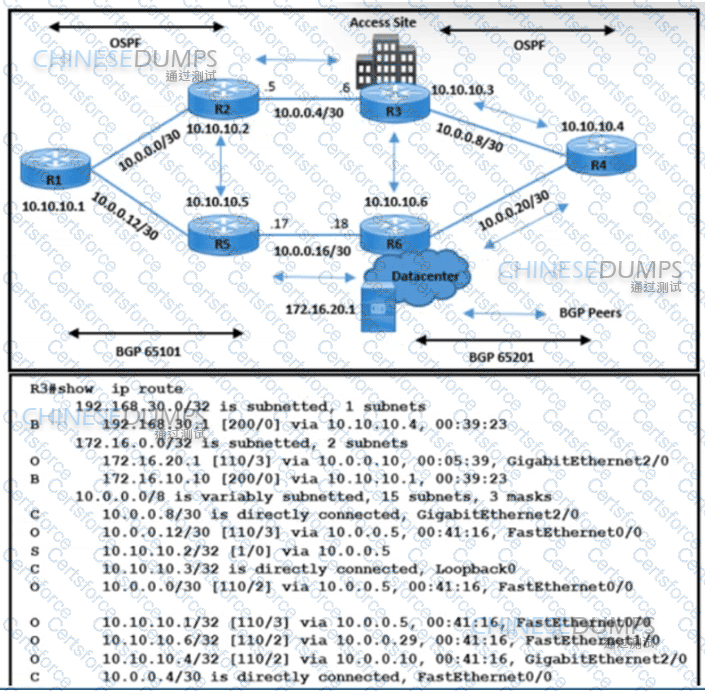
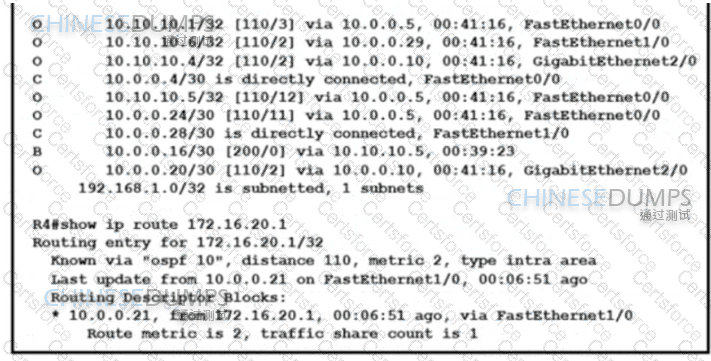
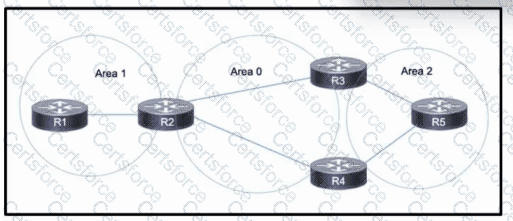
Refer to the exhibit. The network operations team reported that the access site that is connected to R3 is not connecting to the application server in the data center and that all packets that are sent from the application server to the access site are dropped. The team verified that OSPF and BGP peerings are up in BGP AS 65101 and BGP AS 65201. R4 is expected to receive traffic from the application server route via OSPF. Which action resolves this issue?
Options:

A.

Remove the route-map on R4 when advertising 172.16.20.1 in BGP to R3.


B.

Advertise application server 172.16.20.1 in the OSPF routing table on R6.


C.

Allow 172.16.20.1 in the BGP advertisement on R3 in the route-map.


D.

Add the next-hop-self command on R6 to enable R3 iBGP peering.


Expert Solution
Questions # 133:

Question # 133

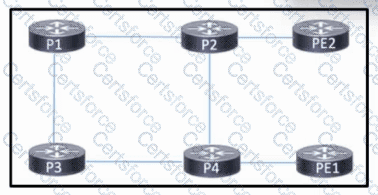
Refer to the exhibit. OSPF is running in the given network. R1 was previously running EIGRP on a standalone network, and a network engineer just migrated it to OSPF. The R1 peering with R2 has come up.

Which additional action must the engineer take so that R2 receives routes from Area 1 and Area 0 but is prevented from receiving routes from Area 2?
Options:

A.

Implement a route map that matches R2's interface to R3 and R4, and then attach the route map to an inbound distribute list on R2.


B.

Implement a route map that matches the routes in an ACL from Area 2, and then attach the route map to an inbound distribute list on R2.


C.

Implement a route map that matches the routes from Area 2 in a prefix list, and then attach the route map to an outbound distribute list on R2.


D.

Implement a route map that matches R1's next-hop address, and then attach the route map to an outbound distribute list on R2.


Expert Solution
Questions # 134:

Question # 134

Refer to the exhibit. A service provider is running MPLS in the core to support Layer 3 VPN. OSPF is configured to support dynamic routing, and BGP is enabled throughout the network. A network engineer is adding a new P router to the infrastructure and is connecting it to P1 and P3.

Which task must the engineer perform on the new router to allow it to participate in the Layer 3 VPN?

Options:

A.

Enable LDP sync under the OSPF routing process.


B.

Establish an LDP neighbor relationship with P1 and P3.


C.

Configure OSPF and BGP to support MPLS.


D.

Enable LDP and establish an OSPF adjacency in a new area.


Expert Solution
Questions # 135:

Which two features will be used when defining SR-TE explicit path hops if the devices are using IP unnumbered interfaces? (Choose two.)

Options:

A.

router ID


B.

labels


C.

node address


D.

next hop address


E.

output interface


Expert Solution
Viewing page 9 out of 11 pages
Viewing questions 121-135 out of questions