New Year Sale Limited Time 70% Discount Offer - Ends in 0d 00h 00m 00s - Coupon code: simple70

Pass the Cisco CyberOps Associate 200-201 Questions and answers with CertsForce

Viewing page 4 out of 14 pages
Viewing questions 31-40 out of questions
Questions # 31:

Which attack represents the evasion technique of resource exhaustion?

Options:

A.

SQL injection


B.

man-in-the-middle


C.

bluesnarfing


D.

denial-of-service


Expert Solution
Questions # 32:

Question # 32

Refer to the exhibit. Which type of data filtering is provided?

Options:

A.

Web


B.

Firewall


C.

Mail


D.

Application


Expert Solution
Questions # 33:

Refer to the exhibit.

Question # 33

What is the potential threat identified in this Stealthwatch dashboard?

Options:

A.

A policy violation is active for host 10.10.101.24.


B.

A host on the network is sending a DDoS attack to another inside host.


C.

There are two active data exfiltration alerts.


D.

A policy violation is active for host 10.201.3.149.


Expert Solution
Questions # 34:

Question # 34

Refer to the exhibit. An attacker scanned the server using Nmap. What did the attacker obtain from this scan?

Options:

A.

Identified a firewall device preventing the pert state from being returned.


B.

Identified open SMB ports on the server


C.

Gathered information on processes running on the server


D.

Gathered a list of Active Directory users


Expert Solution
Questions # 35:

How low does rule-based detection differ from behavioral detection?

Options:

A.

Behavioral systems find sequences that match particular attach behaviors, and rule-based systems identify potential zero-day attacks.


B.

Rule-based systems search for patterns linked to specific types of attacks, and behavioral systems Identify attacks per signature.


C.

Behavioral systems have patterns are for complex environments, and rule-based systems can be used on low-mid-sized businesses.


D.

Rule-based systems have predefined patterns, and behavioral systems learn the patterns that are specific to the environment.


Expert Solution
Questions # 36:

An analyst received a ticket regarding a degraded processing capability for one of the HR department's servers. On the same day, an engineer noticed a disabled antivirus software and was not able to determine when or why it occurred. According to the NIST Incident Handling Guide, what is the next phase of this investigation?

Options:

A.

Recovery


B.

Detection


C.

Eradication


D.

Analysis


Expert Solution
Questions # 37:

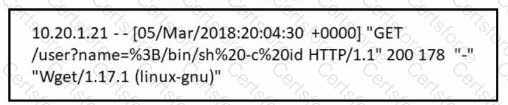
Refer to the exhibit.

Question # 37

A network administrator is investigating suspicious network activity by analyzing captured traffic. An engineer notices abnormal behavior and discovers that the default user agent is present in the headers of requests and data being transmitted What is occurring?

Options:

A.

indicators of denial-of-service attack due to the frequency of requests


B.

garbage flood attack attacker is sending garbage binary data to open ports


C.

indicators of data exfiltration HTTP requests must be plain text


D.

cache bypassing attack: attacker is sending requests for noncacheable content


Expert Solution
Questions # 38:

Question # 38

Refer to the exhibit. A SOC analyst is examining the Windows security logs of one of the endpoints. What is the possible reason for this event log?

Options:

A.

Brute force attack


B.

Windows failed to audit logs


C.

Malware Attack


D.

System maintenance logs


Expert Solution
Questions # 39:

Which tool is used by threat actors on a webpage to take advantage of the software vulnerabilities of a system to spread malware?

Options:

A.

script kiddie kit


B.

exploit kit


C.

vulnerability kit


D.

root kit


Expert Solution
Questions # 40:

What is the difference between vulnerability and risk?

Options:

A.

A vulnerability is a sum of possible malicious entry points, and a risk represents the possibility of the unauthorized entry itself.


B.

A risk is a potential threat that an exploit applies to, and a vulnerability represents the threat itself


C.

A vulnerability represents a flaw in a security that can be exploited, and the risk is the potential damage it might cause.


D.

A risk is potential threat that adversaries use to infiltrate the network, and a vulnerability is an exploit


Expert Solution
Viewing page 4 out of 14 pages
Viewing questions 31-40 out of questions