New Year Sale Limited Time 70% Discount Offer - Ends in 0d 00h 00m 00s - Coupon code: simple70

Pass the Cisco CyberOps Associate 200-201 Questions and answers with CertsForce

Viewing page 7 out of 14 pages
Viewing questions 61-70 out of questions
Questions # 61:

Which are two denial-of-service attacks? (Choose two.)

Options:

A.

TCP connections


B.

ping of death


C.

man-in-the-middle


D.

code-red


E.

UDP flooding


Expert Solution
Questions # 62:

Which action should be taken if the system is overwhelmed with alerts when false positives and false negatives are compared?

Options:

A.

Modify the settings of the intrusion detection system.


B.

Design criteria for reviewing alerts.


C.

Redefine signature rules.


D.

Adjust the alerts schedule.


Expert Solution
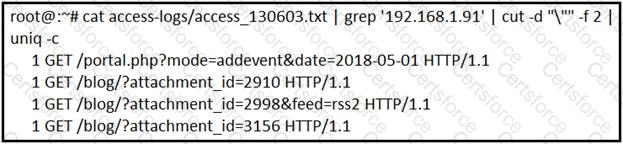
Questions # 63:

Refer to the exhibit.

Question # 63

A security analyst is investigating unusual activity from an unknown IP address Which type of evidence is this file1?

Options:

A.

indirect evidence


B.

best evidence


C.

corroborative evidence


D.

direct evidence


Expert Solution
Questions # 64:

What is a difference between a threat and a risk?

Options:

A.

A threat is a sum of risks and a risk itself represents a specific danger toward the asset


B.

A threat can be people property, or information, and risk is a probability by which these threats may bring harm to the business


C.

A risk is a flaw or hole in security, and a threat is what is being used against that flaw


D.

A risk is an intersection between threat and vulnerabilities, and a threat is what a security engineer is trying to protect against


Expert Solution
Questions # 65:

Which vulnerability type is used to read, write, or erase information from a database?

Options:

A.

cross-site scripting


B.

cross-site request forgery


C.

buffer overflow


D.

SQL injection


Expert Solution
Questions # 66:

What is a difference between signature-based and behavior-based detection?

Options:

A.

Signature-based identifies behaviors that may be linked to attacks, while behavior-based has a predefined set of rules to match before an alert.


B.

Behavior-based identifies behaviors that may be linked to attacks, while signature-based has a predefined set of rules to match before an alert.


C.

Behavior-based uses a known vulnerability database, while signature-based intelligently summarizes existing data.


D.

Signature-based uses a known vulnerability database, while behavior-based intelligently summarizes existing data.


Expert Solution
Questions # 67:

What is the difference between a threat and a risk?

Options:

A.

Threat represents a potential danger that could take advantage of a weakness in a system


B.

Risk represents the known and identified loss or danger in the system


C.

Risk represents the nonintentional interaction with uncertainty in the system


D.

Threat represents a state of being exposed to an attack or a compromise, either physically or logically.


Expert Solution
Questions # 68:

Question # 68

Refer to the exhibit. What occurred on this system based on this output?

Options:

A.

A user connected to the system using remote access VPN.


B.

A user created a new HTTP session using the SHA256 hashing algorithm.


C.

A user connected to the system after 450 attempts.


D.

A user connected to the system using SSH using source port 55796.


Expert Solution
Questions # 69:

Which type of evasion technique is accomplished by separating the traffic into smaller segments before transmitting across the network?

Options:

A.

tunneling


B.

fragmentation


C.

encryption


D.

proxies


Expert Solution
Questions # 70:

Refer to the exhibit.

Question # 70

What should be interpreted from this packet capture?

Options:

A.

81.179.179.69 is sending a packet from port 80 to port 50272 of IP address 192.168.122.100 using UDP protocol.


B.

192.168.122.100 is sending a packet from port 50272 to port 80 of IP address 81.179.179.69 using TCP protocol.


C.

192.168.122.100 is sending a packet from port 80 to port 50272 of IP address 81.179.179.69 using UDP protocol.


D.

81.179.179.69 is sending a packet from port 50272 to port 80 of IP address 192.168.122.100 using TCP UDP protocol.


Expert Solution
Viewing page 7 out of 14 pages
Viewing questions 61-70 out of questions