A Health Trust has contracted with Servitup, a catering services organisation that has been certified to ISO 9001 for one year. It provides services to
10 small rural hospitals in remote locations involving the purchase and storage of dry goods and fresh produce, preparing meals, and loading heated
trolleys for Ward Service by hospital staff. You, as auditor, are conducting the first surveillance audit at one site with the Deputy Catering Manager
(DCM).
DCM: " I apologise for the absence of the Catering Manager. He has called in sick today and we are really short of staff. "
You: " I see. It really shouldn ' t affect the QMS so the audit can progress as normal. "
DCM: " The Catering Manager set up the system. I ' m afraid I ' m not as familiar with it as he is. "
You: " OK, let ' s start with the Quality Policy. What are the main issues for the QMS here? "
DCM: " Give me a minute. I need to look at the Quality Policy on the noticeboard in his office. "
As the audit progresses, it is clear that the DCM has a very low knowledge of the QMS. He continually has to look up the answers to your questions
or ask staff members about their processes. You decide to raise a nonconformity.
Select one of the following options that best describes the nonconformity.
Select the two statements that are true.
Scenario 6: Davis Clinic (DC) is an American medical center focused on integrated health care. Since its establishment DC was committed to providing qualitative services for its clients, which is the reason why the company decided to implement a quality management system (QMS) based on ISO 9001. After a year of having an active QMS in place, DC applied for a certification audit.
A team of five auditors, from a well-known certification body, was selected to conduct the audit. Eva was appointed as the audit team leader. After three days of auditing, the team gathered to review and examine their findings. They also discussed the audit findings with DC ' s top management and then drafted the audit conclusions.
In the closing meeting, which was held between the audit team and the top management of DC. Eva presented two nonconformities that were detected during the audit. Eva stated that the company did not retain documented information regarding its outsourced services for an analysis laboratory and regarding the conducted management reviews. During the closing meeting, the audit team required from DCs top management to come up with corrective action plans within two weeks. Although the top management did not agree with the audit findings, the audit team insisted that the auditee must submit corrective actions within the given time frame in order for the audit activities to continue.
Once the action plans were evaluated, the audit team began preparing the audit report. Eva required from the team to provide accurate descriptions of the audit findings and the audit conclusions. The report was then distributed to all the interested parties involved in the audit, including the certification body Based on the report, the certification body together with Eva, as the audit team leader, made the certification decision.
Based on the scenario above, answer the following question:
According to Scenario 6, the audit team required DC’s top management to submit corrective action plans within two weeks. Is this action acceptable?
Scenario 1: AL-TAX is a company located in California which provides financial and accounting services. The company manages the finances of 17 companies and now is seeking to expand their business even more The CEO of AL-TAX, Liam Durham, claims that the company seeks to provide top-notch services to their clients Recently, there were a number of new companies interested in the services provided by AL-TAX.
In order to fulfill the requirements of new clients and further improve quality, Liam discussed with other top management members the idea of implementing a quality management system (QMS) based on ISO 9001. During the discussion, one of the members of the top management claimed that the size of the company was not large enough to implement a QMS. In addition, another member claimed that a QMS is not applicable for the industry in which AL TAX operates. However, as the majority of the members voted for implementing the QMS. Liam initiated the project.
Initially, Liam hired an experienced consultant to help AL-TAX with the implementation of the QMS. They started by planning and developing processes and methods for the establishment of a QMS based on ISO 9001. Furthermore, they ensured that the quality policy is appropriate to the purpose and context of AL TAX and communicated to all employees. In addition, they also tried to follow a process that enables the company to ensure that its processes are adequately resourced and managed, and that improvement opportunities are determined.
During the implementation process, Liam and the consultant focused on determining the factors that could hinder their processes from achieving the planned results and implemented some preventive actions in order to avoid potential nonconformities Six months after the implementation of the QMS. AL-TAX conducted an internal audit. The results of the internal audit revealed that the QMS was not fulfilling all requirements of ISO 9001. A serious issue was that the QMS was not fulfilling the requirements of clause 5.1.2 Customer focus and had also not ensured clear and open communication channels with suppliers.
Throughout the next three years, the company worked on improving its QMS through the PDCA cycle in the respective areas. To assess the effectiveness of the intended actions while causing minimal disruptions, they tested changes that need to be made on a smaller scale. After taking necessary actions, AL-TAX decided to apply for certification against ISO 9001.
Based on the scenario above, answer the following question:
The CEO of AL-TAX hired an experienced consultant to help with the implementation of the QMS. Is this required from ISO 9001?
Scenario 7: POLKA is a car manufacturing company based in Stockholm, Sweden. The company has around 14,000 employees working in different sectors which help with the design, painting, assembling, and test drives of the final product. The company is widely known for its qualitative products and affordable prices. In order to retain their reputation, POLKA implemented a quality management system (QMS) based on ISO 9001.
Before applying for certification, the company decided to conduct an internal audit to check whether there are any nonconformities in their QMS and if the requirements of ISO 9001 are being fulfilled. The top management appointed Sean, the internal auditor, as the team leader of the internal audit team. Sean required from the top management to have unrestricted access to the employees and executives of POLKA and to the documented information. Furthermore, Sean required to establish a team with a large number of auditors, considering the size and the complexity of the organization. The top management of POLKA agreed with Sean ' s requirements.
The top management, in cooperation with Sean, assigned 10 more employees to the audit team. Following that. Sean planned the audit activities and assigned the roles and responsibilities to each auditor. They began by interviewing employees of different manufacturing departments to check whether they are aware of the process of the QMS implementation. While conducting these activities, one of the auditors asked Sean for permission to audit the department in which he worked on a daily basis, as he was very familiar with the processes of the department.
Along the way, the teams findings showed that the staff were trained, documented information was updated, and the QMS fulfilled the requirements of ISO 9001. The internal audit took three weeks to complete, and on the last week the audit team held a final meeting
The team shared their results and together drafted the audit report This report was submitted to the top management of the company. The report was maintained as documented information, and was available to the relevant interested parties.
Based on the scenario above, answer the following question:
Scenario 7 states that Sean planned audit activities on his own. Is this acceptable?
An audit team of three people is conducting a Stage 2 audit to ISO 9001 of an engineering organisation that manufactures sacrificial anodes for the oil and gas industry in marine environments. These are aluminium products designed to prevent corrosion of submerged steel structures. You, as one of the auditors, find that the organisation has shipped anodes for Project DK in the Gulf of Mexico before the galvanic efficiency test results for the anodes have been fully analysed and reported as required by the customer. The Quality Manager explains that the Managing Director authorised the release of the anodes to avoid late delivery as penalties would be Imposed. The customer was not informed since the tests very rarely fall below the required efficiency. You raise a nonconformity against clause 8.6 of ISO 9001.
At the Closing meeting, the audit team leader presents the findings of the audit and comes to the above
nonconformity. The Quality Manager produces the test report for Project DK, which shows an acceptable galvanic efficiency, and presents an email from the customer confirming acceptance of the anodes. He asks that the nonconformity be withdrawn.
Which two of the following responses by the audit team leader would be acceptable?
Scenario 3:
Fin-Pro is a financial institution in Austria offering commercial banking, wealth management, and investment services. The company faced a significant loss of customers due to failing to improve service quality as they expanded.
To regain customer confidence, top management implemented a QMS based on ISO 9001. After a year, they contacted ACB, a local certification body, to pursue ISO 9001 certification.
The audit team was led by Emilia, an experienced lead auditor, and included three auditors. After an agreement was reached, ACB sent the audit objectives to the audit team.
The audit team began by gathering information about Fin-Pro’s understanding of ISO 9001 requirements. While reviewing documented information, they noticed missing records of training and awareness sessions. They conducted employee interviews to verify attendance.
The team also reviewed the organizational chart and job descriptions to confirm employee competence. They observed the company’s working environment (social, psychological, and physical conditions).
The audit team analyzed the evidence and prepared an audit report with findings and conclusions.
Based on the last paragraph of scenario 3, which audit principle did the audit team follow?
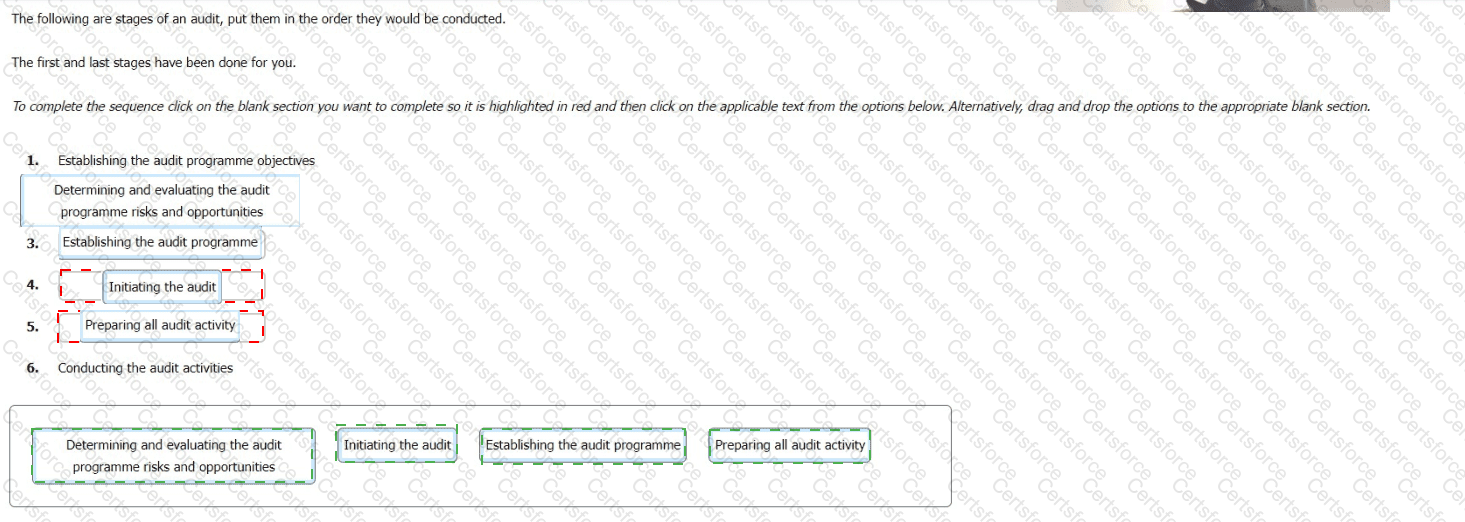
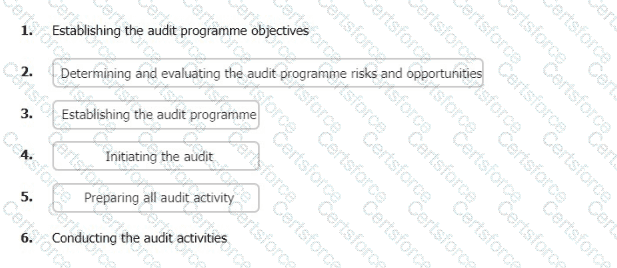
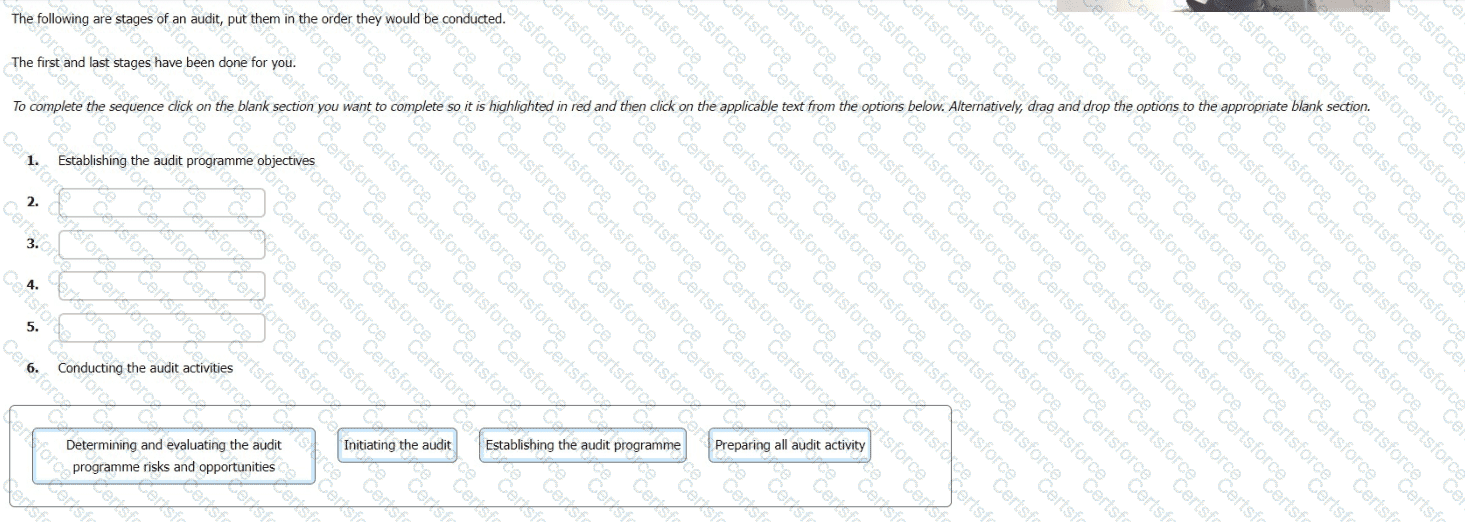
The following are stages of an audit, put them in the order they would be conducted.
Scenario 3:
Fin-Pro is a financial institution in Austria offering commercial banking, wealth management, and investment services. The company faced a significant loss of customers due to failing to improve service quality as they expanded.
To regain customer confidence, top management implemented a QMS based on ISO 9001. After a year, they contacted ACB, a local certification body, to pursue ISO 9001 certification.
The audit team was led by Emilia, an experienced lead auditor, and included three auditors. After an agreement was reached, ACB sent the audit objectives to the audit team.
The audit team began by gathering information about Fin-Pro’s understanding of ISO 9001 requirements. While reviewing documented information, they noticed missing records of training and awareness sessions. They conducted employee interviews to verify attendance.
The team also reviewed the organizational chart and job descriptions to confirm employee competence. They observed the company’s working environment (social, psychological, and physical conditions).
The audit team analyzed the evidence and prepared an audit report with findings and conclusions.
Which statement below represents the level of responsibility demonstrated by the audit team in scenario 3?
You are auditing an organisation that has been certificated to ISO 9001 for ten years. The organisation is a privately-owned, multi-site car tyre fitting
organisation. You are auditing one of the sites. You are auditing the car tyre fitting service. You are interviewing the Site Manager (SM).
You: " Would you explain the car tyre fitting service? "
SM: " Of course. Customers typically call us by phone with their requirements. We ask them what they want. We check whether we have the tyres
they need in stock. If we don ' t have the tyres in stock, we contact our supplier to confirm when they would be able to supply the tyres. We then
determine the cost. We then check what availability we have in our busy schedule to fit the new tyres. We then inform the customer with details of
cost and when we can fit the tyres. If the customer is happy to proceed with the booking, we update our Work Schedule. The same process applies
for customers who walk into our office and for online requests. "
You: " What information do you retain should there be a defect reported by a manufacturer of tyres that you have fitted? "
SM: " We maintain records of customer names, addresses and contact phone numbers. We maintain a record of the type of tyre fitted and the tyre
manufacturers batch information. We also maintain a record of the registration numbers of the vehicles we have fitted tyres to. All records are in our
Work Schedule. "
Which two of the following options you would take to enable you to gather further audit evidence to validate what the Site Manager
has told you?