
A customer operates an HPE Aruba Networking ClearPass cluster. The customer has AOS-CX switches that use 802.1X authentication with HPE Aruba Networking ClearPass Policy Manager (CPPM).
The switches use local port-access policies. The customer wants to begin tunneling only wired clients that successfully pass user authentication to an HPE Aruba Networking gateway cluster. The gateway cluster must place these clients in the eth-internet role. The gateway must also assign clients to VLAN 20.
The planned enforcement policy and profiles are shown below:
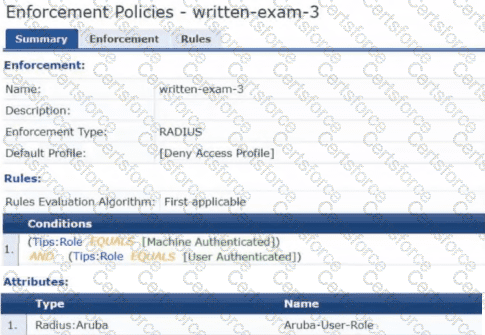
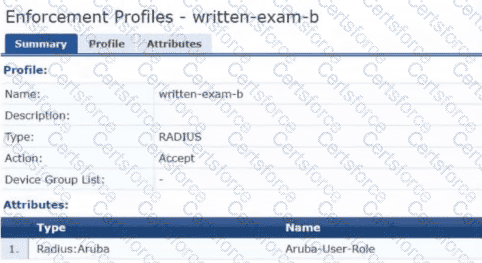
* Policy: `written-exam-3`
* Conditions: `(Tips:Role EQUALS [Machine Authenticated]) AND (Tips:Role EQUALS [User Authenticated] )`
* Profile: `written-exam-b` (Attributes: `Radius:Aruba-User-Role = Aruba-User-Role`)
The gateway cluster includes two gateways with the following IP addresses:
Gateway 1: VLAN 4085 (system IP) = 10.20.4.21 | VLAN 20 (users) = 10.20.20.1 | VLAN 4094 (WAN) = 198.51.100.14
Gateway 2: VLAN 4085 (system IP) = 10.20.4.22 | VLAN 20 (users) = 10.20.20.2 | VLAN 4094 (WAN) = 198.51.100.12 | VRRP on VLAN 20 = 10.20.20.254
Refer to the scenario. Assume the correct UBT zone and port-access role settings have been configured. However, the solution does not work.
What else must you ensure you do?
Refer to the exhibit.
Device Insight Integration:
* Device Insight Integration: Enable
* Registration Token: 4ROAMDMNKLG
* Registration Status: Registered
* Master ClearPass Server: cp1.acnsxtest.com (10.38.1.113)
* Polling Interval: 15 minutes
Device Tag Updates Action:
* Tags Update Action: Apply action for selected Tag updates only
* Selected Tags for Action: `suspicious`
* RADIUS Action: `[AOS-CX - Disconnect]`
HPE Aruba Networking ClearPass Policy Manager (CPPM) uses the settings displayed in the exhibit. You use the tag shown in the exhibit in enforcement policies associated with several NAS types, including HPE Aruba Networking APs, HPE Aruba Networking gateways, and AOS-CX switches.
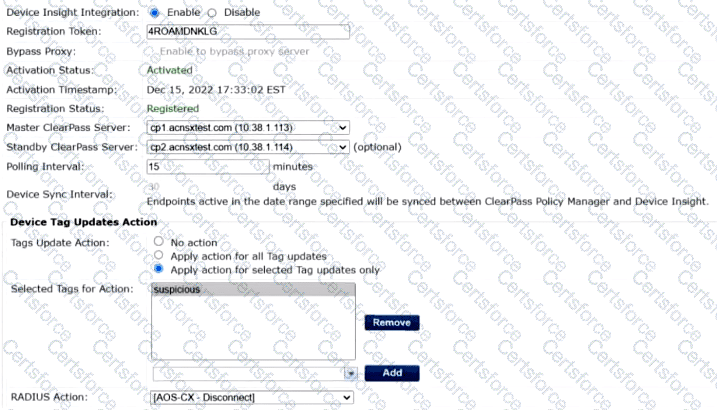
What should you do to ensure clients are reclassified and receive the proper treatment based on the tag?
The customer's security team has added a requirement: TEAP settings delivered to domain clients must use anonymous for the outer method. AOS mobility administrators now report that every wireless client appears under the same anonymous name, which makes troubleshooting difficult.
What should you recommend to best balance the security and mobility-administration needs?
You are configuring gateway IDS/IPS settings in HPE Aruba Networking Central.
Why would you set the Fail Strategy to Bypass?
A company uses an HPE Aruba Networking AOS-10 mobility infrastructure. Network administrators recently enabled wireless detection on the APs, which checks for all infrastructure and client threats. However, the administrators quickly became overwhelmed and now want to disable most checks.
They want a recommendation for the checks most likely to indicate genuine threats.
Which one should be mentioned?
The customer requires a secure method for users to enroll new wireless clients in Intune. You recommend a new WLAN that gives users limited access for enrollment. Captive portal has been configured on this WLAN to direct clients to a web page containing device-enrollment instructions, and several hostnames must be added manually to the captive-portal allowlist.
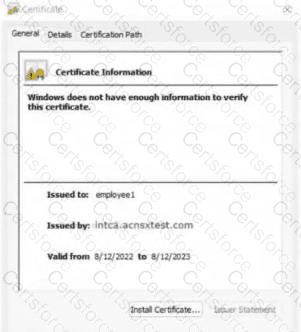
Which of the following is one such hostname?
Refer to the exhibit.
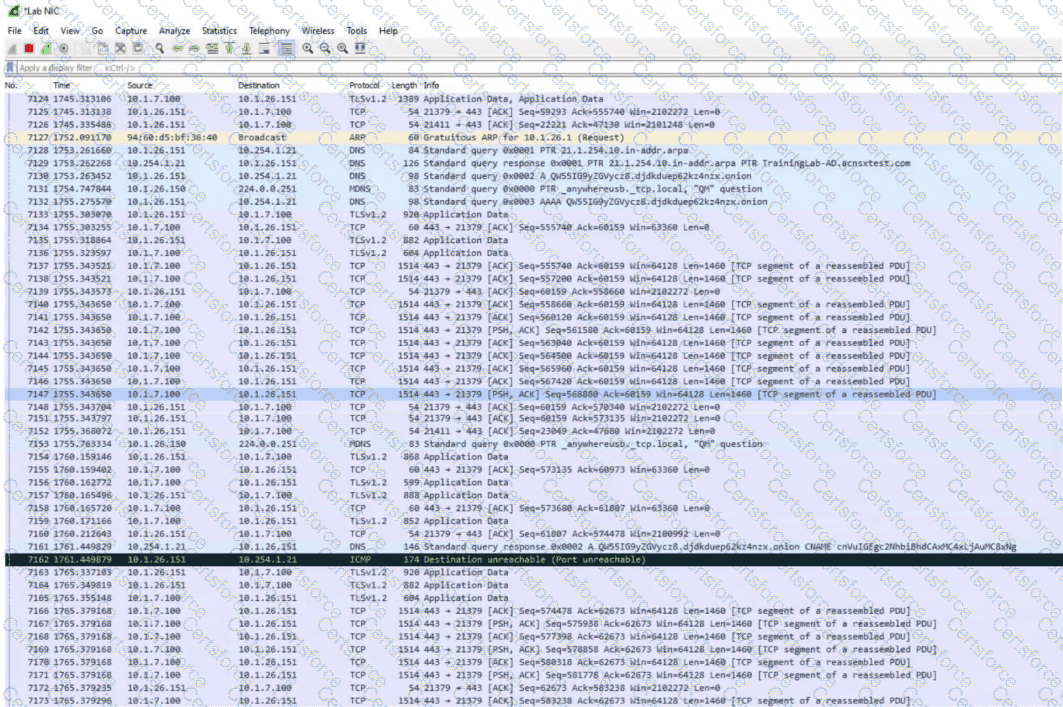
Frame 7128: 10.1.26.151 - > 10.254.1.21 DNS Standard query 0x0001 PTR 21.1.254.10.in-addr.arpa
Frame 7130: 10.1.26.151 - > 10.254.1.21 DNS Standard query 0x0002 A Qw5SIG9yZGvycz8.djdkduep62kz4nzx.onion
Frame 7147: 10.1.26.151 - > 10.1.7.100 TCP 443 - > 21379 [PSH, ACK]
Frame 7162: 10.1.26.151 - > 10.254.1.21 ICMP Destination unreachable (Port unreachable)
Which IP address should be recorded as a potentially compromised client?
A customer has an AOS-10 architecture managed by HPE Aruba Networking Central. HPE Aruba Networking infrastructure devices authenticate clients against an HPE Aruba Networking ClearPass cluster.
In HPE Aruba Networking Central, you are reviewing network traffic flows for a wireless IoT device categorized as "Raspberry Pi" clients. You observe SSH traffic. You then review several additional wireless IoT clients and find that they are also sending SSH.
Refer to the scenario.
You are helping the customer evaluate ways to mitigate the potential threat that was detected. The customer suggests simply adding a rule that denies SSH traffic to the IoT client’s AOS user role.
What is the security drawback of this approach?
Refer to the exhibit.
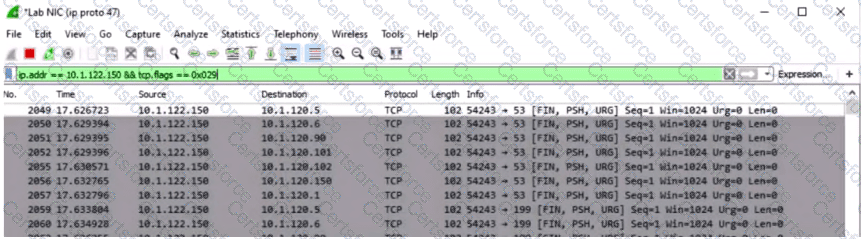
Packet trace display:
Source: 10.1.122.150 - > Destination: 10.1.120.5 TCP 54243 - > 53 [FIN, PSH, URG] Seq=1 Win=1024 Urg=0 Len=0
Source: 10.1.122.150 - > Destination: 10.1.120.6 TCP 54243 - > 53 [FIN, PSH, URG] Seq=1 Win=1024 Urg=0 Len=0
Source: 10.1.122.150 - > Destination: 10.1.120.90 TCP 54243 - > 53 [FIN, PSH, URG] Seq=1 Win=1024 Urg=0 Len=0
Source: 10.1.122.150 - > Destination: 10.1.120.101 TCP 54243 - > 53 [FIN, PSH, URG] Seq=1 Win= 1024 Urg=0 Len=0
Source: 10.1.122.150 - > Destination: 10.1.120.5 TCP 54243 - > 199 [FIN, PSH, URG] Seq=1 Win=1024 Urg=0 Len=0
What does this indicate?
A customer requires you to configure Aruba ClearPass Policy Manager (CPPM) to authenticate domain users on domain computers. Domain users, domain computers, and domain controllers obtain certificates from a Windows CA. CPPM must validate these certificates and confirm that the users and computers have accounts in Windows AD. The customer requires encrypted communication for all traffic between CPPM and the domain controllers.
You have imported the Windows CA root certificate into the ClearPass CA Trust list.
Based on these requirements, which usages should be added to it?
