
A customer has an HPE Aruba Networking ClearPass cluster that uses the Intune extension. ClearPass Policy Manager (CPPM) has a service called myservice; as part of authorization, this service queries the ClearPass Intune extension.
What is recommended for high availability?
A customer has an HPE Aruba Networking ClearPass cluster. The customer uses AOS-CX switches that perform 802.1X authentication through HPE Aruba Networking ClearPass Policy Manager (CPPM). The switches use local port-access policies.
The customer wants to begin tunneling wired clients that pass user authentication only to an HPE Aruba Networking gateway cluster. The gateway cluster must place these clients in the eth-internet role. The gateway must also assign the clients to VLAN 20.
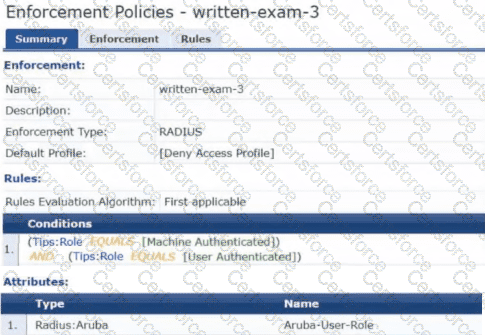
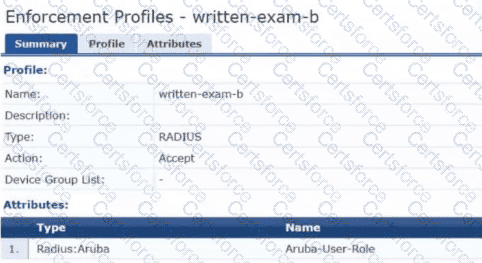
The proposed enforcement policy and profiles are shown below:
* Policy: `written-exam-3`
* Profile: `written-exam-b`
The gateway cluster contains two gateways with the following IP addresses:
Gateway 1: VLAN 4085 (system IP) = 10.20.4.21 | VLAN 20 (users) = 10.20.20.1 | VLAN 4094 (WAN) = 198.51.100.14
Gateway 2: VLAN 4085 (system IP) = 10.20.4.22 | VLAN 20 (users) = 10.20.20.2 | VLAN 4094 (WAN) = 198.51.100.12 | VRRP on VLAN 20 = 10.20.20.254
The customer needs high availability for tunnels between the switches and the gateway cluster. If one gateway fails, the other gateway must take over its tunnels. The switch must also be able to discover the gateway cluster whether either gateway is present in the cluster.
Refer to the scenario.
You are configuring the UBT zone on an AOS-CX switch. Which IP addresses should you configure in the zone?
Refer to the exhibit, which depicts the topology for an HPE Aruba Networking network.
* Gateways: GW1 (10.1.30.2 / 10.1.36.2), GW2 (10.1.30.3 / 10.1.36.3), VRRP: 10.1.36.1
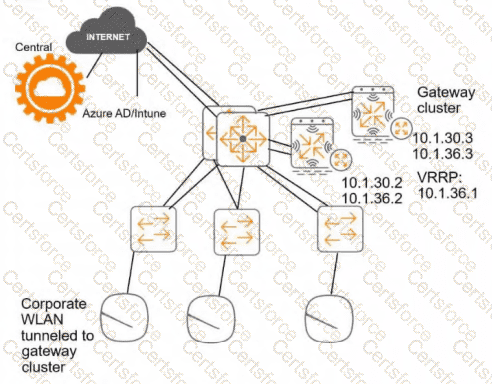
The gateways have sent the following logs to your Syslog server:
```text
< 142 > Jan 9 18:01:15 GW1 authmgr[6118]: < 124039 > < 6118 > Time-range night-hours activated
< 142 > Jan 9 18:01:15 GW1 authmgr[6118]: < 124040 > < 6118 > Time-range working-hours deactivated
< 142 > Jan 9 18:13:07 GW2 authmgr[6159] : < 124709 > < 6159 > Drop ARP-packet with unknown-IP: smac:a0:e7:7b:97:a2:98 sender-mac: a0:e7:7b:97:a2:98 sender-ip:10.1.30.2
< 142 > Jan 9 18:13:38 GW2 authmgr[6159]: < 124709 > < 6159 > Drop ARP-packet with unknown-IP: smac: a0:e7:7b:97:a2:98 sender-mac: a0:e7:7b:97:a2:98 sender-ip:10.1.30.2
< 142 > Jan 9 18:21:24 GW2 isakmpd[6132]: < 103076 > < 6132 > IKEv2 IPSEC Tunnel created for peer 10.1.30.2:500
< 142 > Jan 9 18:21:24 GW2 isakmpd[6132]: < 103101 > < 6132 > IPSEC SA deleted for peer 10.1.30.2
< 142 > Jan 9 18:21:24 GW2 isakmpd[6132]: < 103078 > < 6132 > IKEv2 CHILDSA successful for peer 10.1.30.2:500
< 142 > Jan 9 18:21:26 GW1 isakmpd[6091]: < 103076 > < 6091 > IKEv2 IPSEC Tunnel created for peer 10.1.30.3:500
< 142 > Jan 9 18:21:26 GW1 isakmpd[6091]: < 103101 > < 6091 > IPSEC SA deleted for peer 10.1.30.3
< 142 > Jan 9 18:21:26 GW1 isakmpd[6091]: < 103078 > < 6091 > IKEv2 CHILDSA successful for peer 10.1.30.3:500
```
What potential security issue can be identified from these logs?
A company has HPE Aruba Networking gateways implementing gateway IDS/IPS in IDS mode. The customer reports that administrators are receiving repeat email notifications for the same threat too frequently. Although the threat may require investigation, the customer does not want the email notification to recur as often.
Which setting in HPE Aruba Networking Central should be adjusted?
A customer has an AOS-10 architecture that includes HPE Aruba Networking APs. The customer recently enabled WIDS at the high level on the APs. Administrators see several "ad hoc using valid SSID" events.
What should you explain?
What benefit does an organization obtain by upgrading wireless security from WPA2-Personal to WPA3-Personal?
A company wants its AOS-CX switches to obtain certificates from ClearPass Onboard and use those certificates to implement RadSec with ClearPass Policy Manager (CPPM).
ClearPass Onboard has a CA with EST enabled and this EST URL: `[https://cp1.acnsxtest.com/.well-known/est/ca:2](https://cp1.acnsxtest.com/.well-known/est/ca:2)`
ClearPass Guest has an account whose username is `switchcorp123`. (Assume CPPM also has a valid service to authenticate users who access the EST application.)
CPPM has a network-device account for the switches with RadSec enabled. The RadSec settings validate by CN or SAN using this regex: `switchcorp123`
ClearPass has these certificates:
* HTTPS certificate signed by DigiCert
* RadSec certificate signed by DigiCert
* RADIUS/EAP certificate signed by MyDomainCA
This configuration is on the AOS-CX switches:
```text
crypto pki est-profile est1
url https://clearpass1.acnsxtest.com/.well-known/est/ca:2
username switchcorp123
password plaintext %FY212h & zaTk
vrf default
exit
crypto pki certificate cert1
subject switchcorp123
enroll est-profile onboard
crypto pki application radsec-client certificate cert1
```
The switches’ TA-profile list includes DigiCert.
Assume you have obtained the correct password associated with the indicated username. What error or errors are present?
A company uses an HPE Aruba Networking EdgeConnect SD-Branch solution. The customer wants to integrate the solution with HPE Aruba Networking SSE.
What is one step that must be completed in HPE Aruba Networking SSE and is not automated as part of the typical setup?
You are assisting a company with designing role-based access control policies on HPE Aruba Networking AOS-10 gateways. The security policy dictates that traffic originating from authenticated corporate user roles must be inspected statefully, allowing client-initiated outbound flows to the data center while strictly dropping any unsolicited inbound connection attempts initiated from data center servers back toward the clients.
What design principle ensures this traffic flow behavior?
A client connected to an AOS-CX switch has been assigned Role1. Role1 has the following port-access classes and policy associated with it:
```text
class ip class1
10 match tcp any any eq 22
20 ignore tcp any 10.10.4.0/23 eq 443
30 match ip any 10.10.4.0/23
class ip class2
10 match any any eq 67
20 match ip any 10.10.4.0/22
port-access policy policy1
10 class ip class1 action drop
20 class ip class2
```
The client sends two packets:
1: HTTPS to 10.10.5.5
2: DNS to 10.10.6.6
What occurs?
