
Refer to the exhibit.
A routing table is shown
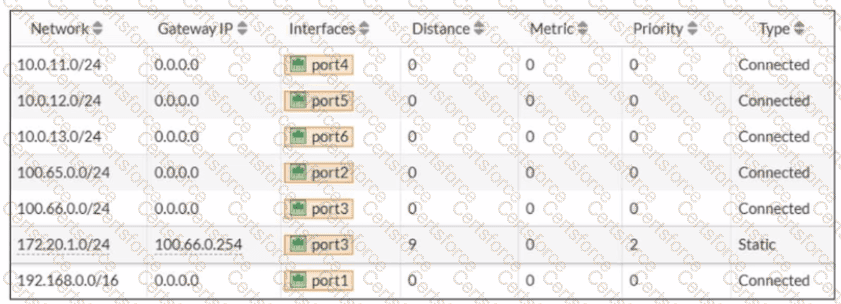
An administrator wants to create a new static route so the traffic to the subnet 172.20.1.0/24 is routed through port2 only. What are the two criteria that the administrator can use to achieve this objective? (Choose two.)
An administrator manages a FortiGate model that supports NTurbo
How does NTurbo acceleration enhance antivirus performance?
Refer to the exhibit.
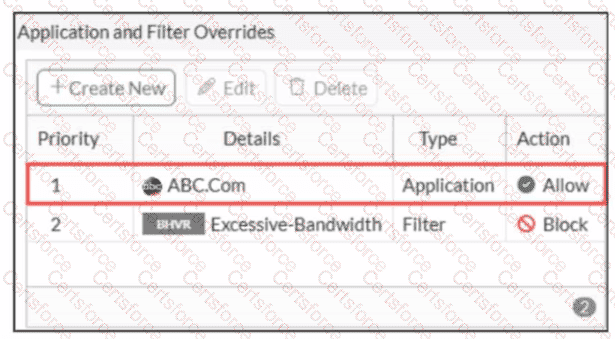
An administrator has configured an Application Overrides for the ABC.Com application signature and set the Action to Allow This application control profile is then applied to a firewall policy that is scanning all outbound traffic. Logging is enabled in the firewall policy. To test the configuration, the administrator accessed the ABC.Com web site several times.
Why are there no logs generated under security logs for ABC.Com?
Which two statements are correct when FortiGate enters conserve mode? (Choose two answers)
Refer to the exhibit.
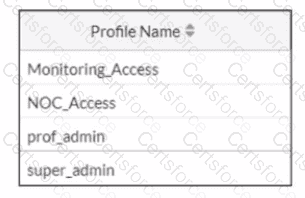
The NOC team connects to the FortiGate GUI with the NOC_Access admin profile. They request that their GUI sessions do not disconnect too early during inactivity. What must the administrator configure to answer this specific request from the NOC team?
A network administrator is configuring an IPsec VPN tunnel for a sales employee travelling abroad.
Which VPN Wizard template must the administrator apply?
Refer to the exhibit.
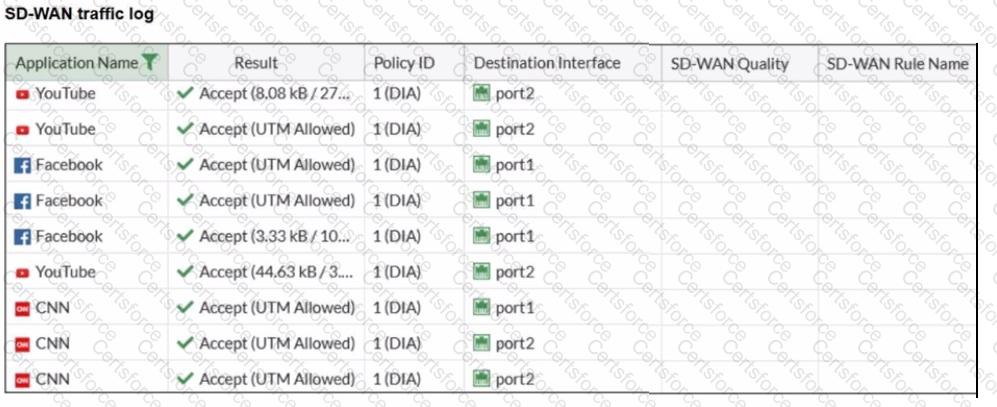
The administrator configured SD-WAN rules and set the FortiGate traffic log page to display SD-WAN-specific columns: SD-WAN Quality and SD-WAN Rule Name
FortiGate allows the traffic according to policy ID 1 placed at the top. This is the policy that allows SD-WAN traffic. Despite these settings, the traffic logs do not show the name of the SD-WAN rule used to steer those traffic flows
What could be the reason?
Refer to the exhibit.
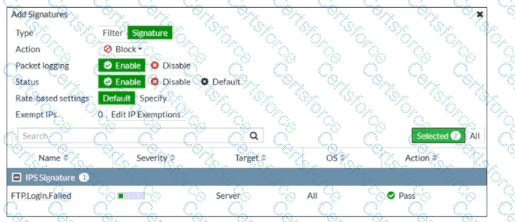
An intrusion prevention system (IPS) profile signature setting is shown.
What can you conclude about the signature when adding the FTP.Login.Failed signature to the IPS Sensor profile?
Refer to the exhibit.

As an administrator you have created an IPS profile, but it is not performing as expected. While testing you got the output as shown in the exhibit What could be the possible reason of the diagnose output shown in the exhibit?
Refer to the exhibit.
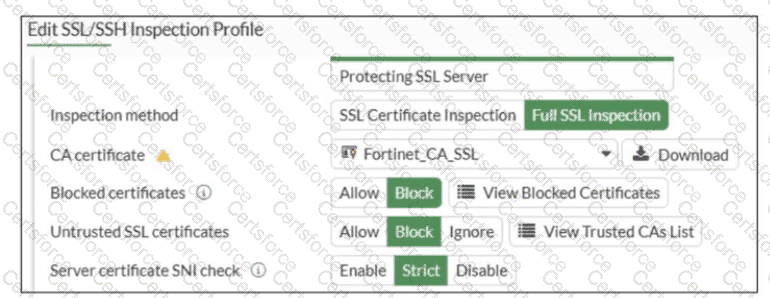
What would be the impact of these settings on the Server certificate SNI check configuration on FortiGate?
