Pre-Summer Special Limited Time 70% Discount Offer - Ends in 0d 00h 00m 00s - Coupon code: force70

Pass the Fortinet Fortinet Certified Solution Specialist FCSS_NST_SE-7.6 Questions and answers with CertsForce

Viewing page 4 out of 4 pages
Viewing questions 31-40 out of questions
Questions # 31:

Exhibit.

Question # 31

Refer to the exhibit, which shows two entries that were generated in the FSSO collector agent logs.

What three conclusions can you draw from these log entries? {Choose three.)

Options:

A.

Remote registry is not running on the workstation.


B.

The user ' s status shows as " not verified " in the collector agent.


C.

DNS resolution is unable to resolve the workstation name.


D.

The FortiGate firmware version is not compatible with that of the collector agent.


E.

A firewall is blocking traffic to port 139 and 445.


Expert Solution
Questions # 32:

Which authentication option can you not configure under config user radius on FortiOS?

Options:

A.

mschap


B.

pap


C.

mschap2


D.

eap


Expert Solution
Questions # 33:

What are two reasons you might see iprope_in_check() check failed, drop when using the debug flow? (Choose two.)

Options:

A.

Packet was dropped because of policy route misconfiguration.


B.

Packet was dropped because of traffic shaping.


C.

Trusted host list misconfiguration.


D.

VIP or IP pool misconfiguration.


Expert Solution
Questions # 34:

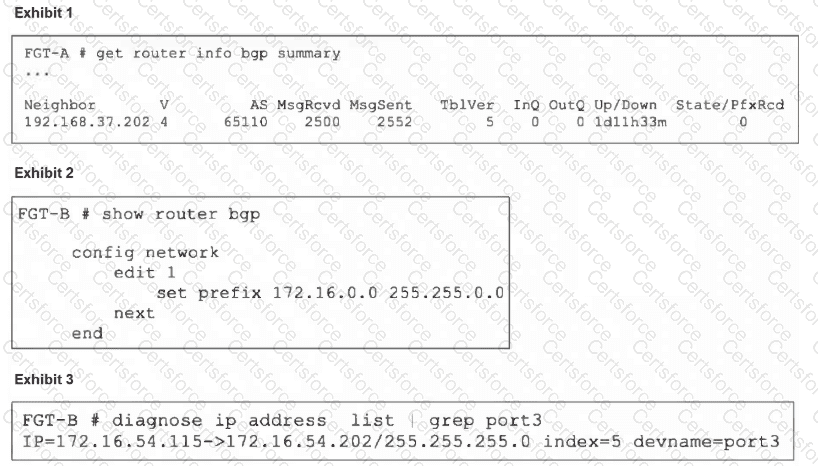
Refer to the exhibit, which shows the output of get router info bgp summary.

Question # 34

Which two statements are true? (Choose two.)

Options:

A.

The local ForliGate has received one prefix from BGP neighbor 100.64.1.254.


B.

The TCP connection with BGP neighbor 100.64.2.254 was successful.


C.

The local FortiGate has received 18 packets from a BGP neighbor.


D.

The local FortiGate is still calculating the prefixes received from BGP neighbor 100.64.2.264


Expert Solution
Questions # 35:

Which statement about IKEv2 is true?

Options:

A.

Both IKEv1 and IKEv2 share the feature of asymmetric authentication.


B.

IKEv1 and IKEv2 have enough of the header format in common that both versions can run over the same UDP port.


C.

IKEv1 and IKEv2 use the same TCP port but run on different UDP ports.


D.

IKEv1 and IKEv2 share the concept of phase1 and phase2.


Expert Solution
Questions # 36:

Refer to the exhibit.

The exhibit shows the output from using the command diagnose debug application samld -1 to diagnose a SAML connection.

Question # 36

Based on this output, what can you conclude?

Options:

A.

Active Directory is used for authentication.


B.

The authentication request is for an SSL VPN connection.


C.

The IdP IP address is 10.1.10.254.


D.

The IdP IP address is 10.1.10.2.


Expert Solution
Questions # 37:

What is the correct order of the IKEv2 request-and-response protocol?

Options:

A.

Create_Child_SA, IKEAUTH, IKESAJNIT


B.

Create_Child_SA, IKE_SA_INIT. IKE_AUTH


C.

IKE SA INIT, IKE AUTH. Create Child SA OIKE AUTH.


D.

IKE_AUTH_IKE_SA_INIT, Create_Child_SA


Expert Solution
Questions # 38:

Refer to the exhibit, which shows the output of a real-time debug. Which statement about this output is true? (Choose one answer)

Question # 38

Options:

A.

The server hostname was extracted from the SNI in the client request, or from the CN in the server certificate.


B.

FortiGate found the requested URL in its local cache.


C.

This web request was inspected using the ftgd-allow web filter profile.


D.

The requested URL belongs to category ID 255.


Expert Solution
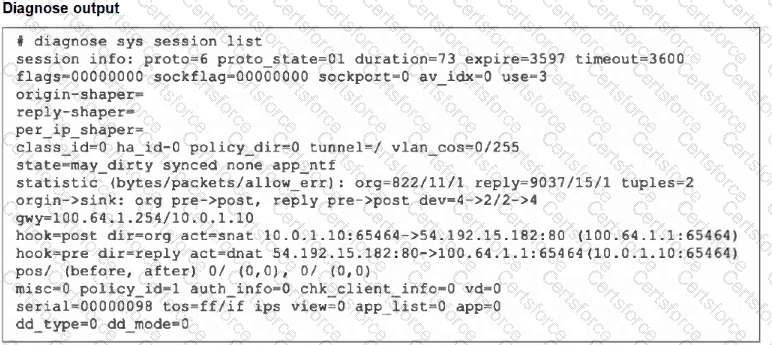
Questions # 39:

Refer to the exhibit, which shows the output of a diagnose command.

Question # 39

What two conclusions can you draw from the output shown in the exhibit? (Choose two answers)

Options:

A.

This is an expected session created by the IPS engine.


B.

Traffic in the original direction (coming from the IP address 10.171.121.38) will be routed to the next-hop IP address 10.0.1.10.


C.

Traffic in the original direction (coming from the IP address 10.171.121.38) will be routed to the next-hop IP address 10.200.1.1.


D.

This is a pinhole session created to allow traffic for a protocol that requires additional sessions to operate through FortiGate.


Expert Solution
Viewing page 4 out of 4 pages
Viewing questions 31-40 out of questions