
Which SQL keyword can be used to convert a table from a long format to a wide format?
Identify a scenario to use an external table.
A Data Engineer needs to create a parquet bronze table and wants to ensure that it gets stored in a specific path in an external location.
Which table can be created in this scenario?
A data engineer observes that an ETL job in Databricks has increased its execution time from a five-minute baseline to 12 minutes over the past week. Using the Lakeflow Jobs run-history view, the engineer needs to identify whether the slowdown is consistent or intermittent and determine its root cause.
Which action should the engineer take to analyze execution-time trends against the baseline?
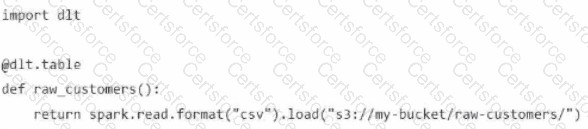
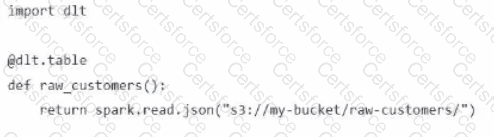
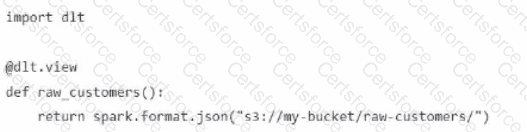
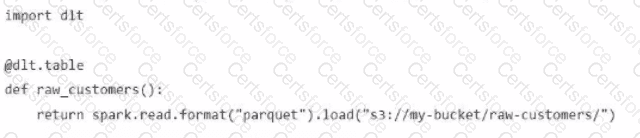
A Data Engineer is building a simple data pipeline using Delta Live Tables (DLT) in Databricksto ingest customer data. The raw customer data is stored in a cloud storage location in JSON format. The task is to create a DLT pipeline that reads the rawJSON data and writes it into a Delta table for further processing.
Which code snippet will correctly ingest the raw JSON data and create a Delta table using DLT?
A)
B)
C)
D)
A data engineer has a Declarative Automation Bundle with a job resource keyed as etl_job in databricks.yml. After running databricks bundle deploy, the job appears in the workspace but has not executed.
Which command triggers execution of the deployed job?
A data engineer uses the Databricks workspace UI with Unity Catalog enabled. In Catalog Explorer, they select catalog corp_marketing, then schema campaigns, and see table email_stats. The engineer must let the growth-analysts group read email_stats from its SQL warehouses, but not create, alter, or delete any objects in corp_marketing or campaigns.
Which action sequence meets the requirement?
A data engineer needs to create a table in Databricks using data from their organization’s existing SQLite database.
They run the following command:
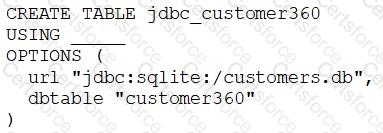
Which of the following lines of code fills in the above blank to successfully complete the task?
A data engineering team needs to incrementally ingest customer transactions from a SaaS application into the Databricks Data Intelligence Platform with the following capabilities:
Built-in change data capture, including updates and deletes
Automatic schema evolution
Serverless execution with retries and minimal maintenance
OAuth support and basic monitoring
Which solution meets all the requirements?
A data engineer is configuring Unity Catalog in Databricks and needs to assign a role to a user who should have the ability to grant and revoke privileges on various data objects within a specific schema but should not have read/write access over the schema or its objects.
Which role should the data engineer assign to this user?
