Summer Certification Special Limited Time 70% Discount Offer - Ends in 0d 00h 00m 00s - Coupon code: force70

Pass the Databricks Databricks Certification Databricks-Certified-Data-Engineer-Associate Questions and answers with CertsForce

Viewing page 6 out of 7 pages
Viewing questions 51-60 out of questions
Questions # 51:

A new data engineering team has been assigned to work on a project. The team will need access to database customers in order to see what tables already exist. The team has its own group team.

Which of the following commands can be used to grant the necessary permission on the entire database to the new team?

Options:

A.

GRANT VIEW ON CATALOG customers TO team;


B.

GRANT CREATE ON DATABASE customers TO team;


C.

GRANT USAGE ON CATALOG team TO customers;


D.

GRANT CREATE ON DATABASE team TO customers;


E.

GRANT USAGE ON DATABASE customers TO team;


Expert Solution
Questions # 52:

An organization is looking for an optimized storage layer that supports ACID transactions and schema enforcement. Which technology should the organization use?

Options:

A.

Cloud File Storage


B.

Unity Catalog


C.

Data lake


D.

Delta Lake


Expert Solution
Questions # 53:

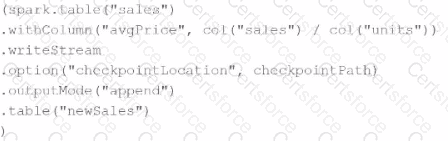
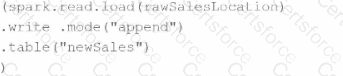
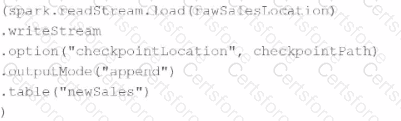
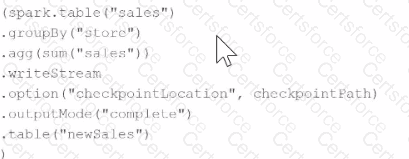
Which query is performing a streaming hop from raw data to a Bronze table?

A)
Question # 53

B)

Question # 53

C)

Question # 53

D)

Question # 53

Options:

A.

Option A


B.

Option B


C.

Option C


D.

Option D


Expert Solution
Questions # 54:

A data engineer needs to audit who made changes to a Delta table during the last seven days.

Which SQL statement returns the record of past operations, including timestamps, users, and operation types?

Options:

A.

SHOW TBLPROPERTIES my_table


B.

DESCRIBE DETAIL my_table


C.

DESCRIBE HISTORY my_table


D.

SELECT * FROM delta.\my_table/_delta_log/``


Expert Solution
Questions # 55:

A data engineering team has two tables. The first table march_transactions is a collection of all retail transactions in the month of March. The second table april_transactions is a collection of all retail transactions in the month of April. There are no duplicate records between the tables.

Which of the following commands should be run to create a new table all_transactions that contains all records from march_transactions and april_transactions without duplicate records?

Options:

A.

CREATE TABLE all_transactions ASSELECT * FROM march_transactionsINNER JOIN SELECT * FROM april_transactions;


B.

CREATE TABLE all_transactions ASSELECT * FROM march_transactionsUNION SELECT * FROM april_transactions;


C.

CREATE TABLE all_transactions ASSELECT * FROM march_transactionsOUTER JOIN SELECT * FROM april_transactions;


D.

CREATE TABLE all_transactions ASSELECT * FROM march_transactionsINTERSECT SELECT * from april_transactions;


E.

CREATE TABLE all_transactions ASSELECT * FROM march_transactionsMERGE SELECT * FROM april_transactions;


Expert Solution
Questions # 56:

A data engineer is designing a Bronze-to-Silver pipeline on the Databricks Data Intelligence Platform. The source system sends daily CSV files, and new optional columns are added over time.

The engineer needs a storage format and table capabilities that provide all of the following:

    Writes that do not conform to the defined schema are rejected.

    The schema can evolve to include new optional columns without manually recreating the table.

    Previous table versions can be queried for debugging and auditing.

Which solution fulfills these requirements?

Options:

A.

Use a Parquet table with Spark’s default schema inference and rerun the job whenever the schema changes.


B.

Use a Delta table with schema enforcement and recreate the table whenever new columns are added.


C.

Use an external table with Auto Loader schema inference for the CSV files.


D.

Use a Delta table with its native schema enforcement, schema evolution, and table-history capabilities.


Expert Solution
Questions # 57:

A company has a strict 15-minute service-level agreement for updating its currency-exchange dashboard. Source data arrives in small increments every few minutes. The team needs a Lakeflow Jobs trigger strategy that keeps end-to-end latency within the SLA while minimizing compute cost and DBU consumption.

Which strategy is recommended?

Options:

A.

Use a scheduled trigger every 1 minute.


B.

Use a file-arrival trigger whenever a single JSON file arrives.


C.

Use a continuous trigger.


D.

Use a scheduled trigger every 12 minutes, with the streaming task configured to use Trigger.AvailableNow.


Expert Solution
Questions # 58:

A data engineering team needs to integrate two data sources into Databricks:

    Clickstream events: 5,000 events per second from an Apache Kafka topic

    Customer master data: Only changed records every four hours from a Snowflake database

The solution must process clickstream data with latency under 30 seconds and prevent reprocessing customer master data that has not changed.

Which ingestion approach meets these requirements?

Options:

A.

Use Structured Streaming for Kafka and a Lakeflow Connect managed connector with incremental processing for Snowflake.


B.

Use a non-incremental Snowflake connector, fetch all data every four hours, and apply MERGE operations.


C.

Use spark.readStream() with Kafka and query Snowflake hourly using a time-based filter.


D.

Use Structured Streaming for Kafka and a Lakeflow Connect connector with a full refresh for Snowflake.


Expert Solution
Questions # 59:

A data engineer converts an external Delta table to a Unity Catalog managed table. A Structured Streaming job that reads from the table continues running during the conversion. After the conversion completes, the streaming job stops processing new records.

How should the data engineer resolve the issue?

Options:

A.

Restart the streaming job so that it uses the new managed-table location.


B.

Run REFRESH TABLE on the converted table to update the streaming checkpoint.


C.

Grant the streaming job additional permissions on the new managed-storage location.


D.

Delete the streaming checkpoint directory and reprocess the complete source from the beginning.


Expert Solution
Questions # 60:

A dataset has been defined using Delta Live Tables and includes an expectations clause:

CONSTRAINT valid_timestamp EXPECT (timestamp > ' 2020-01-01 ' ) ON VIOLATION FAIL UPDATE

What is the expected behavior when a batch of data containing data that violates these constraints is processed?

Options:

A.

Records that violate the expectation cause the job to fail.


B.

Records that violate the expectation are added to the target dataset and flagged as invalid in a field added to the target dataset.


C.

Records that violate the expectation are dropped from the target dataset and recorded as invalid in the event log.


D.

Records that violate the expectation are added to the target dataset and recorded as invalid in the event log.


Expert Solution
Viewing page 6 out of 7 pages
Viewing questions 51-60 out of questions