
The competition authorities are investigating the takeover of Company Z by a larger company, Company Y.
Both companies are food retailers.
The takeover terms involve using a part cash, part share exchange means of payment.
Company Z is resisting the bid, arguing that it undervalues its business, while lobbying extensively among politicians to sway public opinion against the bidder.
Which of the following actions by Company Y is most likely to persuade the competition authorities to approve the acquisition?
The Board of Directors of Company T is considering a rights issue to fund a new investment opportunity which has a zero NPV.
The Board of Directors wishes to explain to shareholders what the theoretical impact on their wealth will be as a result of different possible actions during the rights issue.
Which THREE of the following statements in respect of theoretical shareholder wealth are true?
Which of the following statements is true of a spin-off (or demerger)?
Company T is a listed company in the retail sector.
Its current profit before interest and taxation is $5 million.
This level of profit is forecast to be maintainable in future.
Company T has a 10% corporate bond in issue with a nominal value of $10 million.
This currently trades at 90% of its nominal value.
Corporate tax is paid at 20%.
The following information is available:
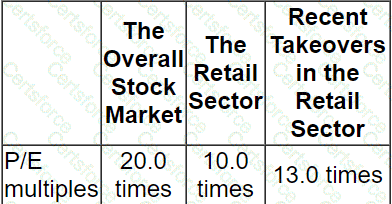
Which of the following is a reasonable expectation of the equity value in the event of an attempted takeover?
A project requires an initial outlay of $2 million which can be financed with either a bank loan or finance lease.
The company will be responsible for annual maintenance under either option.
The tax regime is:
• Tax depreciation allowances can be claimed on purchased assets.
• If leased using a finance lease, tax relief can be claimed on the interest element of the lease payments and also on the accounting depreciation charge.
The trainee management accountant has begun evaluating the lease versus buy decision and has produced the following data. He is not confident that all this information is relevant to this decision.
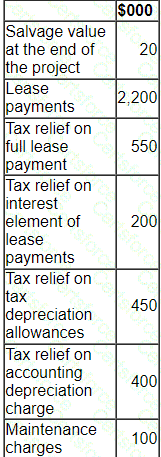
Using only the relevant data, which of the following is correct?
A company which is forecast to experience a strong growth in its profitability is evaluating a potential bond issue.
Which of the following changes in corporate income tax and in bond yields would make the bond issue more attractive to the company?
CAPM:
E(R)=Rf+β(Rm−Rf)E(R) = R_f + \beta (R_m - R_f)E(R)=Rf+β(Rm−Rf)
Given:
E(R)=11%,Rf=2%,Rm=8%E(R) = 11\% , R_f = 2\%, R_m = 8\%E(R)=11%,Rf=2%,Rm=8%
0.11=0.02+β(0.08−0.02)⇒0.11−0.02=0.06β⇒0.09=0.06β⇒β=1.50.11 = 0.02 + \beta(0.08 - 0.02) \Rightarrow 0.11 - 0.02 = 0.06\beta \Rightarrow 0.09 = 0.06\beta \Rightarrow \beta = 1.50.11=0.02+β(0.08−0.02)⇒0.11−0.02=0.06β⇒0.09=0.06β⇒β=1.5
Beta > 1 ⇒ higher risk than the market.
An unlisted company is attempting to value its equity using the dividend valuation model.
Relevant information is as follows:
• A dividend of $500,000 has just been paid.
• Dividend growth of 8% is expected for the foreseeable future.
• Earnings growth of 6% is expected for the foreseeable future.
• The cost of equity of a proxy listed company is 15%.
• The risk premium required due to the company being unlisted is 3%.
The calculation that has been performed is as follows:
Equity value = $540,000 / (0.18 - 0.08) = $5,400,000
What is the fault with the calculation that has been performed?
D has US$10 million to invest over 12 months in either USS or GBP Its options are to invest in USS at the present USS interest rate of 10 18%. or to convert the USS to GBP at the spot rate GBP1 =US$1 61 and invest in GBP at an interest rate of 6.4%.
According to the interest rate parity theory, what will the one year forward rate be?
Give your answer to three decimal places.

Delta and Kappa both wish to borrow $50m.
Delta can borrow at a fixed rate of 12% or at a floating rate of the risk-free rate +3%
Kappa can borrow at 15% fixed or the risk-free rate +4%.
Delta wishes a variable rate loan and Kappa a fixed rate loan The bank for the two companies suggests a swap arrangement The two companies agree to a swap arrangement, sharing savings equally
What is the effective swap rate for each company?
