
On 1 January:
• Company X has a value of $50 million
• Company Y has a value of $20 million
• Both companies are wholly equity financed
Company X plans to take over Company Y by means of a share exchange. Following the acquisition the post-tax cashflow of Company X for the foreseeable future is estimated to be $8 million each year. The post-acquisition cost of equity is expected to be 10%.
What is the best estimate of the value of the synergy that would arise from the acquisition?
A large multi-divisional company in the food processing and distribution business is conducting a strategic review. The divisions all compete in the same market.
The sale of one of its underperforming food processing divisions to the divisional management team is currently being considered. The purchase by the divisional management team will require venture capital finance.
Which THREE of the following are likely to influence the multi-divisional company's decision on whether or not to sell the under-performing division to the management team?
On 1 January:
• Company ABB has a value of $55 million
• Company BBA has a value of $25 million
• Both companies are wholly equity financed
Company ABB plans to take over Company BBA by means of a share exchange Following the acquisition the post-tax cashflow of Company ABB for the foreseeable future is estimated to be $10 million each year The post-acquisition cost of equity is expected to be 10%
What is the best estimate of the value of the synergy that would arise from the acquisition?
Which of the following statements about companies seeking a stock market listing is correct?
The directors of a financial services company need to calculate a valuation of their company’s equity in preparation for an upcoming initial Public Offering (IPO) of shares. At a recent board meeting they discussed the various methods of business valuation.
The Chief Executive suggested using a Price-earing (P./E) method of valuation, but the finance Director argued that a valuation based on forecast cash flows to equity would be more appropriate.
Which THREE of the following are advantages of valuation based on forecast cash flows to equity, compared to a valuating using a price earnings methods?
A company has in a 5% corporate bond in issue on which there are two loan covenants.
• Interest cover must not fall below 3 times
• Retained earnings for the year must not fall below $3.5 million
The Company has 200 million shares in issue.
The most recent dividend per share was $0.04.
The Company intends increasing dividends by 10% next year.
Financial projections for next year are as follows:
Advise the Board of Directors which of the following will be the status of compliance with the loan covenants next year?
A listed publishing company owns a subsidiary company whose business activity is training.
It wishes to dispose of the subsidiary company.
The following information is available:
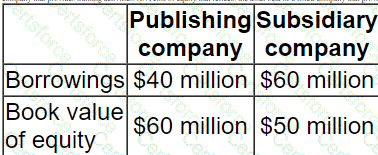
The board of the publishing company believe that the value of the subsidiary company, and hence the value of the equity invested in it, can be determined by calculating the present value of the subsidiary's free cashflows.
Which of the following is the most appropriate discount rate to use when determining the enterprise value of the company?
Company M plans to bid for Company J. Company M has 20 million shares in issue and a current share price of $10.00 before publicly announcing the planned takeover. Company J has 10 million shares in issue and a current share price of $4.00.
The directors of Company M are considering an all-share bid of 1 Company M shares for 2 Company J shares.
Synergies worth $20m are expected from the acquisition.
What is the likely change in wealth for Company M's shareholders (in total) if the bid is accepted?
Give your answer to the nearest $ million.
$ ? million
Company A has made an offer to acquire Company Z.
Both companies are quoted and their current market share prices are:
• Company A - $4
• Company Z - $5
Shareholders in company Z have been given three alternative offers:
• Cash of $5.50 per share
• Share for share exchange on the basis of 3 for 2
• 10.5% long dated bond for every 20 shares
The bond is has a nominal value of $100 and the expected yield on bonds of similar risk is 10%.
You are advising a Company Z shareholder on the three offers.
She requires a 15% premium if she is to accept the offer.
In providing your advice, which of the following statements is correct?
A company has a loss-making division that it has decided to divest in order to raise cash for other parts of the business.
The losses stem from a combination of a lack of capital investment and poor divisional management.
The loss-making division would require new capital investment of at least $20 million in order to replace worn out and obsolete assets.
If this investment was carried out, the present value of the future cashflows, excluding the investment expenditure, is expected to be $15 million.
Which TWO of the following divestment methods are most likely to be suitable for the company?
