
What concept enables the simultaneous operation of multiple ADM phases?
Consider the following statements about Architecture Partitioning:
The TOGAF ADM requires a partitioning model for architecture development
Architectures are partitioned when different teams need to work on different elements of the architecture at the same time
Partitions can be used to facilitate architecture re-use
Which statements are correct?
Consider the diagram showing a classification model for Architecture Landscapes.
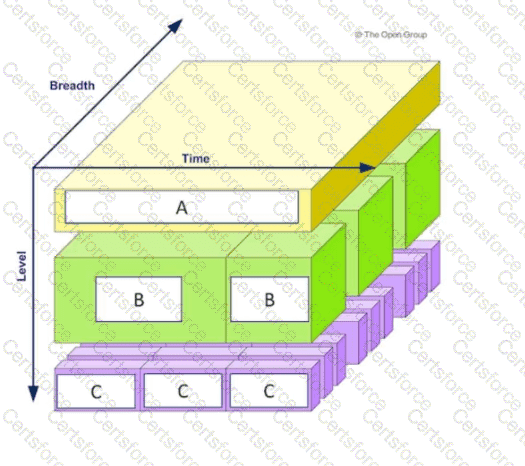
What are the items labelled A, B and C?
Complete the sentence. When considering agile development, Architecture to Support Portfolio will identify what products the Enterprise needs, the boundary of the products, and what constraints a product owner has; this defines the Enterprise ' s
Please read this scenario prior to answering the question
You are employed as an Enterprise Architect at a multinational energy company. The company is committed to reducing its emissions. To achieve this, the company is increasing production of renewable energy and adopting eco-friendly practices.
The company has an Enterprise Architecture (RA) practice and follows the TOGAF standard for its EA framework. The EA team manages all the major projects in the company. The EA team reports to the Chief Technical Officer (CTO), who is the sponsor of the EA program. The Architecture Board is made up of senior leaders from all parts of the company.
The company is starting to invest in developing various kinds of renewable energy projects, including solar, and wind. A large part of the growth in its renewable energy portfolio has come from buying other companies. The company is keen on acquiring small startups and mid-size companies to leverage their technical innovations. This way, the company aims to outperform its competitors, scale rapidly, and establish a presence in new markets.
The existing business and the newly acquired companies are not working well together, which increasingly causes problems. In response, a strategic plan was created and approved. The plan aims to make the merged companies work more effectively together. This will save money by sharing their common assets, including fixed capital assets, research and development facilities, and resources.
The EA team have been asked to oversee the transformation to carry out the strategic plan. A Request for Architecture Work for the project has created and has been approved. The goal is to strengthen the company ' s position in the market and reduce costs by taking advantage of economies of scale. The Chief Executive Officer (CEO) has stated that to stay competitive and relevant, the company must transform or entirely reinvent its business model.
Refer to the Scenario
What needs to be done to make sure that the company succeeds with the changes and how should risks be managed?
Based on the TOGAF standard, which of the following is the best answer?
Please read this scenario prior to answering the question
You are employed as an Enterprise Architect working at a vehicle manufacturing
company. The company specializes in buses and coaches. You are part of an
Enterprise Architecture (EA) team that has responsibilities across multiple divisions of
the company. EA provides the company with a comprehensive framework to develop
and manage their manufacturing infrastructure, processes for component production,
and design and testing systems.
The company has a corporate strategy that focuses on switching to electric power for
its vehicles. It has invested heavily in a new standardized design, production efforts,
and major components to use across all its product range. The company has multiple
manufacturing plants in North America, Europe, and in Asia.
Customer demand has caused a backlog of orders because many customers want to
have more environmentally friendly public transportation. There are not enough
electronic components available, which is making it hard to produce products and
meet customer demand. To address this issue, the company has started making the
battery packs themselves and has hired new suppliers.
The EA team is working on a project to improve the process and systems to design,
produce, and test the battery pack. As part of putting the new battery pack into
production, changes to the assembly processes need to be made. A trial has been
completed at a single location. The Chief Engineer, sponsor of the project, and the
Architecture Board have approved the plan to roll out these changes to all plants.
Preliminary Architecture Contracts are being developed to detail the work needed to
put in place the new processes for each location. The EA team leader has called a
meeting to discuss the contracts. It is emphasized that the Architecture Contract will
serve as the key connection between architecture and implementation organizations.
The company mixes internal teams with a few third-party contractors at the locations.
The Chief Engineer is worried that the implementation and deployment will not be
consistent and of satisfactory quality.
The company has an established EA practice. It uses the TOGAF standard as the
foundation for its work including the internal EA framework. Additionally, the company
uses various management frameworks such as business planning, project
management, and operations management.
Refer to the scenario
The EA team leader asks you how you would address the Chief Engineer ' s concern.
Based on the TOGAF standard, which of the following is the best answer?
Please read this scenario prior to answering the question.
You are employed as an Enterprise Architect within an Enterprise Architecture (EA) team at an environmental agency. The agency has multiple divisions, and is responsible for overseeing environmental protection, regulation, and conservation efforts.
The agency has a well-established EA practice and follows the TOGAF standard as its method for architecture development. Along with the EA program, the agency also uses various management frameworks, including business planning, project/portfolio management, and operations management. The EA program is sponsored by the Chief Information Officer (CIO), who has actively promoted architecting with agility within the EA department as the preferred approach for projects.
The agency is preparing itself for a world where Artificial Intelligence (AI) is widely adopted. As a result, the agency is looking to determine the impact and role that AI will play moving forward.
The CIO has approved a Request for Architecture Work to look at how AI can be used for services across the agency. She has noted that digital platforms will be a priority for investment in order to scale the planned AI applications. Using AI to automate tasks and make things run smoother is seen as a big advantage. Process automation, and improved efficiency from manual, repetitive activities has been identified as the key benefits of applying generative AI to their agency’s business. This will include back-office automation, for example, for help center agents who receive hundreds of email inquiries. This should also improve services for their customers by making them more efficient and personalized, tailored to each individual’s needs.
Many of the agency leaders are worried about relying too much on AI. Some leaders think their employees will need to learn new skills. Some employees are worried they might lose their jobs to AI. Other leaders worry about security and cyber resilience in the digital platforms needed for AI to be successful.
Question:
Refer to the scenario.
The EA team leader has asked how to address the concerns, and how to manage the risks of a new architecture for the project.
Based on the TOGAF standard, which of the following is the best answer?
Please read this scenario prior to answering the question
You are working as the Chief Enterprise Architect within a law firm specializing in personal injury cases. Many of the firm ' s competitors have improved their litigation strategies, and efficiency by streamlining their processes using Artificial Intelligence {Al).
The CIO has approved a Request for Architecture Work to examine the use of Machine Learning in defining a new Al-driven litigation and finance process for the firm. This process would instruct the lawyers and analysts as to what tasks and portfolio they should work on. The key objectives are to increase task profitability, maximize staff utilization, and increase individual profitability.
The CIO has emphasized that the architecture should enable the fast implementation of continuous Machine Learning. The solution will need to be constantly measured for delivered value and be quickly iterated to success.
Some of the partners have expressed concerns about letting the Al make the decisions, others about the risks associated with use of it for the type of service they deliver. The CIO wants to know if these concerns can be addressed, and how risks will be covered by a new architecture enabling Al and Machine Learning.
Refer to the scenario
You have been asked to respond to the CIO recommending an approach that would enable the development of an architecture that addresses the concerns of the CIO and the concerns of the partners.
Based on the TOGAF standard which of the following is the best answer?
Please read this scenario prior to answering the question
You are employed as an Enterprise Architect within a multinational company. The
company has been very successful and has been buying companies around the
world. This has led to a growing number of manufacturing divisions in various
locations with a complex supply chain.
The top management recently expressed concerns about the company ' s effectiveness
because of its multiple data centers and duplicate applications. The EA team has
been working on a project to solve this issue. An analysis shows that supply chain
issues have led to not enough products being produced to meet all the customer
demand.
A strategic architecture has been defined to help meet customer demand and manage
the supply chain more effectively. The strategic architecture involves combining
different Enterprise Resource Planning (ERP) applications that are currently used
separately in the company ' s production sites.
Each division has finished the Architecture Definition documentation to address their
own specific manufacturing needs. The Enterprise Architects have agreed an overall
strategy for the migration. They have defined a set of work packages that address the
gaps found. They have defined the intermediate architectural states between the
Baseline and Target architecture to add a new ERP environment into the company.
Because of the risks posed by this change from the current environment, the
architects have recommended that a phased approach should be taken to implement
the target architecture with several stages of change. They have created a draft
roadmap with the implementation process estimated to take over two years.
The company has an established Enterprise Architecture (EA) practice and follows the
TOGAF Architecture Development Method. The company also uses various
management frameworks such as business planning, project/portfolio management,
and operations management. The EA program is sponsored by the Chief Information
Officer (CIO). In your role as an Enterprise Architect within the EA team, you work
closely with the important stakeholders from the various divisions within the company.
Refer to the scenario
You have been assigned to plan the next steps for the migration. Which approach will
you choose?
Based on the TOGAF standard which of the following is the best answer?
Scenario:
You are working as an Enterprise Architect within a company providing legal services. The company operates in many countries and has a complicated structure. Every office must follow the local regulations in their country.
The company’s Enterprise Architecture (EA) department has been operating for several years and has mature, well-developed architecture governance and development processes based on the TOGAF standard. In addition to the EA program, the company has several management frameworks, including business planning, project/portfolio management, and operations management. The Architecture Board includes representatives from all parts of the company.
The Chief Information Officer (CIO) is the sponsor of the Enterprise Architecture program. The CIO has actively encouraged architecting with agility within the EA department as the preferred approach for projects. The CIO has given approval for a Request for Architecture Work to explore the adoption of an AI-powered system for managing legal cases and financial processes.
Senior management has become more concerned about business performance, especially with the advancements in Artificial Intelligence (AI). Many of the company’s competitors have started using AI to assist with legal strategies, streamline processes, and boost productivity. One of the most important benefits AI has for the business is its ability to increase accuracy and minimize mistakes.
Some of the top managers are worried about a change in the way of working, and if it will achieve the business goals. Their staff also fear that management will use the AI system to measure their performance. The CIO wants to know how to address these concerns and reduce risks.
The new system is expected to guide legal professionals and analysts on which tasks to focus on. The main goals are to improve productivity and make better use of staff. In addition, the CIO hopes these changes will lead to higher customer satisfaction.
Refer to the scenario:
You have been asked to respond to the Chief Information Officer (CIO) recommending an approach that would enable the development of an architecture that addresses the concerns of the top managers and the multiple branches in different parts of the company.
Based on the TOGAF standard, which of the following is the best answer?
