
Please read this scenario prior to answering the question
You are employed as an Enterprise Architect at a company. The company manages
large-scale farming operations with food production, processing, and distribution. The
goal of the company is to maximize profit while satisfying the needs of consumers for
its products. Its customers demand food that is produced sustainably, safely, and
transparently, while reducing environmental impact.
The business is highly mechanized, and this mechanization has brought about a
decrease in the number of workers needed, together with a focus on agricultural
engineering to improve the efficiency of its farms, its processing facilities, and the
overall enterprise. As part of this, the company has established an Enterprise
Architecture (EA) practice based on the TOGAF standard, using it as the method and
guiding framework. The Chief Information Officer (CIO) is the sponsor of EA practice.
The practice has adopted an iterative approach for its architecture development. This
has enabled the decision makers to have valuable insights into the different aspects
of the business.
In recent years there have been a series of bad harvests, and a major reduction in
yields of the main crop produced by the company. This combined with an increase in
costs for energy, feed, fuel, and fertilizer, had led to a significant decrease in profits.
The rising costs and lower profits mean that the company is unable to take as much
planned action on climate measures as it would like, such as reducing its carbon
footprint. The Chief Executive Officer (CEO) has stated that big changes are needed
to improve yields and profitability.
The outline strategy for change, includes new products, and new markets. The
company will switch to a mix of crops rather than depend on a main crop and will
allow use of its processing facilities by third parties. This is a major decision, and the
CEO has stated a desire to repurpose and reuse rather than replace so as to manage
the risks and limit the costs.
The CIO has assigned the EA team to manage this project. The CIO has stated that
although the overall objective is known, the EA team are expected to define the
scope, a shared vision, and the requirements.
Refer to the scenario
You have been asked to recommend the best approach for architecture development
to realize the CEO ' s change in direction for the company.
Based on the TOGAF standard which of the following is the best answer?
Please read this scenario prior to answering the question
You are employed as an Enterprise Architect at a technology company, reporting directly
to the Chief Enterprise Architect. The company supplies personnel and delivers cloud-
based solutions to numerous government agencies.
The nature of the business is such that the data and the information stored on the
company systems is the company ' s major asset and is highly confidential. The company
employees work remotely and need constant access to the company systems, which is
done by the public infrastructure. They use message encryption, secure internet
connections using Virtual Private Networks (VPNs), and other standard security
measures. The company provides computer security awareness training for all its staff.
The Chief Security Officer (CSO) has noted an increase in distributed denial of service
(DDoS) attacks on companies with a similar profile. The CSO understands that even
with thorough preparation, a major attack could stop employees from being able to do
their jobs. This could lead to a large financial loss, damage to the company ' s reputation
with customers, and employees being unable to work.
A risk assessment has been completed and the company has looked for cyber insurance
that covers such attacks. The price for this insurance is very high. The CTO has decided
not to get cyber insurance to cover such attacks.
The company follows the TOGAF standard as the method and guiding framework for its
Enterprise Architecture (EA) practice. The Chief Technology Officer (CTO) is the sponsor
of the activity. The practice uses an iterative approach for its architecture development.
This has enabled the decision makers to gain valuable insights into the different aspects
of the business
Please read this scenario prior to answering the question
You have been asked to describe the steps you would take to strengthen the current
architecture to improve data protection.
Based on the TOGAF standard which of the following is the best answer?
Please read this scenario prior to answering the question
Your role is that of a consultant to the Lead Enterprise Architect to an international supplier of
engineering services and automated manufacturing systems. It has three manufacturing plants
where it assembles both standard and customized products for industrial production
automation. Each of these plants has been operating its own planning and production
scheduling systems, as well as applications and control systems that drive the automated
production line.
The Enterprise Architecture department has been operating for several years and has mature,
well-developed architecture governance and development processes that are based on the
TOGAF Standard. The CIO sponsors the Enterprise Architecture.
During a recent management meeting, a senior Vice-President highlighted an interview where
a competitor company ' s CIO is reported as saying that their production efficiency had been
improved by replacing multiple planning and scheduling systems with a common Enterprise
Resource Planning (ERP) system located in a central data center. Some discussion followed,
with the CIO responding that the situations are not comparable, and the current architecture is
already optimized.
In response, the Architecture Board approved a Request for Architecture Work covering the
investigations to determine if such an architecture transformation would lead to improvements
in efficiency. You have been assigned to support the architecture team working on this project.
A well-known concern of the plant managers is about the security and reliability of driving their
planning and production scheduling from a remote centralized system. Any chosen system
would also need to support the current supply chain network consisting of local partners at
each of the plants.
Refer to the scenario
You have been asked to explain how you will initiate the architecture project.
Based on the TOGAF Standard, which of the following is the best answer?
Scenario:
You are working as an Enterprise Architect within an Enterprise Architecture (EA) team at an electric vehicle manufacturer. The company produces electric cars and battery systems. The goal of the company is to build the best technology and software platform for electric vehicles.
The company has decided to introduce a major change to its vehicle design over a five-year period. This will be a cross-functional effort between hardware and software teams, delivering significant new features in the vehicles they manufacture. It is planned to be developed in phases.
An architecture to support strategy has been completed with a roadmap for a set of projects.
The EA team has inherited the architecture for the hardware and software automotive platform used by current vehicles, some of which can be carried over to the new vehicle design. The EA team has started to define which parts of the architecture to carry forward.
The presentation and access to different variations of data that the company plans to offer through its vehicles creates an architecture challenge. The application portfolio and supportinginfrastructure must connect with multiple cloud services and data repositories in different countries to be able to handle large-scale data.
Enough of the Business Architecture has been defined, so that work can commence on the Information Systems and Technology Architectures. These architectures need to be defined to support the primary business services that the company plans to provide. These services will manage and process the data created by vehicles, paving the way for self-driving vehicles in the future.
The company uses the TOGAF Standard as the basis for its Enterprise Architecture framework.
The EA team reports to the Chief Technical Officer (CTO), who is the sponsor of the EA program.
The CTO requires that the EA team follow the purpose-based EA Capability model as described in:
The TOGAF Series Guide: A Practitioners’ Approach to Developing Enterprise Architecture Following the TOGAF® ADM.
Refer to the scenario:
You have been asked how to decide and organize the work to deliver the requested architectures.
Based on the TOGAF standard, which of the following is the best answer?
Please read this scenario prior to answering the question
Your role is that of a senior architect, reporting to the Chief Enterprise Architect, at a medium-sized company with 400 employees. The nature of the business is such that the data and the information stored on the company systems is their major asset and is highly confidential.
The company employees travel extensively for work and must communicate over public infrastructure using message encryption, VPNs, and other standard safeguards. The company has invested in cybersecurity awareness training for all its staff. However, it is recognized that even with good education as well as system security, there is a dependency on third-parly suppliers of infrastructure and software.
The company uses the TOGAF standard as the method and guiding framework for its Enterprise Architecture (EA) practice. The CTO is the sponsor of the activity.
The Chief Security Officer (CSO) has noted an increase in ransomware (malicious software used in ransom demands) attacks on companies with a similar profile. The CSO recognizes that no matter how much is spent on education, and support, it is likely just a matter of time before the company suffers a significant attack that could completely lock them out of their information assets.
A risk assessment has been done and the company has sought cyber insurance that includes ransomware coverage. The quotation for this insurance is hugely expensive. The CTO has recently read a survey that stated that one in four organizations paying ransoms were still unable to recover their data, while nearly as many were able to recover the data without paying a ransom. The CTO has concluded that taking out cyber insurance in case they need to pay a ransom is not an option.
Refer to the scenario
You have been asked to describe the steps you would take to improve the resilience of the current architecture?
Based on the TOGAF standard which of the following is the best answer?
Within the Architecture Repository, what does the class of information known as the Architecture Capability include?
Complete the sentence When considering agile development Architecture to Support Project will identify what products the Enterprise needs the boundary of the products and what constraints a product owner has. this defines the Enterprise ' s___________.
Complete the sentence. The dimensions used to scope an architecture are time period, depth, and
Complete the sentence Business Transformation Readiness Assessment is_________________.
Full Question:
Consider the image showing basic architectural concepts.
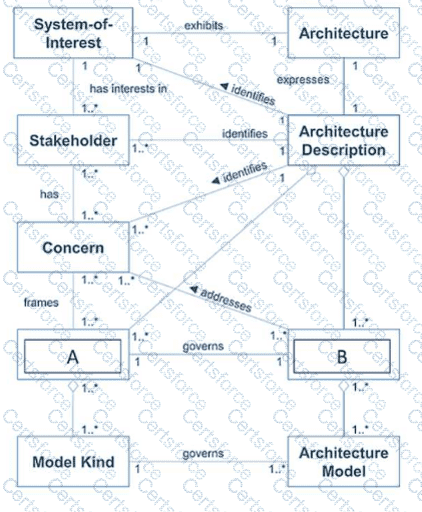
Complete the sentence: Item A ____________, while item B ____________.
