
Summer Certification Special Limited Time 70% Discount Offer - Ends in 0d 00h 00m 00s - Coupon code: force70

Pass the The Open Group Enterprise Architecture OGEA-103 Questions and answers with CertsForce

Viewing page 6 out of 6 pages
Viewing questions 51-60 out of questions
Questions # 51:

Consider the description.

The typical contents of the assessment include: an overview of project progress and status and project architecture/design.

Which form of assessment is described?

Options:

A.

Organizational


B.

Capability


C.

Risk


D.

Compliance


Expert Solution
Questions # 52:

Which of the following are the four purposes that typically frame the planning horizon, depth and breadth of an Architecture Project, and the contents of the EA Repository-?

Options:

A.

General Foundational Subordinate and Superior Architecture


B.

Segment, Capability. Enterprise and End-to-end Target Architecture


C.

Avant-Garde Big-Bang, Discreet and Cohesive


D.

Strategy Portfolio Project Solution Delivery


Expert Solution
Questions # 53:

Complete the sentence. ______ can be used to explain how generic solutions can be leveraged and specialized to meet the needs of an organization.

Options:

A.

The Architecture Repository


B.

The Solutions Landscape


C.

The TOGAF ADM


D.

The Enterprise Continuum


Expert Solution
Questions # 54:

Full Question:

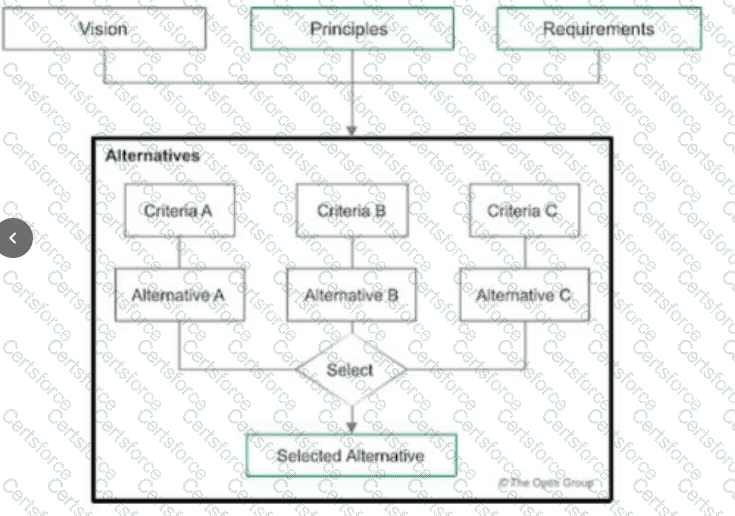
Consider the graphic from the TOGAF Standard.
Question # 54

The graphic shows Vision , Principles , and Requirements feeding into a set of Alternatives . Each alternative is evaluated against Criteria A , Criteria B , and Criteria C . A Select step is then performed, resulting in a Selected Alternative .

What does this illustrate?

Options:

A.

Iteration


B.

The Business Scenario method


C.

Architecture Partitioning


D.

The Architecture Trade-off method


Expert Solution
Questions # 55:

Please read this scenario prior to answering the question

You are the Lead Enterprise Architect at a major agribusiness company. The company ' s main

annual harvest is lentils, a highly valued food grown worldwide. The lentil parasite, broomrape,

has been an increasing concern for many years and is now becoming resistant to chemical

controls. In addition, changes in climate favor the propagation and growth of the parasite. As a

result, the parasite cannot realistically be exterminated, and it has become pandemic, with lentil

yields falling globally.

The CEO appreciates the seriousness of the situation and has set out a change in direction

that is effectively a new business for the company. There are opportunities for new products,

and new markets. The company will use the fields for another harvest and will cease to process

third-party lentils. Thus, the target market will change, and the end-products will be different

and more varied. This is a major decision and the CEO has stated a desire to repurpose rather

than replace so as to manage the risks and limit the costs.

The company has a mature Enterprise Architecture practice based in its headquarters and uses

the TOGAF standard as the method and guiding framework. The practice has an established

Architecture Capability, and uses iteration for architecture development. The CIO is the sponsor

of the activity.

The CIO has assigned the Enterprise Architecture team to this activity. At this stage there is no

shared vision, or requirements.

Refer to the scenario

You have been asked to propose the best approach for architecture development to realize the

CEO ' s change in direction for the company.

Based on the TOGAF standard which of the following is the best answer?

Options:

A.

You propose that the team focus on architecture definition, with emphasis on definingthe change parameters to support this new business strategy that the CEO hasidentified. Once understood, the team will be in the best position to identify therequirements, drivers, issues, and constraints for the change. You would ensure that thearchitecture development addresses non-functional requirements to assure that thetarget architecture is robust an


B.

You propose that this engagement define the baseline Technology Architecture first inorder to assess the current infrastructure capacity and capability for the company. Thenthe focus should be on transition planning and incremental architecture deployment.This will identify requirements to ensure that the projects are sequenced in an optimalfashion so as to realize the change.


C.

You propose that the priority is to understand and bring structure to the definition of thechange. The team should focus iteration cycles on a baseline first approach toarchitecture development, and then transition planning. This will identify what needs tochange in order to transition from the baseline to the target, and can be used to work outin detail what the shared vision is for the change.


D.

You propose that the team focus its iteration cycles on architecture development bygoing through the architecture definition phases (B-D) with a baseline first approach.This will support the change in direction as stated by the CEO. It will ensure that thechange can be defined in a structured manner and address the requirements needed torealize the change.


Expert Solution
Questions # 56:

Please read this scenario prior to answering the question.

You are employed as an Enterprise Architect for a company that is an international supplier of manufacturing systems.

The company has multiple manufacturing plants where it assembles both standard and customized products for industrial production automation. Each of these plants has been operating its own planning and production scheduling systems, as well as applications and control systems that drive the automated production line. The current systems work with the local partners in the supply chain at each plant.

The company has been facing competition in the marketplace and its leadership has been considering how to improve production efficiency. A favored proposal is to replace many of the systems with a centralized system communicating with the manufacturing plants. The CIO has asked the EA team to develop an architecture for this approach that supports both standardized and customized production across multiple manufacturing plants, while maintaining enterprise-wide integration and governance.

The company has an Enterprise Architecture (EA) practice and uses the TOGAF standard as the basis for its work. It has been running for many years and has established governance and development processes for EA. The Chief Information Officer (CIO) sponsors the Enterprise Architecture program. You are part of an Enterprise Architecture (EA) team that has responsibilities across the company.

As a supplier of manufacturing systems with multiple plants, there are many interested parties that will need to be satisfied.

The Architecture Board has approved the Request for Architecture Work to find out if such an architecture transformation would lead to efficiency improvements.

Question:

Refer to the scenario.

You have been assigned to lead this project and asked to outline your next steps.

Based on the TOGAF standard, which of the following is the best answer?

Options:

A.

You would conduct a series of workshops with the local partners to gather requirements from them. Based on the findings from the workshops, you would define a preliminary Architecture Vision including summary views, high-level requirements, and high-level definitions of the baseline and target environments from a business, information systems, and technology perspective. You would then use the Architecture Vision to build agre


B.

You would run a proof-of-concept project to allow your suppliers to demonstrate candidate off-the-shelf solutions that address the concerns of the stakeholders. After looking at the results of the project, you would select the most efficient solution and use that to set the requirements. Once the requirements are complete, there should be a formal stakeholder review, and permission requested to move forward to develop the Targ


C.

You would run multiple workshops at the manufacturing plants to discover and document business requirements. This would also help you understand the location-specific problems and identify the actors and roles at each location. You would create a matrix of stakeholders to identify key people involved and their concerns. You would then determine and record the main stakeholder requirements for the architecture. Finally, you wou


D.

You would create high-level views of the baseline and target Architectures for each manufacturing plant, and then a set of views corresponding to selected viewpoints to address key concerns of the stakeholders. The gap analysis results for the architectures should be reviewed and consolidated into a single list. A set of work packages should be identified. A formal stakeholder review should be held to obtain approval before m


Expert Solution
Questions # 57:

Full Question:

Which of the following best describes the TOGAF Architecture Development Method?

Options:

A.

A classification mechanism for architectures and solutions.


B.

A process for managing architecture requirements.


C.

A technique to assess readiness for change.


D.

A repeatable process for developing architectures.


Expert Solution
Questions # 58:

Which of the following best describes the purpose of the Architecture Requirements Specification?

Options:

A.

It contains an assessment of the current architecture requirements


B.

It provides a set of statements that outline what a project must do to comply with the architecture


C.

It is sent from the sponsor and triggers the start of an architecture development cycle


D.

It defines the scope and approach to complete an architecture project


Expert Solution
Questions # 59:

Which of the following are two of the architecture domains that are considered as subsets of an overall Enterprise Architecture?

Options:

A.

Strategy, Enterprise


B.

Vision, Target


C.

Technology, Digital


D.

Business, Technology


Expert Solution
Questions # 60:

Full Question:

How does an Enterprise Metamodel provide value?

Options:

A.

It leverages reference material for the creation of new architectures.


B.

It forms an architecture completeness-check for use in an enterprise.


C.

It identifies candidate architecture roadmap components by analyzing gaps.


D.

It defines parameters, structures, and processes that support governance.


Expert Solution
Viewing page 6 out of 6 pages
Viewing questions 51-60 out of questions