
Pre-Winter Sale Limited Time 65% Discount Offer - Ends in 0d 00h 00m 00s - Coupon code: pass65

Pass the NAHQ CPHQ Certification CPHQ Questions and answers with CertsForce

Viewing page 9 out of 17 pages
Viewing questions 121-135 out of questions
Questions # 121:

An organization with a focus on population health may use data to

Options:

A.

Identify high-risk low-volume processes


B.

Determine the voice of the customer


C.

Determine high cost procedures


D.

Identify high-risk patients


Expert Solution
Questions # 122:

A provider’s Ongoing Professional Practice Evaluation (OPPE) profile is shown below. In this organization, if a provider partially meets or does not meet performance expectations, they are referred to peer review for a Focused Professional Practice Evaluation (FPPE).

Fully Meets: >80% of measures at threshold

Meets: 65% to 80% of measures at threshold

Partially Meets: 40% to 64% of measures threshold

Does Not Meet: <40% of measures at threshold

After reviewing this provider’s overall profile, what should the healthcare quality professional suggest?

Options:

A.

The provider fully meets expectations; do nothing.


B.

The provider does not meet expectations; refer to peer review.


C.

The provider partially meets expectations; retain privileges.


D.

The provider meets expectations; retain privileges.


Expert Solution
Questions # 123:

The chart shown below is created for a project:

    Task 1 → Task 3 (5 days, then 10 days)

    Task 2 → Task 4 (10 days, then 8 days)

    Task 5 → Task 6 (2 days, then 1 day)

What is the minimum number of days to complete the project?

Options:

A.

15


B.

25


C.

35


D.

36


Expert Solution
Questions # 124:

A pharmacy staff member informs a healthcare quality professional that use of a particularly expensive drug has been increasing over the past six months. Which of the following is the next best step?

Options:

A.

Collect data related to the administration and monitoring of the effects of this drug


B.

Recommend peer reviews of prescribing practitioners


C.

Continue to monitor the pharmacy data for an additional six months


D.

Collect data related to the prescribing and dispensing patterns for this drug


Expert Solution
Questions # 125:

A provider requests to see the peer review file on another provider in their department. What is the healthcare quality professional’s most appropriate response?

Options:

A.

Inform them the file cannot be shared and notify the appropriate personnel.


B.

Inquire what they would like to see in the file and disclose only that information.


C.

Provide them the copy of the file to review since they are a provider in their department.


D.

Ask them to obtain written permission from the provider to review the file.


Expert Solution
Questions # 126:

A continuous quality improvement team has proposed a major change in the billing process for home health service. Staff acceptance of the change is best facilitated by:

Options:

A.

Immediate implementation


B.

Medical staff education


C.

Long-range planning


D.

A pilot project


Expert Solution
Questions # 127:

Each provider in a primary care practice has the potential of earning a $20,000 bonus based on individual performance on select Healthcare Effectiveness Data and Information Set (HEDIS) indicators.

Indicator

Percent of Bonus

Target

Breast Cancer Screening (BCS)

25%

≥74%

Controlling High Blood Pressure (CBP)

25%

≥72%

Childhood Immunization Status (CIS)

50%

≥63%

Provider performance:

Provider

BCS

CBP

CIS

A

75%

71%

63%

B

77%

69%

65%

C

79%

73%

64%

D

73%

74%

62%

Which of the following conclusions is accurate?

Options:

A.

Provider D earned a $15,000 bonus.


B.

Provider B earned the lowest bonus.


C.

Provider A earned a $10,000 bonus.


D.

Provider C earned the highest bonus.


Expert Solution
Questions # 128:

After in-depth data analysis, there is evidence of overutilization of computerized tomography to diagnose acute appendicitis. A team has been formed to develop a performance improvement plan for emergency department physicians. Which of the following leadership styles is most effective to implement best practice guidelines?

Options:

A.

Laissez-faire


B.

Autocratic


C.

Participatory


D.

Democratic


Expert Solution
Questions # 129:

A healthcare quality professional works in a primary care setting and has been asked to develop a patient safety program. The first step in program development is to

Options:

A.

complete a literature search.


B.

survey patients.


C.

visit similar organizations.


D.

define the scope.


Expert Solution
Questions # 130:

The main goal of a clinical pathway/guideline Is lo

Options:

A.

assist in documentation of care.


B.

document practitioner variances.


C.

guide the patient's care toward identified outcomes.


D.

ensure precise treatment plans are followed.


Expert Solution
Questions # 131:

The initial step in clinical pathway development is review of

Options:

A.

patient education materials.


B.

continuous quality improvement methods.


C.

data for targeted population.


D.

provider input.


Expert Solution
Questions # 132:

An initial step to address health disparities within a population is to:

Options:

A.

Expand the collection and standardization of health equity data.


B.

Create dashboards to visualize gaps in health equity.


C.

Increase accessibility to healthcare services for all equally.


D.

Engage with community leaders and identify available resources.


Expert Solution
Questions # 133:

Which of the following is the most proactive approach to quality improvement?

Options:

A.

Plan-Do-Study-Act


B.

fishbone diagram


C.

failure mode and effects analysis (FMEA)


D.

root cause analysis (RCA)


Expert Solution
Questions # 134:

An orthopedic surgeon performed surgery on the wrong finger. After the case, the surgeon took full responsibility, disclosed the error to the patient, and discussed the event with the Chief of Surgery. The Chief of Surgery believed the error occurred because the splint was not removed for preoperative site marking. The surgeon stated, “I have learned from the situation and will never repeat it.” Neither believed further analysis or action was needed. The healthcare quality professional should conclude that:

Options:

A.

No one was harmed and the surgeon’s accountability was consistent with just culture.


B.

The Chief of Surgery demonstrated hindsight bias and minimized the situation.


C.

Rapid identification of the root cause and learning dispersion reflected the approaching stage of high reliability.


D.

The patient disclosure and discussion with the Chief of Surgery potentiate litigation risk.


Expert Solution
Questions # 135:

Analysis of the following wound infection rate control chart shows which of the following?
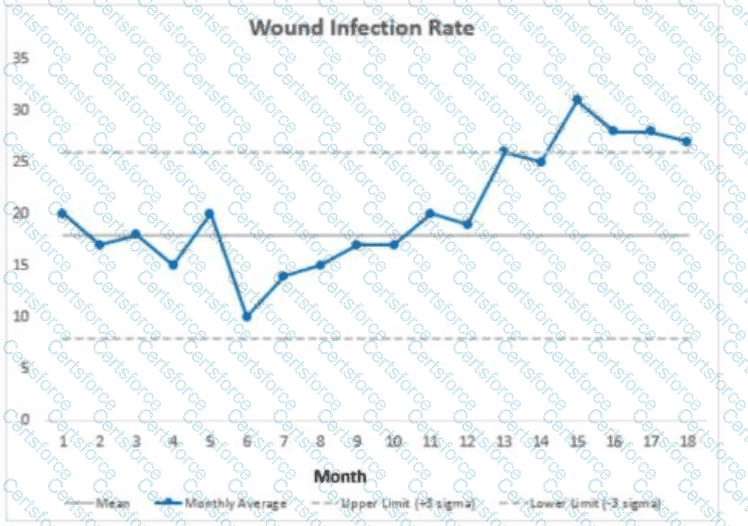
Question # 135

Options:

A.

The variations represent chance events, not collectable sources of variation.


B.

The wound infection rate is under control and should be allowed to continue.


C.

The variations represent a common cause that is inherent in the system.


D.

The wound infection rate is out of control and evaluation is needed.


Expert Solution
Viewing page 9 out of 17 pages
Viewing questions 121-135 out of questions
