New Year Sale Limited Time 70% Discount Offer - Ends in 0d 00h 00m 00s - Coupon code: simple70

Pass the MuleSoft MuleSoft Certified Platform Architect MCPA-Level-1 Questions and answers with CertsForce

Viewing page 4 out of 5 pages
Viewing questions 31-40 out of questions
Questions # 31:

An operations team is analyzing the effort needed to set up monitoring of their application network. They are looking at which API invocation metrics can be used to identify and predict trouble without having to write custom scripts or install additional analytics software or tools.

Which type of metrics can satisfy this goal of directly identifying and predicting failures?

Options:

A.

The number and types of API policy violations per day


B.

The effectiveness of the application network based on the level of reuse


C.

The number and types of past API invocations across the application network


D.

The ROI from each APT invocation


Expert Solution
Questions # 32:

An organization is deploying their new implementation of the OrderStatus System API to multiple workers in CloudHub. This API fronts the organization's on-premises Order Management System, which is accessed by the API implementation over an IPsec tunnel.

What type of error typically does NOT result in a service outage of the OrderStatus System API?

Options:

A.

A CloudHub worker fails with an out-of-memory exception


B.

API Manager has an extended outage during the initial deployment of the API implementation


C.

The AWS region goes offline with a major network failure to the relevant AWS data centers


D.

The Order Management System is Inaccessible due to a network outage in the organization's on-premises data center


Expert Solution
Questions # 33:

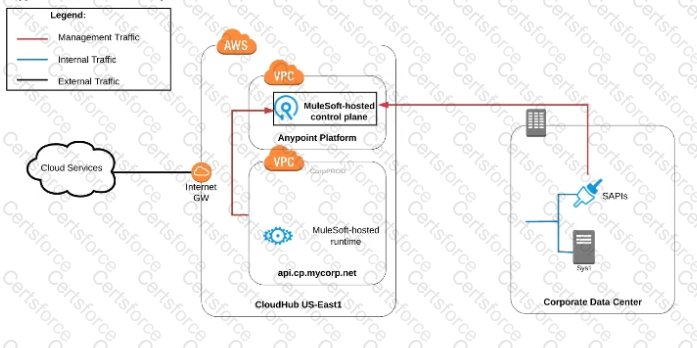
An organization uses various cloud-based SaaS systems and multiple on-premises systems. The on-premises systems are an important part of the organization's application network and can only be accessed from within the organization's intranet.

What is the best way to configure and use Anypoint Platform to support integrations with both the cloud-based SaaS systems and on-premises systems?

A) Use CloudHub-deployed Mule runtimes in an Anypoint VPC managed by Anypoint Platform Private Cloud Edition control plane

B) Use CloudHub-deployed Mule runtimes in the shared worker cloud managed by the MuleSoft-hosted Anypoint Platform control plane

C) Use an on-premises installation of Mule runtimes that are completely isolated with NO external network access, managed by the Anypoint Platform Private Cloud Edition control plane

D) Use a combination of Cloud Hub-deployed and manually provisioned on-premises Mule runtimes managed by the MuleSoft-hosted Anypoint Platform control plane
Question # 33

Options:

A.

Option A


B.

Option B


C.

Option C


D.

Option D


Expert Solution
Questions # 34:

What is true about automating interactions with Anypoint Platform using tools such as Anypoint Platform REST APIs, Anypoint CU, or the Mule Maven plugin?

Options:

A.

Access to Anypoint Platform APIs and Anypoint CU can be controlled separately through the roles and permissions in Anypoint Platform, so that specific users can get access to Anypoint CLI white others get access to the platform APIs


B.

Anypoint Platform APIs can ONLY automate interactions with CloudHub, while the Mule Maven plugin is required for deployment to customer-hosted Mule runtimes


C.

By default, the Anypoint CLI and Mule Maven plugin are NOT included in the Mule runtime, so are NOT available to be used by deployed Mule applications


D.

API policies can be applied to the Anypoint Platform APIs so that ONLY certain LOBs have access to specific functions


Expert Solution
Questions # 35:

An API client calls one method from an existing API implementation. The API implementation is later updated. What change to the API implementation would require the API client's invocation logic to also be updated?

Options:

A.

When the data type of the response is changed for the method called by the API client


B.

When a new method is added to the resource used by the API client


C.

When a new required field is added to the method called by the API client


D.

When a child method is added to the method called by the API client


Expert Solution
Questions # 36:

The asset version 2.0.0 of the Order API is successfully published in Exchange and configured in API Manager with the Autodiscovery API ID correctly linked to the

API implementation, A new GET method is added to the existing API specification, and after updates, the asset version of the Order API is 2.0.1,

What happens to the Autodiscovery API ID when the new asset version is updated in API Manager?

Options:

A.

The API ID changes, but no changes are needed to the API implementation for the new asset version in the API Autediscovery global element because the API ID is automatically updated


B.

The APL ID changes, so the API implementation must be updated with the latest API ID for the new asset version in the API Autodiscovery global element


C.

The APLID does not change, so no changes to the APT implementation are needed for the new asset version in the API Autodiscovery global element


D.

The APL ID does not change, but the API implementation must be updated in the AP] Autodiscovery global element to indicate the new asset version 2.0.4


Expert Solution
Questions # 37:

A company uses a hybrid Anypoint Platform deployment model that combines the EU control plane with customer-hosted Mule runtimes. After successfully testing a Mule API implementation in the Staging environment, the Mule API implementation is set with environment-specific properties and must be promoted to the Production environment. What is a way that MuleSoft recommends to configure the Mule API implementation and automate its promotion to the Production environment?

Options:

A.

Bundle properties files for each environment into the Mule API implementation's deployable archive, then promote the Mule API implementation to the Production environment using Anypoint CLI or the Anypoint Platform REST APIsB.


B.

Modify the Mule API implementation's properties in the API Manager Properties tab, then promote the Mule API implementation to the Production environment using API Manager


C.

Modify the Mule API implementation's properties in Anypoint Exchange, then promote the Mule API implementation to the Production environment using Runtime Manager


D.

Use an API policy to change properties in the Mule API implementation deployed to the Staging environment and another API policy to deploy the Mule API implementation to the Production environment


Expert Solution
Questions # 38:

An API implementation is deployed to CloudHub.

What conditions can be alerted on using the default Anypoint Platform functionality, where the alert conditions depend on the API invocations to an API implementation?

Options:

A.

When the API invocations are sent directly to the internal DNS record of the API implementation


B.

When the API invocations are not over-a- secure TLS/SSL communication channel


C.

When the APL invecations originate from a geography different than the API


D.

When the number of API invocations are below a threshold


Expert Solution
Questions # 39:

An auto manufacturer has a mature CI/CD practice and wants to automate packaging and deployment of any Mule applications to various deployment targets, including CloudHub workers/replicas, customer-hosted Mule runtimes, and Anypoint Runtime Fabric.

Which MuleSoft-provided tool or component facilitates automating the packaging and deployment of Mule applications to various deployment targets as part of the company's

CI/CD practice?

Options:

A.

Anypoint Runtime Manager


B.

Mule Maven plugin


C.

Anypoint Platform CLI


D.

Anypoint Platform REST APIs


Expert Solution
Questions # 40:

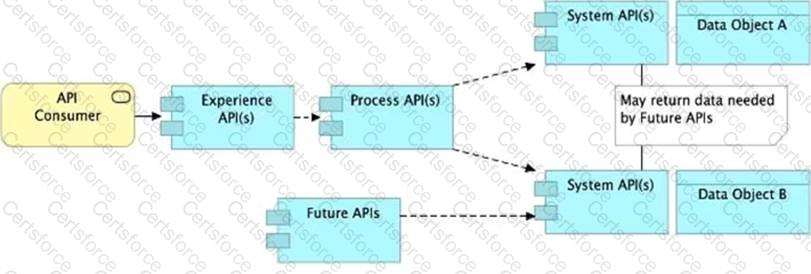
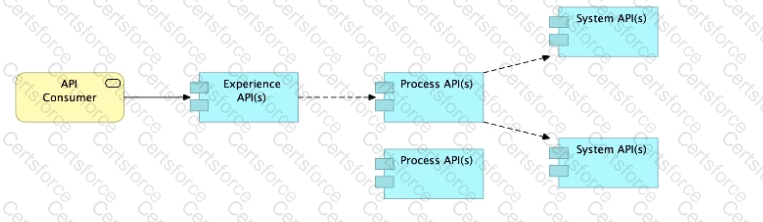
Refer to the exhibit.

What is the best way to decompose one end-to-end business process into a collaboration of Experience, Process, and System APIs?

A) Handle customizations for the end-user application at the Process API level rather than the Experience API level

B) Allow System APIs to return data that is NOT currently required by the identified Process or Experience APIs

C) Always use a tiered approach by creating exactly one API for each of the 3 layers (Experience, Process and System APIs)

D) Use a Process API to orchestrate calls to multiple System APIs, but NOT to other Process APIs
Question # 40

Options:

A.

Option A


B.

Option B


C.

Option C


D.

Option D


Expert Solution
Viewing page 4 out of 5 pages
Viewing questions 31-40 out of questions