
New Year Sale Limited Time 70% Discount Offer - Ends in 0d 00h 00m 00s - Coupon code: simple70

Pass the MuleSoft MuleSoft Certified Platform Architect MCPA-Level-1 Questions and answers with CertsForce

Viewing page 1 out of 5 pages
Viewing questions 1-10 out of questions
Questions # 1:

A company is building an application network using MuleSoft's recommendations for various API layers.

What is the main (default) role of a process API in an application network?

Options:

A.

To secure and optimize the data synchronization processing of large data dumps between back-end systems


B.

To manage and process the secure direct communication between a back-end system and an end-user client of mobile device in the application network


C.

To automate parts of business processes by coordinating and orchestrating the invocation of other APIs in the application network


D.

To secure, Manage, and process communication with specific types of end-user client applications or devices in the application network


Expert Solution
Questions # 2:

What should be ensured before sharing an API through a public Anypoint Exchange portal?

Options:

A.

The visibility level of the API instances of that API that need to be publicly accessible should be set to public visibility


B.

The users needing access to the API should be added to the appropriate role in Anypoint Platform


C.

The API should be functional with at least an initial implementation deployed and accessible for users to interact with


D.

The API should be secured using one of the supported authentication/authorization mechanisms to ensure that data is not compromised


Expert Solution
Questions # 3:

Version 3.0.1 of a REST API implementation represents time values in PST time using ISO 8601 hh:mm:ss format. The API implementation needs to be changed to instead represent time values in CEST time using ISO 8601 hh:mm:ss format. When following the semver.org semantic versioning specification, what version should be assigned to the updated API implementation?

Options:

A.

3.0.2


B.

4.0.0


C.

3.1.0


D.

3.0.1


Expert Solution
Questions # 4:

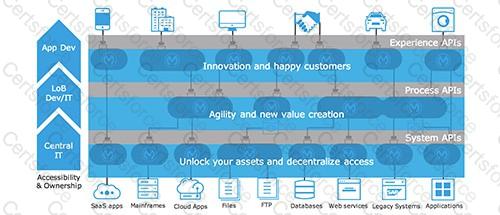
Select the correct Owner-Layer combinations from below options

Options:

A.

1. App Developers owns and focuses on Experience Layer APIs

2. Central IT owns and focuses on Process Layer APIs

3. LOB IT owns and focuses on System Layer APIs


B.

1. Central IT owns and focuses on Experience Layer APIs

2. LOB IT owns and focuses on Process Layer APIs

3. App Developers owns and focuses on System Layer APIs


C.

1. App Developers owns and focuses on Experience Layer APIs

2. LOB IT owns and focuses on Process Layer APIs

3. Central IT owns and focuses on System Layer APIs


Expert Solution
Questions # 5:

An API implementation is updated. When must the RAML definition of the API also be updated?

Options:

A.

When the API implementation changes the structure of the request or response messages


B.

When the API implementation changes from interacting with a legacy backend system deployed on-premises to a modern, cloud-based (SaaS) system


C.

When the API implementation is migrated from an older to a newer version of the Mule runtime


D.

When the API implementation is optimized to improve its average response time


Expert Solution
Questions # 6:

A team is planning to enhance an Experience API specification, and they are following API-led connectivity design principles.

What is their motivation for enhancing the API?

Options:

A.

The primary API consumer wants certain kinds of endpoints changed from the Center for Enablement standard to the consumer system standard


B.

The underlying System API is updated to provide more detailed data for several heavily used resources


C.

An IP Allowlist policy is being added to the API instances in the Development and Staging environments


D.

A Canonical Data Model is being adopted that impacts several types of data included in the API


Expert Solution
Questions # 7:

A company deployed an API to a single worker/replica in the shared cloud in the U.S. West Region.

What happens when the Availability Zone experiences an outage?

Options:

A.

CloudHub will auto-redeploy the APL in the U.S. East Region


B.

The APT will be unavailable until the availability comes back online, at which time the worker/replica will be auto-restarted


C.

CloudHub will auto-redeploy the API in another Availability Zone in the U.S. West Region


D.

The Anypoint Platform admin is alerted when the AP] is experiencing an outage and needs the trigger the CI/CD pipeline to redeploy to the US. East Region


Expert Solution
Questions # 8:

A system API has a guaranteed SLA of 100 ms per request. The system API is deployed to a primary environment as well as to a disaster recovery (DR) environment, with different DNS names in each environment. An upstream process API invokes the system API and the main goal of this process API is to respond to client requests in the least possible time. In what order should the system APIs be invoked, and what changes should be made in order to speed up the response time for requests from the process API?

Options:

A.

In parallel, invoke the system API deployed to the primary environment and the system API deployed to the DR environment, and ONLY use the first response


B.

In parallel, invoke the system API deployed to the primary environment and the system API deployed to the DR environment using a scatter-gather configured with a timeout, and then merge the responses


C.

Invoke the system API deployed to the primary environment, and if it fails, invoke the system API deployed to the DR environment


D.

Invoke ONLY the system API deployed to the primary environment, and add timeout and retry logic to avoid intermittent failures


Expert Solution
Questions # 9:

Which statement is true about Spike Control policy and Rate Limiting policy?

Options:

A.

All requests are rejected after the limit is reached in Rate Limiting policy, whereas the requests are queued in Spike Control policy after the limit is reached


B.

In a clustered environment, the Rate Limiting.and Spike Control policies are applied to each node in the cluster


C.

To protect Experience APIs by limiting resource consumption, Rate Limiting policy must be applied


D.

In order to apply Rate Limiting and Spike Control policies, a contract to bind client application and API is needed for both


Expert Solution
Questions # 10:

How are an API implementation, API client, and API consumer combined to invoke and process an API?

Options:

A.

The API consumer creates an API implementation, which receives API invocations from an API such that they are processed for an API client


B.

The API client creates an API consumer, which receives API invocations from an API such that they are processed for an API implementation


C.

The ApI consumer creates an API client, which sends API invocations to an API such that they are processed by an API implementation


D.

The ApI client creates an API consumer, which sends API invocations to an API such that they are processed by an API implementation


Expert Solution
Viewing page 1 out of 5 pages
Viewing questions 1-10 out of questions