Traffic is routed through an API proxy to an API implementation. The API proxy is managed by API Manager and the API implementation is deployed to a CloudHub VPC using Runtime Manager. API policies have been applied to this API. In this deployment scenario, at what point are the API policies enforced on incoming API client requests?
An API implementation is deployed to CloudHub.
What conditions can be alerted on using the default Anypoint Platform functionality, where the alert conditions depend on the end-to-end request processing of the API implementation?
A Rate Limiting policy is applied to an API implementation to protect the back-end system. Recently, there have been surges in demand that cause some API client
POST requests to the API implementation to be rejected with policy-related errors, causing delays and complications to the API clients.
How should the API policies that are applied to the API implementation be changed to reduce the frequency of errors returned to API clients, while still protecting the back-end
system?
A customer has an ELA contract with MuleSoft. An API deployed to CloudHub is consistently experiencing performance issues. Based on the root cause analysis, it is
determined that autoscaling needs to be applied.
How can this be achieved?
An Anypoint Platform organization has been configured with an external identity provider (IdP) for identity management and client management. What credentials or token must be provided to Anypoint CLI to execute commands against the Anypoint Platform APIs?
When could the API data model of a System API reasonably mimic the data model exposed by the corresponding backend system, with minimal improvements over the backend system's data model?
An organization wants to create a Center for Enablement (C4E). The IT director schedules a series of meetings with IT senior managers.
What should be on the agenda of the first meeting?
A company wants to move its Mule API implementations into production as quickly as possible. To protect access to all Mule application data and metadata, the company requires that all Mule applications be deployed to the company's customer-hosted infrastructure within the corporate firewall. What combination of runtime plane and control plane options meets these project lifecycle goals?
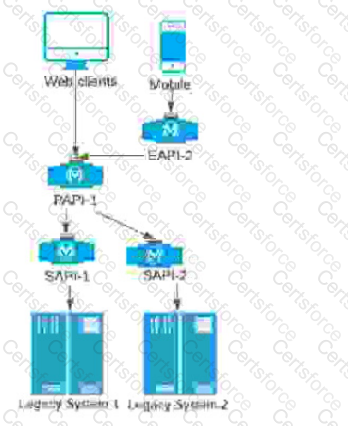
A company stores financial transaction data in two legacy systems. For each legacy system, a separate, dedicated System API (SAPI) exposes data for that legacy system. A Process API (PAPI) merges the data retrieved from ail of the System APIs into a common format. Several API clients call the PAPI through its public domain name.
The company now wants to expose a subset of financial data to a newly developed mobile application that uses a different Bounded Context Data Model. The company wants to follow MuleSoft's best practices for building out an effective application network.
Following MuleSoft's best practices, how can the company expose financial data needed by the mobile application in a way that minimizes the impact on the currently running API clients, API implementations, and support asset reuse?
Add two new Experience APIs (EAPI-i and EAPI-2}.
Add Mobile PAPI-2 to expose the Intended subset of financial data as requested.
Both PAPIs access the Legacy Systems via SAPI-1 and SAP]-2.
Add two new Experience APIs (EAPI-i and EAPI-2}.
Add Mobile PAPI-2 to expose the Intended subset of financial data as requested.
Both PAPIs access the Legacy Systems via SAPI-1 and SAP]-2.
Create a new mobile Experince API (EAPI) chat exposes that subset of PAPI endpoints.
Add transformtion login to the mobile Experince API implementation to make mobile data compatible with the required PAPIs.
Develop and deploy is new PAPI implementation with data transformation and ... login to support this required endpoints of both mobile and web clients.
Deploy an API Proxy with an endpoint from API Manager that redirect the existing PAPI endpoints to the new PAPI.
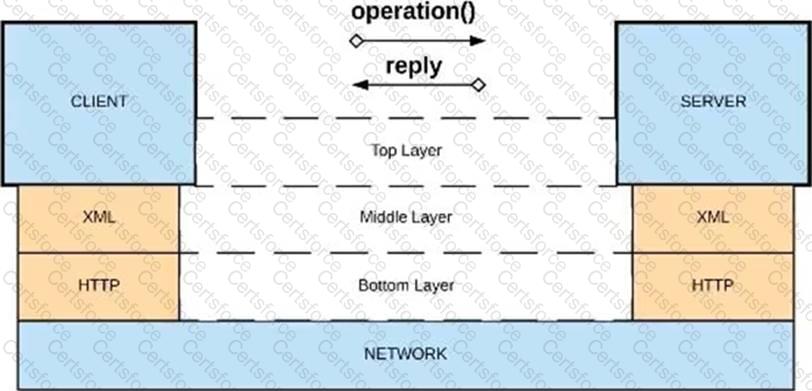
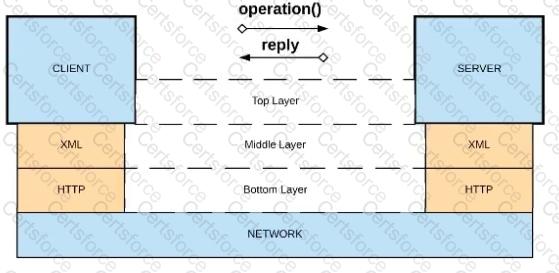
Refer to the exhibit.
What is a valid API in the sense of API-led connectivity and application networks?
A) Java RMI over TCP
B) Java RMI over TCP
C) CORBA over HOP
D) XML over UDP