
Winter Sale Limited Time 65% Discount Offer - Ends in 0d 00h 00m 00s - Coupon code: pass65

Pass the MuleSoft MuleSoft Certified Architect MCIA-Level-1 Questions and answers with CertsForce

Viewing page 4 out of 9 pages
Viewing questions 31-40 out of questions
Questions # 31:

A developer needs to discover which API specifications have been created within the organization before starting a new project.

Which Anypoint Platform component can the developer use to find and try out the currently released API specifications?

Options:

A.

Anypoint Exchange


B.

Runtime Manager


C.

API Manager


D.

Object Store


Expert Solution
Questions # 32:

An ABC Farms project team is planning to build a new API that is required to work with data from different domains across the organization.

The organization has a policy that all project teams should leverage existing investments by reusing existing APIs and related resources and documentation that other project teams have already developed and deployed.

To support reuse, where on Anypoint Platform should the project team go to discover and read existing APIs, discover related resources and documentation, and interact with mocked versions of those APIs?

Options:

A.

Design Center


B.

API Manager


C.

Runtime Manager


D.

Anypoint Exchange


Expert Solution
Questions # 33:

An organization plans to migrate all its Mule applications to Runtime Fabric (RTF). Currently, all Mule applications have been deployed to CloudHub using automated CI/CD scripts.

What steps should be taken to properly migrate the applications from CloudHub to RTF, while keeping the same automated CI/CD deployment strategy?

Options:

A.

A runtimefabric dependency should be added as a mule-plugin to the pom.xml file in all the Mule applications.


B.

runtimeFabric command-line parameter should be added to the CI/CD deployment scripts.


C.

A runtimefFabricDeployment profile should be added to Mule configuration properties YAML files in all the Mule applications.

CI/CD scripts must be modified to use the new configuration properties.


D.

runtimefabricDeployment profile should be added to the pom.xml file in all the Mule applications. CI/CD scripts must be modified to use the new RTF profile.


E.

- The pom.xml and Mule configuration YAML files can remain unchanged in each Mule application.

A --runtimeFabric command-line parameter should be added to the CI/CD deployment scripts


Expert Solution
Questions # 34:

An organization is designing Mule application which connects to a legacy backend. It has been reported that backend services are not highly available and experience downtime quite often. As an integration architect which of the below approach you would propose to achieve high reliability goals?

Options:

A.

Alerts can be configured in Mule runtime so that backend team can be communicated when services are down


B.

Until Successful scope can be implemented while calling backend API's


C.

On Error Continue scope to be used to call in case of error again


D.

Create a batch job with all requests being sent to backend using that job as per the availability of backend API's


Expert Solution
Questions # 35:

An integration team follows MuleSoft’s recommended approach to full lifecycle API development.

Which activity should this team perform during the API implementation phase?

Options:

A.

Validate the API specification


B.

Use the API specification to build the MuleSoft application


C.

Design the API specification


D.

Use the API specification to monitor the MuleSoft application


Expert Solution
Questions # 36:

A developer is examining the responses from a RESTful web service that is compliant with the Mypertext Transfer Protocol (HTTP/1.1) a8 defined by the Internet Engineering Task Force (IETF).

In this HTTP/1.1-compliant web service, which class of HTTP response status codes should be specified to indicate when client requests are successfully received, understood, and accepted by the web service?

Options:

A.

3xx


B.

2xx


C.

4xx


D.

5xx


Expert Solution
Questions # 37:

A mule application must periodically process a large dataset which varies from 6 GB lo 8 GB from a back-end database and write transform data lo an FTPS server using a properly configured bad job scope.

The performance requirements of an application are approved to run in the cloud hub 0.2 vCore with 8 GB storage capacity and currency requirements are met.

How can the high rate of records be effectively managed in this application?

Options:

A.

Use streaming with a file storage repeatable strategy for reading records from the database and batch aggregator with streaming to write to FTPS


B.

Use streaming with an in-memory reputable store strategy for reading records from the database and batch aggregator with streaming to write to FTPS


C.

Use streaming with a file store repeatable strategy for reading records from the database and batch aggregator with an optimal size


D.

Use streaming with a file store repeatable strategy reading records from the database and batch aggregator without any required configuration


Expert Solution
Questions # 38:

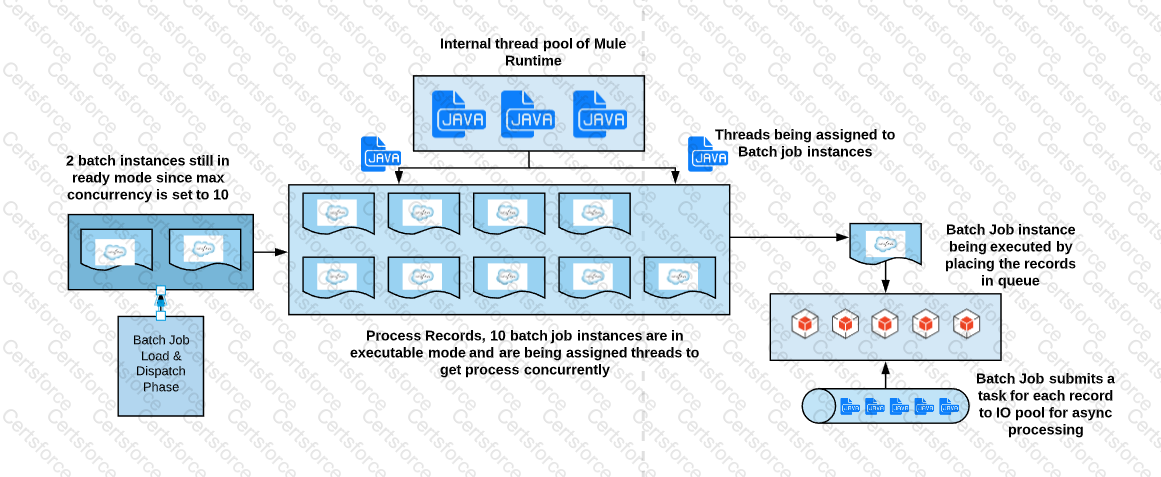
A Mule application contains a Batch Job with two Batch Steps (Batch_Step_l and Batch_Step_2). A payload with 1000 records is received by the Batch Job.

How many threads are used by the Batch Job to process records, and how does each Batch Step process records within the Batch Job?

Options:

A.

Each Batch Job uses SEVERAL THREADS for the Batch Steps Each Batch Step instance receives ONE record at a time as the payload, and RECORDS are processed IN PARALLEL within and between the two Batch Steps


B.

Each Batch Job uses a SINGLE THREAD for all Batch steps Each Batch step instance receives ONE record at a time as the payload, and RECORDS are processed IN ORDER, first through Batch_Step_l and then through Batch_Step_2


C.

Each Batch Job uses a SINGLE THREAD to process a configured block size of record Each Batch Step instance receives A BLOCK OF records as the payload, and BLOCKS of records are processed IN ORDER


D.

Each Batch Job uses SEVERAL THREADS for the Batch Steps Each Batch Step instance receives ONE record at a time as the payload, and BATCH STEP INSTANCES execute IN PARALLEL to process records and Batch Steps in ANY order as fast as possible


Expert Solution
Questions # 39:

An IT integration delivery team begins a project by gathering all of the requirements, and proceeds to execute the remaining project activities as sequential, non-repeating phases.

Which IT project delivery methodology is this team following?

Options:

A.

Kanban


B.

Scrum


C.

Waterfall


D.

Agile


Expert Solution
Questions # 40:

According to MuleSoft, which major benefit does a Center for Enablement (C4E) provide for an enterprise and its lines of business?

Options:

A.

Enabling Edge security between the lines of business and public devices


B.

Centralizing project management across the lines of business


C.

Centrally managing return on investment (ROI) reporting from lines of business to leadership


D.

Accelerating self-service by the lines of business


Expert Solution
Viewing page 4 out of 9 pages
Viewing questions 31-40 out of questions