Winter Sale Limited Time 65% Discount Offer - Ends in 0d 00h 00m 00s - Coupon code: pass65

Pass the MuleSoft MuleSoft Certified Architect MCIA-Level-1 Questions and answers with CertsForce

Viewing page 7 out of 9 pages
Viewing questions 61-70 out of questions
Questions # 61:

An organization has deployed both Mule and non-Mule API implementations to integrate its customer and order management systems. All the APIs are available to REST clients on the public internet.

The organization wants to monitor these APIs by running health checks: for example, to determine if an API can properly accept and process requests. The organization does not have subscriptions to any external monitoring tools and also does not want to extend its IT footprint.

What Anypoint Platform feature provides the most idiomatic (used for its intended purpose) way to monitor the availability of both the Mule and the non-Mule API implementations?

Options:

A.

API Functional Monitoring


B.

Runtime Manager


C.

API Manager


D.

Anypoint Visualizer


Expert Solution
Questions # 62:

An external API frequently invokes an Employees System API to fetch employee data from a MySQL database. The architect must design a caching strategy to query the database only when there Is an update to the Employees table or else return a cached response in order to minimize the number of redundant transactions being handled by the database.

Options:

A.

Use an On Table Row operation configured with the Employees table, call invalidate cache, and hardcode the new Employees data to cache. Use an object-store-caching-strategy and set the expiration interval to 1 hour.


B.

Use an On Table Row operation configured with the Employees table and cail invalidate cache. Use an object-store-caching-strategy and the default expiration interval.


C.

Use a Scheduler with a fixed frequency set to every hour to trigger an invalidate cache flow. Use an object-store-caching-strategy and the default expiration interval.


D.

Use a Scheduler with a fixed frequency set to every hour, triggering an invalidate cache flow. Use an object-store-caching-strategy and set the expiration interval to 1 hour.


Expert Solution
Questions # 63:

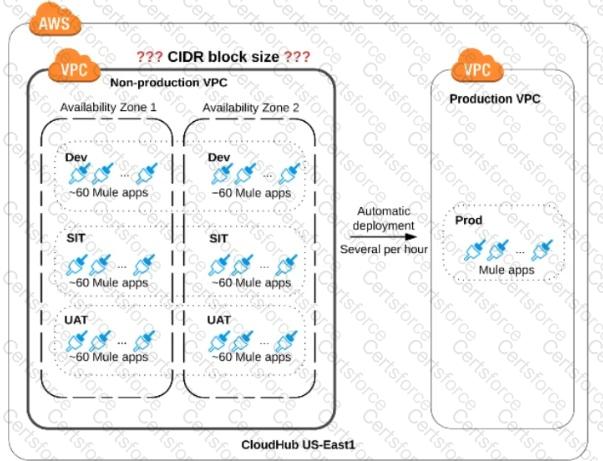
Refer to the exhibit.

Question # 63

An organization is sizing an Anypoint VPC for the non-production deployments of those Mule applications that connect to the organization's on-premises systems. This applies to approx. 60 Mule applications. Each application is deployed to two CloudHub i workers. The organization currently has three non-production environments (DEV, SIT and UAT) that share this VPC. The AWS region of the VPC has two AZs.

The organization has a very mature DevOps approach which automatically progresses each application through all non-production environments before automatically deploying to production. This process results in several Mule application deployments per hour, using CloudHub's normal zero-downtime deployment feature.

What is a CIDR block for this VPC that results in the smallest usable private IP address range?

Options:

A.

10.0.0.0/26 (64 IPS)


B.

10.0.0.0/25 (128 IPs)


C.

10.0.0.0/24 (256 IPs)


D.

10.0.0.0/22 (1024 IPs)


Expert Solution
Questions # 64:

According to MuleSoft, which deployment characteristic applies to a microservices application architecture?

Options:

A.

Services exist as independent deployment artifacts and can be scaled -independently of other services


B.

All services of an application can be deployed together as single Java WAR file


C.

A deployment to enhance one capability requires a redeployment of all capabilities


D.

Core business capabilities are encapsulated in a single, deployable application


Expert Solution
Questions # 65:

What is maximum vCores can be allocated to application deployed to CloudHub?

Options:

A.

1 vCores


B.

2 vCores


C.

4 vCores


D.

16 vCores


Expert Solution
Questions # 66:

An application load balancer routes requests to a RESTful web API secured by Anypoint Flex Gateway.

Which protocol is involved in the communication between the load balancer and the Gateway?

Options:

A.

SFTP


B.

HTTPS


C.

LDAP


D.

SMTP


Expert Solution
Questions # 67:

An organization currently uses a multi-node Mule runtime deployment model within their datacenter, so each Mule runtime hosts several Mule applications. The organization is planning to transition to a deployment model based on Docker containers in a Kubernetes cluster. The organization has already created a standard Docker image containing a Mule runtime and all required dependencies (including a JVM), but excluding the Mule application itself.

What is an expected outcome of this transition to container-based Mule application deployments?

Options:

A.

Required redesign of Mule applications to follow microservice architecture principles


B.

Required migration to the Docker and Kubernetes-based Anypoint Platform - Private Cloud Edition


C.

Required change to the URL endpoints used by clients to send requests to the Mule applications


D.

Guaranteed consistency of execution environments across all deployments of a Mule application


Expert Solution
Questions # 68:

An external web UI application currently accepts occasional HTTP requests from client web browsers to change (insert, update, or delete) inventory pricing information in an inventory system's database. Each inventory pricing change must be transformed and then synchronized with multiple customer experience systems in near real-time (in under 10 seconds). New customer experience systems are expected to be added in the future.

The database is used heavily and limits the number of SELECT queries that can be made to the database to 10 requests per hour per user.

What is the most scalable, idiomatic (used for its intended purpose), decoupled. reusable, and maintainable integration mechanism available to synchronize each inventory pricing change with the various customer experience systems in near real-time?

Options:

A.

Write a Mule application with a Database On Table Row event source configured for the inventory pricing database, with the watermark attribute set to an appropriate database column

In the same now, use a Scatter-Gather to call each customer experience system's REST API with transformed inventory-pricing records


B.

Add a trigger to the inventory-pricing database table so that for each change to the inventory pricing database, a stored procedure is called that makes a REST call to a Mule application

Write the Mule application to publish each Mule event as a message to an Anypoint MQ exchange

Write other Mule applications to subscribe to the Anypoint MQ exchange, transform each received message, and then update the Mule application's corresp


C.

Replace the external web UI application with a Mule application to accept HTTP requests from client web browsers

In the same Mule application, use a Batch Job scope to test if the database request will succeed, aggregate pricing changes within a short time window, and then update both the inventory pricing database and each customer experience system using a Parallel For Each scope


D.

Write a Mule application with a Database On Table Row event source configured for the inventory pricing database, with the ID attribute set to an appropriate database column

In the same flow, use a Batch Job scope to publish transformed Inventory-pricing records to an Anypoint MQ queue

Write other Mule applications to subscribe to the Anypoint MQ queue, transform each received message, and then update the Mule application's corr


Expert Solution
Questions # 69:

Which productivity advantage does Anypoint Platform have to both implement and manage an AP?

Options:

A.

Automatic API proxy generation


B.

Automatic API specification generation


C.

Automatic API semantic versioning


D.

Automatic API governance


Expert Solution
Questions # 70:

An architect is designing a Mule application to meet the following two requirements:

1. The application must process files asynchronously and reliably from an FTPS server to a back-end database using VM intermediary queues for

load-balancing Mule events.

2. The application must process a medium rate of records from a source to a target system using a Batch Job scope.

To make the Mule application more reliable, the Mule application will be deployed to two CloudHub 1.0 workers.

Following MuleSoft-recommended best practices, how should the Mule application deployment typically be configured in Runtime Manger to best

support the performance and reliability goals of both the Batch Job scope and the file processing VM queues?

Options:

A.

Check the Persistent VM queues checkbox in the application deployment configuration


B.

Check the Non-persistent VM queues checkbox in the application deployment configuration


C.

In the Runtime Manager Properties tab, disable persistent VM queues for Batch Job scopes


D.

In the Runtime Manager Properties tab, enable persistent VM queues for the FTPS connector


Expert Solution
Viewing page 7 out of 9 pages
Viewing questions 61-70 out of questions