
The administrator runs the interface Eth-Trunk 1 command to create Eth-Trunk 1 on SW1 and SW2. After the network is stable, the administrator runs the display interface brief command on SW1, and finds that Eth-Trunk 1 is Down, the states of its member interfaces are normal, and the configuration on SW1 is correct. The possible cause is that the member interfaces on SW2 are not added to Eth-Trunk 1.
If host A wants to communicate with host B, which is on another subnet, host A broadcasts an ARP request to obtain host B ' s MAC address. After receiving the request, host B replies with an ARP response to notify host A of its MAC address.
The configuration of an interface on a switch is shown below. When a data frame carrying the VLAN 20 tag is sent out through this interface, how does the switch process the data frame?
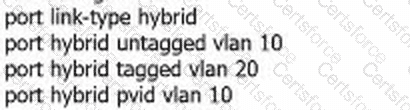
port link-type hybrid
port hybrid untagged vlan 10
port hybrid tagged vlan 20
port hybrid pvid vlan 10
Assume that the IPv6 address of GE0/0/0 on R1 is 2001:db8:12::1/64. Which of the following is the solicited-node multicast address of this IPv6 address?
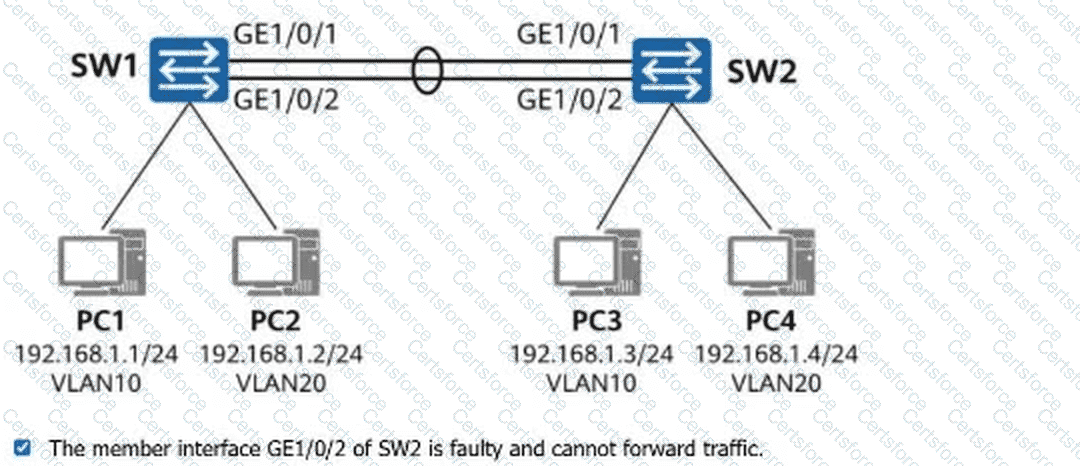
On the network shown in the figure, the administrator creates Eth-Trunk 1 in manual mode on SW1 and SW2, adds GE1/0/1 and GE1/0/2 on both switches to the Eth-Trunk 1, and sets the traffic forwarding mode to per-packet load balancing. However, the administrator finds that traffic from VLAN 10 cannot be forwarded, while traffic from VLAN 20 can be forwarded normally. The administrator verifies that the configuration of SW1 is correct. Which of the following statements are false about this fault scenario? (Select all that apply)
Enterprise data center (DC) services are no longer carried by physical machines or provided only for internal users. Instead, cloud platforms integrate resources in a unified manner and provide services for external users. Continuous service innovation requires the DC construction mode to evolve from single-DC to multi-site multi-DC.
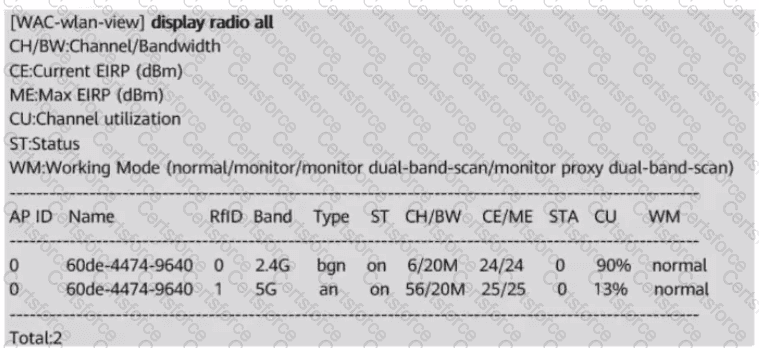
An enterprise has deployed a Huawei WLAN, but some STAs cannot associate with wireless signals. To troubleshoot this issue, you log in to the WAC and run related commands. The command output is as follows. According to the command output, which of the following is the possible cause of the STA association failure?
During VLAN planning for a campus network, VLAN IDs for different service types must be allocated consecutively, without redundancy, to prevent omissions in future allocations.
With the continuous development of AI, data center application scenarios are gradually divided into general-purpose computing and intelligent computing scenarios. Data centers need to ensure service continuity of general-purpose computing clusters while unleashing the full potential of intelligent computing clusters, so as to guarantee stable and efficient operation in the AI era. Which of the following statements are true about the service requirements of data center networks in the two scenarios? (Select all that apply)
OSPF supports the division of a network into areas, each identified by an area ID that ranges from 0 to 255. Area 0 is designated as the backbone area.
