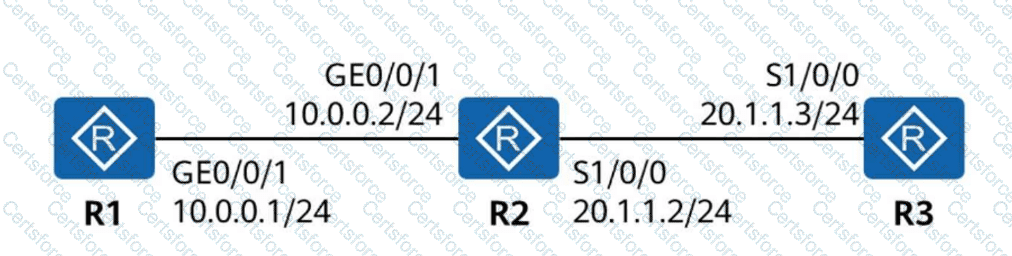
For two directly connected edge networks to communicate through intermediate routing, each end router must have a route to the remote destination network pointing to the correct next hop on the transit link. Since 10.0.0.0/24 is directly connected to R1 and 20.1.1.0/24 is directly connected to R3, R1 needs a route to 20.1.1.0/24, and R3 needs a route to 10.0.0.0/24.
Option A is correct because it configures on R1 a static route to the remote network 20.1.1.0/24 using next hop 10.0.0.2, which is the neighbor toward the transit path. Option D is correct because it configures on R3 a static route to the remote network 10.0.0.0/24 using next hop 20.1.1.1, which is the proper adjacent forwarding address in that direction. Option B is incorrect because a router cannot use a next hop that belongs to the remote destination network but is not directly reachable as a valid immediate forwarding address in this topology. Option C is also incorrect because the specified next hop is not the correct adjacent next-hop address for R3. HCIA-Datacom stresses that static routes must always point to a reachable next hop or outbound interface.
Contribute your Thoughts:
Chosen Answer:
This is a voting comment (?). You can switch to a simple comment. It is better to Upvote an existing comment if you don't have anything to add.


Submit