
You support a trading application written in Python and hosted on App Engine flexible environment. You want to customize the error information being sent to Stackdriver Error Reporting. What should you do?
You support a high-traffic web application that runs on Google Cloud Platform (GCP). You need to measure application reliability from a user perspective without making any engineering changes to it. What should you do?
Choose 2 answers
You support a web application that is hosted on Compute Engine. The application provides a booking service for thousands of users. Shortly after the release of a new feature, your monitoring dashboard shows that all users are experiencing latency at login. You want to mitigate the impact of the incident on the users of your service. What should you do first?
You support an application that stores product information in cached memory. For every cache miss, an entry is logged in Stackdriver Logging. You want to visualize how often a cache miss happens over time. What should you do?
You are developing a strategy for monitoring your Google Cloud Platform (GCP) projects in production using Stackdriver Workspaces. One of the requirements is to be able to quickly identify and react to production environment issues without false alerts from development and staging projects. You want to ensure that you adhere to the principle of least privilege when providing relevant team members with access to Stackdriver Workspaces. What should you do?
You are deploying a Cloud Build job that deploys Terraform code when a Git branch is updated. While testing, you noticed that the job fails. You see the following error in the build logs:
Initializing the backend. ..
Error: Failed to get existing workspaces : querying Cloud Storage failed: googleapi : Error
403
You need to resolve the issue by following Google-recommended practices. What should you do?
You manage a critical, user-facing application and have configured a service level objective (SLO) in Cloud Monitoring to track 99% availability over a 30-day rolling window. Recently, a series of minor issues have increased latency, causing the error budget to be consumed at an accelerated rate. You need to be proactively notified when the service is at risk of violating its SLO before the error budget is fully depleted. What should you do?
You are the on-call Site Reliability Engineer for a microservice that is deployed to a Google Kubernetes Engine (GKE) Autopilot cluster. Your company runs an online store that publishes order messages to Pub/Sub and a microservice receives these messages and updates stock information in the warehousing system. A sales event caused an increase in orders, and the stock information is not being updated quickly enough. This is causing a large number of orders to be accepted for products that are out of stock You check the metrics for the microservice and compare them to typical levels.
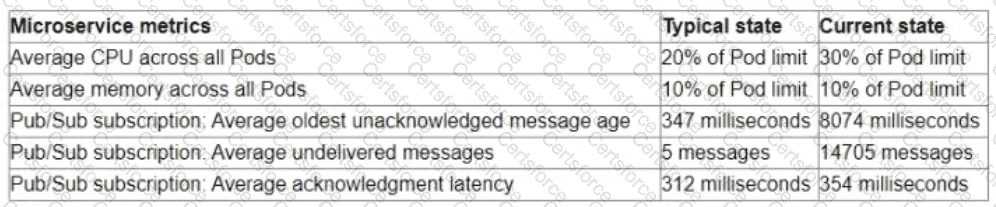
You need to ensure that the warehouse system accurately reflects product inventory at the time orders are placed and minimize the impact on customers What should you do?
Your product is currently deployed in three Google Cloud Platform (GCP) zones with your users divided between the zones. You can fail over from one zone to another, but it causes a 10-minute service disruption for the affected users. You typically experience a database failure once per quarter and can detect it within five minutes. You are cataloging the reliability risks of a new real-time chat feature for your product. You catalog the following information for each risk:
• Mean Time to Detect (MUD} in minutes
• Mean Time to Repair (MTTR) in minutes
• Mean Time Between Failure (MTBF) in days
• User Impact Percentage
The chat feature requires a new database system that takes twice as long to successfully fail over between zones. You want to account for the risk of the new database failing in one zone. What would be the values for the risk of database failover with the new system?
You support a service that recently had an outage. The outage was caused by a new release that exhausted the service memory resources. You rolled back the release successfully to mitigate the impact on users. You are now in charge of the post-mortem for the outage. You want to follow Site Reliability Engineering practices when developing the post-mortem. What should you do?
