
Weekend Sale Special Limited Time 75% Discount Offer - Ends in 0d 00h 00m 00s - Coupon code: CFsave75

Pass the Fortinet NSE 7 Network Security Architect NSE7_FSN_AR-7.6 Questions and answers with CertsForce

Viewing page 3 out of 5 pages
Viewing questions 21-30 out of questions
Questions # 21:

Refer to the exhibit, which shows the partial output of a diagnose command.

Question # 21

Which two conclusions can you draw from the output shown in the exhibit? (Choose two.)

Options:

A.

FortiGate will drop the expected traffic if it does not arrive within 23 seconds.


B.

Clearing the master session has no impact on the expectation session.


C.

This is a pinhole session to allow traffic for a TCP protocol that dynamically assigns TCP ports.


D.

The session is checked against firewall policy ID 25.


Expert Solution
Questions # 22:

Which exchange lakes care of DoS protection in IKEv2?

Options:

A.

Create_CHILD_SA


B.

IKE_Auth


C.

IKE_Req_INIT


D.

IKE_SA_NIT


Expert Solution
Questions # 23:

Refer to the exhibit.

Partial output of diagnose sys session stat command is shown.

Question # 23

An administrator has noticed unusual behavior from FortiGate. It appears that sessions are randomly removed. Which two reasons could explain this? (Choose two.)

Options:

A.

FortiGate is deleting sessions because the kernel cannot allocate more memory pages


B.

FortiGate is dropping all TCP sessions with incomplete three-way handshakes.


C.

FortiGate is not accepting sessions because the device has been down 10 out of 120 seconds.


D.

FortiGate is flushing sessions because of high memory usage.


Expert Solution
Questions # 24:

What are two functions of automation stitches? (Choose two.)

Options:

A.

You can configure automation stitches on any FortiGate device in a Security Fabric environment.


B.

You can configure automation stitches to execute actions sequentially by taking parameters from previous actions as input for the current action.


C.

You can set an automation stitch configured to execute actions in parallel to insert a specific delay between actions.


D.

You can create automation stitches to run diagnostic commands and attach the results to an email message when CPU or memory usage exceeds specified thresholds.


Expert Solution
Questions # 25:

Refer to the exhibit.

Question # 25

The exhibit shows a session entry. Which statement about this TCP session is true?

Options:

A.

The session will expire in one second.


B.

It is a TCP session from 10.9.31.117 to 10.1.0.3.


C.

The session is offloaded using NPU.


D.

Return traffic to the initiator is sent to 10.9.31.117.


Expert Solution
Questions # 26:

Refer to the exhibit, which shows a truncated output of a real-time LDAP debug.

Question # 26

What two conclusions can you draw from the output? (Choose two.)

Options:

A.

The name of the configured LDAP server is Lab.


B.

The user is authenticating using CN=John Smith.


C.

FortiOS is able to locate the user in step 3 (Bind Request) of the LDAP authentication process.


D.

FortiOS is performing the second step (Search Request) in the LDAP authentication process.


Expert Solution
Questions # 27:

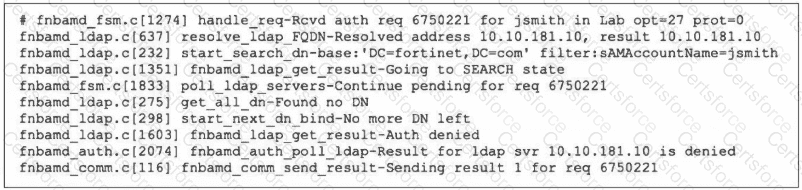
Refer to the exhibit, which shows a partial output of the real-time LDAP debug.
Question # 27

What two actions can the administrator take to resolve this issue? (Choose two.)

Options:

A.

Ensure the user logs in using ' John Smith ' not ' jsmith ' .


B.

Ensure the user is providing the correct user credentials.


C.

Ensure the user is a member of at least one AD group to ensure step 4 of the LDAP authentication process is successful.


D.

Ensure the account is active.


Expert Solution
Questions # 28:

Refer to the exhibits.

Question # 28

An OSPF peer is advertising route 172.16.52.0/24. The local FortiGate is configured with an inbound distribution list that allows the 172.16.0.0/16 network to be injected into its routing table. However, the 1 ' 2.16.52.0/24 subnet cannot be seen in the FIB.

Which two stops can the administrator of the local FortiGate take to ensure that the advertised 172.16. 52.0/24 subnet will be injected into the routing table? (Choose two.)

Options:

A.

Add another entry to the prefix list to specifically allow the 172.16.52.0/24 network.


B.

Change the ge value to 17.


C.

Change the R- value lo 16.


D.

Modify the default prefix-list behavior from implicit deny to implicit allow.


Expert Solution
Questions # 29:

Refer to the exhibits.

Question # 29

FGT-1 is an area border router (ABR) that has interfaces in OSPF areas 0.0.0.0 and 0.0.0.5. FGT-3 acts as an autonomous system border router (ASBR), importing static routes into OSPF. FGT-2 is an internal router with all its interfaces belonging to area 0.0.0.5. FGT-1 is receiving all advertised routes from FGT-2, however, FGT-3 is not receiving any of the advertised routes from FGT-1. What is the most likely reason for this? (Choose one answer)

Options:

A.

Area 0.0.0.5 is configured not to propagate type 5 LSAs.


B.

FGT-2 is configured with a distribution list to block all advertised routes from FGT-3.


C.

FGT-3 and FGT-2 have not formed an OSPF adjacency yet.


D.

IP protocol 89 is blocked between FGT-1 and FGT-3.


Expert Solution
Questions # 30:

Exhibit.

Question # 30

Refer to the exhibit, which shows the output of get system ha status.

NGFW-1 and NGFW-2 have been up for a week.

Which two statements about the output are true? (Choose two.)

Options:

A.

If a configuration change is made to the primary FortiGate at this time, the secondary will initiate a synchronization reset.


B.

If port 7 becomes disconnected on the secondary, both FortiGate devices will elect itself as primary.


C.

If FGVM...649 is rebooted. FGVM...650 will become the primary and retain that role, even after FGVM...649 rejoins the cluster.


D.

If no action is taken, the primary FortiGate will leave the cluster because of the current sync status.


Expert Solution
Viewing page 3 out of 5 pages
Viewing questions 21-30 out of questions