
A company uses activity based costing. The total production overheads of $16,050 for the next period are for set up costs of $6,450 and quality inspection costs of $9,600. The company produces two products, Product F and Product G. Details relating to the next period are as follows:
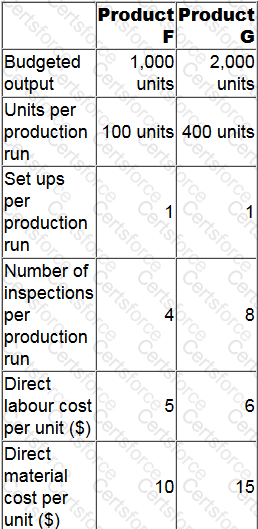
A new customer has offered to purchase Product F for $28.00 per unit. The only costs incurred would be those shown above.
What is the profit per unit of Product F that would be gained by accepting the offer? Give your answer to two decimal places.
Which of the following statements are fundamental concepts that underlie the Beyond Budgeting approach?
1. Use traditional budgeting in conjunction with other techniques.
2. Use adaptive management processes rather than the more rigid annual budget.
3. Move towards devolved networks rather than centralized hierarchies.
4. Move towards centralized hierarchies rather than devolved networks.
When considering a capital investment, relevant costs for decision making have which THREE of the following features?
Residual income is an appropriate performance measure for which type of responsibility centre?
A goal congruent transfer price will always:
Which of the following statements about the use of traditional budgeting compared with a beyond budgeting approach is correct?
An organization is comprised of two divisions. One of the divisions manufactures a product that it sells both to an imperfect external market and to the other division.
The organization wishes to establish the most suitable basis for the transfer price for this product and is considering either a negotiated transfer price or a market-based transfer price.
Which of the following statements is correct?
The following cost of quality report has been prepared for the latest period.

What is the difference between the cost of conformance and the cost of non-conformance?
An investment appraisal has identified that a project has a positive net present value when discounted at the company's cost of capital. If the cost of capital is now increased, indicate whether each of the following appraisal measures will increase, decrease or stay the same.

Risk management can be represented as a four step process. The four steps, shown randomly, are:
1. Establish appropriate risk management policies.
2. Risks are identified by key stakeholders.
3. Risks are monitored on an ongoing basis.
4. Risks are evaluated according to the likelihood of occurrence and impact on the organization.
Which of the following is the correct order for the four steps?

