
Oliver owns a computer repair company. He is looking to close of of his departments as the demand for computer cleaning has dropped dramatically in the last 2 years and is no longer profitable.
The contribution margin of the department is £12,000, and the overheads are £23,000 (out of which £4,000 cannot be eliminated).
How would closing this department impact operating income?
A company is considering two mutually exclusive projects, an analysis of which is given below:
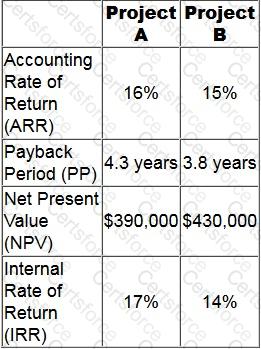
The company's cost of capital is 12%.
Assuming an objective of maximising shareholders' wealth, which project would be recommmended?
It is often claimed that a two-part transfer pricing system offers a number of advantages to organizations which use it.
Which of the following statements is NOT an advantage of using a two-part transfer pricing system?
Which of the following correctly defines the expected value of a project?
Company S has two divisions, X and Y. Division X transfers 50,000 component units to Division Y each quarter. The market price of the component is $20. Division X's variable cost is $10 per unit and its fixed cost is $150,000 each quarter.
What price would be credited to Division X for each component that it transfers to Division Y under:
two-part tariff pricing (where the two divisions have agreed that the fixed fee will be $100,000); and dual pricing (based on market price and marginal cost).
Under the absorption costing system, which simply allocates our entire amount of production overheads based on machine hours, we have found that out of our 4 products, 2 are profitable, 1 breaks even and 1 is
making a loss.
Model D the most recent addition to the range is making a large loss after the price of a major component rose dramatically. Model A is only just breaking now too as costs have risen. The only two products making profit
are Models B and C. These two require the least about of machine hours so this makes sense.
However, the management have a few reservations. They cannot understand how B is so profitable. It requires several more stages of production than the other models and a whole day longer to be customised by an
expert.
Select the correct answer from the list below that can help to explain this situation.
An electronics company sells a range of tablet computers. Tablet computers come complete with an operating system that is regarded as the market leader. The company aims to launch a new version of its hardware every eighteen months and a major update to its software every three years. The latest version of the tablet computer is always sold at a higher price, but the older version that has been replaced is then sold for a time at a discounted price.
Which pricing model does this company appear to be using?
A company has a cost of capital of 12% and a maximum of $20 million to invest. It has identified three possible investment projects, none of which is divisible, as follows.
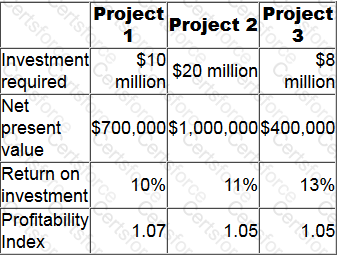
Which project(s) should the company invest in?
A machine requires an initial investment of $500,000. The net present value (NPV) of the investment in the machine is $36,500.
Which of the following statements is correct in relation to the sensitivity of the investment?
A cost centre manager's performance is monitored based on a comparison of actual and budgeted cost. A summary performance report for the latest period is shown below.

The actual costs include:
*$28,000 for allocated head office costs.
*$18,000 payment for a rental agreement entered into by the cost centre manager two years ago.
*$34,000 for depreciation.
What is the cost centre manager's controllable actual cost for the period?
Give your answer to the nearest $000.
