You receive a warning about approaching the 2,000,000 row limit with synced records in your Production environment.
What are two ways to efficiently address this warning to prevent reaching the limit? (Choose two.)
How can a user in the Appian environment prevent the uploading of documents without extensions?
Which section of the Interface Performance View explains the contribution towards the overall evaluation time of the current function, rule, or parameter?
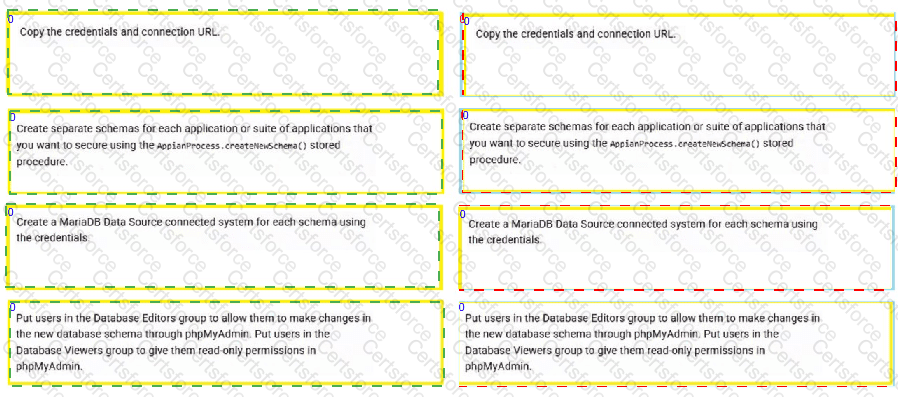
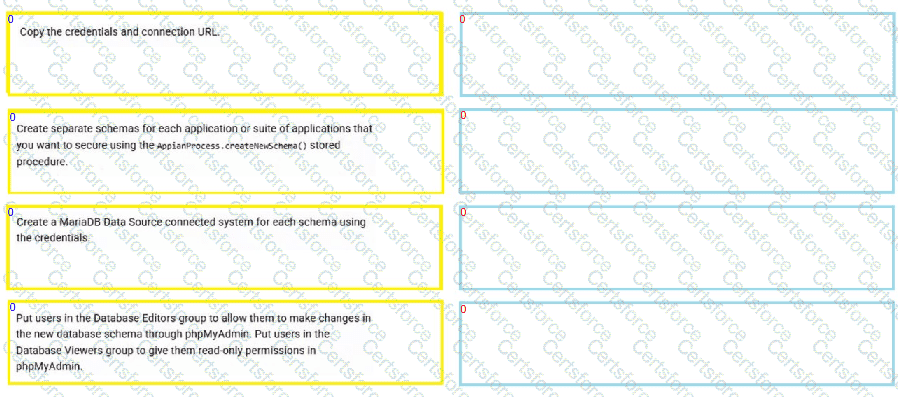
You need to create a new database schema using a connected data source system.
What should you do?
Note: To answer, move all steps from the Options list to the Answer List area and arrange them in the correct order.
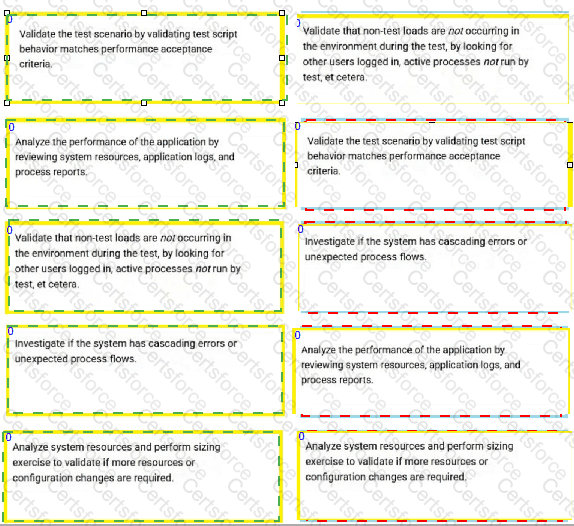
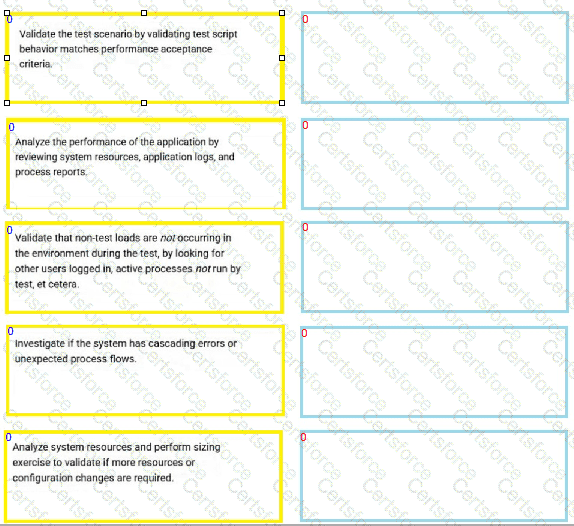
You're executing a performance test of the client's application. You notice that server-side resources are at high-to-critical operating levels.
What should you do to troubleshoot this issue?
Note: To answer, move all steps from the Options list to the Answer List area and arrange them in the correct order.
A view is created with the primary table PERSON and is joined using a left join with the APPOINTMENT table on the column "PERSON_ID". There is a one-to-many relationship between the PERSON and APPOINTMENT tables.
A Custom Data Type (CDT) and a data store entity have been created based on this view, with the primary key being "PERSON_ID".
Review the data presented in the PERSON and APPOINTMENT tables:

Which two statements are true when the following query entity is executed? (Choose two.)

You're conducting a design review.
You identify slow-performing expression rules querying a specific data store, and need to understand the "number of operations against data stores."
Which metric from the data_store_details.csv file is helpful to you?
What are two advantages of database normalization? (Choose two.)
You're developing a user input form for a government services application that includes a file upload component.
If the uploaded file is a multimedia file (for example: .MP4, .MOV or .WAV), the customer wants these uploaded to Microsoft SharePoint instead.
What is the best way to achieve this requirement?
A seamless user experience (UX) is important for an application so that a user does not feel like they are moving through different applications. Often when many developers are working on the same project all together, this can be a concern.
How should you ensure that a seamless UX is maintained throughout the app?