You're creating an interface to display all the employees of a company on a staff list.
You decide to use a!gridField() to create a user grid to display information from the company's AAA_Employee record, which has 42 fields relating to various employee information. To avoid cluttering the grid, you want to show six (6) fields on the grid.
How should you optimize the interface?
You need to test a related action that updates record data.
Appropriate users must be able to access the form. You also need to ensure that the data is successfully updated.
Using Appian, which is the best testing method you should use?
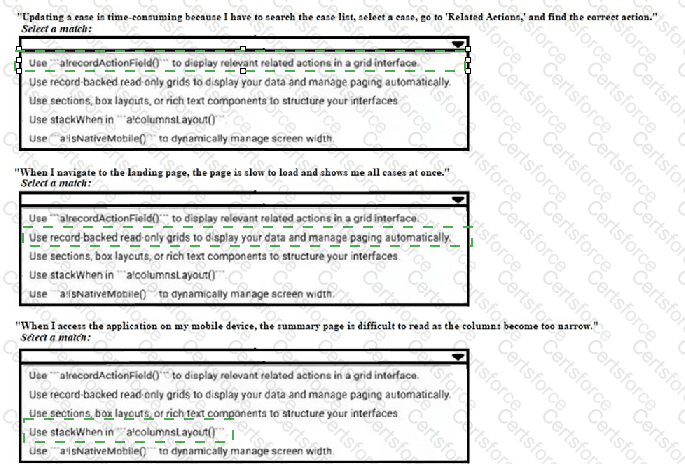
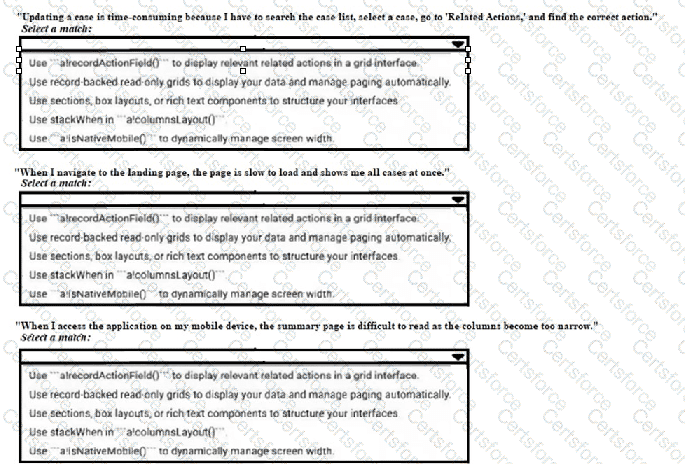
You’re developing a case management application. Currently, users can view a list of all cases designed using a a!forEach() loop from a record query. Users can navigate to the case summary page which shows the case details in a two (2) column layout. Users are also able to update the case details.
During the last round of UAT testing, users reported that the tool was not intuitive to use.
Match each feedback comment to the suggested UI/UX improvements.
Note: Each UI/UX improvement will be used once, or not at all. To change your responses, you may deselect your response by clicking the blank space at the top of the selection list.
The synced record Task has a self-referential relationship defined in the column parentTaskId. There is a many-to- one record relationship between the id and parentTaskId called parentTask.
For a given task ID, you need to return the task name and the parent task name.
What should you do?
You’re making a POST request to the Appian web API. You need to include complex data structures, such as lists or objects, in the request body.
How should you design the API to accept those requests?
In reviewing the process model metrics of your application, you notice a process model with a completion rate of only 10%.
What are two possible reasons for this low completion rate? (Choose two.)
You need to implement a requirement where a third-party system starts a process in Appian. The third-party system can invoke a service only through Web Services Description Language (WSDL).
What should you do to start the process in Appian?
You need to allow external systems to invoke Appian web APIs.
Which user role should be assigned?
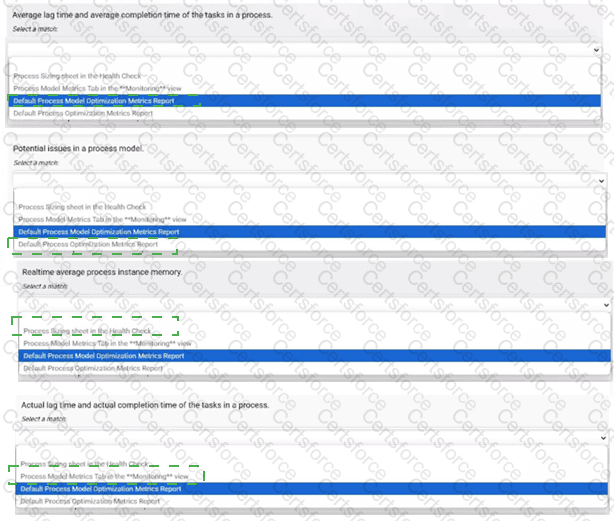
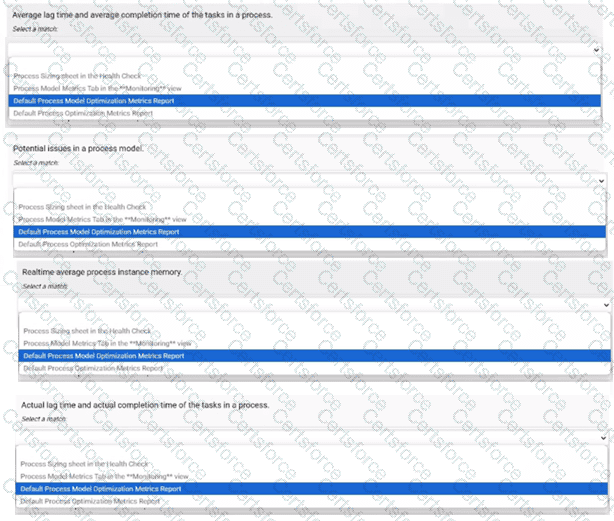
You are reviewing application performance-related issues reported by users.
As part of this activity, you need to check interface performance, expression rules performance, and process model performance.
Match each statement to the option that best describes where you can view this information.
Note: Each object or view will be used once. To change your responses, you may deselect your response by clicking the blank space at the top of the selection list
Users are experiencing slow load times when retrieving customer records with many transactions.
After using performance monitoring tools, you discover that the following interface definition is responsible for the majority of page load time:
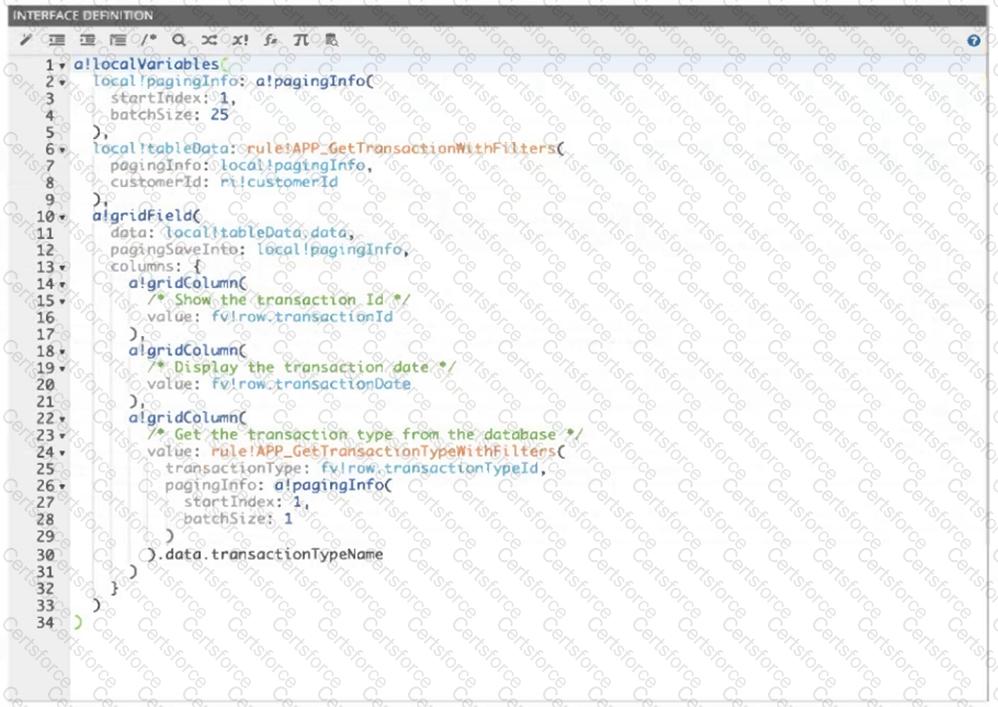
Additionally, both queries (rule!APP_GetTransactionsWithFilters and rule!APP_GetTransactionTypeWithFilters) take approximately 25 milliseconds each to execute when you test them using the expression editor.
Which action would result in the greatest reduction in the load time for this interface component?