
New Year Sale Limited Time 70% Discount Offer - Ends in 0d 00h 00m 00s - Coupon code: simple70

Pass the Amazon Web Services AWS Certified Specialty SCS-C02 Questions and answers with CertsForce

Viewing page 4 out of 14 pages
Viewing questions 31-40 out of questions
Questions # 31:

A company is operating an open-source software platform that is internet facing. The legacy software platform no longer receives security updates. The software platform operates using Amazon Route 53 weighted load balancing to send traffic to two Amazon EC2 instances that connect to an Amazon RDS cluster. A recent report suggests this software platform is vulnerable to SQL injection attacks, with samples of attacks provided. The company's security engineer must secure this system against SQL injection attacks within 24 hours. The security engineer's solution must involve the least amount of effort and maintain normal operations during implementation.

What should the security engineer do to meet these requirements?

Options:

A.

Create an Application Load Balancer with the existing EC2 instances as a target group. Create an AWS WAF web ACL containing rules that protect the application from this attack, then apply it to the ALB. Test to ensure the vulnerability has been mitigated, then redirect the Route 53 records to point to the ALB. Update security groups on the EC2 instances to prevent direct access from the internet.


B.

Create an Amazon CloudFront distribution specifying one EC2 instance as an origin. Create an AWS WAF web ACL containing rules that protect the application from this attack, then apply it to the distribution. Test to ensure the vulnerability has been mitigated, then redirect the Route 53 records to point to CloudFront.


C.

Obtain the latest source code for the platform and make the necessary updates. Test the updated code to ensure that the vulnerability has been mitigated, then deploy the patched version of the platform to the EC2 instances.


D.

Update the security group that is attached to the EC2 instances, removing access from the internet to the TCP port used by the SQL database. Create an AWS WAF web ACL containing rules that protect the application from this attack, then apply it to the EC2 instances. Test to ensure the vulnerability has been mitigated, then restore the security group to the original setting.


Expert Solution
Questions # 32:

A company uploads data files as objects into an Amazon S3 bucket. A vendor downloads the objects to perform data processing.

A security engineer must implement a solution that prevents objects from residing in the S3 bucket for longer than 72 hours.

Which solution will meet this requirement?

Options:

A.

Configure S3 Versioning to expire object versions that have been in the S3 bucket for 72 hours.


B.

Configure an S3 Lifecycle configuration rule on the S3 bucket to expire objects that have been in the S3 bucket for 72 hours.


C.

Use the S3 Intelligent-Tiering storage class for all objects in the S3 bucket. Configure S3 Intelligent-Tiering to expire objects that have been in the S3 bucket for 72 hours.


D.

Generate S3 presigned URLs for the vendor to use to download the objects. Expire the URLs after 72 hours.


Expert Solution
Questions # 33:

A company uses SAML federation to grant users access to AWS accounts. A company workload that is in an isolated AWS account runs on immutable infrastructure with no human access to Amazon EC2. The company requires a specialized user known as a break glass user to have access to the workload AWS account and instances in the case of SAML errors. A recent audit discovered that the company did not create the break glass user for the AWS account that contains the workload.

The company must create the break glass user. The company must log any activities of the break glass user and send the logs to a security team.

Which combination of solutions will meet these requirements?(Select TWO.)

Options:

A.

Create a local individual break glass IAM user for the security team. Create a trail in AWS CloudTrail that has Amazon CloudWatch Logs turned on. Use Amazon EventBridge to monitor local user activities.


B.

Create a break glass EC2 key pair for the AWS account. Provide the key pair to the security team. Use AWS CloudTraiI to monitor key pair activity. Send notifications to the security team by using Amazon Simple Notification Service (Amazon SNS).


C.

Create a break glass IAM role for the account. Allow security team members to perform the AssumeRoleWithSAML operation. Create an AWS Cloud Trail trail that has Amazon CloudWatch Logs turned on. Use Amazon EventBridge tomonitor security team activities.


D.

Create a local individual break glass IAM user on the operating system level of each workload instance. Configure unrestricted security groups on the instances to grant access to the break glass IAM users.


E.

Configure AWS Systems Manager Session Manager for Amazon EC2. Configure an AWS Cloud Trail filter based on Session Manager. Send the results to an Amazon Simple Notification Service (Amazon SNS) topic.


Expert Solution
Questions # 34:

An organization wants to log all IAM API calls made within all of its IAM accounts, and must have a central place to analyze these logs. What steps should be taken to meet these requirements in the MOST secure manner? (Select TWO)

Options:

A.

Turn on IAM CloudTrail in each IAM account


B.

Turn on CloudTrail in only the account that will be storing the logs


C.

Update the bucket ACL of the bucket in the account that will be storing the logs so that other accounts can log to it


D.

Create a service-based role for CloudTrail and associate it with CloudTrail in each account


E.

Update the bucket policy of the bucket in the account that will be storing the logs so that other accounts can log to it


Expert Solution
Questions # 35:

A company uses an external identity provider to allow federation into different IAM accounts. A security engineer for the company needs to identify the federated user that terminated a production Amazon EC2 instance a week ago.

What is the FASTEST way for the security engineer to identify the federated user?

Options:

A.

Review the IAM CloudTrail event history logs in an Amazon S3 bucket and look for the Terminatelnstances event to identify the federated user from the role session name.


B.

Filter the IAM CloudTrail event history for the Terminatelnstances event and identify the assumed IAM role. Review the AssumeRoleWithSAML event call in CloudTrail to identify the corresponding username.


C.

Search the IAM CloudTrail logs for the Terminatelnstances event and note the event time. Review the IAM Access Advisor tab for all federated roles. The last accessed time should match the time when the instance was terminated.


D.

Use Amazon Athena to run a SQL query on the IAM CloudTrail logs stored in an Amazon S3 bucket and filter on the Terminatelnstances event. Identify the corresponding role and run another query to filter the AssumeRoleWithWebldentity event for the user name.


Expert Solution
Questions # 36:

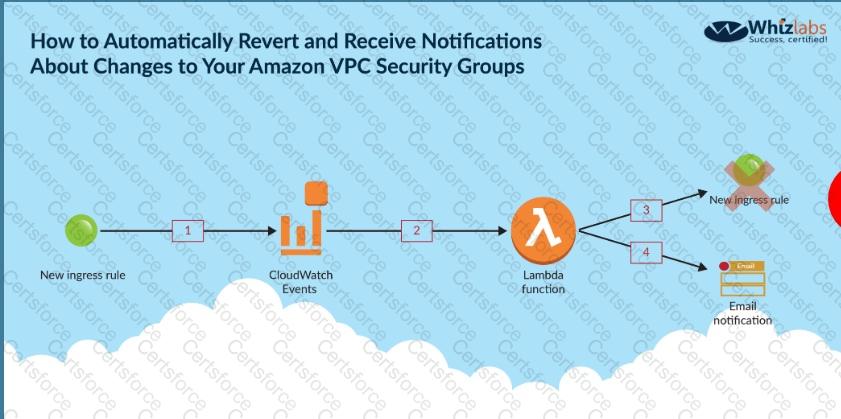
Your company has a set of EC2 Instances defined in IAM. These Ec2 Instances have strict security groups attached to them. You need to ensure that changes to the Security groups are noted and acted on accordingly. How can you achieve this?

Please select:

Options:

A.

Use Cloudwatch logs to monitor the activity on the Security Groups. Use filters to search for the changes and use SNS for the notification.


B.

Use Cloudwatch metrics to monitor the activity on the Security Groups. Use filters to search for the changes and use SNS for the notification.


C.

Use IAM inspector to monitor the activity on the Security Groups. Use filters to search for the changes and use SNS f the notification.


D.

Use Cloudwatch events to be triggered for any changes to the Security Groups. Configure the Lambda function for email notification as well.


Expert Solution
Questions # 37:

A security engineer is implementing a logging solution for a company's AWS environment. The security engineer has configured an AWS CloudTrail trail in the company's AWS account. The logs are stored in an Amazon S3 bucket for a third-party service provider to monitor. The service provider has a designated 1AM role to access the S3 bucket.

The company requires all logs to be encrypted at rest with a customer managed key. The security engineer uses AWS Key Management Service (AWS KMS) lo create the customer managed key and key policy. The security engineer also configures CloudTrail to use the key to encrypt the trail.

When the security engineer implements this configuration, the service provider no longer can read the logs.

What should the security engineer do to allow the service provider to read the logs?

Options:

A.

Ensure that the S3 bucket policy allows access to the service provider's role to decrypt objects.


B.

Add a statement to the key policy to allow the service provider's role the kms: Decrypt action (or the key.


C.

Add the AWSKeyManagementServicePowerUser AWS managed policy to the service provider's role.


D.

Migrate the key to AWS Certificate Manager (ACM) to create a shared endpoint for access to the key.


Expert Solution
Questions # 38:

A company's policy requires that all API keys be encrypted and stored separately from source code in a centralized security account. This security account is managed by the company'ssecurity team However, an audit revealed that an API key is steed with the source code of an IAM Lambda function m an IAM CodeCommit repository in the DevOps account

How should the security learn securely store the API key?

Options:

A.

Create a CodeCommit repository in the security account using IAM Key Management Service (IAM KMS) tor encryption Require the development team to migrate the Lambda source code to this repository


B.

Store the API key in an Amazon S3 bucket in the security account using server-side encryption with Amazon S3 managed encryption keys (SSE-S3) to encrypt the key Create a resigned URL tor the S3 key. and specify the URL m a Lambda environmental variable in the IAM CloudFormation template Update the Lambda function code to retrieve the key using the URL and call the API


C.

Create a secret in IAM Secrets Manager in the security account to store the API key using IAM Key Management Service (IAM KMS) tor encryption Grant access to the IAM role used by the Lambda function so that the function can retrieve the key from Secrets Manager and call the API


D.

Create an encrypted environment variable for the Lambda function to store the API key using IAM Key Management Service (IAM KMS) tor encryption Grant access to the IAM role used by the Lambda function so that the function can decrypt the key at runtime


Expert Solution
Questions # 39:

An IAM user receives an Access Denied message when the user attempts to access objects in an Amazon S3 bucket. The user and the S3 bucket are in the same AWS account. The S3 bucket is configured to use server-side encryption with AWS KMS keys (SSE-KMS) to encrypt all of its objects at rest by using a customer managed key from the same AWS account. The S3 bucket has no bucket policy defined. The IAM user has been granted permissions through an IAM policy that allows the kms:Decrypt permission to the customer managed key. The IAM policy also allows the s3:List* and s3:Get* permissions for the S3 bucket and its objects.

Which of the following is a possible reason that the IAM user cannot access the objects in the S3 bucket?

Options:

A.

The IAM policy needs to allow the kms:DescribeKey permission.


B.

The S3 bucket has been changed to use the AWS managed key to encrypt objects at rest.


C.

An S3 bucket policy needs to be added to allow the IAM user to access the objects.


D.

The KMS key policy has been edited to remove the ability for the AWS account to have full access to the key.


Expert Solution
Questions # 40:

A company uses infrastructure as code (IaC) to create AWS infrastructure. The company writes the code as AWS CloudFormation templates to deploy the infrastructure. The company has an existing CI/CD pipeline that the company can use to deploy these templates.

After a recent security audit, the company decides to adopt a policy-as-code approach to improve the company's security posture on AWS. The company must prevent the deployment of any infrastructure that would violate a security policy, such as an unencrypted Amazon Elastic Block Store (Amazon EBS) volume.

Which solution will meet these requirements?
Options:

A.

Turn on AWS Trusted Advisor. Configure security notifications as webhooks in the preferences section of the CI/CD pipeline.


B.

Turn on AWS Config. Use the prebuilt rules or customized rules. Subscribe the CI/CD pipeline to an Amazon Simple Notification Service (Amazon SNS) topic that receives notifications from AWS Config.


C.

Create rule sets in AWS CloudFormation Guard. Run validation checks for CloudFormation templates as a phase of the CI/CD process.


D.

Create rule sets as SCPs. Integrate the SCPs as a part of validation control in a phase of the CI/CD process.


Expert Solution
Viewing page 4 out of 14 pages
Viewing questions 31-40 out of questions
