New Year Sale Limited Time 70% Discount Offer - Ends in 0d 00h 00m 00s - Coupon code: simple70

Pass the Amazon Web Services AWS Certified Specialty SCS-C02 Questions and answers with CertsForce

Viewing page 2 out of 14 pages
Viewing questions 11-20 out of questions
Questions # 11:

A company receives a notification from the AWS Abuse team about an AWS account The notification indicates that a resource in the account is compromised The company determines that the compromised resource is an Amazon EC2 instance that hosts a web application The compromised EC2 instance is part of an EC2 Auto Scaling group

The EC2 instance accesses Amazon S3 and Amazon DynamoDB resources by using an 1AM access key and secret key The 1AM access key and secret key are stored inside the AMI that is specified in the Auto Scaling group's launch configuration The company is concerned that the credentials that are stored in the AMI might also have been exposed

The company must implement a solution that remediates the security concerns without causing downtime for the application The solution must comply with security best practices

Which solution will meet these requirements'?

Options:

A.

Rotate the potentially compromised access key that the EC2 instance uses Create a new AM I without the potentially compromised credentials Perform an EC2 Auto Scaling instance refresh


B.

Delete or deactivate the potentially compromised access key Create an EC2 Auto Scaling linked 1AM role that includes a custom policy that matches the potentiallycompromised access key permission Associate the new 1AM role with the Auto Scaling group Perform an EC2 Auto Scaling instance refresh.


C.

Delete or deactivate the potentially compromised access key Create a new AMI without the potentially compromised credentials Create an 1AM role that includes the correct permissions Create a launch template for the Auto Scaling group to reference the new AMI and 1AM role Perform an EC2 Auto Scaling instance refresh


D.

Rotate the potentially compromised access key Create a new AMI without the potentially compromised access key Use a user data script to supply the new access key as environmental variables in the Auto Scaling group's launch configuration Perform an EC2 Auto Scaling instance refresh


Expert Solution
Questions # 12:

An organization must establish the ability to delete an IAM KMS Customer Master Key (CMK) within a 24-hour timeframe to keep it from being used for encrypt or decrypt operations Which of tne following actions will address this requirement?

Options:

A.

Manually rotate a key within KMS to create a new CMK immediately


B.

Use the KMS import key functionality to execute a delete key operation


C.

Use the schedule key deletion function within KMS to specify the minimum wait period for deletion


D.

Change the KMS CMK alias to immediately prevent any services from using the CMK.


Expert Solution
Questions # 13:

A company is implementing new compliance requirements to meet customer needs. According to the new requirements the company must not use any Amazon RDS DB instances or DB clusters that lack encryption of the underlying storage. The company needs a solution that will generate an email alert when an unencrypted DB instance or DB cluster is created. The solution also must terminate the unencrypted DB instance or DB cluster.

Which solution will meet these requirements in the MOST operationally efficient manner?

Options:

A.

Create an AWS Config managed rule to detect unencrypted ROS storage. Configure an automatic remediation action to publish messages to an Amazon SimpleNotification Service (Amazon SNS) topic that includes an AWS Lambda function and an email delivery target as subscribers. Configure the Lambda function to delete the unencrypted resource.


B.

Create an AWS Config managed rule to detect unencrypted RDS storage. Configure a manual remediation action to invoke an AWS Lambda function. Configure the Lambda function to publish messages to an Amazon Simple Notification Service (Amazon SNS) topic and to delete the unencrypted resource.


C.

Create an Amazon EventBridge rule that evaluates RDS event patterns and is initiated by the creation of DB instances or DB clusters Configure the rule to publish messages to an Amazon Simple Notification Service (Amazon SNS) topic that includes an AWS Lambda function and an email delivery target as subscribers. Configure the Lambda function to delete the unencrypted resource.


D.

Create an Amazon EventBridge rule that evaluates RDS event patterns and is initiated by the creation of DB instances or DB clusters. Configure the rule to invoke an AWS Lambda function. Configure the Lambda function to publish messages to an Amazon Simple Notification Service (Amazon SNS) topic and to delete the unencrypted resource.


Expert Solution
Questions # 14:

A company needs to retain tog data archives for several years to be compliant with regulations. The tog data is no longer used but It must be retained

What Is the MOST secure and cost-effective solution to meet these requirements?

Options:

A.

Archive the data to Amazon S3 and apply a restrictive bucket policy to deny the s3 DeleteOotect API


B.

Archive the data to Amazon S3 Glacier and apply a Vault Lock policy


C.

Archive the data to Amazon S3 and replicate it to a second bucket in a second IAM Region Choose the S3 Standard-Infrequent Access (S3 Standard-1A) storage class and apply a restrictive bucket policy to deny the s3 DeleteObject API


D.

Migrate the log data to a 16 T8 Amazon Elastic Block Store (Amazon EBS) volume Create a snapshot of the EBS volume


Expert Solution
Questions # 15:

A security engineer configures VPC Flow Logs and the associated IAM role to log all VPC traffic to a log group in Amazon CloudWatch Logs. After a wait of 10 minutes, no logs are appearing in the log group. The security engineer confirms that traffic is being sent to the VPC.

After additional debugging, the security engineer isolates the problem to the role that is associated with the VPC flow logs.

What could be the reason that the logs are not appearing in CloudWatch Logs?

Options:

A.

The logs:GetLogEvents permission is not granted in the role.


B.

The security engineer does not have permission to assume the role.


C.

The principal vpc-flow-logs.amazonaws.com does not have permission to assume the role.


D.

The role does not have permission to tag a CloudWatch Logs stream.


Expert Solution
Questions # 16:

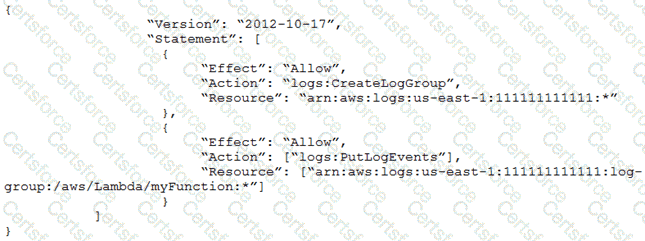
A security engineer logs in to the AWS Lambda console with administrator permissions. The security engineer is trying to view logs in Amazon CloudWatch for a Lambda function that is named my Function.

When the security engineer chooses the option in the Lambda console to view logs in CloudWatch, an “error loading Log Streams" message appears.

The IAM policy for the Lambda function's execution role contains the following:
Question # 16

How should the security engineer correct the error?

Options:

A.

Move the logs:CreateLogGroup action to the second Allow statement.


B.

Add the logs:PutDestination action to the second Allow statement.


C.

Add the logs:GetLogEvents action to the second Allow statement.


D.

Add the logs:CreateLogStream action to the second Allow statement.


Expert Solution
Questions # 17:

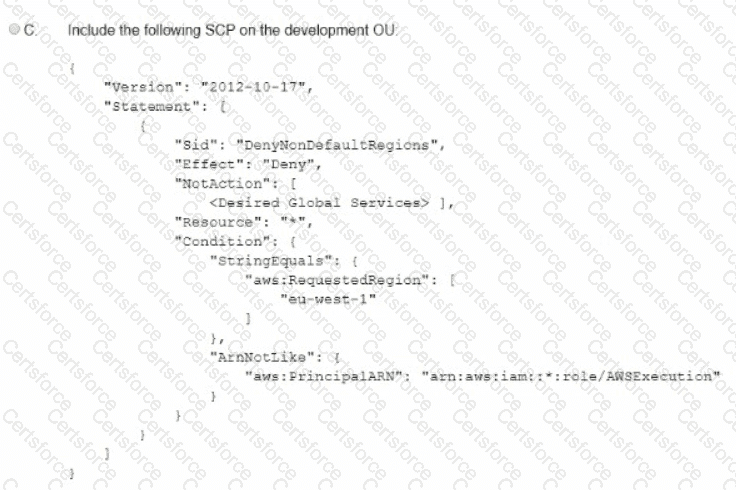
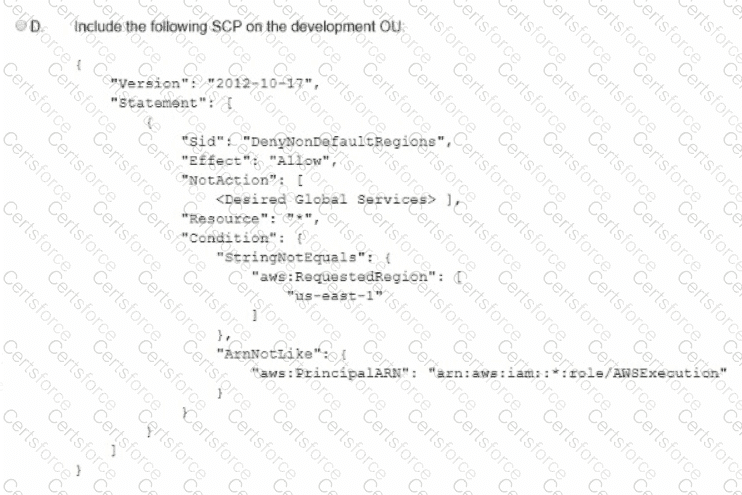
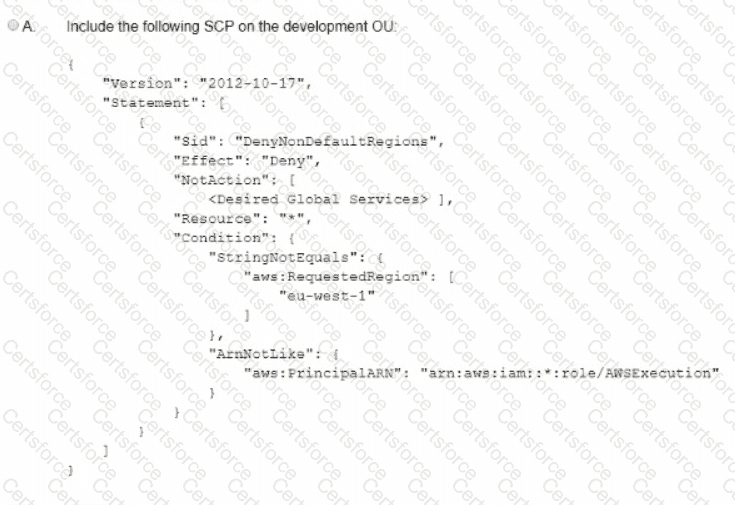
A company is using IAM Organizations. The company wants to restrict IAM usage to the eu-west-1 Region for all accounts under an OU that is named "development." The solution must persist restrictions to existing and new IAM accounts under the development OU.
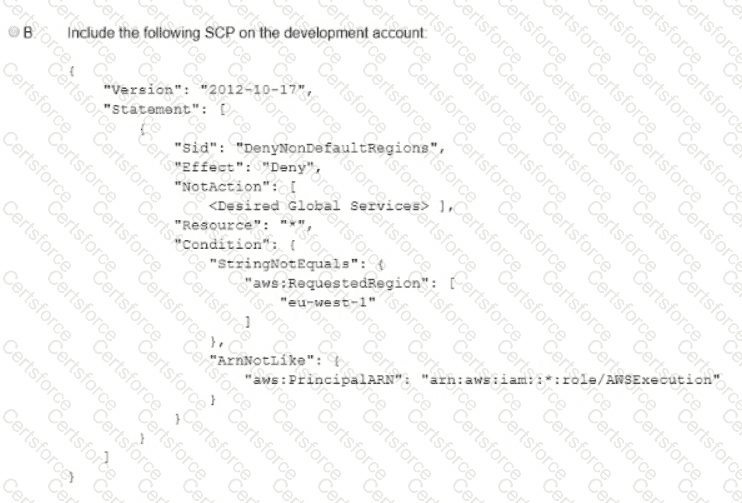
Question # 17

Question # 17

Question # 17

Question # 17

Options:

A.

Option A


B.

Option B


C.

Option C


D.

Option D


Expert Solution
Questions # 18:

A Network Load Balancer (NLB) target instance is not entering the InService state. A security engineer determines that health checks are failing.

Which factors could cause the health check failures? (Select THREE.)

Options:

A.

The target instance's security group does not allow traffic from the NLB.


B.

The target instance's security group is not attached to the NLB.


C.

The NLB's security group is not attached to the target instance.


D.

The target instance's subnet network ACL does not allow traffic from the NLB.


E.

The target instance's security group is not using IP addresses to allow traffic from the NLB.


F.

The target network ACL is not attached to the NLB.


Expert Solution
Questions # 19:

A company needs to implement data lifecycle management for Amazon RDS snapshots. The company will use AWS Backup to manage the snapshots.

The company must retain RDS automated snapshots for 5 years and will use Amazon S3 for long-term archival storage.

Which solution will meet these requirements?

Options:

A.

Use AWS Backup to apply a 5-year retention tag to the RDS snapshots.


B.

Enable versioning on the S3 bucket that AWS Backup uses for the RDS snapshots. Configure a 5-year retention period.


C.

Create an S3 Lifecycle policy. Include a 5-year retention period for the S3 bucket that AWS Backup uses for the RDS snapshots.


D.

Create a backup plan in AWS Backup. Configure a 5-year retention period.


Expert Solution
Questions # 20:

A company has several Amazon S3 buckets thai do not enforce encryption in transit A security engineer must implement a solution that enforces encryption in transit for all the company's existing and future S3 buckets.

Which solution will meet these requirements'?

Options:

A.

Enable AWS Config Create a proactive AWS. Config Custom Policy rule Create a Guard clause to evaluate the S3 bucket policies to check for a value of True for the aws SecureTransport condition key. If the AWS Config rule evaluates to NON_COMPLIANT, block resource creation.


B.

Enable AWS Config Configure the s3-bucket-ssl-requests-only AWS Config managed rule and set the rule trigger type to Hybrid Create an AWS Systems Manager.

Automation runbook that applies a bucket policy to deny requests when the value of the aws SecureTransport condition key is False Configure automatic remediation Set the runbook as the target of the rule.


C.

Enable Amazon Inspector Create a custom AWS Lambda rule. Create a Lambda function that applies a bucket policy to deny requests when the value of the aws SecureTransport condition key is False Set the Lambda function as the target of the rule.


D.

Create an AWS CloudTrail trail Enable S3 data events on the trail. Create an AWS Lambda function that applies a bucket policy to deny requests when the value of the aws SecureTransport condition key is False. Configure the CloudTrail trail to invoke the Lambda function.


Expert Solution
Viewing page 2 out of 14 pages
Viewing questions 11-20 out of questions