
New Year Sale Limited Time 70% Discount Offer - Ends in 0d 00h 00m 00s - Coupon code: simple70

Pass the Amazon Web Services AWS Certified Specialty SCS-C02 Questions and answers with CertsForce

Viewing page 7 out of 14 pages
Viewing questions 61-70 out of questions
Questions # 61:

A company wants to start processing sensitive data on Amazon EC2 instances. The company will use Amazon CloudWatch Logs to monitor, store, and access log files from the EC2 instances.

The company's developers use CloudWatch Logs for troubleshooting. A security engineer must implement a solution that prevents the developers from viewing the sensitive data The solution must automatically apply to any new log groups that are created in the account in the future.

Which solution will meet these requirements?

Options:

A.

Create a CloudWatch Logs account-wide data protection policy. Specify the appropriate data identifiers for the policy. Ensure that the developers do not have the logs:Unmask 1AM permission.


B.

Export the CloudWatch Logs data to an Amazon S3 bucket. Set up automated discovery by using Amazon Macie on the S3 bucket. Create a custom data identifier for the sensitive data. Remove the developers' access to CloudWatch Logs. Grant permissions for the developers to view the exported log data in Amazon S3.


C.

Export the CloudWatch Logs data to an Amazon S3 bucket. Set up automated discovery by using Amazon Macie on the S3 bucket. Specify the appropriate managed data identifiers. Remove the developers' access to CloudWatch Logs. Grant permissions for the developers to view the exported log data in Amazon S3.


D.

Create a CloudWatch Logs data protection policy for each log group. Specify the appropriate data identifiers for the policy. Ensure that the developers do not have the logsiUnmask 1AM permission.


Expert Solution
Questions # 62:

A company hired an external consultant who needs to use a laptop to access the company's VPCs Specifically, the consultant needs access to two VPCs that are peered together in the same AWS Region. The company wants to provide the consultant with access to these VPCs without also providing any unnecessary access to other network resources.

Which solution will meet these requirements?

Create an AWS Site-to-Site VPN endpoint in the same Region as the VPCs. Configure access through an appropriate subnet and authorization rule. Create an AWS account Use the VPC sharing feature through AWS Resource Access Manager to allow the consultant to access the VPCs.

Options:

A.

Create an AWS Client VPN endpoint in the same Region as the B. VPCs. Configure access through an appropriate subnet and authorization rule.


B.

Create a gateway VPC endpoint in the same Region as the VPCs. D. Configure access through an appropriate subnet and authorization rule.


Expert Solution
Questions # 63:

A company uses AWS Organizations to manage a multi-accountAWS environment in a single AWS Region. The organization's management account is named management-01. The company has turned on AWS Config in all accounts in the organization. The company has designated an account named security-01 as the delegated administra-tor for AWS Config.

All accounts report the compliance status of each account's rules to the AWS Config delegated administrator account by using an AWS Config aggregator. Each account administrator can configure and manage the account's own AWS Config rules to handle each account's unique compliance requirements.

A security engineer needs to implement a solution to automatically deploy a set of 10 AWS Config rules to all existing and future AWS accounts in the organiza-tion. The solution must turn on AWS Config automatically during account crea-tion.

Which combination of steps will meet these requirements? (Select TWO.)

Options:

A.

Create an AWS CloudFormation template that contains the 1 0 required AVVS Config rules. Deploy the template by using CloudFormation StackSets in the security-01 account.


B.

Create a conformance pack that contains the 10 required AWS Config rules. Deploy the conformance pack from the security-01 account.


C.

Create a conformance pack that contains the 10 required AWS Config rules. Deploy the conformance pack from the management-01 account.


D.

Create an AWS CloudFormation template that will activate AWS Config. De-ploy the template by using CloudFormation StackSets in the security-01 ac-count.


E.

Create an AWS CloudFormation template that will activate AWS Config. De-ploy the template by using CloudFormation StackSets in the management-01 account.


Expert Solution
Questions # 64:

A company's cloud operations team is responsible for building effective security for IAM cross-account access. The team asks a security engineer to help troubleshoot why some developers in the developer account (123456789012) in the developers group are not able to assume a cross-account role (ReadS3) into a production account (999999999999) to read the contents of an Amazon S3 bucket (productionapp).The two account policies are as follows:
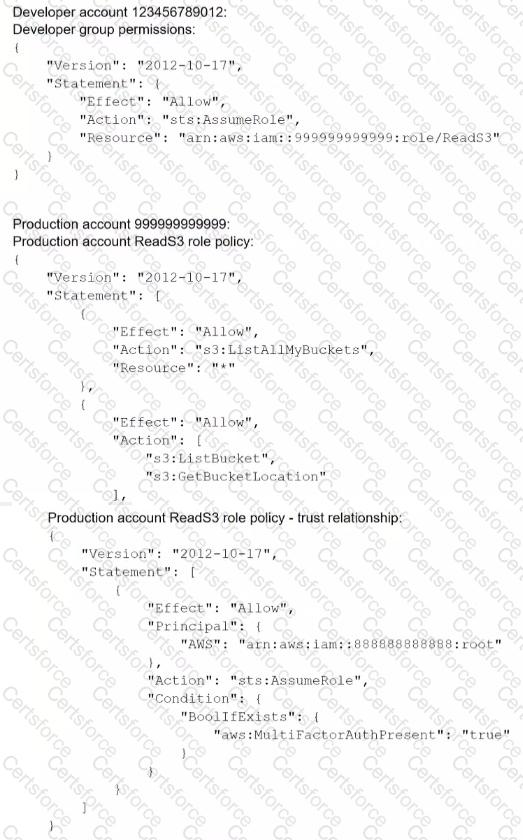
Question # 64

Which recommendations should the security engineer make to resolve this issue? (Select TWO.)

Options:

A.

Ask the developers to change their password and use a different web browser.


B.

Ensure that developers are using multi-factor authentication (MFA) when they log in to their developer account as the developer role.


C.

Modify the production account ReadS3 role policy to allow the PutBucketPolicy action onthe productionapp S3 bucket.


D.

Update the trust relationship policy on the production account S3 role to allow the account number of the developer account.


E.

Update the developer group permissions in the developer account to allow access to the productionapp S3 bucket.


Expert Solution
Questions # 65:

A company has implemented IAM WAF and Amazon CloudFront for an application. The application runs on Amazon EC2 instances that are part of an Auto Scaling group. The Auto Scaling group is behind an Application Load Balancer (ALB).

The IAM WAF web ACL uses an IAM Managed Rules rule group and is associated with the CloudFront distribution. CloudFront receives the request from IAM WAF and then uses the ALB as the distribution's origin.

During a security review, a security engineer discovers that the infrastructure is susceptible to a large, layer 7 DDoS attack.

How can the security engineer improve the security at the edge of the solution to defend against this type of attack?

Options:

A.

Configure the CloudFront distribution to use the Lambda@Edge feature. Create an IAM Lambda function that imposes a rate limit on CloudFront viewer requests. Block the request if the rate limit is exceeded.


B.

Configure the IAM WAF web ACL so that the web ACL has more capacity units to process all IAM WAF rules faster.


C.

Configure IAM WAF with a rate-based rule that imposes a rate limit that automatically blocks requests when the rate limit is exceeded.


D.

Configure the CloudFront distribution to use IAM WAF as its origin instead of the ALB.


Expert Solution
Questions # 66:

A company is running workloads on AWS. The workloads are in separate AWS accounts for development, testing, and production. All the company's developers can access the development account. A subset of the developers can access the testing account and the production account.

The company is spending too much time managing individual credentials for every developer across every environment. A security engineer must implement a more scalable solution that the company can use when a developer needs different access. The solution must allow developers to access resources across multiple accounts. The solution also must minimize credential sharing.

Which solution will meet these requirements?

Options:

A.

Use AWS Identity and Access Management Access Analyzer to identity the permissions that the developers need on each account. Configure 1AM Access Analyzer to automatically provision the correct access for each developer.


B.

Create an Amazon Simple Workflow Service (Amazon SWF) workflow. Instruct the developers to use the workflow to request access to other accounts when additional access is necessary.


C.

Create I AM roles in the testing account and production account. Add a policy that allows the sts:AssumeRole action to the roles. Create 1AM roles in the development account for the developers who have access to the testing and production accounts. Add these roles to the trust policy on the new roles in the testing and production accounts.


D.

Create service accounts in the testing environment and production environment. Give the access keys for the service accounts to developers who require access to the testing account and the production account. Rotate the access keys for the service accounts periodically.


Expert Solution
Questions # 67:

A company has several Amazon S3 buckets that do not enforce encryption in transit. A security engineer must implement a solution that enforces encryption in transit for all the company's existing and future S3 buckets.

Which solution will meet these requirements?

Options:

A.

Enable AWS Config. Create a proactive AWS Config Custom Policy rule. Create a Guard clause to evaluate the S3 bucket policies to check for a value of True for the aws:SecureTransport condition key. If the AWS Config rule evaluates to NON_COMPLIANT, block resource creation.


B.

Enable AWS Config. Configure the s3-bucket-ssl-requests-only AWS Config managed rule and set the rule trigger type to Hybrid. Create an AWS Systems Manager Automation runbook that applies a bucket policy to deny requests when the value of the aws:SecureTransport condition key is False. Configure automatic remediation. Set the runbook as the target of the rule.


C.

Enable Amazon Inspector. Create a custom AWS Lambda rule. Create a Lambda function that applies a bucket policy to deny requests when the value of the aws:SecureTransport condition key is False. Set the Lambda function as the target of the rule.


D.

Create an AWS CloudTrail trail. Enable S3 data events on the trail. Create an AWS Lambda function that applies a bucket policy to deny requests when the value of the aws:SecureTransport condition key is False. Configure the CloudTrail trail to invoke the Lambda function.


Expert Solution
Questions # 68:

A company has a new partnership with a vendor. The vendor will process data from the company's customers. The company will upload data files as objects into an Amazon S3 bucket. The vendor will download the objects to perform data processing. The objects will contain sensi-tive data.

A security engineer must implement a solution that prevents objects from resid-ing in the S3 bucket for longer than 72 hours.

Which solution will meet these requirements?

Options:

A.

Use Amazon Macie to scan the S3 bucket for sensitive data every 72 hours. Configure Macie to delete the objects that contain sensitive data when they are discovered.


B.

Configure an S3 Lifecycle rule on the S3 bucket to expire objects that have been in the S3 bucket for 72 hours.


C.

Create an Amazon EventBridge scheduled rule that invokes an AWS Lambda function every day. Program the Lambda function to remove any objects that have been in the S3 bucket for 72 hours.


D.

Use the S3 Intelligent-Tiering storage class for all objects that are up-loaded to the S3 bucket. Use S3 Intelligent-Tiering to expire objects that have been in the S3 bucket for 72 hours.


Expert Solution
Questions # 69:

A company is building an application on AWS that will store sensitive information. The company has a support team with access to the IT infrastructure, including databases. The company's security engineer must introduce measures to protect the sensitive data against any data breach while minimizing management overhead. The credentials must be regularly rotated.

What should the security engineer recommend?

Options:

A.

Enable Amazon RDS encryption to encrypt the database and snapshots. Enable Amazon Elastic Block Store (Amazon EBS) encryption on Amazon EC2 instances. Include the database credential in the EC2 user data field. Use an AWS Lambda function to rotate database credentials. Set up TLS for the connection to the database.


B.

Install a database on an Amazon EC2 instance. Enable third-party disk encryption to encrypt Amazon Elastic Block Store (Amazon EBS) volume. Store the database credentials in AWS CloudHSM with automatic rotation. Set up TLS for the connection to the database.


C.

Enable Amazon RDS encryption to encrypt the database and snapshots. Enable Amazon Elastic Block Store (Amazon EBS) encryption on Amazon EC2 instances. Store the database credentials in AWS Secrets Manager with automatic rotation. Set up TLS for the connection to the RDS hosted database.


D.

Set up an AWS CloudHSM cluster with AWS Key Management Service (AWS KMS) to store KMS keys. Set up Amazon RDS encryption using AWS KSM to encrypt the database. Store the database credentials in AWS Systems Manager Parameter Store with automatic rotation. Set up TLS for the connection to the RDS hosted database.


Expert Solution
Questions # 70:

A company needs to detect unauthenticated access to its Amazon Elastic Kubernetes Service (Amazon EKS) clusters. The company needs a solution that requires no additional configuration of the existing EKS deployment.

Which solution will meet these requirements with the LEAST operational effort?

Options:

A.

Install an Amazon EKS add-on from a security vendor.


B.

Enable AWS Security Hub. Monitor the Kubernetes findings.


C.

Monitor Amazon CloudWatch Container Insights metrics for Amazon EKS.


D.

Enable Amazon GuardDuty. Use EKS Audit Log Monitoring.


Expert Solution
Viewing page 7 out of 14 pages
Viewing questions 61-70 out of questions