
New Year Sale Limited Time 70% Discount Offer - Ends in 0d 00h 00m 00s - Coupon code: simple70

Pass the Amazon Web Services AWS Certified Specialty SCS-C02 Questions and answers with CertsForce

Viewing page 1 out of 14 pages
Viewing questions 1-10 out of questions
Questions # 1:

A company suspects that an attacker has exploited an overly permissive role to export credentials from Amazon EC2 instance metadata. The company uses Amazon GuardDuty and AWS Audit Manager. The company has enabled AWS CloudTrail logging and Amazon CloudWatch logging for all of its AWS accounts.

A security engineer must determine if the credentials were used to access the company's resources from an external account.

Which solution will provide this information?

Options:

A.

Review GuardDuty findings to find InstanceCredentialExfiltration events.


B.

Review assessment reports in the Audit Manager console to find InstanceCredentialExfiltration events.


C.

Review CloudTrail logs for GetSessionToken API calls to AWS Security Token Service (AWS STS) that come from an acount ID from outside the company.


D.

Review CloudWatch logs for GetSessionToken API calls to AWS Security Token Service (AWS STS) that come from an account ID from outside the company.


Expert Solution
Questions # 2:

A company runs workloads on Amazon EC2 instances. The company needs to continually monitor the EC2 instances for software vulnerabilities and must display the findings in AWS Security Hub. The company must not install agents on the EC2 instances.

Options:

A.

Enable Amazon Inspector. Set the scan mode to hybrid scanning. Enable the integration for Amazon Inspector in Security Hub.


B.

Use Security Hub to enable the AWS Foundational Security Best Practices standard.Wait for Security Hub to generate the findings.


C.

Enable Amazon GuardDuty. Initiate on-demand malware scans by using GuardDuty Malware Protection. Enable the integration for GuardDuty in Security Hub.


D.

Use AWS Config managed rules to detect EC2 software vulnerabilities. Ensure that Security Hub has the AWS Config integration enabled.


Expert Solution
Questions # 3:

A company controls user access by using IAM users and groups in AWS accounts across an organization in AWS Organizations. The company uses an external identity provider (IdP) for workforce single sign-on (SSO). The company needs to implement a solution to provide a single management portal to access accounts within the organization. The solution must support the external IdP as a federation source.

Options:

A.

Enable AWS IAM Identity Center. Specify the external IdP as the identity source.


B.

Enable federation with AWS Identity and Access Management (IAM). Specify the external IdP as the identity source.


C.

Migrate to Amazon Verified Permissions. Implement fine-grained access to AWS by using policy-based access control (PBAC).


D.

Migrate users to AWS Directory Service. Use AWS Control Tower to centralize security across the organization.


Expert Solution
Questions # 4:

A company uses AWS Config rules to identify Amazon S3 buckets that are not compliant with the company's data protection policy. The S3 buckets are hosted in several AWS Regions and several AWS accounts. The accounts are in an organization in AWS Organizations.

The company needs a solution to remediate the organization's existing noncompliant S3 buckets and any noncompliant S3 buckets that are created in the future.

Which solution will meet these requirements?

Options:

A.

Deploy an AWS Config aggregator with organization-wide resource data aggregation. Create an AWS Lambda function that responds to AWS Config findings of noncompliant S3 buckets by deleting or reconfiguring the S3 buckets.


B.

Deploy an AWS Config aggregator with organization-wide resource data aggregation. Create an SCP that contains a Deny statement that prevents the creation of new noncompliant S3 buckets. Apply the SCP to all OUs in the organization.


C.

Deploy an AWS Config aggregator that scopes only the accounts and Regions that the company currently uses. Create an AWS Lambda function that responds to AWS Config findings of noncompliant S3 buckets by deleting or reconfiguring the S3 buckets.


D.

Deploy an AWS Config aggregator that scopes only the accounts and Regions that the company currently uses. Create an SCP that contains a Deny statement that prevents the creation of new noncompliant S3 buckets. Apply the SCP to all OUs in the organization.


Expert Solution
Questions # 5:

A security engineer discovers that the Lambda function is failing to create the report. The security engineer must implement a solution that corrects the issue and provides least privilege permissions. Which solution will meet these requirements?

Options:

A.

Create a resource based policy that allows Security Hub access to the ARN of the Lambda function.


B.

Attach the AWSSecurityHubReedOnlyAccess AWS managed policy to the Lambda function's execution role.


C.

Grant the Lambda function s execution role read-only permissions to access Amazon Inspector and Security Hub.


D.

Create a custom 1AM policy that grants the Security Hub Get' List" Batch' and Desert*" permissions on the arn aws securityhub us-west-2 productaws/inspector' resource Anacn the policy to the Lambda function's execution role.


Expert Solution
Questions # 6:

A company has an organization with SCPs in AWS Organizations. The root SCP for the organization is as follows:
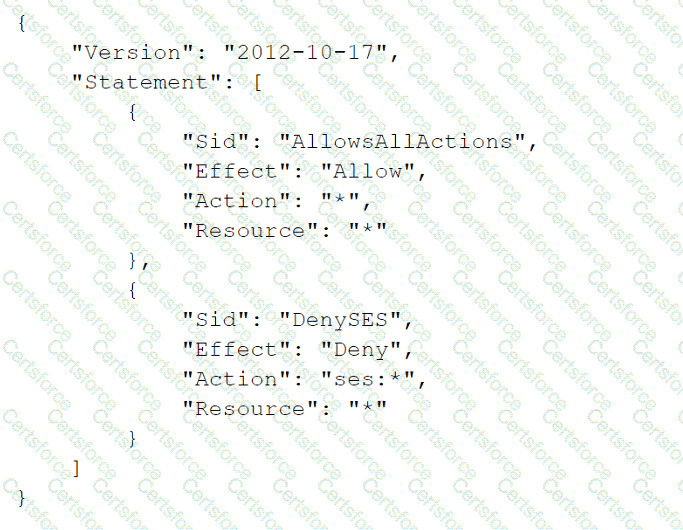
Question # 6

The company's developers are members of a group that has an IAM policy that allows access to Amazon Simple Email Service (Amazon SES) by allowing ses:* actions. The account is a child to an OU that has an SCP that allows Amazon SES. The developers are receiving a not-authorized error when they try to access Amazon SES through the AWS Management Console.

Which change must a security engineer implement so that the developers can access Amazon SES?

Options:

A.

Add a resource policy that allows each member of the group to access Amazon SES.


B.

Add a resource policy that allows "Principal": {"AWS": "arn:aws:iam::account-number:group/Dev"}.


C.

Remove the AWS Control Tower control (guardrail) that restricts access to Amazon SES.


D.

Remove Amazon SES from the root SCP.


Expert Solution
Questions # 7:

A company is using an AWS Key Management Service (AWS KMS) AWS owned key in its application to encrypt files in an AWS account The company's security team wants the ability to change to new key material for new files whenever a potential key breach occurs A security engineer must implement a solution that gives the security team the ability to change the key whenever the team wants to do so

Which solution will meet these requirements?

Options:

A.

Create a new customer managed key Add a key rotation schedule to the key Invoke the key rotation schedule every time the security team requests a key change


B.

Create a new AWS managed key Add a key rotation schedule to the key Invoke the key rotation schedule every time the security team requests a key change


C.

Create a key alias Create a new customer managed key every time the security team requests a key change Associate the alias with the new key


D.

Create a key alias Create a new AWS managed key every time the security team requests a key change Associate the alias with the new key


Expert Solution
Questions # 8:

A company has several petabytes of data. The company must preserve this data for 7 years to comply with regulatory requirements. The company's compliance team asks a security officer to develop a strategy that will prevent anyone from changing or deleting the data.

Which solution will meet this requirement MOST cost-effectively?

Options:

A.

Create an Amazon S3 bucket. Configure the bucket to use S3 Object Lock in compliance mode. Upload the data to the bucket. Create a resource-based bucket policy that meets all the regulatory requirements.


B.

Create an Amazon S3 bucket. Configure the bucket to use S3 Object Lock in governance mode. Upload the data to the bucket. Create a user-based IAM policy that meets all the regulatory requirements.


C.

Create a vault in Amazon S3 Glacier. Create a Vault Lock policy in S3 Glacier that meets all the regulatory requirements. Upload the data to the vault.


D.

Create an Amazon S3 bucket. Upload the data to the bucket. Use a lifecycle rule to transition the data to a vault in S3 Glacier. Create a Vault Lock policy that meets all the regulatory requirements.


Expert Solution
Questions # 9:

A company is evaluating its security posture. In the past, the company has observed issues with specific hosts and host header combinations that affected

the company's business. The company has configured AWS WAF web ACLs as an initial step to mitigate these issues.

The company must create a log analysis solution for the AWS WAF web ACLs to monitor problematic activity. The company wants to process all the AWS WAF logs in a central location. The company must have the ability to filter out requests based on specific hosts.

A security engineer starts to enable access logging for the AWS WAF web ACLs.

What should the security engineer do next to meet these requirements with the MOST operational efficiency?

Options:

A.

Specify Amazon Redshift as the destination for the access logs. Deploy the Amazon Athena Redshift connector. Use Athena to query the data from Amazon Redshift and to filter the logs by host.


B.

Specify Amazon CloudWatch as the destination for the access logs. Use Amazon CloudWatch Logs Insights to design a query to filter the logs by host.


C.

Specify Amazon CloudWatch as the destination for the access logs. Export the CloudWatch logs to an Amazon S3 bucket. Use Amazon Athena to query the logs and to filter the logs by host.


D.

Specify Amazon CloudWatch as the destination for the access logs. Use Amazon Redshift Spectrum to query the logs and to filter the logs by host.


Expert Solution
Questions # 10:

A company has thousands of AWS Lambda functions. While reviewing the Lambda functions, a security engineer discovers that sensitive information is being stored in environment variables and is viewable as plaintext in the Lambda console. The values of the sensitive information are only a few characters long.

What is the MOST cost-effective way to address this security issue?

Options:

A.

Set up IAM policies from the Lambda console to hide access to the environment variables.


B.

Use AWS Step Functions to store the environment variables. Access the environment variables at runtime. Use IAM permissions to restrict access to the environment variables to only the Lambda functions that require access.


C.

Store the environment variables in AWS Secrets Manager, and access them at runtime. Use IAM permissions to restrict access to the secrets to only the Lambda functions that require access.


D.

Store the environment variables in AWS Systems Manager Parameter Store as secure string parameters, and access them at runtime. Use IAM permissions to restrict access to the parameters to only the Lambda functions that require access.


Expert Solution
Viewing page 1 out of 14 pages
Viewing questions 1-10 out of questions