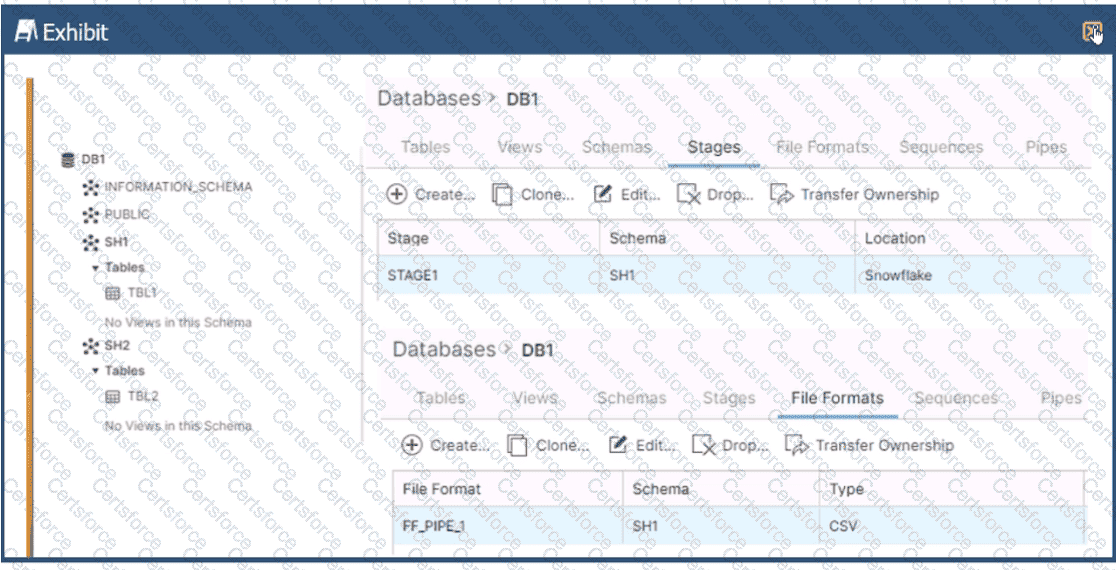
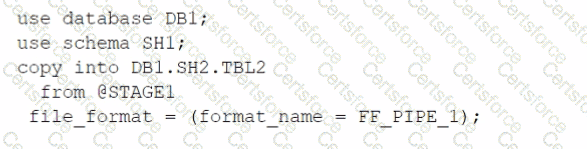
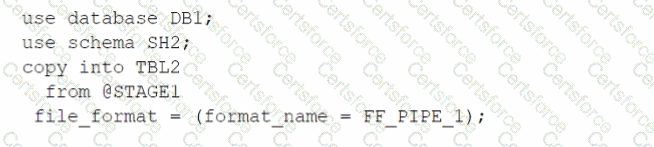
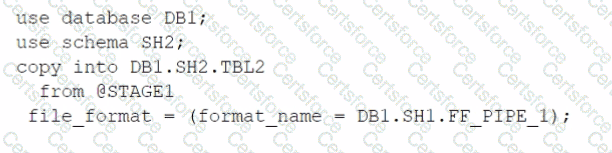
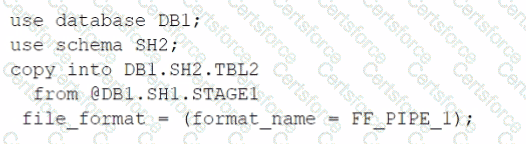
Snowflake tracks loaded files using load history metadata to prevent accidental duplicate ingestion. By default, if a file with the same name, size, and checksum has already been loaded into a table, subsequent COPY INTO attempts will skip that file—even months later.
Setting FORCE = TRUE overrides this safeguard and forces Snowflake to load the file again regardless of load history (Answer B). This is the most common and explicit way to reload previously ingested files.
The LOAD_UNCERTAIN_FILES = TRUE option instructs Snowflake to load files when the load status is uncertain—such as when metadata has aged out or when Snowflake cannot confidently determine whether the file was previously loaded (Answer D). This can also allow reloading in certain scenarios.
PURGE = TRUE only removes files from the stage after a successful load; it does not affect load history. VALIDATION_MODE is used for testing and does not load data. ALLOW_DUPLICATE is not a valid COPY INTO option. This question reinforces SnowPro Architect knowledge of Snowflake ingestion safeguards and how to intentionally override them.
=========
QUESTION NO: 22 [Performance Optimization and Monitoring]
An Architect wants to use clustering keys to improve table performance.
What should the Architect consider? (Select THREE).
A. Clustering has a storage and compute cost.
B. Snowflake recommends a maximum of five clustering keys.
C. Clustering keys are designed to co-locate data within micro-partitions.
D. Clustering keys are only recommended for tables larger than 1 GB.
E. Snowflake can cluster a materialized view to tailor for specific queries.
F. A high value returned by SYSTEM$CLUSTERING_DEPTH indicates good clustering.
Answer: A, C, E
Clustering in Snowflake is a performance optimization technique that physically reorganizes data within micro-partitions to improve pruning for selective queries. Maintaining clustering incurs both compute and storage costs because Snowflake must periodically rewrite micro-partitions to maintain the defined order (Answer A).
Clustering keys work by co-locating related data values within micro-partitions, which improves pruning efficiency and reduces the amount of data scanned during queries (Answer C). While Snowflake does not impose a hard limit on the number of clustering keys, best practice is to keep them few and aligned with common access patterns.
Materialized views can also be clustered independently of their base tables, allowing architects to tailor physical data organization for specific query patterns without affecting the base table (Answer E).
Snowflake does not recommend clustering based on a specific table size threshold such as 1 GB; instead, it depends on query patterns and clustering depth. A high clustering depth indicates poor clustering, not good clustering. This question tests an architect’s ability to evaluate when and how clustering should be applied effectively.
=========
QUESTION NO: 23
(Intentionally skipped — no Question 23 in the original set)
=========
QUESTION NO: 24 [Architecting Snowflake Solutions]
Which of the following are characteristics of Snowflake’s parameter hierarchy?
A. Session parameters override virtual warehouse parameters.
B. Virtual warehouse parameters override user parameters.
C. Table parameters override virtual warehouse parameters.
D. Schema parameters override account parameters.
Answer: A
Snowflake parameters follow a clear hierarchy that determines which setting takes precedence when multiple levels define the same parameter. Session-level parameters have the highest precedence and override settings defined at lower levels such as user, warehouse, or account (Answer A). This allows temporary, session-specific behavior without permanently altering broader configurations.
Virtual warehouse parameters do not override user parameters; instead, user-level parameters override warehouse-level settings. Table parameters apply only to table-specific behaviors and do not override warehouse settings. Schema parameters can override account-level parameters only for parameters that are allowed at the schema level, but this is not a general rule across all parameters.
Understanding parameter precedence is critical for SnowPro Architect candidates, especially when troubleshooting unexpected behavior related to timeouts, resource usage, or formatting. Architects must know where to look when behavior differs from expectations and how session-level overrides can impact workloads.
=========
QUESTION NO: 25 [Snowflake Ecosystem and Integrations]
A company needs an efficient way to get data from an external partner who is also a Snowflake user. The current process involves daily JSON files uploaded manually and frequently changed.
What is the MOST efficient solution?
A. Ask the partner to create a share and add the company’s account.
B. Ask the partner to export data to cloud storage for ingestion.
C. Keep the current approach but stop file changes.
D. Ask the partner to set up a reader account.
Answer: A
When both parties are Snowflake users, Secure Data Sharing is the most efficient and reliable way to exchange data (Answer A). By creating a share, the data provider can grant real-time access to selected objects without copying or moving data. This eliminates ingestion pipelines, reduces latency, and automatically adapts to schema changes.
Exporting data to cloud storage introduces unnecessary complexity, delays, and maintenance overhead. Reader accounts are intended for consumers who are not Snowflake customers, which does not apply in this scenario. Maintaining manual file-based ingestion is inefficient and error-prone, especially when schemas change frequently.
For SnowPro Architect candidates, this question reinforces a core Snowflake principle: whenever possible, use native Secure Data Sharing to simplify architectures, improve freshness, and reduce operational costs.