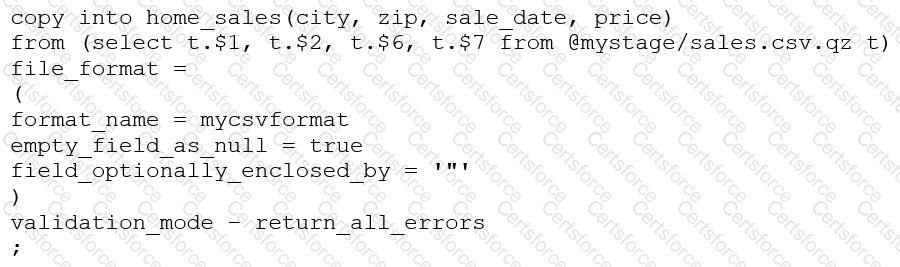
The Data Vault modeling approach separates data into hubs (business keys), links, and satellites, often requiring simultaneous insertion of related records derived from the same source dataset. Snowflake’s conditional multi-table INSERT enables a single source query to populate multiple target tables in parallel based on conditional logic. This capability aligns well with Data Vault patterns, where hubs and satellites are typically loaded together from the same staging data.
By inserting into hubs and satellites in parallel using surrogate keys (Answer A), architects ensure consistency, atomicity, and efficient processing without re-scanning source data multiple times. This approach reduces compute usage and simplifies ETL logic, which is particularly valuable in large-scale, near–real-time ingestion pipelines.
Options involving dimensions and facts relate more closely to star schema modeling, not Data Vault. Sequential insertion is also less efficient and not the defining advantage of conditional multi-table inserts. For SnowPro Architect candidates, this question emphasizes understanding how Snowflake SQL features support modern data modeling techniques such as Data Vault.
=========
QUESTION NO: 42 [Architecting Snowflake Solutions]
An Architect wants to alter a virtual warehouse for horizontal scaling but cannot find minimum and maximum cluster settings in the interface, even with the ACCOUNTADMIN role.
What is the MOST likely issue?
A. Missing CREATE WAREHOUSE privilege.
B. Incorrect SQL command used.
C. Using Standard edition where multi-cluster is not available.
D. A Snowflake Support ticket is required.
Answer: C
Multi-cluster virtual warehouses are only available in Snowflake Enterprise edition and higher. If the account is running on Standard edition, the options to configure minimum and maximum clusters for horizontal scaling will not appear in the UI or be available via SQL (Answer C).
This limitation is independent of role privileges; even ACCOUNTADMIN cannot enable multi-cluster functionality on unsupported editions. Incorrect SQL or missing privileges would result in errors rather than missing configuration options.
For SnowPro Architect candidates, this question tests awareness of edition-based feature availability, which is critical when designing scalable architectures and recommending Snowflake editions to meet workload requirements.
=========
QUESTION NO: 43 [Performance Optimization and Monitoring]
A 2 TB table with 400 columns is queried frequently to calculate average employee tenure by country and career level. The query exhibits poor partition pruning and runs on an X-Small warehouse.
What improvement meets the requirements with the LEAST operational overhead?
A. Add clustering keys on COUNTRY and EMPLOYMENT_STATUS.
B. Enable Query Acceleration Service (QAS).
C. Enable search optimization on equality predicates for COUNTRY and EMPLOYMENT_STATUS.
D. Build a materialized view for latest active employee records per country.
Answer: C
The query filters on equality predicates for COUNTRY, EMPLOYMENT_STATUS, and a specific EFFECTIVE_DATE value representing the latest record. Search Optimization Service (SOS) is specifically designed to accelerate highly selective equality predicates without requiring data reorganization (Answer C).
Clustering would introduce ongoing maintenance overhead and is less effective when cardinality is low or when multiple filter combinations exist. Query Acceleration Service helps with overall query execution time but does not directly improve partition pruning. Materialized views would require ongoing maintenance and additional storage, increasing operational complexity.
For SnowPro Architect candidates, this question highlights choosing the simplest effective optimization tool—SOS—when dealing with selective filters and large tables.
=========
QUESTION NO: 44 [Snowflake Data Engineering]
A team needs to recover data after pipeline failures or business rule violations.
Requirements:
• Database recoverable for 48 hours
• Analytics schema recoverable for 5 days
What is the correct approach?
A. Use custom stored procedure backups.
B. Use tasks with database and schema clones.
C. Use Time Travel with MIN_DATA_RETENTION_TIME_IN_DAYS = 2 and DATA_RETENTION_TIME_IN_DAYS = 5 on the ANALYTICS schema.
D. Use Time Travel with DATA_RETENTION_TIME_IN_DAYS = 2 and MIN_DATA_RETENTION_TIME_IN_DAYS = 5 on the ANALYTICS schema.
Answer: C
Snowflake Time Travel enables point-in-time recovery without manual backups. Setting MIN_DATA_RETENTION_TIME_IN_DAYS = 2 ensures that all database objects retain at least 48 hours of recoverable history. Extending DATA_RETENTION_TIME_IN_DAYS = 5 at the schema level allows longer recovery specifically for the analytics schema (Answer C).
This approach meets both recovery requirements with minimal operational overhead and aligns with Snowflake best practices. Cloning via tasks introduces unnecessary complexity and storage management. Custom backups are not required due to built-in Time Travel capabilities.
SnowPro Architect exams emphasize using native Snowflake features such as Time Travel for data recovery scenarios.
=========
QUESTION NO: 45 [Security and Access Management]
A financial services company needs to isolate sensitive production data from development data within the same region and support secure data transfer between environments.
What is the best solution?
A. Create two accounts with network policies and use data sharing.
B. Create two accounts with federated authentication and use cloning.
C. Create two databases in one account and use replication.
D. Create two databases in one account and use user-level network policies and shares.
Answer: A
Strong isolation of sensitive production data from development environments is best achieved using separate Snowflake accounts. Account-level isolation ensures independent security boundaries, network policies, and governance controls. Secure Data Sharing allows controlled, read-only access to production data without copying it, supporting safe data transfer between environments (Answer A).
Using cloning across accounts is not supported; cloning works only within the same account. Database-level separation does not provide the same security guarantees as account-level isolation, and user-level network policies are not supported in Snowflake.
This design aligns with SnowPro Architect best practices for regulated industries, emphasizing strong isolation, least privilege, and secure data access mechanisms.