
Which Anypoint Platform component should a MuleSoft developer use to create an API specification prior to building the API implementation?
A project uses Jenkins to implement CI/CD process. It was observed that each Mule package contains some of the Jenkins files and folders for configurations of CI/CD jobs.
As these files and folders are not part of the actual package, expectation is that these should not be part of deployed archive.
Which file can be used to exclude these files and folders from the deployed archive?
A Mule application is synchronizing customer data between two different database systems.
What is the main benefit of using eXtended Architecture (XA) transactions over local transactions to synchronize these two different database systems?
What are two reasons why a typical MuleSoft customer favors a MuleSoft-hosted Anypoint Platform runtime plane over a customer-hosted runtime for its Mule application deployments? (Choose two.)
An organization is sizing an Anypoint VPC to extend their internal network to Cloudhub.
For this sizing calculation, the organization assumes 150 Mule applications will be deployed among three(3) production environments and will use Cloudhub’s default zero-downtime feature. Each Mule application is expected to be configured with two(2) Cloudhub workers.This is expected to result in several Mule application deployments per hour.
An organization is evaluating using the CloudHub shared Load Balancer (SLB) vs creating a CloudHub dedicated load balancer (DLB). They are evaluating how this choice affects the various types of certificates used by CloudHub deployed Mule applications, including MuleSoft-provided, customer-provided, or Mule application-provided certificates. What type of restrictions exist on the types of certificates for the service that can be exposed by the CloudHub Shared Load Balancer (SLB) to external web clients over the public internet?
What is required before an API implemented using the components of Anypoint Platform can be managed and governed (by applying API policies) on Anypoint Platform?
Refer to the exhibit.
An organization is designing a Mule application to receive data from one external business partner. The two companies currently have no shared IT infrastructure and do not want to establish one. Instead, all communication should be over the public internet (with no VPN).
What Anypoint Connector can be used in the organization's Mule application to securely receive data from this external business partner?
A marketing organization is designing a Mule application to process campaign data. The Mule application will periodically check for a file in a SFTP location and process the records in the file. The size of the file can vary from 10MB to 5GB. Due to the limited availabiltty of vCores, the Mule application is deployed to a single CloudHub worker configured with vCore size 0.2.
The application must transform and send different formats of this file to three different downstream SFTP locations.
What is the most idiomatic (used for its intended purpose) and performant way to configure the SFTP operations or event sources to process the large files to support these deployment requirements?
An organization has implemented a continuous integration (CI) lifecycle that promotes Mule applications through code, build, and test stages. To standardize the organization's CI journey, a new dependency control approach is being designed to store artifacts that include information such as dependencies, versioning, and build promotions.
To implement these process improvements, the organization will now require developers to maintain all dependencies related to Mule application code in a shared location.
What is the most idiomatic (used for its intended purpose) type of system the organization should use in a shared location to standardize all dependencies related to Mule application code?
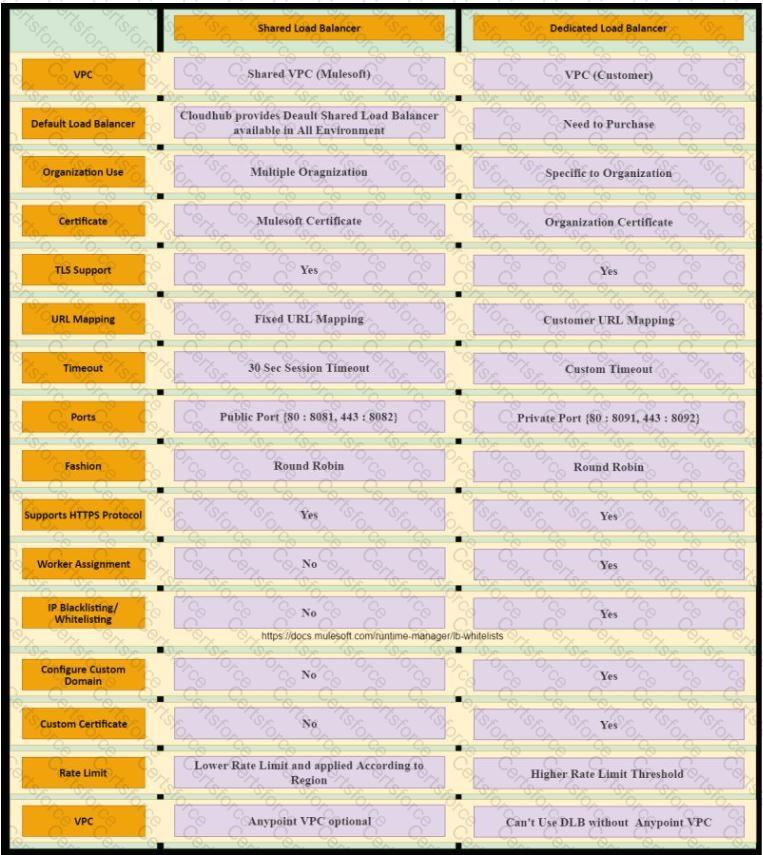 Table Description automatically generated