
A Data Guard environment has this configuration and these attributes:
A primary database
A physical standby database named sbdb
The configuration is in maximum availability protection mode.
Then sbdb is converted to a snapshot standby database.
Which two statements are true?
Which four factors can influence the rate of SQL apply on a logical standby database?
Which statement is true regarding Oracle Net connectivity for a Data Guard Broker configuration?
Examine the fast-start failover configuration:
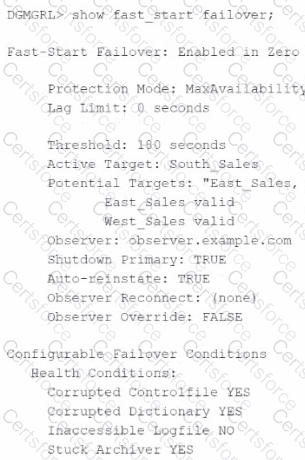
The Oracle database 19c Observer is currently running on host1 and you wish to have it running on host2.
Examine this list of possible steps:
1) Stop the observer on host1
2) Disable Fast-Start Failover
3) Update the broker configuration with the new observer hostname
4) Enable Fast-Start Failover
5) Start the Observer on host2
Which contains the minimum required steps to move the observer to host2?
Which TWO statements are true about Far Sync instances?
Examine the Data Guard configuration:
DGMGRL> show configuration;
Configuration - Animals
Protection Mode: Max Availability
Databases:
dogs - Primary database sheep
- Physical standby database cats
- Physical standby database
Fast-Start Failover: DISABLED
Configuration Status: SUCCESS
An attempt to enable fast-start failover raises an error:
DGMGRL> enable fast_start failover;
Error: ORA-16693: requirements not met for enabling fast-start failover
Failed.
Identify three possible reasons for this error.
Which four requirements can be met by deploying a logical standby database?
You created a physical standby database prodsbyi from the primary database prod using SQL and RMAN. Which THREE are prerequisites for creating a Data Guard Broker configuration to manage these databases?
Which TWO statements are true about configuring Oracle Net Service in a Data Guard environment?
